Seth Myth Meaning & Symbolism
The story of the desert god Seth, whose chaotic power of dissolution is essential for the renewal of cosmic and psychic order.
The Tale of Seth
Hear now the tale that whispers on the hot wind from the Red Land, the story of the Necessary Storm.
In the First Time, when the world was green and the Nile’s heartbeat was steady, there was balance. Osiris ruled, his presence like the rich, black soil, generous and life-giving. His sister-wife, Isis, was his counterpart, her wisdom the hidden currents that nourish the roots. And there was Horus, the falcon-child, the promise of the future perched in the nest of order.
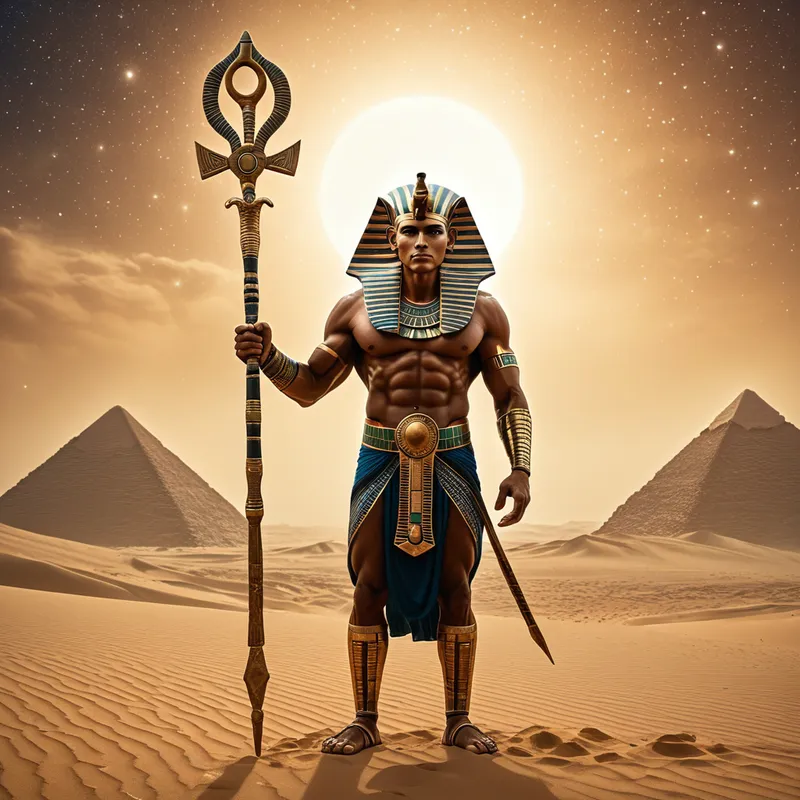
But from the burning wastes, from the realm of scorching stone and howling emptiness, came the other brother. Seth. His voice was the crack of thunder in a rainless sky. His form was that of a creature unknown—part aardvark, part canine, part desert mystery—a being shaped by the land of lack. Where Osiris brought forth grain, Seth revealed the bedrock. Where Osiris connected, Seth defined the boundary. He was the fierce wind that tests the palm tree’s resolve, the drought that reminds the river of its power.
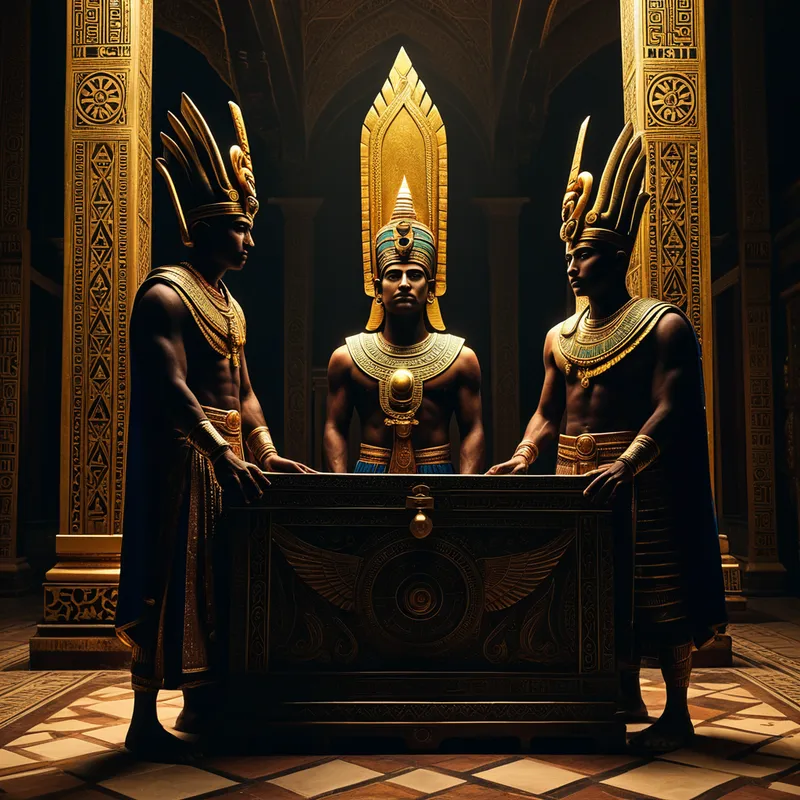
A great feast was held in the white-walled palace. Laughter flowed like beer, and the air was thick with the scent of lotus and roast duck. Seth arrived, and a subtle tension entered, a dryness in the throat. With a smile that did not touch his storm-grey eyes, he presented a gift: a chest of breathtaking craftsmanship, inlaid with ebony and ivory. “A game,” Seth proclaimed, his voice rolling through the hall. “He who fits most perfectly within this chest shall claim it as his own.”
One by one, the gods tried, and it fit none. Then Osiris, ever trusting, ever gracious, lay down within the silken interior. It was made for him. It embraced him like a second skin. The moment his back touched the bottom, Seth’s demeanor shifted. The storm broke. With a roar that shook the pillars, he and his conspirators slammed the lid shut. They sealed it with molten lead, a horrific parody of a royal sarcophagus. The laughter died. The chest, now a coffin, was carried away and flung into the Nile’s cold, betraying waters.
Thus began the great unraveling. Isis’s wail was the first note of a long lament. Her search, desperate and magical, is its own epic—a journey through despair to a grim shore in Byblos, where she found the chest grown into a tamarisk tree. She brought her husband’s body back, hiding in the marshes of the Delta to work the greatest magic of all: to conceive Horus from the inert Osiris, to pull life from the heart of death.
But Seth, hunting by the light of the full moon—his moon—found the hidden place. In a rage that blanched the reeds, he did the unthinkable. He dismembered the body of Osiris, scattering fourteen pieces to the far corners of the Two Lands. It was the ultimate act of chaos, the dissolution of form itself.
Yet, this was not the end. It was the necessary fracture. Isis, with her sister Nephthys</ab title>, began the second, more terrible search. They gathered the pieces, all but one, consumed by the Nile’s fish. Where Seth had scattered, they reassembled. Where he had dissolved, they bound and preserved, creating the first mummy. From fragmentation came a new, eternal form. From the chaos of the murder sprang the ordered rituals of the afterlife.
And so the stage was set for the final conflict: the Contendings. Horus of the piercing eye, rightful heir, faced his uncle Seth, the usurper whose strength was that of the untamed world. Their battle was cosmic, fought in courtrooms and in bloody duels across the sky. Horus lost an eye; Seth lost his testicles. The world teetered. Finally, the aged Ptah proposed a decree that restored balance, not through annihilation, but through integration. Horus took the throne of the living, the Black Land. But Seth was not cast into oblivion. He was given a vital post: to stand at the prow of the Solar Barque of Ra, to repel the serpent of utter chaos, Apep. The force that threatened order was now harnessed as its essential defender.
Cultural Origins & Context
The myth of Seth is not a single, canonical text but a complex tapestry woven from fragments in the Pyramid Texts, Coffin Texts, and later narratives like The Contendings of Horus and Seth. Its telling was not mere entertainment; it was a foundational cosmology. Priests would have recited these stories in temple rituals, linking the fate of Osiris to the annual flooding and retreating of the Nile, and the battle of Horus and Seth to the daily victory of the sun over darkness.
Seth’s role evolved dramatically over three millennia of Egyptian history. In early dynasties, he was a respected god of strength and the desert frontier, even a patron of some pharaohs. His chaotic aspect was seen as a necessary, if dangerous, counterbalance to fertile order. However, as Egyptian identity solidified in opposition to foreign invaders from the deserts (the “lands of Seth”), his image darkened. He became increasingly associated with foreignness, violence, and taboo. This societal function was profound: by projecting the qualities of disorder, rebellion, and the “other” onto Seth, the culture could define and reinforce its own values of ma’at—cosmic and social order, truth, and harmony. He was the eternal “outsider within,” a psychological container for everything civilization feared yet could not eradicate.
Symbolic Architecture
Seth is the archetype of the Shadow made divine. He does not represent evil in a simplistic sense, but the potent, undifferentiated force of nature and the psyche that exists before and beyond human morality. He is raw potential, unbridled instinct, and the principle of entropy that makes creation possible by clearing the old ground.
He is the fire that destroys the forest so the soil can be reborn; the crisis that shatters a stagnant life so a new consciousness can emerge.
His murder of Osiris is the essential, terrible act of differentiation. Osiris represents the status quo, the established, perhaps complacent, order of the psyche or society. Seth’s violence is the disruptive insight, the traumatic event, or the surge of repressed anger that breaks apart a unified but unconscious state. The dismemberment is not merely destruction; it is analysis. It breaks the whole into its constituent parts so that each piece—each memory, complex, or talent—can be examined, mourned, and ultimately reconstituted in a more conscious, resilient form (the mummified Osiris).
Seth’s final appointment as defender of Ra’s barque is the myth’s deepest wisdom. It reveals that the chaotic force, once integrated and given a conscious direction, becomes our greatest strength. The psyche’s raw aggression, rightly channeled, is the energy that protects our core integrity (Ra) from total dissolution (Apep).
The Dreamer’s Resonance
When the energy of Seth stirs in the modern dreamscape, it rarely appears as a literal god-figure. It manifests as atmosphere and event. You may dream of violent, unexpected storms breaking over a familiar landscape. You may find yourself in a vast, beautiful, yet terrifying desert—a place of stark clarity and existential exposure. Dreams of sudden, shocking betrayals by family members or trusted allies can channel the Sethian archetype, representing a felt betrayal by a part of your own psyche or life structure you had relied upon.
Somatically, this process feels like a rising, chaotic heat in the body—a flush of anger or panic that seems to come from nowhere. Psychologically, it is the experience of your own “unacceptable” feelings breaking through: rage, envy, a desire to dismantle everything, a fierce independence that rejects belonging. The dream is not diagnosing you as “chaotic”; it is presenting the raw material of the Shadow that demands recognition. It is the psyche’s own act of dismemberment, breaking apart an old self-image that has become a confining “chest,” so that a more authentic integration can begin.

Alchemical Translation
The alchemical journey modeled by the Seth myth is the Nigredo, the blackening, the descent into the chaotic prima materia. For an individual, the “murder of Osiris” is the inevitable collapse of a persona or life structure that has served its time but has become limiting. It could be the end of a career, the rupture of a relationship, or a profound disillusionment with a belief system. This is not a mistake, but a necessary, if brutal, stage of individuation.
The work is not to avoid the desert, but to learn its language; not to defeat the Seth within, but to enlist his strength in service of the whole self.
The “Isis work” that follows—the gathering, mourning, and reassembly—is the conscious process of shadow integration. It requires searching the “marshes” of memory and emotion for the scattered parts of ourselves we have disowned: our anger, our wildness, our foreignness. We must perform the “magic” of binding these fragments back into a new, conscious whole, creating an inner “mummified form”—a structure of self that acknowledges both life and death, order and chaos.
The ultimate goal is the “Decree of Ptah”: the internal reconciliation where the ruling consciousness (Horus) acknowledges its dependency on the resilient, defensive, chaotic strength (Seth). You put your Seth to work. Your raw aggression becomes the fierce protection of your boundaries. Your disruptive impulses become the source of innovation. Your capacity for dissolution allows you to let go of what no longer serves you. In this alchemy, the god of the red desert is not vanquished, but redeemed, standing at the prow of your own solar barque, howling his challenge into the face of the void.
Associated Symbols
Explore related symbols from the CaleaDream lexicon: