Set Myth Meaning & Symbolism
The myth of Set, the desert god of chaos and violence, reveals the essential role of disruption and the shadow in forging cosmic and psychic order.
The Tale of Set
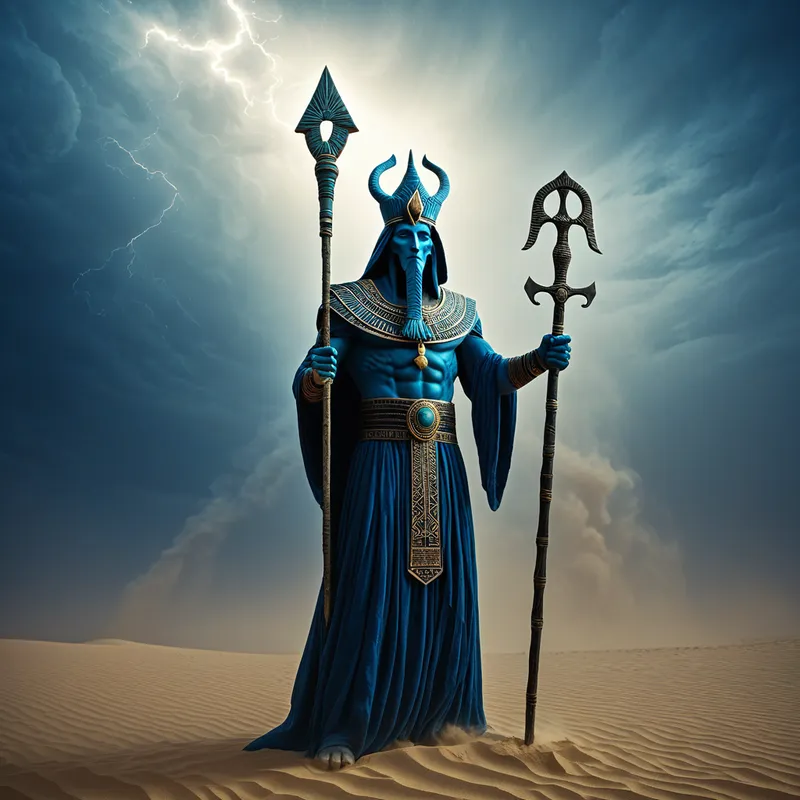
Hear now the tale not of light, but of the storm that gives light its name. In the time when the world was still wet from the hands of the creator, the Two Lands knew a golden age. Osiris ruled, his voice the murmur of the Nile’s rise, his skin the color of fertile silt. His sister-wife Isis was his throne, her wings encompassing the kingdom in safety. Their brother Set was of a different substance. His voice was the crack of thunder over the Red Land, his skin the hue of burning ochre and twilight. He was the lord of the barren places, the necessary fury that scours the land clean.
The court glittered with harmony, but Set’s heart was a tempest in a jar. He watched Osiris bestow order, civilization, and law, and in that perfect order, Set felt himself erased. He was the roar that had no place in a hymn, the sharp edge on a smoothed tool. The tension grew, thick as the air before a khamsin. At a great feast, Set brought forth a chest of breathtaking cedar and ebony, inlaid with lapis and gold. “A game,” he declared, his eyes like chips of flint. “He who fits perfectly within this chest shall claim it as his own.”
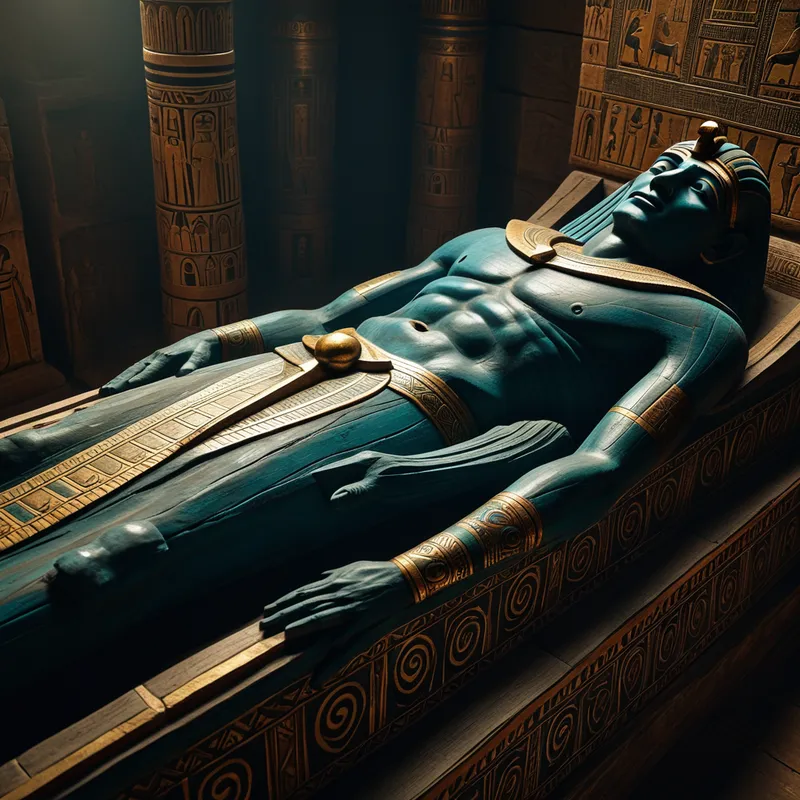
One by one, the court tried and failed. When Osiris, curious and trusting, lay within the ornate coffin, it fit him as a seed fits its husk. In that instant, Set’s companions sprang forth. With a sound like a mountain splitting, they slammed the lid shut, sealed it with molten lead, and cast it into the Nile’s treacherous currents. The ordered world gasped. The river that gave life had become a coffin’s road.
Thus began the great unraveling. Isis, with a sorrow that could bend time, searched the length of the world. She found the chest entangled in a tamarisk tree in a far-off land, but Set, ever vigilant, found it again. In a rage that shook the sky, he dismembered his brother’s body, scattering the fourteen pieces to the farthest corners of Egypt, burying them in the sand so that no tomb could ever hold him whole.
Yet Isis, with her sister Nephthys, searched again. They wept over each recovered piece. Where they wept, reeds grew. From their magic and their grief, Osiris was reconstituted—not as a king of the living, but as the Lord of the Duat, the underworld, a king of the reconciled dead. From this union in death was conceived Horus, the falcon-headed, whose right eye was the sun and whose left was the moon.
Horus grew for one purpose: to face the uncle who was his father’s murderer. Their battle was the battle of the world. It raged for eighty years, a conflict of spear and claw, of sandstorm and piercing light. Horus lost an eye. Set was castrated. The earth trembled with their strife. In the end, before the council of gods, Horus was granted the kingship of the living world. But Set was not destroyed. He was given a new, vital domain: to ride the solar barque of Ra each night, and with his mighty spear, to repel the serpent of utter chaos, Apep. The destroyer had become the essential protector. The chaos within had been harnessed to guard the very order it once sought to shatter.
Cultural Origins & Context
The myth of Set is not a single story but a complex, evolving tapestry woven over millennia of Egyptian history. Its origins are rooted in the stark, physical reality of Egypt: the eternal, life-giving conflict between the Black Land (Kemet) and the Red Land (Deshret). Set was the god of the latter—the terrifying yet awe-inspiring desert, the foreign lands, the violent storm that brought both destruction and rare, life-saving rain.
His myth was passed down through temple rituals, royal propaganda, and funerary texts like the Book of the Dead. His role shifted dramatically with political tides. In early dynasties, he was a respected god of strength and royal power, even paired with Horus as a symbol of the unified Two Lands. Later, particularly as Osiris worship grew, his narrative darkened into the archetypal villain. Yet, even at his most demonized, he retained his essential, paradoxical function: the necessary force of disruption. Society told his story to explain the presence of evil, conflict, and foreignness, but also to legitimize the pharaoh (as the living Horus) and to assure that even in death, the chaotic forces were kept at bay by a god who understood them intimately.
Symbolic Architecture
Set is the embodiment of the shadow on a cosmic scale. He represents everything that civilized order rejects: rage, jealousy, the untamed wilderness, the fracturing of unity, and the violent end of an era. He is not mere “evil,” but the principle of entropy, differentiation, and necessary conflict.
The ego, like the kingdom of Osiris, desires stasis and perfect order. The shadow, like Set, is the force that shatters the coffin of complacency, forcing a confrontation with all that has been disowned.
His murder of Osiris is a symbolic death of the prevailing conscious attitude—the old king, the outdated self. This act, though traumatic, initiates the entire process of transformation. Without this rupture, there is no search (Isis), no descent into the fragments of the psyche, no reconstitution into a deeper, more resilient form (Osiris as Lord of the Duat), and no birth of a new, more conscious principle (Horus). Set is the catalyst. His final integration as Ra’s defender signifies the ultimate psychological truth: the energy of the shadow, once made conscious and directed, becomes the individual’s greatest protection against total dissolution.
The Dreamer’s Resonance
When the archetype of Set stirs in the modern dreamscape, it often heralds a profound internal rebellion. To dream of violent storms, terrifying desert animals, or a powerful, antagonistic figure may feel like an invasion of chaos. Somatically, this can manifest as anxiety, a clenched jaw, or a feeling of restless, undirected energy.
Psychologically, this is the Self signaling that a too-rigid structure in the dreamer’s life—a job, a relationship, a self-image—has become a gilded coffin. The Set-force within is acting to break it open, even if the method feels brutal and destructive. The dreamer may be experiencing intense jealousy, rage, or a urge to disrupt their own status quo. These are not mere pathologies to be suppressed; they are the psyche’s attempt to initiate its own mythic cycle of death and renewal. The dream asks: What perfect, orderly part of your life feels suffocating? What raw, untamed energy are you sealing in lead and casting into the river?

Alchemical Translation
The alchemical journey mirrored in Set’s myth is the nigredo, the blackening, the descent into chaos and confrontation with the shadow. For the individual pursuing individuation, this is the most dreaded yet essential phase.
One does not become whole by adding more light, but by retrieving the fragments of oneself buried in the desert of denial. The spear that wounded you is the same weapon you must learn to wield.
The process begins with the recognition of the “Set” within—the disruptive impulses, the anger, the parts of oneself deemed unacceptable. The ego (Osiris) must be willing to “lie in the chest,” to submit to this fracturing. The subsequent work of Isis is the labor of consciousness: gathering these disowned fragments through self-reflection, therapy, or creative expression. Reconstituting the self after such a rupture does not restore the old identity; it forges a new one that incorporates the power of the shadow, just as Osiris rules the underworld.
Finally, the battle between Horus and Set is the internal conflict between the new, conscious attitude and the persistent, raw power of the shadow. Victory is not annihilation, but integration. The modern individual achieves this by finding a sacred, conscious outlet for their chaotic energy—using their aggression to set boundaries, their rebelliousness to innovate, their intensity to protect what truly matters. In doing so, they board the solar barque of the evolving Self, where their once-destructive force now stands guard against the serpent of meaninglessness, completing the alchemy from pure chaos to redeemed strength.
Associated Symbols
Explore related symbols from the CaleaDream lexicon: