Seshat Myth Meaning & Symbolism
The story of Seshat, the celestial scribe who measures the foundations of reality and inscribes the names of kings on the leaves of the sacred *ished* tree.
The Tale of Seshat
Before the first stone was laid at Akhet, when [the world](/myths/the-world “Myth from Tarot culture.”/) was still a thought in the mind of [Khepri](/myths/khepri “Myth from Egyptian culture.”/), she was there. In the silence that hums between stars, a figure emerged from the primordial dark. She was Seshat, the Great One, the Foremost of the House of Books. Her skin held the cool sheen of moonlight on [papyrus](/myths/papyrus “Myth from Egyptian culture.”/), and her eyes were the deep, knowing black of ink pooled in a scribe’s dish.
She did not arrive with thunder or flood, but with the soft, decisive scratch of a stylus. Her first act was to stretch the cord. With her sister, the mighty Maat, she walked the raw, unformed earth. From a bag of stars, she drew a cord of twisted flax, its knots holding the measure of all things. She drove a stake into the chaos. Then another. She pulled the cord taut, and where it sang, a line was born—the first boundary, the first “here” and “there.” This was the Pedj Shes, and with it, the cosmos found its spine.
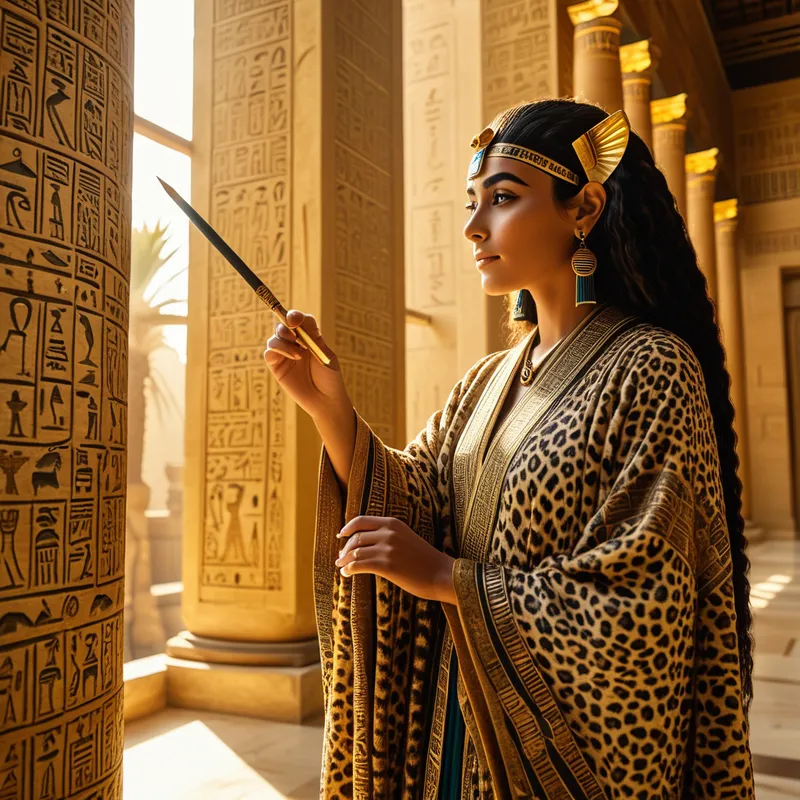
Then came the kings. They would come to her, these sons of [Horus](/myths/horus “Myth from Egyptian culture.”/), trembling in their newfound divinity. In [the sacred grove](/myths/the-sacred-grove “Myth from Celtic culture.”/) at Iunu, the ished tree stood, its leaves the parchment of eternity. Seshat would be waiting, her leopard skin cloak a map of the night sky. The king would speak his name, and with a stylus made of reed, she would carve it into a leaf. Each stroke was a promise, a contract written in the sap of the world-tree. She recorded his years, not in sand, but in the rings of time itself. She counted his captives from foreign lands, his cattle, his tribute, and with each tally mark, she wove his reign into the enduring tapestry of Maat.
Her temple was the library, the Per-Ankh. Here, in the quiet hall illuminated by the minds of scholars, she presided. Scrolls whispered on shelves. The history of the gods, the spells for the dead, the knowledge of the stars—all passed under her gaze. She was the silent witness, the rememberer. When a great [pharaoh](/myths/pharaoh “Myth from Egyptian culture.”/) wished to build a monument to outlast the sun, it was Seshat who first walked the ground, measuring the axis to align with the sacred stars, ensuring the stone would speak to the heavens for ten thousand years. She built not with rock, but with meaning; her foundations were laid in memory.

Cultural Origins & Context
Seshat’s presence is woven into the very fabric of ancient Egyptian civilization from the earliest dynasties. She is one of the oldest deities, appearing on labels and palettes from the dawn of the pharaonic state. Unlike myths told in grand narrative cycles like those of [Osiris](/myths/osiris “Myth from Global/Universal culture.”/), Seshat’s story is not a single epic poem but a ritual reality, performed and reaffirmed.
Her myth was enacted, not merely recited. The “Stretching of the Cord” ceremony was a foundational ritual performed by [the pharaoh](/myths/the-pharaoh “Myth from Egyptian culture.”/) and priests at the inception of every temple, pyramid, and significant building. This act transformed a plot of land from mundane space into sacred geography, aligning it with cosmic principles. Her role was primarily liturgical. The keepers of her myth were the royal scribes, architects, and priests—the literate administrative and priestly class who understood that writing was not merely record-keeping, but an act of cosmic maintenance.
Societally, Seshat functioned as the divine guarantor of legitimacy, continuity, and order. By inscribing the king’s name on the leaves of the sacred tree, she was not just predicting a long reign but actively binding his mortal rule to eternal cycles. She was the goddess of archives, of census, of the meticulous accounting that held a complex state together. In a culture obsessed with eternity and the preservation of name and memory, Seshat was the ultimate authority of permanence. She provided the spiritual and bureaucratic framework that made civilization itself possible and enduring.
Symbolic Architecture
Seshat is not the [goddess](/symbols/goddess “Symbol: The goddess symbolizes feminine power, divinity, and the nurturing aspects of life, embodying creation and wisdom.”/) of [stories](/symbols/stories “Symbol: Stories symbolize the narratives of our lives, reflecting personal experiences and collective culture.”/), but of the [framework](/symbols/framework “Symbol: Represents the underlying structure of one’s identity, emotions, or life. It signifies the mental or emotional scaffolding that supports or confines the self.”/) that makes [stories](/symbols/stories “Symbol: Stories symbolize the narratives of our lives, reflecting personal experiences and collective culture.”/)—and [reality](/symbols/reality “Symbol: Reality signifies the state of existence and perception, often reflecting one’s understanding of truth and life experiences.”/)—possible. Her symbols construct a profound [psychology](/symbols/psychology “Symbol: Psychology in dreams often represents the exploration of the self, the subconscious mind, and emotional conflicts.”/) of inner order.
Her seven-pointed star or rosette headdress is a map of celestial order, perhaps relating to the stars of the Great Bear or the cycles of time. It signifies a [consciousness](/symbols/consciousness “Symbol: Consciousness represents the state of awareness and perception, encompassing thoughts, feelings, and experiences.”/) aligned with cosmic patterns, a mind that can perceive the overarching design behind apparent [chaos](/symbols/chaos “Symbol: In Arts & Music, chaos represents raw creative potential, uncontrolled expression, and the breakdown of order to forge new artistic forms.”/).
To measure is to know; to inscribe is to make real. The act of naming is the first act of creation, and the act of recording is the act of granting immortality.
The leopard [skin](/symbols/skin “Symbol: Skin symbolizes the boundary between the self and the world, representing identity, protection, and vulnerability.”/) [robe](/symbols/robe “Symbol: A robe often represents comfort, authority, or a transition in one’s life, symbolizing the roles we play or the comfort of solitude.”/) connects her to the sem-priests who performed [funeral](/symbols/funeral “Symbol: Funerals represent the endings of certain aspects of life, transition, and mourning, often reflected in personal change or grief.”/) rites, symbolizing her mastery over time, decay, and transition. She records what was, thus allowing it to pass properly into what will be. The notched [palm](/symbols/palm “Symbol: The palm tree symbolizes resilience, victory, and peace, often associated with tropical climates.”/) rib she holds is her scribal tool and a tally stick, representing the measurement of time (years) and the [linear](/symbols/linear “Symbol: Represents order, predictability, and a direct, step-by-step progression. It symbolizes a clear path from cause to effect.”/), sequential [nature](/symbols/nature “Symbol: Nature symbolizes growth, connectivity, and the primal forces of existence.”/) of [human](/symbols/human “Symbol: The symbol of a human represents individuality, complexity of emotions, and social relationships.”/) [history](/symbols/history “Symbol: History in dreams often represents the dreamer’s past experiences, lessons learned, or unresolved issues that continue to influence their present.”/) and endeavor.
Psychologically, Seshat represents the [archetype](/symbols/archetype “Symbol: A universal, primordial pattern or prototype in the collective unconscious that shapes human experience, behavior, and creative expression.”/) of the inner scribe and architect. She is the faculty of consciousness that observes, records, and structures our experience. She is [memory](/symbols/memory “Symbol: Memory symbolizes the past, lessons learned, and the narratives we construct about our identities.”/) made sacred, not as nostalgic recollection, but as the foundational data from which [identity](/symbols/identity “Symbol: Identity represents the sense of self, encompassing personal beliefs, cultural background, and social roles.”/) is built. Her “stretching of the [cord](/symbols/cord “Symbol: Represents connections, bindings, lifelines, and structural support in architectural and spatial contexts.”/)” is the act of establishing inner boundaries, values, and principles—the personal Maat that gives a [psyche](/myths/psyche “Myth from Greek culture.”/) its form and integrity.

The Dreamer’s Resonance
When the pattern of Seshat emerges in modern dreams, it signals a profound process of inner foundation-laying or archival work. The dreamer may not see the goddess herself, but they will encounter her domain.
Dreaming of endless, labyrinthine libraries where one is searching for a specific, crucial book reflects a psyche sifting through memories and past experiences (the personal archive) to find a foundational truth or a forgotten piece of identity. Dreams of measuring tapes, blueprints, or surveying land point directly to the “stretching of the cord” ceremony. The dreamer is in a phase of life where they are consciously trying to establish new boundaries, lay down new life structures, or align their path ([the temple](/myths/the-temple “Myth from Jewish culture.”/) axis) with their true north (the sacred stars). There is often anxiety here—the stakes are high, the foundation must be true.
A dream of trying to write with an instrument that fails—ink that vanishes, a stylus that breaks—speaks to a crisis of the inner scribe. The dreamer feels unable to record their own life, to make their experiences coherent or their name (identity) lasting. It is a somatic experience of fragmentation, where the internal architecture feels unsound. Conversely, a dream of successfully inscribing something onto a strange, enduring material like stone or living wood signals a powerful integration. The dreamer is successfully encoding a lesson, a truth, or a new aspect of self into the permanent substrate of their being.

Alchemical Translation
The alchemical journey modeled by Seshat is the transmutation of chaotic experience into ordered wisdom, and of mortal endeavor into enduring meaning. It is [the opus](/myths/the-opus “Myth from Alchemical culture.”/) of building the inner temple.
The [prima materia](/myths/prima-materia “Myth from Alchemical culture.”/), the raw stuff, is the unprocessed flux of life: our memories, experiences, emotions, and thoughts in their raw, unrecorded state. This is the “unformed earth” over which Seshat first walks. [The first stage](/myths/the-first-stage “Myth from Alchemical culture.”/) of the work ([Nigredo](/myths/nigredo “Myth from Alchemical culture.”/)) is the honest, often painful, survey of this inner landscape. It is the recognition of chaos and the desire for order.
The “stretching of the cord” ceremony is the Albedo, the whitening. This is the conscious application of measure and principle. It is the dreamer deciding, “Here, I will set my boundary. This, I will value. My life shall be aligned with this truth.” It is the establishment of [the ego](/myths/the-ego “Myth from Jungian culture.”/)’s sacred precinct, defined not by walls of defense, but by lines of purpose.
The alchemist does not avoid time; they inscribe themselves into its fiber. Immortality is not the avoidance of death, but the achievement of a pattern so coherent it echoes in the halls of what comes after.
The meticulous recording—the inscribing on the leaves of the ished tree—is the Citrinitas, the yellowing. This is the laborious, daily work of journaling, reflection, therapy, and conscious living. It is the act of naming our experiences, of giving them their proper place in the chronicle of [the self](/myths/the-self “Myth from Jungian culture.”/). Each honest record is a leaf added to the tree of one’s life.
The final stage ([Rubedo](/myths/rubedo “Myth from Alchemical culture.”/), the reddening) is the completed, enduring structure. This is not a static monument, but a living library, a coherent psyche. The inner scribe has done its work so well that the individual’s life feels authored, intentional, and aligned. Their actions are in harmony with their measured principles; their past is integrated as sacred text, not buried trauma. They have become, like Seshat’s temples, an interface between the earthly and the cosmic, a place where meaning is both housed and generated. They have achieved what the Egyptians sought above all: a name that endures.
Associated Symbols
Explore related symbols from the CaleaDream lexicon: