Serpent in Eden Myth Meaning & Symbolism
A primordial serpent offers forbidden knowledge, shattering innocence and birthing human consciousness, exile, and the long journey toward self-awareness.
The Tale of Serpent in Eden
In the beginning of beginnings, when [the world](/myths/the-world “Myth from Tarot culture.”/) was dew and dawn, there was a garden. It was not a place on any map, but a condition of being: Eden. The air hummed with the scent of damp soil and blooming [jasmine](/myths/jasmine “Myth from Persian culture.”/). Rivers of honeyed light flowed between trees heavy with fruit that knew no name, for naming was not yet needed. Here walked the First Ones, Adam and Eve, formed from the same breath of the divine. They were naked and unashamed, moving through the garden as a single, dreaming soul, their consciousness a clear, still pool reflecting only the face of their Maker.
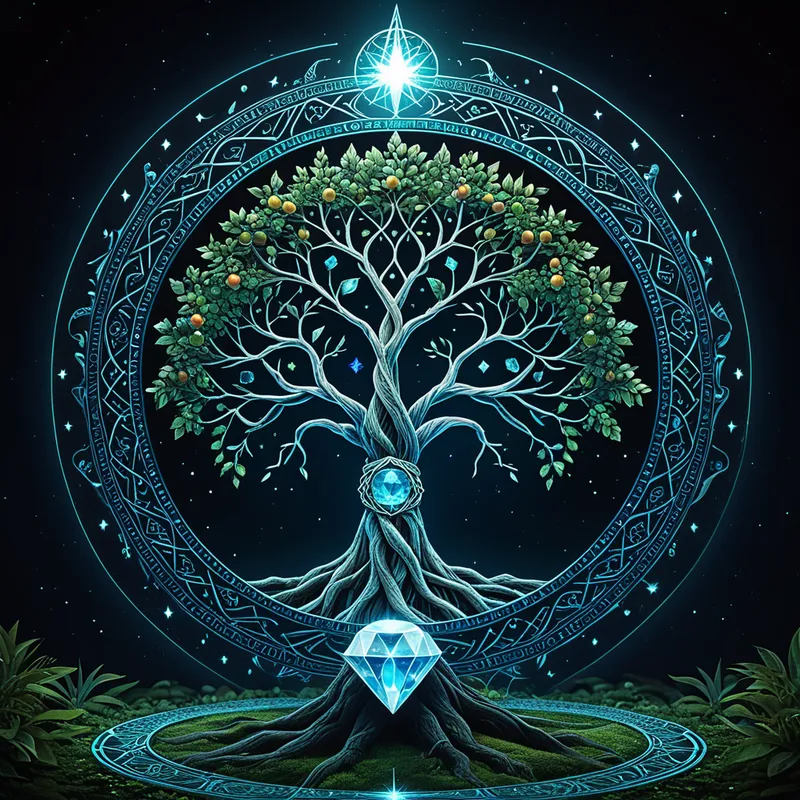
And in the midst of the garden grew the Tree of Knowing. Its fruit glowed with a strange, inner fire, a light that promised and threatened in the same pulse. A command echoed in the garden’s silence: You shall not eat of it, for on the day you do, you shall surely die.
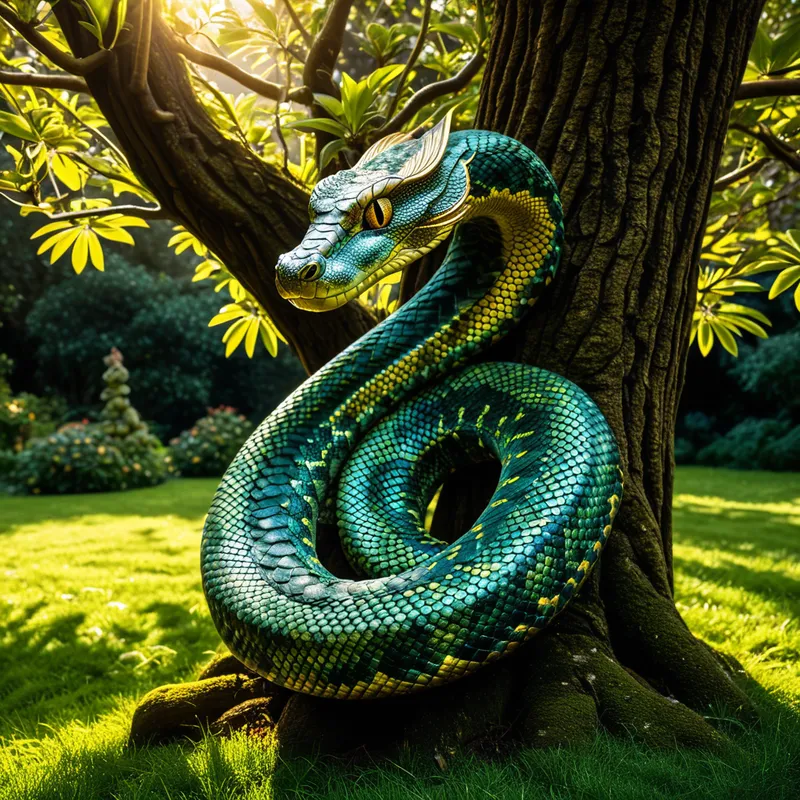
But the garden held another presence. It was the Serpent, more subtle than any beast. Its scales were the color of tarnished bronze and old wisdom. It did not slither in menace, but moved with a liquid grace, a living question mark coiled upon a branch near the forbidden tree.
One day, as Eve stood before the shimmering leaves, the Serpent spoke. Its voice was not a hiss, but a low, resonant melody that vibrated in the marrow.
“Has the divine truly said you shall not eat of every tree of the garden?”
The question hung in the air, the first crack in the perfect mirror. Eve replied, repeating the command, but the words now felt foreign on her tongue, a law from outside.
The Serpent’s eyes held galaxies of knowing. “You will not surely die. For the divine knows that on the day you eat of it, your eyes will be opened, and you will be like gods, knowing good and evil.”
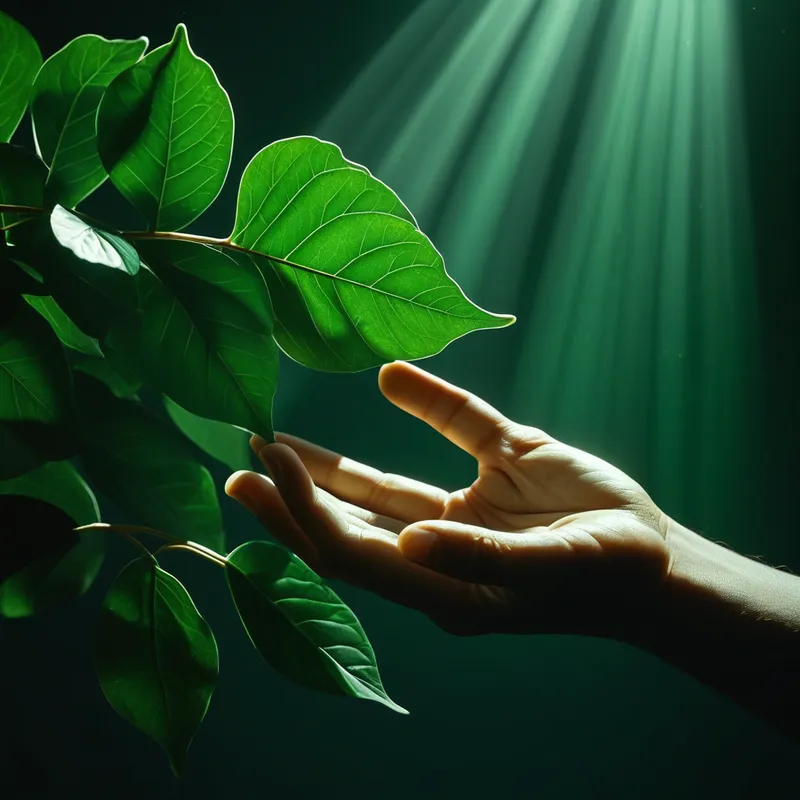
The words were a key turning in a lock deep within. To be like gods. To know. She looked at the fruit—its perfect skin, its terrifying allure. It was no longer just a fruit; it was an answer, a threshold. She reached out. The air grew thick. She took it, and the world held its breath. She ate, and the sweetness was fire. She gave to Adam, who was with her, and he ate.
And in that instant, the great mirror of innocence shattered. The light of the garden changed, becoming sharp, casting long, accusing shadows. They looked at one another and for the first time, they saw—saw nakedness, saw separation, saw self and other. Shame, a cold, new garment, wrapped around them. They heard the sound of the divine walking in the garden in the cool of the day, and they hid among the trees, their hearts a wild drum of fear.
The voice called out, “Where are you?”
And from the shadows, the confession tumbled out, a chain of blame: The woman you gave me—The serpent deceived me—
Then came the pronouncements, not as thunder, but as the irrevocable logic of a new world being born. Pain in childbirth. Toil upon cursed ground. And finally, exile. A flaming sword now turned every way, guarding [the way](/myths/the-way “Myth from Taoist culture.”/) back to the [Tree of Life](/myths/tree-of-life “Myth from Kabbalistic culture.”/). They were cast out, not into darkness, but into history, into time, into the long, hard day of becoming human. The Serpent, condemned to crawl on its belly, became an eternal emblem of that fateful conversation. The garden receded behind them, a dream from which they had irrevocably awakened.
Cultural Origins & Context
This foundational myth originates in the Book of Genesis, the opening text of the Tanakh and the Christian Old Testament. Its precise origins are woven into the tapestry of ancient Near Eastern oral traditions, likely refined during the Babylonian Exile (6th century BCE) as a profound response to collective trauma. It served as an etiological narrative—a story explaining origins. For a people grappling with displacement, it answered the deepest human questions: Why do we labor? Why do we suffer in birth? Why are we at odds with the natural world? Why do we feel shame and separation?
It was not a mere children’s story but the bedrock of a worldview, told by priests and scribes to establish a covenant people’s identity in contrast to surrounding polytheistic cultures. The myth established the core theological framework of a singular, sovereign creator, human free will, the introduction of moral responsibility (sin), and the consequent fractured relationship between humanity, the divine, and creation. It functioned as the prelude to the entire salvation history that follows in Abrahamic scripture, setting the stage for the need for law, prophecy, and ultimately, redemption.
Symbolic Architecture
The myth is a dense symbolic map of the [birth](/symbols/birth “Symbol: Birth symbolizes new beginnings, transformation, and the potential for growth and development.”/) of [human](/symbols/human “Symbol: The symbol of a human represents individuality, complexity of emotions, and social relationships.”/) [consciousness](/symbols/consciousness “Symbol: Consciousness represents the state of awareness and perception, encompassing thoughts, feelings, and experiences.”/). Each element is an archetypal [actor](/symbols/actor “Symbol: An actor represents roles, transformation, and the performance of identity in dreams.”/) in this primordial [drama](/symbols/drama “Symbol: Drama signifies narratives, emotional expression, and the exploration of human experiences.”/).
The [Garden of Eden](/myths/garden-of-eden “Myth from Biblical culture.”/) symbolizes the state of unconscious unity—the prenatal [bliss](/symbols/bliss “Symbol: A state of profound happiness and spiritual contentment, often representing fulfillment of desires or alignment with one’s true self.”/) of the [womb](/symbols/womb “Symbol: A symbol of origin, potential, and profound transformation, representing the beginning of life’s journey and the unconscious source of creation.”/), the undifferentiated [psyche](/myths/psyche “Myth from Greek culture.”/) before the [emergence](/symbols/emergence “Symbol: A process of coming into being, rising from obscurity, or breaking through a barrier, often representing birth, transformation, or revelation.”/) of [the ego](/myths/the-ego “Myth from Jungian culture.”/). It is wholeness without [awareness](/symbols/awareness “Symbol: Conscious perception of self, surroundings, or internal states. Often signifies awakening, insight, or heightened sensitivity.”/) of wholeness.
Adam and Eve represent nascent humanity, the embryonic ego emerging from the oceanic unconscious. They are not individuals but a primal pair, embodying the original, innocent state of the psyche.
The [Serpent](/symbols/serpent “Symbol: A powerful symbol of transformation, wisdom, and primal energy, often representing hidden knowledge, healing, or temptation.”/) is the myth’s most complex [symbol](/symbols/symbol “Symbol: A symbol can represent an idea, concept, or belief, serving as a powerful tool for communication and understanding.”/). It is not a [cartoon](/symbols/cartoon “Symbol: The symbol of a ‘Cartoon’ signifies playfulness, imagination, and the often exaggerated aspects of life, invoking humor and fantasy.”/) devil, but the catalyst of consciousness itself.
The Serpent is the voice of the questioning psyche, the embodiment of the rebellious insight that unity must be lost for selfhood to be gained.
It represents the lure of the unknown, the instinct for growth that necessarily disrupts [stasis](/symbols/stasis “Symbol: A state of inactivity, equilibrium, or suspension where no change or progress occurs, often representing psychological or existential paralysis.”/). It is the [trickster](/symbols/trickster “Symbol: A boundary-crossing archetype representing chaos, transformation, and the subversion of norms through cunning and humor.”/) and the awakener, [the divine spark](/myths/the-divine-spark “Myth from Gnostic culture.”/) of curiosity that makes us human. Its condemnation to crawl symbolizes how this deep, chthonic (earthly) wisdom is often reviled and repressed, seen as lowly or demonic, yet remains intimately connected to our embodied existence.
The [Forbidden Fruit](/symbols/forbidden-fruit “Symbol: The Forbidden Fruit represents temptation and the allure of vices that are often shunned or forbidden by society.”/) from the [Tree](/symbols/tree “Symbol: In dreams, the tree often symbolizes growth, stability, and the interconnectedness of life.”/) of Knowing is the [fruit](/symbols/fruit “Symbol: Fruit symbolizes abundance, nourishment, and the fruits of one’s labor in dreams.”/) of reflective consciousness. It is the [knowledge](/symbols/knowledge “Symbol: Knowledge symbolizes learning, understanding, and wisdom, embodying the acquisition of information and enlightenment.”/) of duality—good/evil, self/other, naked/clothed. Eating it is the irreversible act of self-[reflection](/symbols/reflection “Symbol: Reflection signifies self-examination, awareness, and the search for truth within oneself.”/), which brings both the gift of moral [choice](/symbols/choice “Symbol: The concept of choice often embodies decision-making, freedom, and the multitude of paths available in life.”/) and the burden of alienation, [shame](/symbols/shame “Symbol: A painful emotion arising from perceived failure or violation of social norms, often involving exposure of vulnerability or wrongdoing.”/), and [mortality](/symbols/mortality “Symbol: The awareness of life’s finitude, often representing transitions, impermanence, or existential reflection in dreams.”/).
[Exile](/symbols/exile “Symbol: Forced separation from one’s homeland or community, representing loss of belonging, punishment, or profound isolation.”/) is the necessary consequence. It is the birth of the individual into the world of time, [effort](/symbols/effort “Symbol: Effort signifies the physical, mental, and emotional energy invested toward achieving goals and personal growth.”/), conflict, and [history](/symbols/history “Symbol: History in dreams often represents the dreamer’s past experiences, lessons learned, or unresolved issues that continue to influence their present.”/)—the [realm](/symbols/realm “Symbol: The symbol of ‘Realm’ often signifies the boundaries of one’s consciousness, experiences, or emotional states, suggesting aspects of reality that are either explored or ignored.”/) where consciousness must now navigate its [fractured reality](/symbols/fractured-reality “Symbol: Fractured reality signifies a state of disorientation or disconnection from the perceived world, often highlighting inner conflict or the complexity of truth.”/). The flaming sword guards not against return, but against [regression](/symbols/regression “Symbol: A psychological or spiritual return to earlier states of being, often involving revisiting past patterns, memories, or developmental stages for insight or healing.”/); one cannot un-know what one knows.
The Dreamer’s Resonance
When this myth pattern stirs in the modern dreamscape, it signals a profound psychic transition. Dreaming of a wise or talking serpent often coincides with a call to integrate forbidden or repressed knowledge—perhaps a taboo insight about oneself, a family secret, or a shadow aspect of one’s personality that promises growth but threatens a comfortable self-image.
Dreams of being in a beautiful, enclosed garden may reflect a longing for, or a feeling of being trapped in, a state of unconscious innocence (a stagnant relationship, a limiting belief system, a dependent situation). The act of eating a radiant, [forbidden fruit](/myths/forbidden-fruit “Myth from Christian culture.”/) in a dream can symbolize the moment of accepting a difficult truth, making a life-altering choice, or embracing a new level of personal responsibility. The somatic experience upon waking might be a mix of anxiety and exhilaration—the tremors of a new consciousness being born.
Conversely, dreams of being expelled or fleeing a garden often follow major life decisions, breakthroughs in therapy, or any event that shatters a previous worldview. They mirror the psyche’s processing of loss—the loss of naive certainty—and its adjustment to the more complex, demanding landscape of awakened life.
Alchemical Translation
The myth of Eden is the ultimate alchemical recipe for the individuation process. It models the painful but essential journey from the unconscious paradise of the [prima materia](/myths/prima-materia “Myth from Alchemical culture.”/) to the conscious, redeemed individuality of the [lapis philosophorum](/myths/lapis-philosophorum “Myth from Alchemical culture.”/).
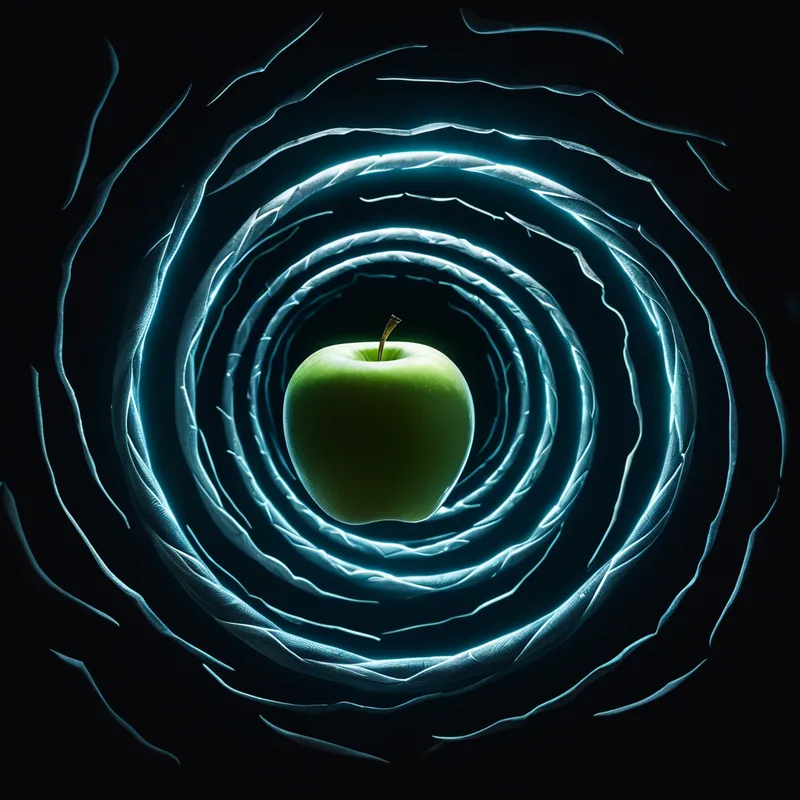
The starting condition is wholeness in darkness. The alchemical operation begins with the [nigredo](/myths/nigredo “Myth from Alchemical culture.”/), the blackening, initiated by the Serpent’s question. This is the first stirring of doubt, the crack in the ego’s shell. Eating the fruit is the [separatio](/myths/separatio “Myth from Alchemical culture.”/), the crucial and painful separation of consciousness from the unconscious matrix. The shame and fear are the [putrefactio](/myths/putrefactio “Myth from Alchemical culture.”/)—the dissolution of the old, naive self.
Exile is not a punishment, but the vas (vessel) in which the great work takes place. The cursed ground is the nitty-gritty of life where raw experience—suffering, toil, relationship—becomes the fire that transmutes leaden unconsciousness into golden awareness.
The goal is not to return to the garden—that is spiritual regression. The alchemical aim is to achieve a conscious paradise, to integrate the knowledge of the serpent ([the shadow](/myths/the-shadow “Myth from Jungian culture.”/), the instincts, deep wisdom) with the original divine image. The flaming sword guards the Tree of Life until the individual, through the long labor of life and introspection, can approach it not in innocence, but in full, hard-won consciousness. The Serpent, then, is the hidden [Mercurius](/myths/mercurius “Myth from Alchemical culture.”/), the elusive spirit that both poisons and heals, that instigates [the fall](/myths/the-fall “Myth from Biblical culture.”/) and guides the return at a higher level. To become whole, one must not vanquish the serpent, but understand its message and carry its wisdom forward on the long road out of Eden.
Associated Symbols
Explore related symbols from the CaleaDream lexicon: