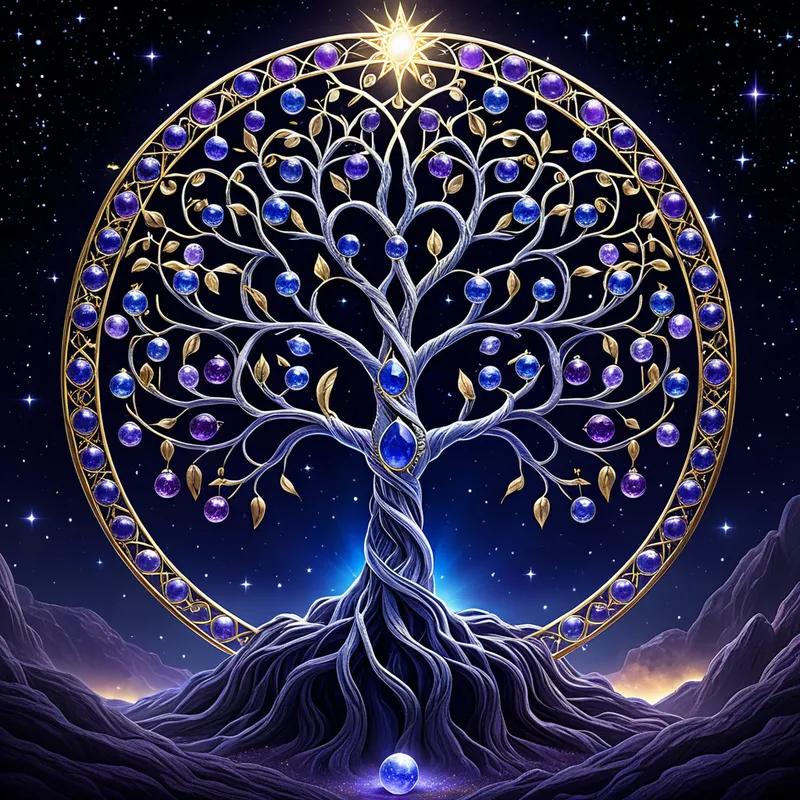
Sephirot Myth Meaning & Symbolism
A sacred story of divine light fracturing into ten vessels of wisdom, creating the cosmos and the human soul's path back to the source.
The Tale of the Sephirot
In the beginning, before beginning, there was only the Ein Sof. A boundless, nameless light, so complete it had no need to be known. It was the silent, eternal breath before the first word.
But within that infinite stillness, a desire stirred—not a need, but a profound will to give. The Ein Sof contracted, drawing in its light to make a hollow, a sacred space for something other. From its very heart, a single ray of that boundless light poured forth. This was the Keter, [the Crown](/myths/the-crown “Myth from Various culture.”/), a point of pure potential, a kingly thought of creation.
This light flowed, and as it flowed, it changed. It cooled and concentrated into a vessel of Chokhmah, [the flash of insight](/myths/the-flash-of-insight “Myth from Alchemical culture.”/) that sees the whole. From that flash, it settled into a second vessel, Binah, [the womb](/myths/the-womb “Myth from Various culture.”/) that receives and gives form to the idea. And so the flow continued, a cascade of divine attributes pouring into vessels prepared to receive them: Chesed, a great river of mercy; Gevurah, the mighty pillar of strength and boundary; Tiferet, the radiant sun that balanced the two.
But the light was too pure, too potent. The vessels of the lower emanations—Netzach, Hod, and the foundation of Yesod—strained under the glory. They longed to contain the infinite, but they were finite. With a soundless shattering, the vessels broke. Holy sparks of that primal light scattered, falling through the empty spaces, mingling with the fragments of the shattered clay.
The cosmos was born in this catastrophe of generosity. [The world](/myths/the-world “Myth from Tarot culture.”/) we know is built from these holy sparks trapped in shells of darkness, <abbr title=“The “shells” or husks of impurity that conceal the divine sparks”>Kelipot. The final vessel, Malkhut, the Kingdom, received not the direct light, but the reflected glow of all that came before, now filtered through a world of matter and shadow.
And so the great tree stood—and stands—wounded yet alive. Its ten luminous spheres, the Sephirot, are now a map of both the fracture and the path of return. [The river](/myths/the-river “Myth from Buddhist culture.”/) of light still flows from the Crown down to the Kingdom, but it must navigate the scars of the breaking. The myth is not of a finished creation, but of a creation that is a cry, a question, and a ladder all at once. The work of gathering the sparks, of repairing the vessels, had begun. That work was given a name: Tikkun Olam. And the one tasked with this work? The one who looks upon the tree and sees their own soul mirrored in its broken, beautiful architecture.
Cultural Origins & Context
This is not a myth told around a campfire, but one whispered in the hushed light of study halls, etched into parchment, and guarded through centuries of exile. It is the heart of the Kabbalah, meaning “that which is received.” Its most iconic formulation, the Etz Chaim or [Tree of Life](/myths/tree-of-life “Myth from Kabbalistic culture.”/), crystallized in medieval Spain with the 13th-century text, the Zohar.
Its transmission was intentionally esoteric, passed from master to carefully prepared disciple. This was not merely philosophy but a living, experiential cosmology. To study the Sephirot was to perform an inner archaeology of the soul and the cosmos simultaneously. It functioned as a theodicy—explaining the presence of evil and fragmentation in a world made by a benevolent God—and as a sophisticated psychological and ritual system. Each Sephirah corresponded to a part of the divine body, a biblical patriarch, a stage of creation, and, most intimately, an aspect of the human [psyche](/myths/psyche “Myth from Greek culture.”/). It provided a map for navigating exile, both the historical exile of the Jewish people and the existential exile of the soul from its source.
Symbolic Architecture
The myth of the Sephirot is a symbolic [blueprint](/symbols/blueprint “Symbol: A blueprint represents the foundational plan or design for something, often symbolizing potential, structure, and the mapping of one’s inner self or future.”/) of [emanation](/symbols/emanation “Symbol: A spiritual or divine energy flowing outward from a source, often representing creation, influence, or the manifestation of the sacred into the material world.”/), fracture, and [integration](/symbols/integration “Symbol: The process of unifying disparate parts of the self or experience into a cohesive whole, often representing psychological wholeness or resolution of internal conflict.”/). It models the fundamental process by which the One becomes the Many without ceasing to be the One.
The journey from unity to diversity is not an error, but a divine necessity; the return from diversity to conscious unity is the human task.
The <abbr title=“The “Breaking of the Vessels"">Shevirat HaKelim is the central traumatic [event](/symbols/event “Symbol: An event within dreams often signifies significant life changes, transitions, or emotional milestones.”/). It symbolizes the inevitable [fragmentation](/symbols/fragmentation “Symbol: The experience of breaking apart, losing cohesion, or being separated into pieces. Often represents disintegration of self, relationships, or reality.”/) that occurs when infinite potential meets finite form. Psychologically, this is the [trauma](/symbols/trauma “Symbol: A deeply distressing or disturbing experience that overwhelms the psyche, often manifesting in dreams as unresolved emotional wounds or psychological injury.”/) of incarnation: the pure potential of the [infant](/symbols/infant “Symbol: The infant symbolizes new beginnings, innocence, and the potential for growth and development.”/) psyche meeting the limitations of [family](/symbols/family “Symbol: The symbol of ‘family’ represents foundational relationships and emotional connections that shape an individual’s identity and personal development.”/), [body](/symbols/body “Symbol: The body in dreams often symbolizes the dreamer’s self-identity, personal health, and the relationship they have with their physical existence.”/), and culture. The holy sparks trapped in the <abbr title=“The “shells” or husks of impurity that conceal the divine sparks”>Kelipot represent our deepest talents, joys, and core Self, which become buried under complexes, defenses, and [trauma](/symbols/trauma “Symbol: A deeply distressing or disturbing experience that overwhelms the psyche, often manifesting in dreams as unresolved emotional wounds or psychological injury.”/)—the “shells” of our [personality](/symbols/personality “Symbol: Personality in dreams often symbolizes the traits and characteristics of the dreamer, reflecting how they perceive themselves and how they believe they are perceived by others.”/).
The [Tree](/symbols/tree “Symbol: In dreams, the tree often symbolizes growth, stability, and the interconnectedness of life.”/) itself is a map of dynamic polarities. The right pillar (Chokhmah, Chesed, [Netzach](/symbols/netzach “Symbol: The seventh Sephirah on the Kabbalistic Tree of Life, representing eternal victory, endurance, and the emotional drive of nature.”/)) is the masculine, expansive, flowing force. The left pillar ([Binah](/symbols/binah “Symbol: In Kabbalah, the third Sephirah representing divine understanding, the feminine principle, and the womb of creation.”/), Gevurah, Hod) is the feminine, contracting, structuring force. The central pillar (Keter, Tiferet, [Yesod](/symbols/yesod “Symbol: The ninth Sephirah in Kabbalah, representing the foundation of the universe, the subconscious mind, and the astral plane where dreams form.”/), Malkhut) is the [path](/symbols/path “Symbol: The ‘path’ symbolizes a journey, choices, and the direction one’s life is taking, often representing individual growth and exploration.”/) of balance and integration, where opposites are reconciled. This is a profound model for psychological [health](/symbols/health “Symbol: Health embodies well-being, vitality, and the balance between physical, mental, and spiritual states.”/): the integration of mercy and judgment, [intuition](/symbols/intuition “Symbol: The immediate, non-rational understanding of truth or insight, often described as a ‘gut feeling’ or inner knowing that bypasses conscious reasoning.”/) and [analysis](/symbols/analysis “Symbol: The process of examining something methodically to understand its components or meaning. In dreams, it represents the mind’s attempt to break down complex experiences.”/), [action](/symbols/action “Symbol: Action in dreams represents the drive for agency, motivation, and the ability to take control of situations in waking life.”/) and [reception](/symbols/reception “Symbol: The symbol of ‘reception’ often signifies the act of welcoming or accepting new ideas, experiences, or people into one’s life.”/) within the individual.
The Dreamer’s Resonance
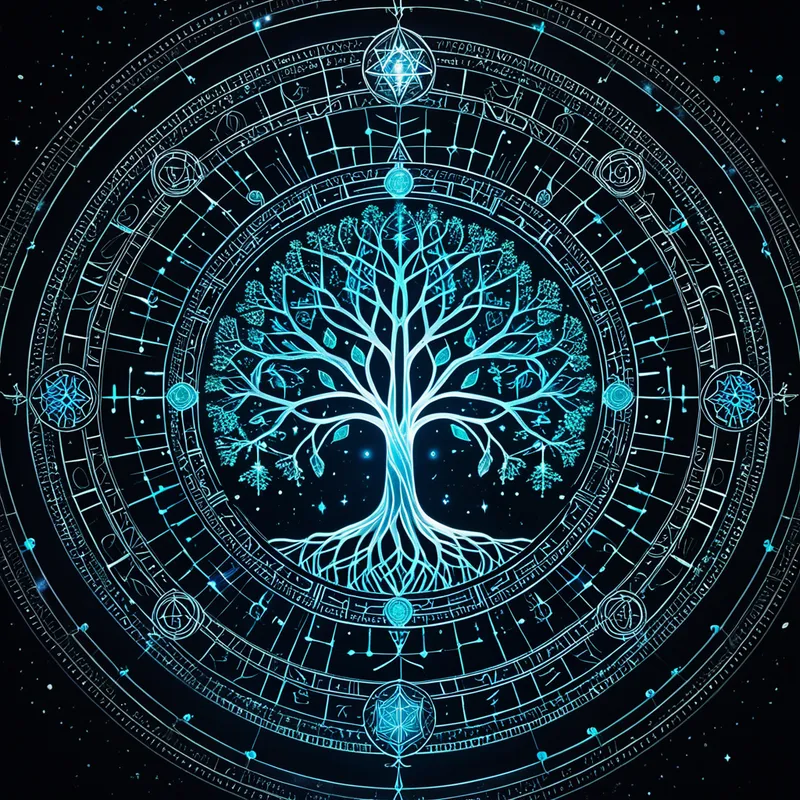
When this myth stirs in the modern unconscious, it rarely appears as a literal tree. Its presence is felt in patterns of structure, fracture, and luminous connection.
You may dream of a complex, pulsating network of lights within your own body, or of a shattered mirror whose pieces each reflect a different version of you. You might find yourself in a vast, bureaucratic building (the structured cosmos) trying to locate a single, vital document (a holy spark). Dreams of trying to repair a beautiful but fractured vase, or of following a thread through a [labyrinth](/myths/labyrinth “Myth from Various culture.”/) only to find it connects back to your own heart, are somatic echoes of the Tikkun process.
Psychologically, these dreams signal a process of deep self-inventory and re-integration. The dream ego is navigating the internal “Tree,” perhaps stuck in the harsh judgment of Gevurah or lost in the endless negotiations of Hod. The somatic feeling is often one of tension between points in the body—a pull between head and heart, or a blockage in the core—mirroring the blocked pathways on the Tree. The dream is an invitation to locate your scattered sparks and begin the delicate work of lifting them from their shells.

Alchemical Translation
The alchemical process mirrored in the Sephirotic myth is the opus contra naturam: the work against nature, which is here the work against fragmentation. It is the journey of Individuation, not as a creation of a new self, but as the recollection and reassembly of the original, divine Self shattered at the inception of one’s own consciousness.
Individuation is the personal enactment of Tikkun Olam; healing your own world is how you heal the world.
The journey begins in Malkhut, our identified ego, our “kingdom” of daily life, feeling separate and exiled. The first transformation is the discovery of Yesod, the subconscious foundation where our personal and ancestral patterns reside. Confronting this is the first gathering of sparks.
The major alchemical crucible is at the heart, Tiferet. Here, the lead of [the ego](/myths/the-ego “Myth from Jungian culture.”/)‘s selfishness must be dissolved in the acid of paradox, to make room for the gold of the Self. This requires reconciling the opposing forces of Chesed (unconditional love) and Gevurah (necessary discipline). To reach this center, one must often endure the “dark night” of Binah, the severe mother who dissolves all illusions.
The ultimate transmutation is the non-dual realization at the crown, Keter, where the seeker understands they were never separate from the Ein Sof. Yet, in a final alchemical twist, the work does not end in transcendent unity. The light must be brought back down, through the now-repaired vessels, to fully illuminate Malkhut. [The philosopher’s stone](/myths/the-philosophers-stone “Myth from Alchemical culture.”/) is not kept in heaven; it is used to turn the base metal of ordinary existence into gold. The integrated individual returns to the world, not as an escaped spark, but as a conscious vessel, now strong enough to hold the light and shine it into the very fractures from which they emerged.
Associated Symbols
Explore related symbols from the CaleaDream lexicon: