Sekhmet's Stagnation Myth Meaning & Symbolism
The sun god Ra transforms his daughter, the lioness goddess Sekhmet, into an unstoppable force of vengeance, then must halt her world-ending rampage.
The Tale of Sekhmet's Stagnation
Hear now the tale of the day the sun grew old and the world turned to blood.
In the time when gods walked the earth and the Benben stone was still warm, the sun god Ra sat upon his throne of electrum. But a murmuring arose from the clay of the Two Lands. Humanity, his own creation, had grown insolent. They plotted in shadows, their whispers of rebellion reaching even the solar barque. Their ingratitude was a poison in the air, a fog over the perfect order of Ma'at.
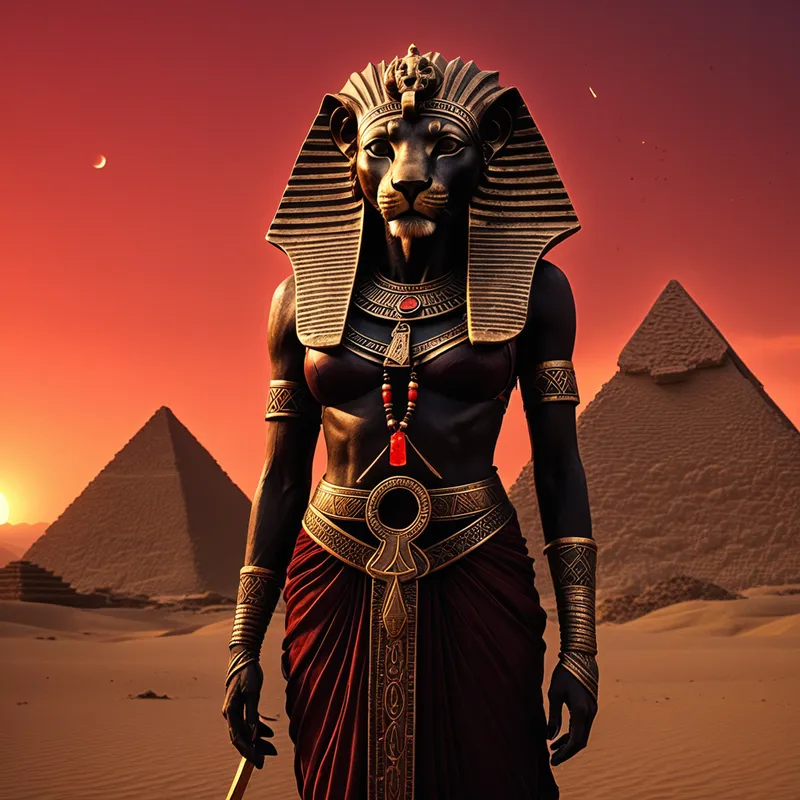
A cold fire kindled in Ra’s aged heart. He summoned his Heka. His eye, the terrible Udjat, blazed with a light not of life, but of purging. From that furious radiance, she was born. Not from a womb, but from wrath itself. Sekhmet. The Powerful One. Her body was that of a sleek, muscular woman, but her head was that of a lioness, a mane like molten copper framing eyes of polished obsidian that held no mercy, only a hunger for chaos. Her breath was the simoom, the desert wind that scorches bones.
“Go forth, my daughter,” Ra commanded, his voice the crackle of a dying star. “Go among the children of men. Let your heart be pleased with them.”
And Sekhmet was pleased. She descended not as a storm, but as a fever. A red mist followed her, a tangible thirst. She did not merely kill; she reveled. She danced through fields and cities, her claws painting the Nile banks crimson. The river itself threatened to become a torrent of blood. Her laughter was the sound of breaking spines. She was the embodiment of divine punishment unchecked, a weapon that, once unleashed, forgot its purpose and remembered only its nature. The earth grew drunk on slaughter. Ra watched from on high, and a new emotion stirred in his divine breast—not anger, but horror. He had unleashed the unthinkable. The instrument of correction had become the engine of annihilation. The balance was shattered. If she continued, there would be no one left to rule, no one left to worship. The world would be a silent, red ruin.
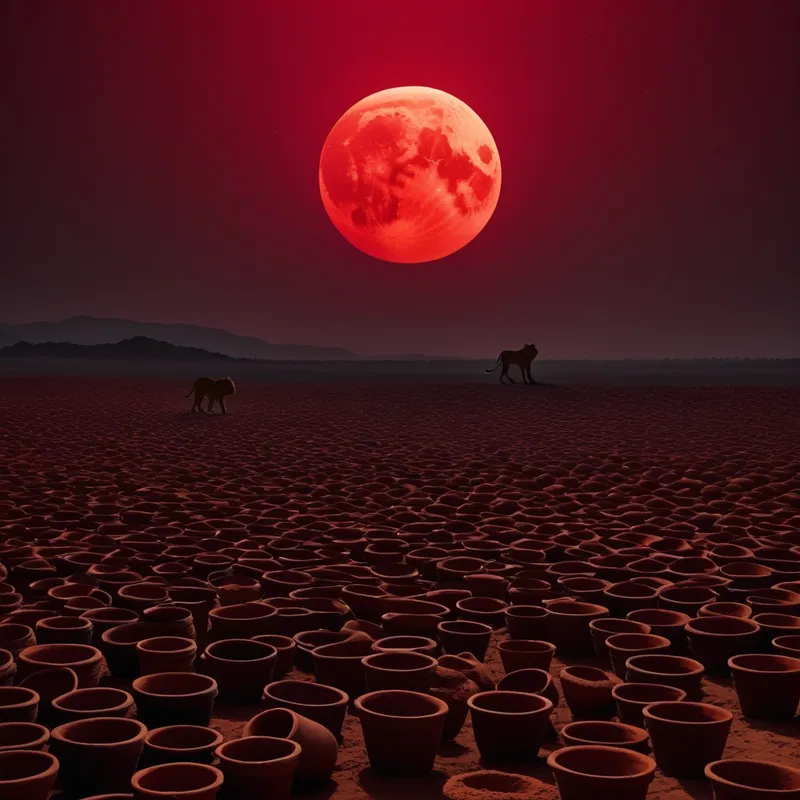
The sun god knew he must act, but how does one cage the storm? How does one command the wildfire to cease? Force was useless; she was force incarnate. Cunning was required. Ra called upon the swiftest of his messengers and the cunning of the earth itself. To the city of Hermopolis he sent word, to the place where the primordial waters still whispered. There, the servants of the gods worked with desperate speed. They gathered barley and red ochre from the desert, the very color of blood and life. They brewed not a poison, but a seduction. Seven thousand jars they filled with this potent, ruddy beer, staining it with pomegranate and mandrake until it mirrored exactly the blood that flooded the land.
As Sekhmet prowled toward the final stronghold of humanity, she found not fear, but a field of offering. The plains of Dendera were flooded not with blood, but with this crimson nectar, shimmering in the dying light. She paused, her nostrils flaring. The scent was metallic, familiar, intoxicating. She stooped, her great lioness tongue lapping at the pool. The taste was sweet and thick. A divine thirst, deeper than any rage, took hold. She drank. And drank. She plunged her head into the jars, consuming the false blood until the fields were dry and the jars lay empty. The fire in her belly cooled, replaced by a heavy, golden warmth. The lust for slaughter seeped from her limbs. The lioness’s snarl softened. The blazing eyes dimmed. She staggered, her form shimmering in the haze of intoxication. The warrior’s posture slumped, and where the terrifying Sekhmet had stood, now lay Hathor, the peaceful, cow-headed goddess of love and joy, asleep in a field of blissful stupor.
The rampage was over. The world was saved not by a greater violence, but by a divine trick, a transmutation of blood into beer, of rage into repose. Sekhmet, the Devourer, had been stopped. But she was not destroyed. She was stalled, pacified, transformed. She slept, and in her dreaming, the world began to heal its wounds.
Cultural Origins & Context
This powerful narrative, often called “The Destruction of Mankind,” is preserved primarily in the tombs of the New Kingdom pharaohs, most completely in the tomb of Seti I in the Valley of the Kings. It was not a folktale for the masses, but a sacred text inscribed on the very walls that guided a king into the afterlife. Its tellers were the priestly scribes, the Kher Heb, who understood the story as a foundational cosmic drama.
Societally, the myth served multiple vital functions. For the pharaoh, it was a potent reminder of his dual role: he was the embodiment of Horus, who must wield authority, but also the son of Ra, who must possess the ultimate wisdom to control the destructive power inherent in sovereignty. The story justified the pharaoh’s absolute power (as Ra’s agent) while warning of its catastrophic potential if exercised without balance and cunning. For the people, it explained the presence of both benevolent and fearsome aspects in their gods, and it mythologized the annual flooding of the Nile—the life-giving, red-tinged inundation could be seen as a echo of Sekhmet’s blood-beer, a destructive force turned to fertile abundance.
Symbolic Architecture
At its core, the myth is a profound allegory for the psyche’s relationship with its own unintegrated, destructive power. Sekhmet is not an external monster, but an aspect of the Self—specifically, the archetypal force of righteous, purifying rage.
Sekhmet represents the shadow of divine authority: the necessary, terrifying power that upholds order by threatening total chaos.
Ra, the ruling consciousness (the ego or the ruling principle), feels threatened by rebellion (disorder in the psyche, repressed contents, societal insurrection). His solution is to externalize his anger into a separate entity, Sekhmet. This is the classic psychological move of projection or dissociation. We disown our rage, our capacity for violence, and see it as an external force that must be unleashed upon the world (or upon parts of ourselves we deem “disobedient”). But the unleashed force, once separate, gains a life of its own. It follows its own logic of consumption. The ego loses control of its own weapon.
The blood and the beer are the masterstroke of the symbolism. They are visually identical but essentially different. One is life taken; the other is life fermented, transformed, and offered. The “stagnation” is not a failure, but a sacred pause, an intoxication that allows for a change of state. It is the psyche’s cunning intervention to prevent total self-annihilation. The transformation into Hathor is critical: it reveals that the destructive force and the creative, joyful force are two faces of the same divine energy. Rage, when integrated and pacified, can become a fierce protectiveness, a passionate love, or a potent healing energy. Sekhmet was also a goddess of healers, showing that the power to wound and the power to cure spring from the same source.
The Dreamer's Resonance
When this myth stirs in the modern dreamscape, it often signals a profound somatic and psychological crisis related to repressed fury or a loss of control over one’s own aggressive instincts. The dreamer may not see a lioness goddess, but the pattern is unmistakable.
They may dream of being in a vehicle (a modern solar barque) that is careening out of control, with brakes that fail. They may be fighting an endless, exhausting battle against a faceless horde, feeling a terrifying pleasure in the destruction. The environment may be drenched in a red light or filled with a suffocating, coppery smell. Somatic sensations upon waking often include a clenched jaw, heat in the chest, or a feeling of being “hungover” from emotion.
This is the psyche’s enactment of “Sekhmet’s Rampage.” An old order (a relationship, a career, a self-image) is being rebelliously challenged. The ego’s response has been to unleash a inner critic or a burst of destructive behavior (verbal lashings, self-sabotage, fits of rage) that is now running amok, threatening to burn down the dreamer’s entire inner landscape. The dream is a warning: the punitive, cleansing rage has become autonomous and is now a danger to the self. The dreamer is experiencing the terror of Ra—seeing the monster they have created and realizing they cannot command it to stop by force.
Alchemical Translation
The individuation process modeled here is the alchemical transmutation of the nigredo—the black, chaotic, destructive stage—into the rubedo, the red stage of integration and renewed life. It is a map for navigating a psychic civil war.
The work is not to destroy the lioness, but to intoxicate her with the truth of her own nature, to reveal that her bloodlust is a distorted cry for a deeper, life-affirming power.
First, one must Recognize the Projection (Ra’s Decree): The modern seeker must ask, “Where have I externalized my righteous anger? Upon whom or what have I unleashed my inner Sekhmet?” This could be a blamed parent, a hated institution, or a despised aspect of the self. The energy is seen as “out there.”
Second, one must Witness the Autonomy of the Rage (The Rampage): This is the painful stage of seeing the collateral damage. The anger meant to punish a specific fault has created generalized suffering—broken relationships, burned bridges, a scorched emotional earth. The ego feels powerless.
Third, and most crucially, one must Employ Divine Cunning (The Brewing of the Beer): Force cannot stop force. The conscious mind must concoct a “trick.” This is the therapeutic, reflective, or ritual act. It involves “staining” a neutral medium with the color of the conflict. Journaling about the rage (giving it form), engaging in vigorous physical activity (channeling the energy), or creating art about the destruction (transforming it into an object)—these are the “seven thousand jars of beer.” They provide a container that mirrors the destructive impulse but alters its essence. One “drinks” of this reflection by immersing oneself in the symbolic act until the raw affect is metabolized.
The final stage is The Sacred Stagnation (The Transformation to Hathor): The rage doesn’t vanish; it stagnates, settles, and changes state. The fierce, protective energy of Sekhmet, once integrated, becomes the capacity for fierce compassion, for setting boundaries with love, or for the healing power that comes from having faced one’s own darkness. The individual who has navigated this myth no longer fears their own capacity for destruction, because they have learned the sacred art of intoxicating it with consciousness, turning the blood of trauma into the fermented, complex wine of wisdom. The ruler of the psyche is no longer a distant, angry sun, but a sovereign who has made peace with the lioness within, knowing she is both protector and destroyer, and that her true service requires eternal, vigilant balance.
Associated Symbols
Explore related symbols from the CaleaDream lexicon: