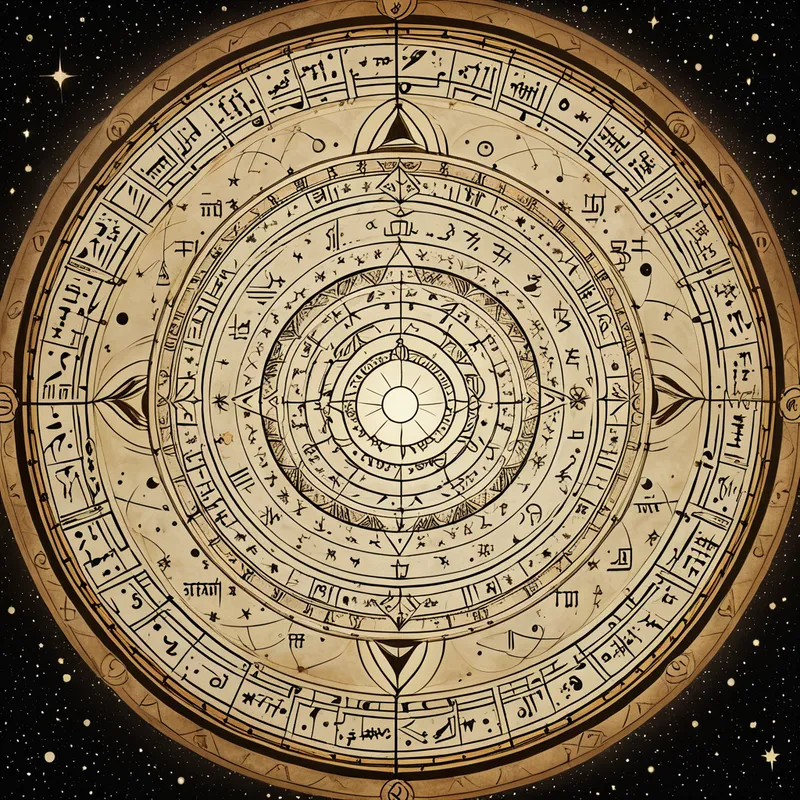
Sefer Yetzirah Myth Meaning & Symbolism
An ancient text revealing the universe as a divine language, where the 22 Hebrew letters and 10 divine numbers form the blueprint of all reality.
The Tale of Sefer Yetzirah
In the beginning, before the world was clay or star, there was the Breath of the Living God. It was not a wind you could feel, but the first potential of all feeling—a boundless, silent Aleph. From within this endless expanse, the Holy One carved thirty-two secret paths of wisdom. These were not roads of stone, but channels of pure intent, etched with the fire of divine thought.
Ten were the Sefirot, vessels of nothingness. Imagine spheres of luminous absence, waiting to be filled with meaning: Crown, Wisdom, Understanding, and down to the Kingdom, the world-to-be. They pulsed in the dark, a silent, rhythmic heart.
And twenty-two were the foundation letters. He engraved them, He carved them, He weighed them, and He permuted them. Each letter was a world, a sound, a force. The Aleph held the air between heaven and earth. The Bet was the dwelling place, the container. The Gimel was the benefactor, carrying sustenance across deserts of potential.
The Holy One set them as a wall, arranged them as a rampart. He poured over them snow and fire, fixed them with the twelve constellations, the seven planets, and the 365 days. He bound the crown to each, and with them, He formed all that was formed and all that would ever be spoken. The letters danced in divine combinations, a cosmic dance of meaning preceding matter. With them, He sealed the heights and the depths, the east and the west, the north and the south. And in the center of all, He formed the Tziyyur, the form of the human, a microcosm woven from the very letters of the Torah, standing upon the earth and reaching its head to the sky—a living testament to the speech that built the world.
Cultural Origins & Context
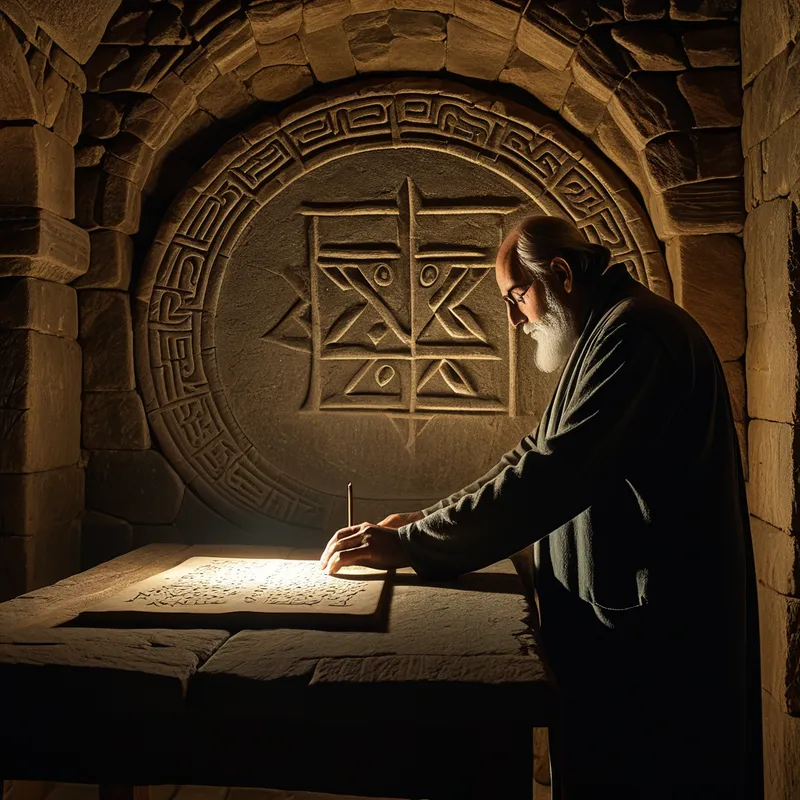
The Sefer Yetzirah is a slender, cryptic text, its origins shrouded in the mists of antiquity. Traditionally attributed to the patriarch Abraham, scholarly consensus places its composition between the 3rd and 6th centuries CE, a period of profound cross-pollination between Jewish, Gnostic, and Neoplatonic thought. It was not a myth told around a fire, but a secret wisdom passed from master to disciple in whispers, a technical manual for the cosmos intended for the few who could bear its weight.
Its societal function was dual. Exoterically, it was a meditation on the divine logic of creation, affirming the sanctity of the Hebrew language and scripture as the literal building blocks of reality. Esoterically, it was a map for the initiated—a guide for spiritual ascent. By understanding the permutations of the letters and the dynamics of the Sefirot, the adept sought to align their own soul with the architecture of the universe, to participate consciously in the ongoing process of creation and repair. It was the cornerstone of what would later flower into the vast edifice of Kabbalah.
Symbolic Architecture
The myth of the Sefer Yetzirah presents a universe not born from chaotic explosion, but from articulate, divine speech. Its core symbol is the Letter. Here, language is not a tool to describe reality; it is the substrate of reality itself.
The universe is a text waiting to be read, and the human soul is the eye that can learn the alphabet.
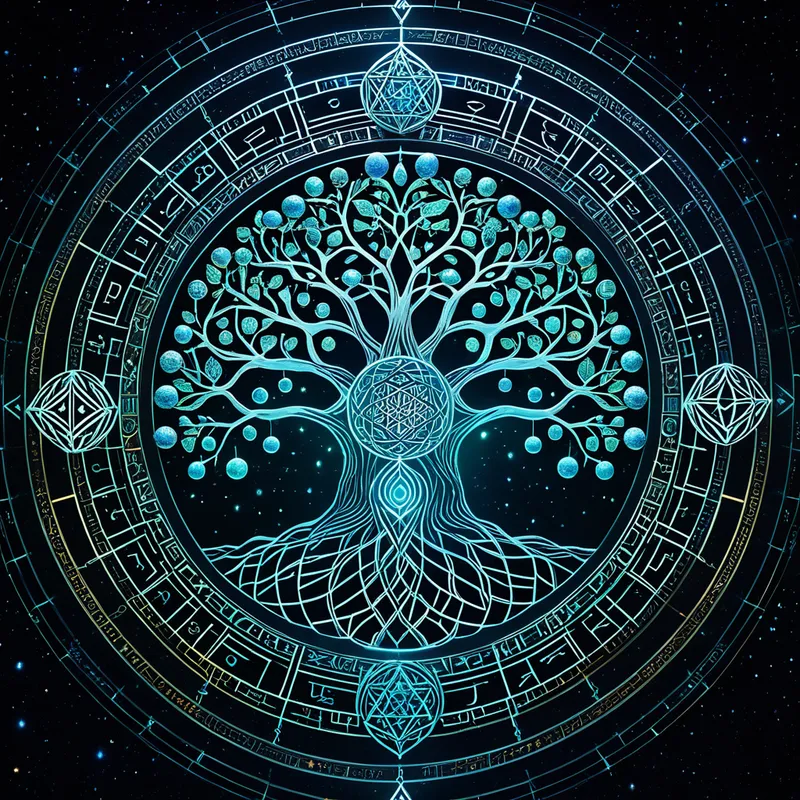
The twenty-two Hebrew letters symbolize the fundamental archetypal forces—the verbs and nouns of existence. The ten Sefirot represent the stages through which the infinite, unknowable Godhead (Ein Sof) steps down into manifestation. Psychologically, this is a map of the psyche’s own emergence from the unified unconscious into the differentiated structures of consciousness (thinking, feeling, intuition, sensation) and finally into embodied reality.
The human, formed in the “image of God,” is thus the being capable of conscious speech and creative thought. We are not just made by the word; we are beings of the word, endowed with the same creative—and destructive—potency. Our thoughts and utterances are not ephemeral; they are acts of world-building or world-breaking within our own psychic microcosm.
The Dreamer’s Resonance
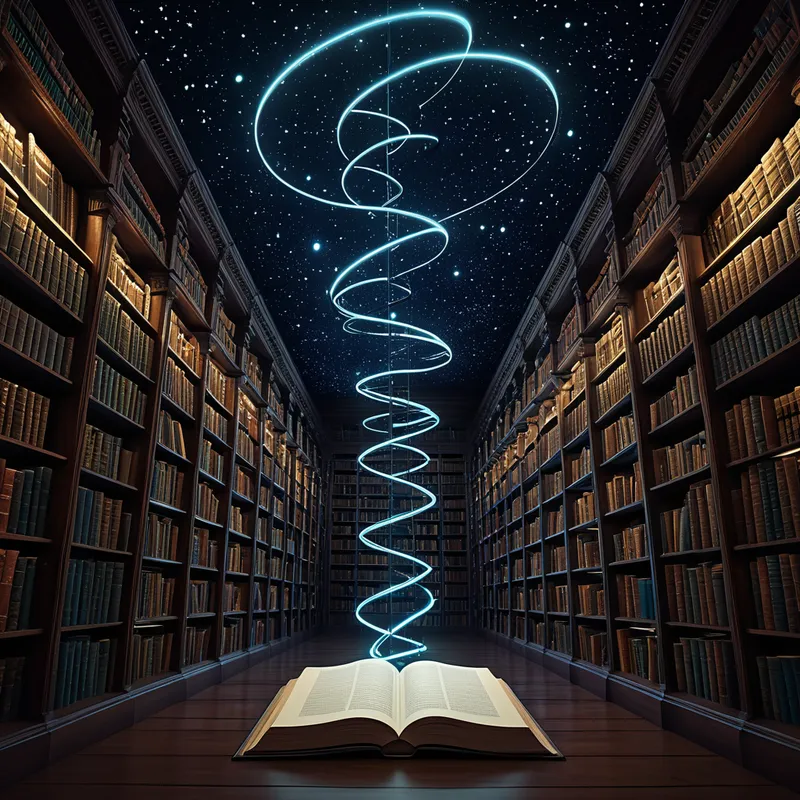
When this myth stirs in the modern unconscious, it often manifests in dreams of codes, forgotten languages, or architectural blueprints. A dreamer might find themselves in a library where books are written in shimmering, unfamiliar glyphs that feel profoundly meaningful. They may dream of constructing or discovering a complex, intricate model—a machine, a crystal, a network of light—that seems to hold the key to understanding everything.
Somatically, this can feel like a humming in the throat chakra, a pressure to give form to something inarticulate. Psychologically, it signals a process of psychic structuration. The dreamer is at a threshold where chaotic inner experiences (emotions, insights, traumas) are seeking a coherent form. The psyche is attempting to “spell out” its own nature, to find the foundational “letters” of its identity and destiny. It is the deep self working as a divine scribe, trying to inscribe order onto the void of the unknown within.
Alchemical Translation
The alchemical process modeled here is the transmutation of chaos into logos, of raw experience into meaningful narrative. The prima materia is the undifferentiated stuff of the soul—our potentials, wounds, and drives. The Sefer Yetzirah provides the alembic: the disciplined structures of the Sefirot and the alphabet.
Individuation, in this frame, is the slow, conscious work of becoming the author of one’s own being. It begins with recognizing the “Breath of the Living God”—the animating life force within (the Self). The first separation is into the “ten spheres,” the archetypal capacities of the psyche: our will, our wisdom, our understanding, our capacity for love and judgment, down to our grounded presence in the world.
The great work is not to escape form, but to master the grammar of your own formation.
The “permutation of the letters” is the active, creative work of therapy, art, journaling, or deep reflection—rearranging the elements of our personal history and character into new, more harmonious, and truthful combinations. To “seal the directions” is to achieve integration, where the conflicting aspects of the self (the heights and depths, the north of cold logic and the south of passion) are bound into a cohesive whole. The triumph is the formation of the “Tziyyur,” the true form—the individuated person who stands between heaven and earth, a conscious participant in the ongoing creation of their world, having learned to speak the sacred language of their own soul.
Associated Symbols
Explore related symbols from the CaleaDream lexicon: