Sefer Raziel HaMalakh Myth Meaning & Symbolism
The myth of an angelic book of cosmic secrets, given to Adam and passed through time, revealing the peril and power of divine knowledge.
The Tale of Sefer Raziel HaMalakh
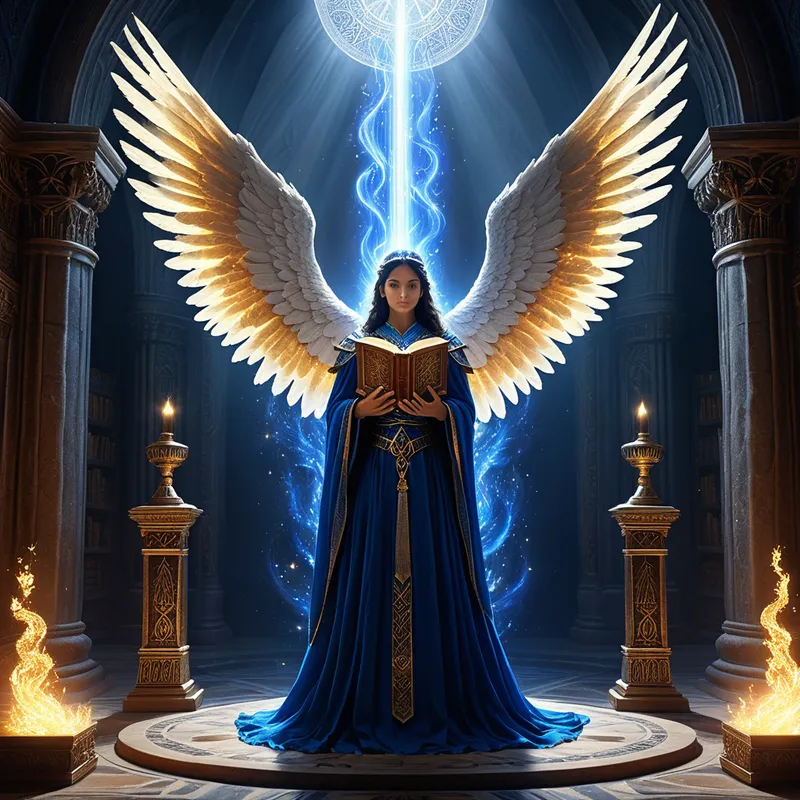
In the first breath of the world, when the light was still raw and the shadows were yet to find their corners, there stood an angel at the edge of the divine presence. His name was Raziel, and he was the keeper of the whispers that built the cosmos. While other angels sang praises, Raziel listened to the silence between the notes, where the blueprint of all things was written.
He held a book. Not a book of parchment and ink, but a living scripture, bound in the blue fire of the firmament. Its letters were not static shapes but moving, breathing sigils of creation—the true names of stars, the grammar of blessing and curse, the maps of the paths between the upper and lower worlds. This was the Sefer Raziel HaMalakh.
And this book, this unbearable weight of knowing, was not meant for the heavens alone.
When Adam sat in the sorrow of his exile from Eden, confused by the vast, terrifying world, a shadow fell across him. It was not the shadow of a tree, but of wings. Raziel descended. The angel did not speak of punishment or regret. He spoke of responsibility. And into Adam’s trembling hands, he placed the book. “Use this,” the angel’s voice was like the sound of a distant river, “to understand your place. To navigate the darkness you have chosen.”
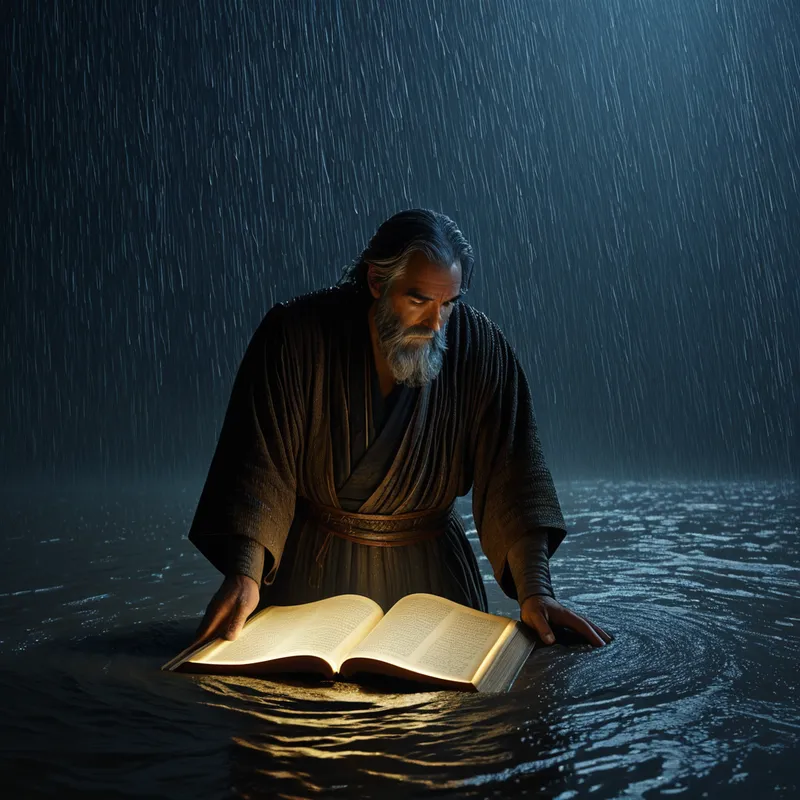
The book became a companion and a burden. Adam learned, and the knowledge was a fire in his mind. But such fire attracts envy. The chayot ha-kodesh, the holy celestial beings, grew furious. What right had this creature of clay to hold the secrets of the throne? In their wrath, they stole the book and cast it into the deep ocean.
The world grew darker for its loss. But the Shekhinah does not abandon its gifts. A monstrous figure, Rahab, the angel of the sea, was commanded. From the abyssal trenches, he retrieved the gleaming book and returned it not to Adam, but to his lineage. It passed to Enoch, who became Metatron. It passed to Noah, who used its diagrams to build the ark that would cradle the world’s remnants.
And so it traveled, down the river of generations—a secret thread of light woven through the tapestry of human suffering and survival. It came to Solomon, who understood the language of the birds and bound demons with its words. The book was always more than pages; it was a covenant of hidden understanding, a testament that the most profound secrets of the universe are entrusted not to those who are perfect, but to those who are striving, who are lost and seek a way through the night.
Cultural Origins & Context
The legend of the Sefer Raziel HaMalakh emerges from the rich soil of Jewish mystical thought, particularly within the tradition of Merkabah and Kabbalah. It is less a single, canonical myth and more a powerful meta-narrative that grew around a family of actual grimoires and mystical texts compiled in the Middle Ages, primarily between the 11th and 13th centuries. These texts, bearing the angel’s name, claimed an ancient, divine provenance to legitimize their profound and often practical contents—angelic names, cosmological diagrams, amulet recipes, and medicinal lore.
The story was passed down not in official scripture, but in the margins, in commentaries, and in oral teachings. It was told by mystics, scribes, and healers. Its societal function was multifaceted: it served as an origin myth for esoteric knowledge, justifying the study of hidden wisdom. It provided a divine anchor for folk magic and protective practices, offering a sense of control in an uncertain world. Most importantly, it established a sacred lineage of transmission (masorah), connecting the contemporary seeker directly back to Adam and the divine source itself, sanctifying the pursuit of knowledge as a holy, if perilous, endeavor.
Symbolic Architecture
At its heart, the myth of the Sefer Raziel is not about a physical book, but about the archetype of Divine Knowledge incarnated as an object. The book symbolizes the structured, communicable aspect of the transcendent—the idea that the infinite can be, however partially, captured in form (letters, diagrams, names).
The book is the vessel that makes the ocean of the unknowable into a river from which one may drink.
Raziel represents the mediating principle between the absolute divine and the human realm. He is the psychopomp of wisdom, the one who translates the ineffable into a language the soul can apprehend. Adam’s reception of the book symbolizes the human condition: we are exiled from instinctual paradise (Gan Eden) and thrust into a world of consciousness, complexity, and moral choice. The book is the tool for that consciousness.
The theft by the angels is a crucial symbolic moment. It represents the inevitable resistance of the psyche (and the cosmos) to integration. The “jealous angels” are those psychic structures or spiritual forces that believe certain knowledge should remain split off, unconscious, or “divine-only.” Their casting of the book into the sea (Tehom) signifies the repression of this profound knowledge into the collective unconscious.
Its retrieval by Rahab and transmission through the generations symbolizes the indestructibility of this deep wisdom. It cannot be lost forever. It will always resurface, often through the help of the very monsters of the deep—our deepest fears, complexes, and shadow elements—that initially seem to threaten it. The lineage from Adam to Enoch to Noah to Solomon maps the evolution of this wisdom through different stages of human consciousness: from primordial man, to the ascended one, to the preserver of life, to the master of the natural and supernatural worlds.
The Dreamer’s Resonance
When this myth activates in the modern psyche, it often manifests in dreams of finding or being given a potent, ancient book, a coded manuscript, or a mysterious digital file. The dreamer may feel a simultaneous awe and dread—a sense that this knowledge will change everything, for better or worse. There may be shadowy figures (the “jealous angels”) trying to take it away, or the book may be hidden in a deep, watery place.
Somatically, this can correlate with a feeling of pressure in the head or chest—the “weight” of knowing. Psychologically, this dream pattern signals a critical threshold in the individuation process. The psyche is offering the ego a piece of its own deep, structural knowledge—perhaps about one’s true purpose, a repressed talent, or a painful but liberating truth about one’s history. The conflict in the dream mirrors the internal resistance: parts of the personality are terrified of this integration, fearing it will disrupt the current, familiar (if dysfunctional) order.
The dream is an invitation to engage in a sacred, responsible retrieval. It asks the dreamer: Are you ready to take custody of your own “book of secrets”? Are you prepared to face the envy of your inner “angels”—your idealized self-images or rigid moral complexes—that want to keep you in manageable ignorance?

Alchemical Translation
The journey of the Sefer Raziel is a perfect allegory for the alchemical process of psychic transmutation, the core of Jungian individuation. The prima materia is the raw, exiled human consciousness (Adam after the Fall). The divine secret (the book) is the latent Self, the wholeness that feels lost.
Individuation begins when the angel of your deepest wisdom places the forbidden text of your own totality into your hands.
The “theft by angels” is the nigredo, the blackening. It is the moment of despair, depression, or confusion when the new consciousness is attacked by the old order (complexes, neuroses, societal expectations) and plunged into the sea of the unconscious. This is a necessary death; the knowledge must be lost to be truly found.
The retrieval by Rahab is the work of shadow integration. One must confront the “monster” of the deep—one’s own rage, shame, or primal fear—and discover that it is not an enemy to be slain, but the very guardian of the treasure. This is the albedo, the whitening, where what was dark becomes illuminating.
Finally, the transmission through the lineage represents the rubedo, the reddening, and the conscious building of the philosophical gold. The integrated knowledge is no longer a personal secret but becomes a living tradition within the individual. It builds your “ark” (a resilient personality structure), guides your kingdom (your managed inner and outer world), and allows you to speak the “language of birds” (intuitive, symbolic communication with the unconscious). The book is no longer an external artifact; you become the living Sefer Raziel, a vessel through which hidden wisdom consciously flows into the world of action. The myth concludes not with an end, but with a sacred charge: to become a link in the chain, responsibly bearing the light you were once given.
Associated Symbols
Explore related symbols from the CaleaDream lexicon: