
Seers and Prophets Myth Meaning & Symbolism
A timeless myth of those who see beyond the veil, wrestling with fate's burden to bring fragmented vision to a world of shadow.
The Tale of Seers and Prophets
Listen. In the time before time was measured, when [the world](/myths/the-world “Myth from Tarot culture.”/) was a tapestry of shadow and half-light, there walked those who saw the threads. They were not born to thrones or forged in battle; they were chosen by a silence so profound it became a voice. The gift—or the curse—came not with fanfare, but with a shudder in the soul, a fissure in the ordinary.
One such was a herder on the high steppes, who one night saw not stars but the silvered paths of destinies crisscrossing the black vault. Another was a weaver in a sun-baked city, whose fingers, tracing thread, suddenly felt the taut lines of lives yet to be lived. And in the deep forests, a solitary soul found that the rustling leaves spoke in the clear tongue of tomorrow’s winds.
Their world was the world of all: solid, demanding, real. Yet superimposed upon it was another—a shimmering, insistent realm of moira, of ørlög, of what-is-yet-to-be. The vision was not a gentle painting. It was a flood. It arrived in fever-dreams that soaked the bedding, in waking trances where [the market](/myths/the-market “Myth from Various culture.”/) square melted into a battlefield, in the haunting certainty that the laughing child before them would drown in a river not yet swollen. They bore the unbearable knowledge of the snake in the garden, the betrayal at the feast, [the fall](/myths/the-fall “Myth from Biblical culture.”/) of [the tower](/myths/the-tower “Myth from Tarot culture.”/).
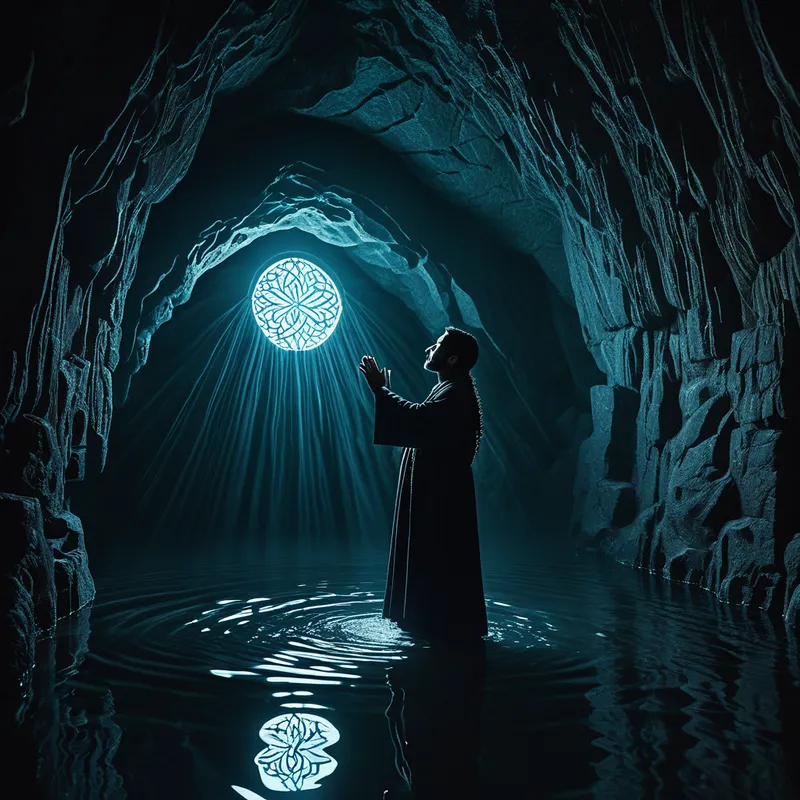
Their tongues grew heavy with unspoken truths. To speak was to risk madness, to be cast out as a harbinger of doom, or worse, to set in motion the very chains they perceived. Some fled to caves, their eyes reflecting only the phantoms in the fire. Others were dragged before kings, their trembling words shaping empires and dooming armies. The conflict was never with monsters of scale and tooth, but with the monstrous weight of sight itself. The rising action was the internal crescendo—the struggle to hold a fragment of the tapestry without unraveling their own mind.
The resolution was never clean victory, but a fraught translation. The true seer learned not to simply see, but to speak—to clothe the raw, formless vision in the flawed, beautiful garments of parable, riddle, and warning. They became the bridge between the realm of pure pattern and the world of human action. Their [triumph](/myths/triumph “Myth from Roman culture.”/) was not in changing the thread, but in helping others walk its length with open eyes. Their end was often a quiet fading, their sight turned inward at last, leaving behind echoes in [oracle bones](/myths/oracle-bones “Myth from Chinese culture.”/), in the lines of epic poetry, and in the cold, clear space in the human heart that suspects there is more.
Cultural Origins & Context
The figure of the seer is a human universal, a psychic artifact found in virtually every culture’s narrative layer. From the mantis of Greece to the spámaðr of the Norse, from the vision-questers of the Plains to the fili of Celtic lands, the archetype emerges independently. This was not formalized priesthood initially, but a terrifying vocation that often chose the outsider, the sensitive, the one touched by what was perceived as the divine or the ancestral.
The myths were passed down not as dry history, but as urgent technology of the soul. They were sung by bards at feasts, whispered by elders at initiations, and enacted in ritual dramas. Their societal function was multifaceted: they were the early-warning system of the collective, the explainers of catastrophe (faming the “will of the gods”), and the anchors of hope, offering glimpses of order in chaos. They mediated the terrifying gap between human limitation and the vast, impersonal forces of the cosmos, making fate somewhat negotiable through prophecy and omen.
Symbolic Architecture
At its core, the myth of the [seer](/symbols/seer “Symbol: A spiritual figure with prophetic or divinatory abilities, often representing access to hidden knowledge, fate, or higher consciousness.”/) symbolizes the awakening of [consciousness](/symbols/consciousness “Symbol: Consciousness represents the state of awareness and perception, encompassing thoughts, feelings, and experiences.”/) itself—specifically, the faculty of foresight. This is not mere prediction, but the psychological [capacity](/symbols/capacity “Symbol: A measure of one’s potential, limits, or ability to contain, process, or achieve something, often reflecting self-assessment or external demands.”/) for self-[reflection](/symbols/reflection “Symbol: Reflection signifies self-examination, awareness, and the search for truth within oneself.”/), consequence-modeling, and the painful [awareness](/symbols/awareness “Symbol: Conscious perception of self, surroundings, or internal states. Often signifies awakening, insight, or heightened sensitivity.”/) of time’s [arrow](/symbols/arrow “Symbol: An arrow often symbolizes direction, purpose, and the pursuit of goals, representing both the journey and the destination.”/).
The seer is the human psyche becoming conscious of its own unfolding pattern.
The “second [sight](/symbols/sight “Symbol: Sight symbolizes perception, awareness, and insight, representing both physical and inner vision.”/)” represents the intrusion of the unconscious into the conscious mind. The swirling, chaotic visions are the raw, unprocessed contents of the [collective unconscious](/symbols/collective-unconscious “Symbol: The Collective Unconscious refers to the part of the unconscious mind shared among beings of the same species, embodying universal experiences and archetypes.”/)—the archetypes and primordial patterns that govern [human](/symbols/human “Symbol: The symbol of a human represents individuality, complexity of emotions, and social relationships.”/) [life](/symbols/life “Symbol: The symbol of ‘Life’ represents a journey of growth, interconnectedness, and existential meaning, encompassing both the joys and challenges that define human experience.”/). The seer’s initial suffering symbolizes [the ego](/myths/the-ego “Myth from Jungian culture.”/)‘s [terror](/symbols/terror “Symbol: An overwhelming, primal fear that paralyzes and signals extreme threat, often linked to survival instincts or deep psychological trauma.”/) when confronted with this vast, impersonal inner [reality](/symbols/reality “Symbol: Reality signifies the state of existence and perception, often reflecting one’s understanding of truth and life experiences.”/). [The cave](/myths/the-cave “Myth from Platonic culture.”/) or solitary place is the necessary [temenos](/myths/temenos “Myth from Greek culture.”/), a sacred retreat where this overwhelming content can be contained and slowly integrated.
The burden of [prophecy](/symbols/prophecy “Symbol: A foretelling of future events, often through divine or supernatural means, representing destiny, fate, and hidden knowledge.”/) is the burden of consciousness. To know a potential future is to bear [responsibility](/symbols/responsibility “Symbol: Responsibility in dreams often signifies the weight of duties and the expectations placed upon the dreamer.”/) for that [knowledge](/symbols/knowledge “Symbol: Knowledge symbolizes learning, understanding, and wisdom, embodying the acquisition of information and enlightenment.”/). The myth dramatizes the fundamental human dilemma between free will and determinism, playing it out on the stage of a single, sensitive [psyche](/myths/psyche “Myth from Greek culture.”/). The ultimate “[translation](/symbols/translation “Symbol: The process of converting meaning from one form or language to another, representing communication, adaptation, and the bridging of differences.”/)” of [vision](/symbols/vision “Symbol: Vision reflects perception, insight, and clarity — often signifying the ability to foresee or understand deeper truths.”/) into [riddle](/symbols/riddle “Symbol: A puzzle or enigmatic statement requiring cleverness to solve, symbolizing hidden truths, intellectual challenge, and the search for meaning.”/) represents the essential psychic act of taking raw, instinctual or intuitive [knowledge](/symbols/knowledge “Symbol: Knowledge symbolizes learning, understanding, and wisdom, embodying the acquisition of information and enlightenment.”/) and shaping it into a form that the conscious [personality](/symbols/personality “Symbol: Personality in dreams often symbolizes the traits and characteristics of the dreamer, reflecting how they perceive themselves and how they believe they are perceived by others.”/) and the [community](/symbols/community “Symbol: Community in dreams symbolizes connection, support, and the need for belonging.”/) can assimilate without being destroyed by it.
The Dreamer’s Resonance
When this myth pattern activates in the modern dreamer, it seldom appears as a figure in robes on a mountain. It manifests somatically as dreams of overwhelming clarity or terrifying responsibility. To dream of knowing a secret that will cause catastrophe if spoken, of seeing the true nature of people as symbolic animals or fading ghosts, or of being forced to read from a book of fate in a language that burns—these are encounters with the Seer archetype.
Psychologically, this marks a critical threshold in the individuation process. The dreamer is being confronted with insights about their own life pattern—the likely outcome of a relationship, career, or habit if left unchanged. The “burden” is the dawning awareness of one’s own [karma](/myths/karma “Myth from Hindu culture.”/) or complexes. The anxiety is the ego’s resistance to this larger perspective. The process at work is the differentiation of intuition from the other psychic functions, a painful but necessary expansion of awareness that feels less like a gift and more like a curse until it is integrated.
Alchemical Translation
The alchemical journey mirrored in this myth is the [solutio](/myths/solutio “Myth from Alchemical culture.”/) and coagulatio of insight—the dissolution of naive consciousness followed by the coagulation of wise consciousness. The modern individual undergoes this when a life transition, crisis, or deep analysis forces a “seeing” of the underlying patterns of their existence.
The first operation is the drowning in the pool of vision: the devastating insight that shatters one’s former worldview. The second is the slow, patient work of distilling that chaotic flood into a single drop of wisdom one can actually use.
The initial stage is the “descent into the cave”—depression, isolation, or a period of intense introversion where the unconscious dominates. This is the [nigredo](/myths/nigredo “Myth from Alchemical culture.”/), the blackening. The struggle to speak the vision is the albedo, the whitening, where one attempts to clarify and articulate the new knowledge, often failing repeatedly. The final translation into a helpful form—a creative act, a changed life direction, a piece of hard-won advice for another—is the [rubedo](/myths/rubedo “Myth from Alchemical culture.”/), the reddening, or gold-making.
The individuation lesson is stark: consciousness is a burden, but it is the only burden that sets us free. We are all, in our own way, asked to read the obscured text of our own fate. The myth of the seer teaches that the goal is not to have a perfect map of the future, but to develop the eyes to see the next step, and the courage to speak the truth of what is revealed, first to oneself, and then, if called, to the world. We integrate the Seer not by becoming infallible prophets, but by learning to tolerate ambiguity, to hold multiple potentials in mind, and to act with integrity in the face of the unknown we have glimpsed.
Associated Symbols
Explore related symbols from the CaleaDream lexicon: