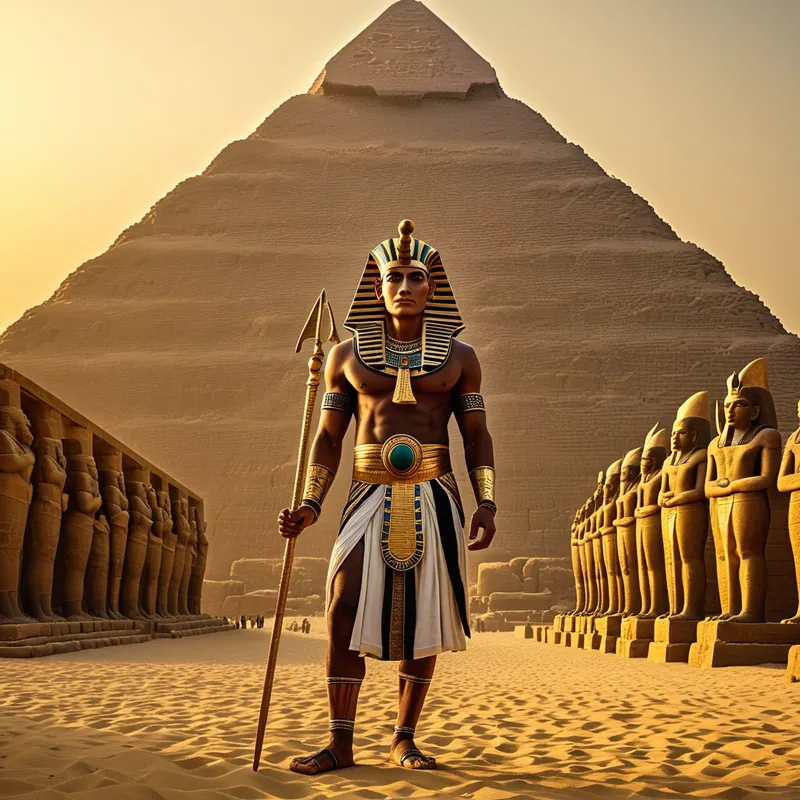
Sed Festival Myth Meaning & Symbolism
The Pharaoh's ritual death and rebirth to renew his divine power, the land's fertility, and the cosmic order itself.
The Tale of the Sed Festival
The sands whisper of a time when the king grows old. Not in body alone, but in his sacred bond with the Two Lands. The Nile’s flood grows timid, the harvest thin. A subtle chill enters the sun’s gaze. The people feel it first—a quiet dread that the world itself is winding down. The order of Maat frays at the edges.
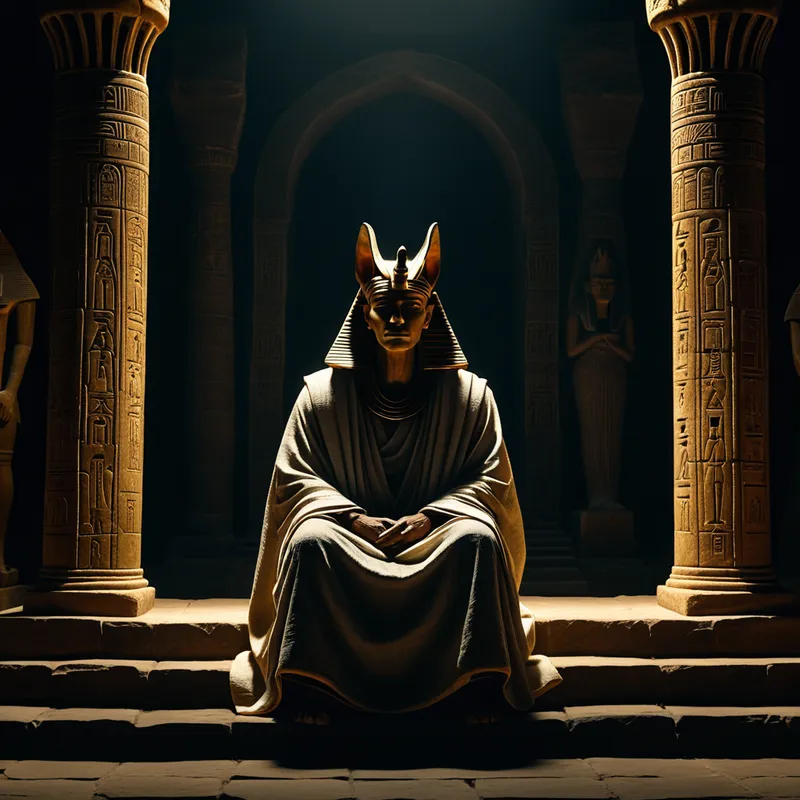
So the word goes forth from the white walls of Ineb-hedj. The Heb-Sed is called. The land holds its breath. The old king enters the House of the Night, a place of shadows and whispers. He is stripped of his regalia, his crowns, his very name. He dons a simple kilt, the garment of a dead man. For three days, he is no longer Pharaoh. He is a soul awaiting judgment in the silent halls of Osiris.
On the fourth day, in the deep blue before dawn, he is led to a sacred lake. The waters are black as obsidian. He descends. The cold is the touch of Nun, the primordial waters. He submerges, and in that drowning, the weary years of his reign are washed away. He emerges, gasping, into a new darkness—not of death, but of the womb.
Then, to the running ground. A vast courtyard marked with boundary stones for the nomes of Egypt. The king, still in his mortuary cloth, stands at one end. At the other, two thrones sit empty beneath pavilions—one for the South, one for the North. The drums begin, a heartbeat pulled from the earth. He runs. He runs not as a young man, but as a soul proving its vitality to the gods. He runs the circuit of his kingdom in symbol, and with each lap, a piece of his divine essence is nailed back into the fabric of the world. He collapses before the thrones, his chest heaving, the desert air burning his lungs.
From the crowd steps the High Priest of Horus. In his hands are the twin crowns: the White Hedjet of the South and the Red Deshret of the North. He lifts them high, chanting the old words. As the first sliver of sun cuts the horizon, he places them, one after the other, upon the king’s brow. The weight is immense. It is the weight of the sky.
The king rises. He is given the crook and the flail, the symbols of care and authority. He is draped in the ceremonial bull’s tail. He turns to face his people. He is no longer the old man who entered the House of the Night. He is the Living Horus, the Strong Bull, beloved of Hathor, the Son of Ra. The land exhales. The Nile, in its distant bed, seems to stir. The festival has begun. The king is renewed. The world is made whole again.
Cultural Origins & Context
The Heb-Sed was not merely a myth but a living, breathing institution of Egyptian kingship, traceable to the very dawn of the dynastic period. Its depictions adorn the walls of tombs and temples, from the Step Pyramid complex of Djoser at Saqqara to the vast monuments of Ramesses II. It functioned as the ultimate state ritual, a cosmic reset button pressed when the Pharaoh’s divine potency—his ka—was perceived to wane, typically after 30 years of rule, though it could be held earlier or repeated.
This was the story told not by bards around a fire, but by the state itself, carved in stone for gods and ancestors to witness. Its primary tellers were the priesthood and the royal artisans who encoded its sequences into the very architecture of power. Its societal function was paramount: it was a drama of national survival. By ritually killing and resurrecting the king—the linchpin between the divine and human realms—the fertility of the land, the flow of the Nile, and the stability of Maat were guaranteed. It transformed the inevitable aging and weakening of a mortal man into a source of renewed cosmic strength.
Symbolic Architecture
At its heart, the Sed Festival is a masterclass in the symbolism of sacred kingship and cyclical time. The king is not a hero who conquers external monsters, but the axis mundi itself who must undergo a deliberate dismantling to prevent the world from decaying.
The true ruler must first become the orphan, the supplicant, and the corpse, to remember that sovereignty is a loan from the cosmos, not a possession of the self.
The ritual stripping and mock death represent the necessary dissolution of the persona—the identified role of “Pharaoh”—to touch the naked, vulnerable core of being. The run is not a test of athleticism, but a symbolic re-conquest and re-animation of the kingdom’s spiritual territory. Each boundary stone he rounds is a psychic complex reclaimed, a fragment of his fragmented authority made whole. The dual crowns and thrones embody the ultimate psychic task of integration: the unification of opposites (Upper and Lower Egypt, spirit and matter, conscious and unconscious) within a single, renewed consciousness.
The festival’s deeper psychological truth is that identity, especially one as total as kingship, can become a prison. Renewal requires a voluntary death of the old self.
The Dreamer’s Resonance
When this myth stirs in the modern unconscious, it rarely appears with Egyptian iconography. Instead, one dreams of being stripped of professional titles at a critical meeting, of running a crucial race in slow motion, or of standing naked before a council of shadowy figures who hold one’s “crown.” The somatic feeling is one of profound exposure and terrifying evaluation.
This dream pattern signals a profound psychological process: the ego’s tenure has expired. The dreamer has been operating from an outdated “reign”—a set of identities, strategies, or sources of authority that have lost their vital connection to the inner wellspring. The psyche is initiating its own Heb-Sed. The feeling of being judged is the Self assessing the alignment between the conscious personality and the deeper, archetypal mandate. The dream-run is the exhausting, often frustrating, work of re-engaging with neglected aspects of one’s own life and psyche to reclaim a sense of authentic power.
Alchemical Translation
The alchemical journey of the Sed Festival is a map for the modern individuation process, specifically the stage of mortificatio and renovatio—death and renewal. We are all, in a sense, rulers of our own psychic kingdoms. And every kingdom grows stale, its laws rigid, its monarch weary.
The first, crucial step is the voluntary descent into the “House of the Night”—a conscious engagement with one’s shadow, limitations, and mortality. This is the mortificatio: allowing the inflated self-image (the “crown”) to be dismantled. In life, this may look like a crisis of meaning, burnout, or the painful end of a long-held role.
The alchemical gold is not found in perpetual light, but forged in the acknowledgment of one’s own night.
The subsequent “run” is the active, often arduous work of reintegration. It is surveying the borders of one’s soul, visiting the neglected “nomes” of creativity, relationship, body, and spirit, and reclaiming sovereignty over them. It is a commitment to wholeness over a comfortable, partial identity.
Finally, the re-coronation is not a return to the old kingship, but an assumption of a new, more conscious form of authority. The renewed individual does not simply get their old title back; they are invested with a legitimacy that now comes from having faced the void and returned. They rule not from ego, but from a re-established connection to the transpersonal Self—the inner Ra. The festival teaches that our power must be periodically returned to the source to be cleansed and re-energized, lest it become a hollow scepter, ruling over a dying land.
Associated Symbols
Explore related symbols from the CaleaDream lexicon: