
Scrying Mirror Myth Meaning & Symbolism
A myth of a magical mirror that reveals not the surface, but the soul's hidden truth, demanding a confrontation with one's deepest self.
The Tale of Scrying Mirror
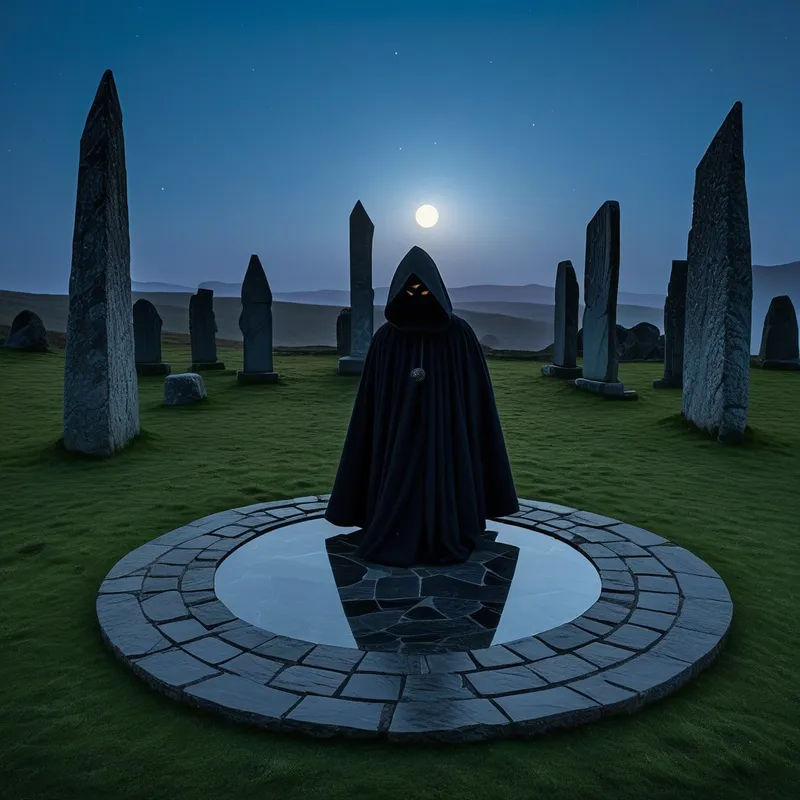
In the time before maps, when [the world](/myths/the-world “Myth from Tarot culture.”/) was woven from whispers and the roots of the oldest trees drank from the well of memory, there existed a glade where light fell differently. It was a place [the wind](/myths/the-wind “Myth from Various culture.”/) avoided, a silent circle where [ferns](/myths/ferns “Myth from Celtic culture.”/) grew in perfect spirals and the air tasted of cold stone and ozone. At its heart, upon an altar of moss-draped granite, rested The Scrying Mirror.
It was not a mirror of silver or glass, but a disc of pure, polished obsidian, darker than a moonless midnight. It did not reflect [the sky](/myths/the-sky “Myth from Persian culture.”/), or the trees, or the face of any who dared approach. It reflected otherness. It showed not what was, but what could be, and more terrifyingly, what already was, hidden beneath the skin of the world and the soul.
The tale tells of a seeker named Elara, who had walked from the bustling villages of men, driven by a hollow echo in her chest. She had heard the old wives’ tales of [the mirror](/myths/the-mirror “Myth from Various culture.”/) that showed truth, and she sought an answer to a question she could not name. When she parted the final curtain of ivy and entered the glade, the silence was a physical weight. The mirror awaited, a pool of captured void.
Kneeling on the damp earth, her breath pluming in the chill, Elara looked. At first, there was only darkness. Then, a swirl, like ink in [water](/myths/water “Myth from Chinese culture.”/). The surface cleared, and she did not see her own weary face. She saw a radiant being of light, crowned with stars, its eyes full of terrible compassion. She gasped at its beauty—was this her soul? But as she leaned closer, enthralled, the image rippled. The light dimmed, and from within the same form emerged a twisted, shadowy figure, its eyes hollow, its mouth a silent scream of rage and grief. The two beings—the luminous and the shadowed—were not separate. They were one, locked in an eternal embrace within the frame of the mirror.
Elara cried out and stumbled back, wanting to flee. This was not the simple truth she sought. This was a confrontation. The glade seemed to press in, the mirror holding her gaze. A voice, neither male nor female, but sounding like the grinding of tectonic plates and the sigh of leaves, emanated from the stone itself: “To know the light, you must greet [the shadow](/myths/the-shadow “Myth from Jungian culture.”/). To own [the crown](/myths/the-crown “Myth from Various culture.”/), you must know the chain. The surface lies. The depth reveals.”
Trembling, Elara forced herself to look again. She did not turn from the shadow, nor cling only to the light. She let her tears fall, and as they did, the two images in the mirror began to soften. The rigid boundaries blurred. The light infused the shadow with warmth; the shadow gave the light depth and form. They did not vanish, but merged into a single, complex, and profoundly human visage—her own, yet more. It was a face containing all her potential for love and cruelty, wisdom and folly, courage and fear. In that moment, she did not see the truth. She became it. The mirror’s surface stilled, becoming a simple, dark pool once more. But Elara was forever changed. She left the glade not with an answer, but with a question she could finally bear: the lifelong task of holding both the crown and the chain within herself.
Cultural Origins & Context
The myth of the Scrying Mirror is a quintessential piece of oral folklore, unattached to any single nation but found in variations across countless hearth-tales and traveler’s warnings. It belongs to the “once-upon-a-time” canon, a story told by grandmothers at twilight, by guides at crossroads, and by mystics in hushed tones. Its primary function was not entertainment, but initiation and caution.
It served as a psychic map for rites of passage. Told to adolescents, it prepared them for the inner tumult of self-discovery. Recounted to those seeking wisdom or power—the aspiring leader, the lovelorn, the artist—it was a parable warning that true power comes only after a harrowing self-reckoning. The mirror was often a narrative device to explain profound personal change or madness in local legends; the hero who returned “touched” or wise from [the wilderness](/myths/the-wilderness “Myth from Biblical culture.”/) had often “gazed into the black glass.”
The story was a communal container for the universal human experience of confronting the disowned parts of [the self](/myths/the-self “Myth from Jungian culture.”/). It democratized the mystical experience, placing the ultimate tool of revelation not in a temple with priests, but in a wild glade, accessible to any who had the courage to seek it. It affirmed that the most important journey was not outward to slay dragons, but inward to befriend one’s own darkness.
Symbolic Architecture
The myth’s power lies in its stark, elegant [symbolism](/symbols/symbolism “Symbol: The use of symbols to represent ideas or qualities, often conveying deeper meanings beyond literal interpretation. In dreams, it’s the language of the unconscious.”/). The Scrying Mirror is the [archetype](/symbols/archetype “Symbol: A universal, primordial pattern or prototype in the collective unconscious that shapes human experience, behavior, and creative expression.”/) of the Self, the total, integrated [psyche](/myths/psyche “Myth from Greek culture.”/). It is not a normal mirror, the [Persona](/symbols/persona “Symbol: The social mask or outward identity one presents to the world, often concealing the true self.”/), which shows only the acceptable, curated [image](/symbols/image “Symbol: An image represents perception, memories, and the visual narratives we create in our minds.”/). This mirror reflects the totality—the Supernal Light (the latent genius, [the divine spark](/myths/the-divine-spark “Myth from Gnostic culture.”/)) and the Personal [Shadow](/symbols/shadow “Symbol: The ‘shadow’ embodies the unconscious, repressed aspects of the self and often represents fears or hidden emotions.”/) (the [shame](/symbols/shame “Symbol: A painful emotion arising from perceived failure or violation of social norms, often involving exposure of vulnerability or wrongdoing.”/), rage, and [primal instincts](/symbols/primal-instincts “Symbol: Primal Instincts represent the basic drives and survival mechanisms inherent in every individual, harkening back to our animalistic nature.”/)).
The mirror does not judge; it presents. Integration is not the annihilation of the shadow, but the conscious marriage of opposites within the vessel of the individual.
Elara’s [journey](/symbols/journey “Symbol: A journey in dreams typically signifies adventure, growth, or a significant life transition.”/) is [the ego](/myths/the-ego “Myth from Jungian culture.”/)‘s journey toward [consciousness](/symbols/consciousness “Symbol: Consciousness represents the state of awareness and perception, encompassing thoughts, feelings, and experiences.”/). Her initial hollow feeling is the call of the Self, a psychic [imbalance](/symbols/imbalance “Symbol: A state of disharmony where opposing forces are unequal, often representing internal conflict or external instability.”/) demanding [attention](/symbols/attention “Symbol: Attention in dreams signifies focus, awareness, and the priorities in one’s life, often indicating where the dreamer’s energy is invested.”/). The glade represents [the threshold](/myths/the-threshold “Myth from Folklore culture.”/) of the unconscious, a liminal [space](/symbols/space “Symbol: Dreaming of ‘Space’ often symbolizes the vastness of potential, personal freedom, or feelings of isolation and exploration in one’s life.”/) outside ordinary [life](/symbols/life “Symbol: The symbol of ‘Life’ represents a journey of growth, interconnectedness, and existential meaning, encompassing both the joys and challenges that define human experience.”/). Her seeing first the radiant being is the [soul](/symbols/soul “Symbol: The soul represents the essence of a person, encompassing their spirit, identity, and connection to the universe.”/)‘s temptation by [inflation](/symbols/inflation “Symbol: A dream symbol representing feelings of diminishing value, loss of control, or expansion beyond sustainable limits in one’s life or psyche.”/)—“I am all light, all goodness.” The subsequent [emergence](/symbols/emergence “Symbol: A process of coming into being, rising from obscurity, or breaking through a barrier, often representing birth, transformation, or revelation.”/) of the shadow is the necessary correction, the devastating [deflation](/symbols/deflation “Symbol: A symbolic loss of energy, value, or purpose; often represents a draining of vitality or a collapse of expectations.”/) that prevents spiritual bypass. The final, merged image is the [symbol](/symbols/symbol “Symbol: A symbol can represent an idea, concept, or belief, serving as a powerful tool for communication and understanding.”/) of the Individuated Self, where conflict is transcended into creative [tension](/symbols/tension “Symbol: A state of mental or emotional strain, often manifesting physically as tightness, pressure, or unease, signaling unresolved conflict or anticipation.”/).

The Dreamer’s Resonance
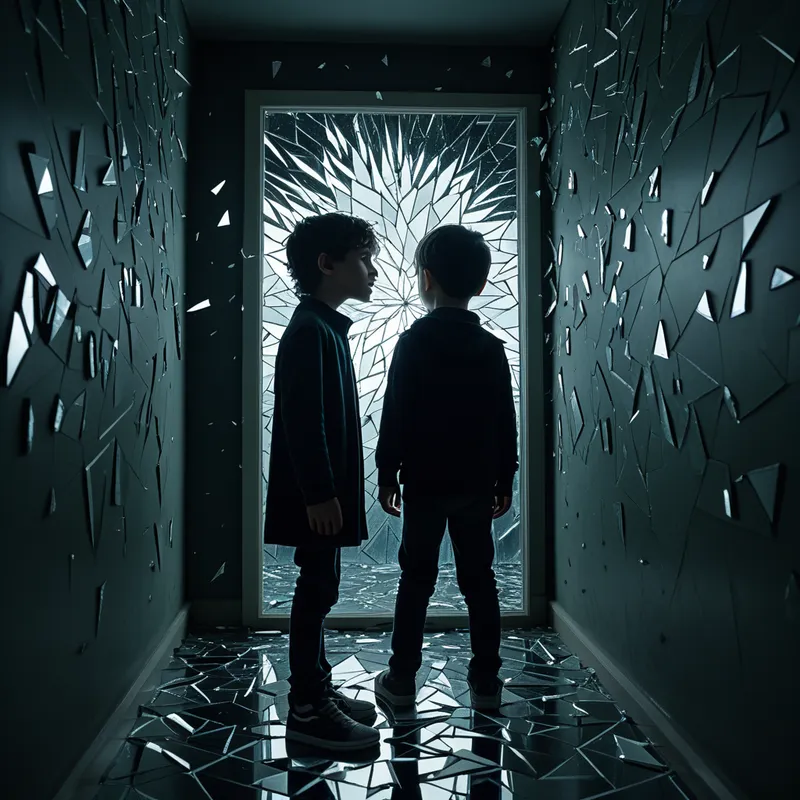
When this myth activates in the modern psyche, it often manifests in dreams of mirrors. To dream of a mirror that shows a different, older, younger, or monstrous reflection is a direct expression of the Scrying Mirror archetype breaking into consciousness. The dream-ego is being confronted with an aspect of itself it has refused to acknowledge.
The somatic experience is one of visceral shock, awe, and often dread—a cold sweat upon waking. Psychologically, this dream marks a critical point in what Jung called the “[nigredo](/myths/nigredo “Myth from Alchemical culture.”/),” the blackening, the initial stage of confronting the shadow. The dreamer is undergoing a process of disillusionment. The comfortable self-image is cracking. This is not a pathological event, but a sacred, if terrifying, moment of growth. The psyche is forcing a dialogue between the ego and what it has excluded, demanding that the dreamer, like Elara, “greet the shadow” to reclaim their full energy and authenticity.
Alchemical Translation
The myth is a perfect allegory for the alchemical Opus. The seeker (the base matter/ego) enters the sealed vessel (the isolated glade). The Scrying Mirror acts as the alchemical fire (Calcination), which burns away the illusion of the [persona](/myths/persona “Myth from Greek culture.”/). The confrontation with the split image represents [Separatio](/myths/separatio “Myth from Alchemical culture.”/).
The triumph is not in finding a single, simple truth, but in developing the capacity to hold the multiplicity of one’s being without shattering.
The final, merged image is the Coniunctio Oppositorum—[the sacred marriage](/myths/the-sacred-marriage “Myth from Various culture.”/) that produces the “filius philosophorum,” the philosophical child, which is the integrated personality. For the modern individual, this translates to the ongoing work of Individuation. It is the move from “either/or” thinking (I am either good or bad, strong or weak) to “both/and” consciousness (I contain the capacity for all these things, and my wholeness depends on acknowledging them). The myth teaches that enlightenment is not a state of pure light, but the ability to see clearly in the dark, to navigate the full spectrum of one’s humanity. The mirror, once faced, becomes an internal compass, reflecting not a static answer, but the dynamic, ever-unfolding process of becoming whole.
Associated Symbols
Explore related symbols from the CaleaDream lexicon: