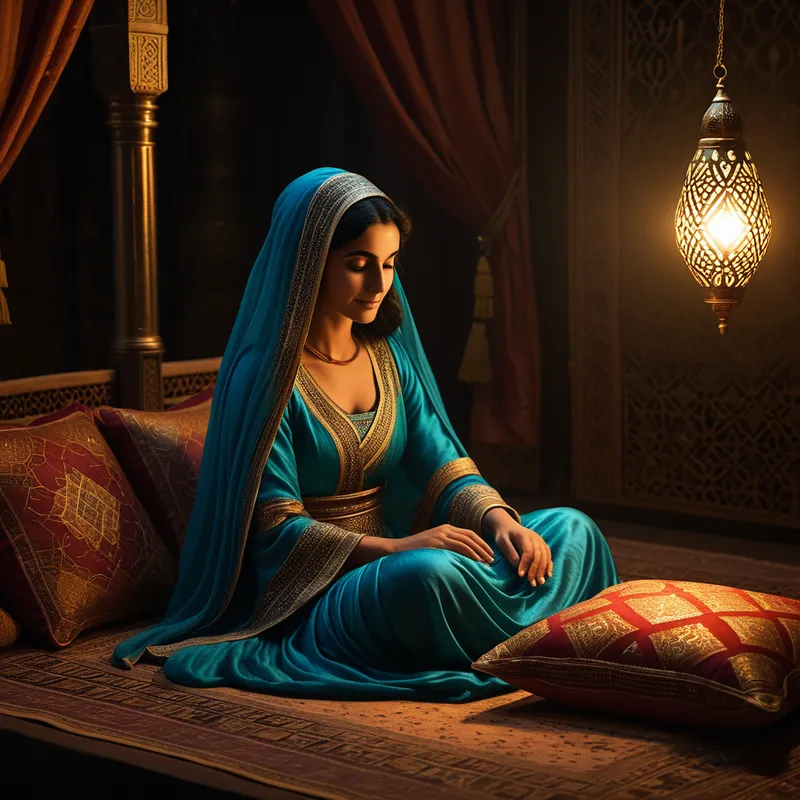
Scheherazade from One Thousand Myth Meaning & Symbolism
A queen saves her life and heals a king's wounded soul by telling a thousand and one stories, weaving a tapestry of narrative to stop a cycle of violence.
The Tale of Scheherazade from One Thousand
Hear now the tale spun in the deep night, a tale to hold back the dawn.
In a kingdom shadowed by a king’s broken heart, a terrible rhythm held sway. Shahryar, once a just ruler, had been shattered by betrayal. In his rage and grief, he enacted a dreadful law: each night he would wed a new virgin of the realm, and with the coming of dawn, she would be put to death. The land was steeped in a mourning silence, its daughters vanishing one by one into the palace of doom, until the very wells seemed to weep.
Into this silence stepped Scheherazade, the vizier’s eldest daughter, a woman whose mind was a library of the world’s wisdom, whose soul was a loom for fate itself. She looked upon her father’s despair and the kingdom’s terror, and she devised a plan of breathtaking audacity. “Give me to him,” she told her fearful father. “I may be the means to deliver the people.”
Against all hope, she entered the bridal chamber not as a lamb to slaughter, but as a sower preparing a field. That first night, as the dread of morning hung in the air, she asked the king if she might bid farewell to her beloved sister, Dunyazad, who waited by the bed. The sister, as prearranged, asked for a story to pass the last hours. And so, as the oil lamps guttered, Scheherazade began. She spoke of genies in brass jars and thieves in caverns, of cunning merchants and lovesick princes. Her voice was a river, her plot a labyrinth. She wove the tale with such skill, such tantalizing hooks, that when the first grey light touched the window, she paused at the most thrilling moment.
The king, who had listened in spite of himself, stirred from the spell. He had to know what happened next. And so, against his own dark decree, he allowed her to live one more day, to finish the tale the next night. But the next night, as she concluded one story, she immediately began another, even more captivating, and again broke off at dawn’s first light. A second reprieve was granted.
Thus began the great weaving. Night after night, for one thousand and one nights, Scheherazade spun her narratives. Stories nested within stories, tales of morality and magic, comedy and tragedy, love and loss. The palace, once a tomb, became a theater of the imagination. The king’s heart, hardened by a single story of betrayal, was slowly, imperceptibly, softened by a thousand others. He was reminded of complexity, of mercy, of hope, and of the sheer, irreducible wonder of life. The stories became the antidote to his poison.
On the one thousand and first night, Scheherazade fell silent. She had no more tales. She presented to the king the three sons she had borne him during those years of storytelling and offered her life. But the king’s transformation was complete. He wept, embraced her, and proclaimed her his true queen and the savior of his soul. The cycle of death was broken, not by sword or decree, but by the irresistible, life-giving power of the story itself.
Cultural Origins & Context
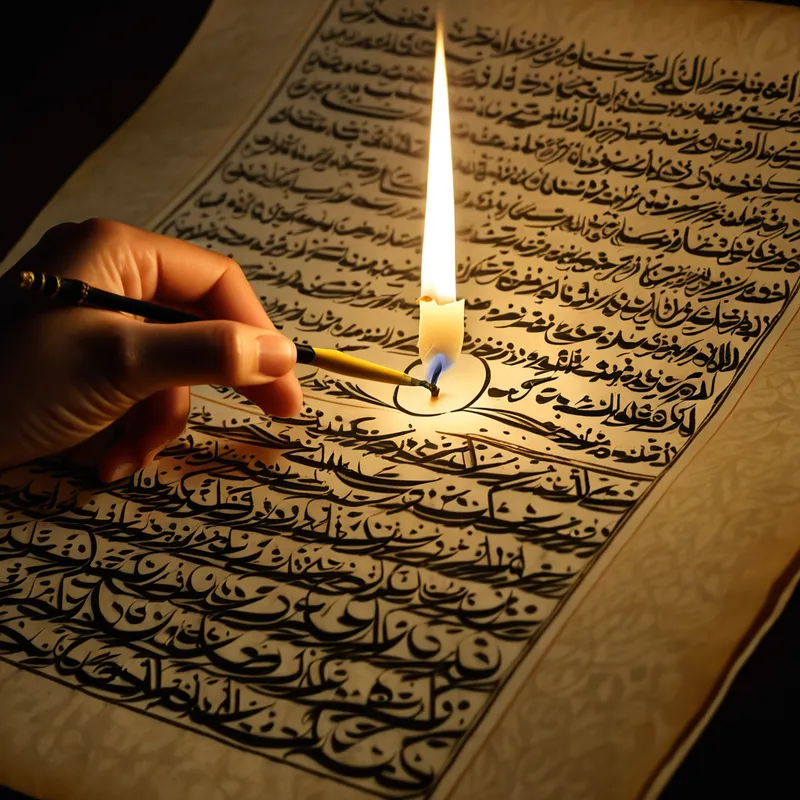
The frame narrative of One Thousand and One Nights is a literary mosaic. Its deepest roots are in ancient Persian and Indian folklore, collected into a Persian work called Hazar Afsan (A Thousand Tales). This core was translated into Arabic in the 8th century during the Abbasid Golden Age, a period of immense cultural synthesis in Baghdad. Here, the frame of the vengeful king and the clever storyteller was firmly established and enriched with layers of stories from across the Islamic world, from Egypt to Syria.
It was never a fixed, canonical text, but a living, oral tradition—a storyteller’s toolkit. Professional hakawatis (storytellers) in coffee houses and public squares would use Scheherazade’s frame to hold audiences night after night, adapting and inserting tales relevant to their time and place. Its societal function was multifaceted: it was entertainment, moral instruction, a repository of cultural wisdom, and a profound meditation on the nature of power, justice, and feminine intelligence in a patriarchal world. It presented a model where erudition, psychological insight, and eloquence—traits embodied by Scheherazade—could triumph over brute force and trauma.
Symbolic Architecture
At its core, the myth is a grand allegory for the psyche’s healing through narrative. Shahryar represents the traumatized masculine principle—the ruling consciousness wounded by betrayal (the anima/ feminine, in Jungian terms), which then turns destructive, severing new connections (killing the brides) to avoid future pain. He is stuck in a literal and psychic night, a state of repetitive, unconscious vengeance.
Scheherazade is the archetypal Mercurius of the soul—the connective intelligence that dares to engage the tyrant with curiosity instead of fear.
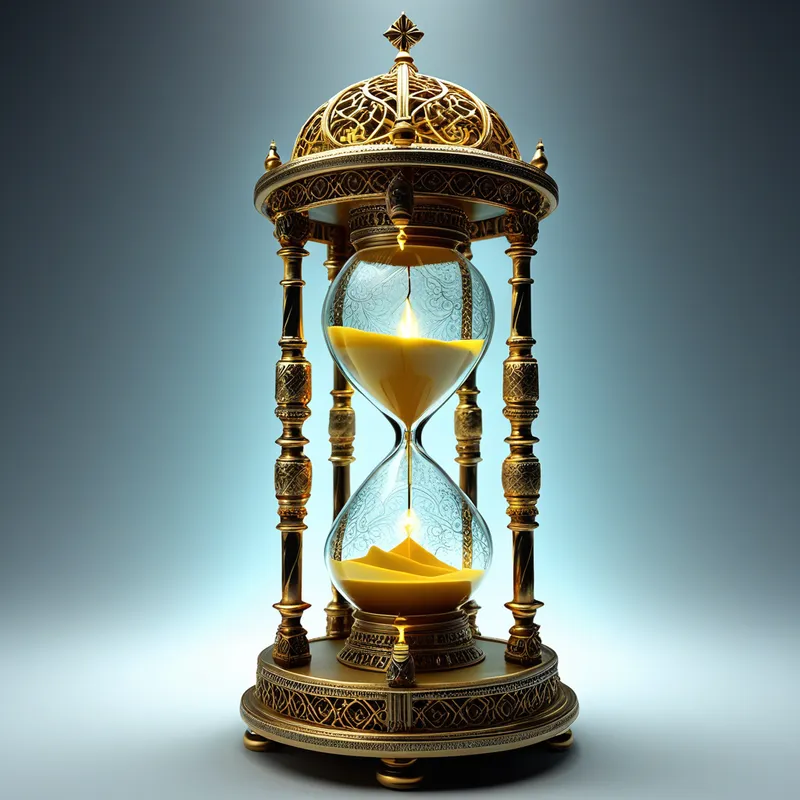
She symbolizes the synthesizing, healing function of the transcendent function. Her stories are not mere distractions; they are carefully chosen psychic nourishment. Each tale is a complex mirror held up to the king, allowing him to experience emotions—wonder, suspense, pity, laughter—safely, at a remove. The one thousand and one nights symbolize the necessary, protracted duration of deep psychological work. Healing is not an event, but a process built night by night, story by story.
The cliffhanger at dawn is the crucial mechanism. It represents the suspension of the destructive impulse by activating Eros (the connective principle) and curiosity. It leaves the conscious mind (the king) in a state of wanting, of unfinished business, which creates a space for growth and anticipation rather than termination.
The Dreamer’s Resonance
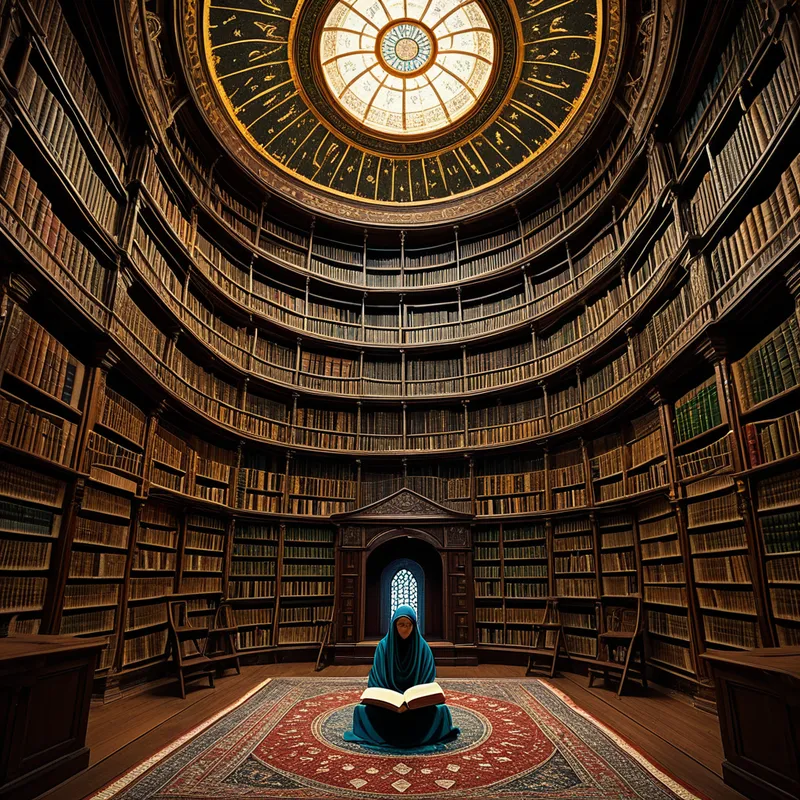
To dream in the pattern of Scheherazade is to be in a state of creative, narrative survival. The dreamer may find themselves in a labyrinthine space (a endless palace, an infinite library), tasked with keeping a dangerous or asleep presence engaged through performance, puzzle-solving, or storytelling. The somatic feeling is one of exquisite, focused tension—a racing heart paired with a clear mind.
Psychologically, this dream signals a process where the ego is using the fabric of the personal and collective unconscious (the stories) to negotiate with a dominant, potentially destructive complex—often the Inner Tyrant or a core wound of betrayal. The dreamer is discovering that their consciousness can be sustained and transformed not by fighting the darkness directly, but by feeding it with the intricate, symbolic language of the psyche itself. It is the dream of the nascent therapist, artist, or diplomat within, learning to heal through engagement.
Alchemical Translation
The alchemical operation here is solutio (dissolution) and coagulatio (coagulation), mediated by narrative. The king’s rigid, petrified heart (fixatio in a negative state) is dissolved not by force, but by the fluid, mercurial stream of stories. His traumatic, monolithic identity is broken down into a multitude of characters and fates. Scheherazade, as the alchemist, does this from within the vessel of the shared night, the temenos or sacred space of the bedchamber.
The ultimate goal is the conjunctio oppositorum: the marriage of the wounded king (consciousness) and the wise storyteller (the guiding unconscious/ anima).
This models the individuation process perfectly. We all have inner Shahryars—cynical, wounded, repetitive patterns that seek to kill new possibilities (new brides) before they can hurt us. The Scheherazade within is our capacity for reflective consciousness, for finding and telling the stories that make sense of our pain without being consumed by it. It is the part that says, “Wait, there is more to this. Let me tell you a story about a similar wound…” It is the practice of journaling, therapy, art, or any discipline where we metabolize our raw experience into meaningful narrative.
The birth of the three sons signifies the new, life-bearing psychic structures that emerge from this sustained union—the tangible fruits of a healed self, capable of legacy and love. The myth teaches that we save our own lives by becoming the diligent, courageous storytellers of our own souls, one night, one chapter, at a time.
Associated Symbols
Explore related symbols from the CaleaDream lexicon: