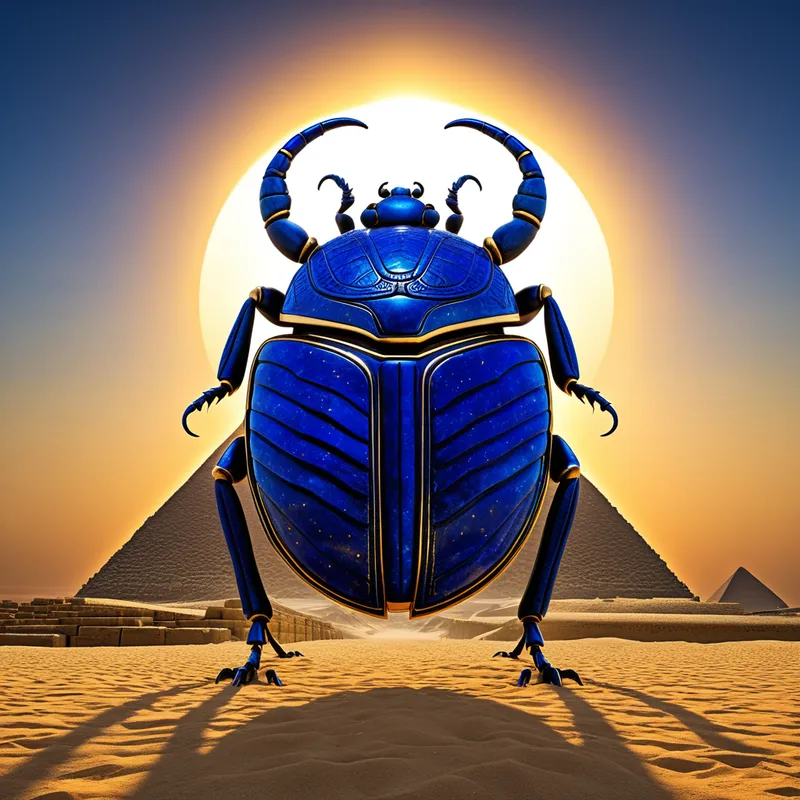
Scarab Beetle Myth Meaning & Symbolism
The dung beetle, rolling the sun across the sky, embodies the eternal cycle of death and rebirth, transforming waste into life through sheer, sacred will.
The Tale of the Scarab Beetle
Before the first word was spoken, in the silent, velvet dark that cradled [the world](/myths/the-world “Myth from Tarot culture.”/), there was only the Nun—the primordial, endless waters of chaos. From its depths, a will stirred. Not a hand, not a voice, but a pure, undifferentiated urge toward being. And in that urge, the first thought took form: a sphere, perfect and self-contained.
This thought was [Khepri](/myths/khepri “Myth from Egyptian culture.”/). He did not walk or fly into existence; he rolled himself into being. With relentless, patient force, he pushed the sphere of his own becoming from the mud of Nun, from the formless waste of potential. He was the beetle in [the earth](/myths/the-earth “Myth from Hindu culture.”/), finding sustenance not in what was given, but in what he could shape with his own limbs. He rolled his ball of matter and spirit, of darkness and latent light, up from [the abyss](/myths/the-abyss “Myth from Kabbalistic culture.”/).
The climb was immense. The weight of creation pressed upon his back. Yet, with each laborious push, the sphere grew warmer, brighter. The inert matter within it began to [ferment](/myths/ferment “Myth from Alchemical culture.”/), to quicken. The chaos was being ordered by sheer, persistent motion. He pushed through the resistance of non-being, up the invisible slope from [the underworld](/myths/the-underworld “Myth from Greek culture.”/), toward the eastern horizon.
As the crest neared, the sphere could no longer contain its own energy. It cracked, not with a sound of destruction, but with the silent, shattering birth of light. From within the shell of dung and clay, the sun—Ra—burst forth, blinding and glorious. Khepri, the humble beetle who had been [the vessel](/myths/the-vessel “Myth from Alchemical culture.”/) and the laborer, was now the father of the day. He had not carried the sun; he had become the act of its rising. His ceaseless rolling was the engine of dawn, and as the golden light spilled over the land, painting the Nile in fire and waking the world, he was there, not as a king upon a throne, but as the enduring, cyclical force beneath all thrones: the will to begin again, born from the refuse of yesterday.
Cultural Origins & Context
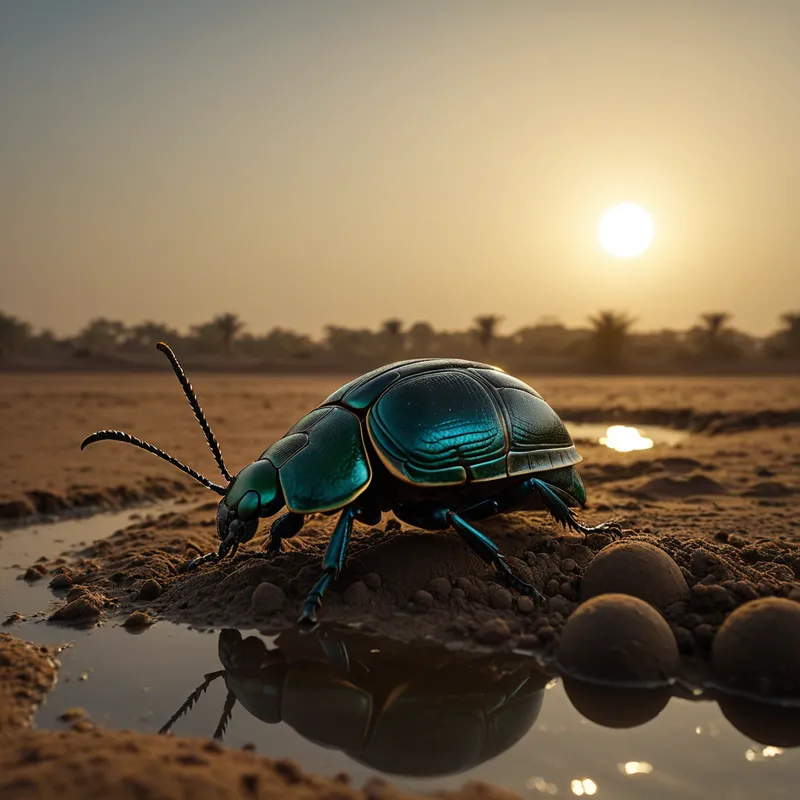
This was not a myth told merely for entertainment, but a fundamental observation woven into the fabric of Egyptian cosmic understanding. It emerged from the black, fertile soil of the [Nile Delta](/myths/nile-delta “Myth from Egyptian culture.”/), where priests and farmers alike watched the humble scarabaeidae, the dung beetle, perform its daily miracle. They saw it lay its eggs in a ball of animal waste, roll it with astonishing determination to a burial site, and from that ball, new life would emerge. The Egyptians, master observers of nature’s cycles, saw in this a divine blueprint.
The myth was embedded in the most sacred texts, the [Pyramid Texts](/myths/pyramid-texts “Myth from Egyptian culture.”/) and later the Book of the Dead. It was recited in temple rituals at dawn and carved onto [heart scarab](/myths/heart-scarab “Myth from Egyptian culture.”/) amulets placed on the chests of the deceased during mummification. The function was multifaceted: it explained the sunrise, assured the daily victory of order (Maat) over chaos (Isfet), and provided a potent metaphor for resurrection. [The pharaoh](/myths/the-pharaoh “Myth from Egyptian culture.”/) was Khepri, rolling the sun of his kingdom forward. Every citizen, through right action, could participate in this eternal cycle of renewal. The myth was a societal and psychological anchor, affirming that transformation and rebirth were not fantastical hopes, but laws of the universe, as evident as the beetle in the dust.
Symbolic Architecture
At its core, the [scarab](/symbols/scarab “Symbol: The scarab symbolizes transformation, protection, and the cycle of life and death, often invoking feelings of awe and respect.”/) myth is an alchemical parable written in the [language](/symbols/language “Symbol: Language symbolizes communication, understanding, and the complexities of expressing thoughts and emotions.”/) of biology and astronomy. Its symbols form a profound [architecture](/symbols/architecture “Symbol: Architecture in dreams often signifies structure, stability, and the framing of personal identity or life’s journey.”/) of meaning.
The Dung [Ball](/symbols/ball “Symbol: The ball symbolizes playfulness, joy, and the cyclical nature of life, often representing the search for balance and wholeness.”/) is [the prima materia](/myths/the-prima-materia “Myth from Alchemical culture.”/), the worthless, rejected, and chaotic base matter of existence—be it [grief](/symbols/grief “Symbol: A profound emotional response to loss, often manifesting as deep sorrow, yearning, and a sense of emptiness.”/), failure, [shame](/symbols/shame “Symbol: A painful emotion arising from perceived failure or violation of social norms, often involving exposure of vulnerability or wrongdoing.”/), or simply the undigested experiences of [life](/symbols/life “Symbol: The symbol of ‘Life’ represents a journey of growth, interconnectedness, and existential meaning, encompassing both the joys and challenges that define human experience.”/). It is what we, and society, often seek to discard.
The Act of Rolling represents conscious, willful engagement with that [material](/symbols/material “Symbol: Material signifies the tangible aspects of life, often representing physical resources, desires, and the physical world’s influence on our existence.”/). It is the difficult, often unglamorous work of introspection, of taking [responsibility](/symbols/responsibility “Symbol: Responsibility in dreams often signifies the weight of duties and the expectations placed upon the dreamer.”/) for one’s psychic contents. The [beetle](/symbols/beetle “Symbol: The beetle symbolizes transformation, resilience, and the ability to adapt to one’s environment, often reflecting personal growth and survival instincts.”/) does not flee from the dung; it embraces it as the sole substance of its future.
The most profound creation does not begin with gold, but with the courage to kneel in the mud and shape what you have been given.
Khepri Himself symbolizes the transformative instinct within the [psyche](/myths/psyche “Myth from Greek culture.”/)—the part of [the Self](/myths/the-self “Myth from Jungian culture.”/) that knows waste can become sustenance, that darkness contains latent light. He is not the glorious, finished sun (Ra), but the process that brings it into being. He is the archetypal force of autogenesis, self-creation from within.
The [Emergence](/symbols/emergence “Symbol: A process of coming into being, rising from obscurity, or breaking through a barrier, often representing birth, transformation, or revelation.”/) of the Sun is the [dawn](/symbols/dawn “Symbol: The first light of day, symbolizing new beginnings, hope, and the transition from darkness to illumination.”/) of [consciousness](/symbols/consciousness “Symbol: Consciousness represents the state of awareness and perception, encompassing thoughts, feelings, and experiences.”/), the “Aha!” [moment](/symbols/moment “Symbol: The symbol of a ‘moment’ embodies the significance of transient experiences that encapsulate emotional depth or pivotal transformations in life.”/), the new life, the creative work, or the healed [perspective](/symbols/perspective “Symbol: Perspective in dreams reflects one’s viewpoints, attitudes, and how one interprets experiences.”/) born from the labor. It signifies that the transformation is complete; the valued has been extracted from the valueless through applied [effort](/symbols/effort “Symbol: Effort signifies the physical, mental, and emotional energy invested toward achieving goals and personal growth.”/).
The Dreamer’s Resonance
When the [scarab](/myths/scarab “Myth from Egyptian culture.”/) pattern stirs in the modern dreamer, it often signals a profound somatic and psychological process of composting. To dream of dung beetles, of rolling a heavy sphere, or of finding beauty in decay, is to encounter the psyche’s innate Khepri.
Somatically, this may manifest as a feeling of pressure, of a burdensome weight in the chest or gut that demands to be moved. It is the body sensing undigested emotional or traumatic material. Psychologically, the dreamer is likely in a phase where they are being compelled, often against their conscious will, to engage with their own “waste”—old patterns, repressed memories, or a sense of life’s meaninglessness. The dream is not a condemnation, but an affirmation: this material, however foul it seems, is your substance. Roll it. Work with it. Do not abandon it.
The scarab in a dream reassures that the process itself is sacred. The feeling of being low to the ground, engaged in repetitive, arduous work, is not a sign of failure, but the essential precondition for the dawn that is to come.
Alchemical Translation
For the individual on the path of individuation—the process of becoming an integrated, whole Self—the scarab myth is a master guide to psychic transmutation. It models the entire alchemical opus: [solve et coagula](/myths/solve-et-coagula “Myth from Alchemical culture.”/) (dissolve and coagulate).
First, one must gather [the Nigredo](/myths/the-nigredo “Myth from Alchemical culture.”/), the blackening. This is the honest acknowledgment of one’s shadow, one’s failures, and one’s base impulses—the “dung” of the personality. Modern life encourages us to disinfect and discard this; the scarab insists we collect it.
Next is the labor of the Rotatio, the rolling. This is the sustained, often lonely work of therapy, journaling, artistic expression, or meditation. It is the daily, cyclical effort to process, to reflect, to knead meaning into the chaotic mass of our experience. This is where will and instinct (Khepri) must cooperate.
Individuation is not a climb to a peak, but a sacred rolling of the sun—a commitment to carry the burden of your own becoming, day after day, until it cracks open with light.
Finally, the emergence of the Sol, the gold. This is not a final state of perfection, but a moment of rebirth, of renewed consciousness. The integrated insight, the creative breakthrough, the deep sense of self-acceptance that arises is the “sun” born from within. And crucially, the process begins again at dusk. The scarab teaches that transformation is not a one-time heroic feat, but a perpetual, renewable cycle. The modern individual learns to trust the process itself, to become the creator who works not with ideal materials, but with the raw, messy, and fertile substance of a life actually lived.
Associated Symbols
Explore related symbols from the CaleaDream lexicon: