Scarab Myth Meaning & Symbolism
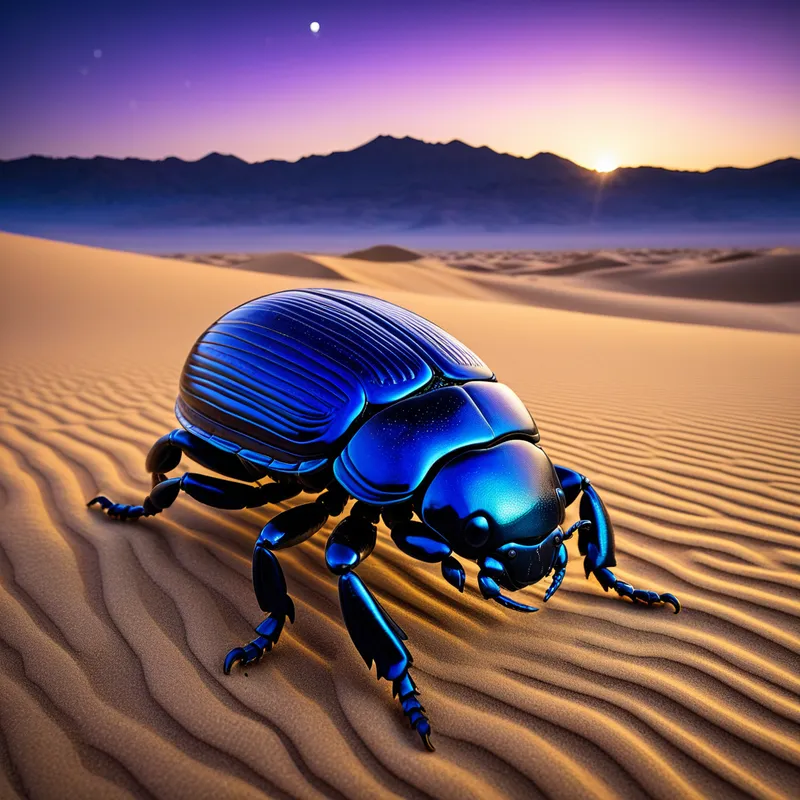
The dung beetle, sacred to Khepri, embodies the sun's daily rebirth and the soul's power to create itself from the substance of its own life.
The Tale of the Scarab
Before the first word was spoken, in the silent, velvet dark that cradled [the world](/myths/the-world “Myth from Tarot culture.”/), there was only the deep, black [water](/myths/water “Myth from Chinese culture.”/) of Nun. No sun, no land, no breath of life. Then, from within the heart of this endless, formless night, a stirring began. Not a sound, but a presence—a gathering of will in the profound stillness.
It was [Khepri](/myths/khepri “Myth from Egyptian culture.”/), the Becoming One. He did not arrive from elsewhere; he emerged. From the fertile, unseen depths of the primeval mound, he pushed. With a patient, inexorable strength, he rolled before him a sphere—not of clay or stone, but of potential itself, heavy with the promise of light. This was the sun-disk, Aten, still cool and dormant.
Through the resisting sands of [the underworld](/myths/the-underworld “Myth from Greek culture.”/), Khepri labored. His six legs found purchase in the dark, his carapace, the color of midnight, became a vessel for a gathering warmth. The conflict was not against a monster, but against inertia, against the eternal pull of Nun to return to formlessness. Each push was an act of defiance, a declaration of existence.
As he neared the eastern horizon, the shell of the world, the sphere began to glow. A faint, rosy light seeped from its core, staining the underbelly of [the sky](/myths/the-sky “Myth from Persian culture.”/). The air grew tense, waiting. With a final, mighty heave, Khepri breached [the threshold](/myths/the-threshold “Myth from Folklore culture.”/). The sun-disk, now blazing and golden, rolled free from the eastern mountain, Bakhu. Light, sharp and glorious, shattered the darkness. The black waters of Nun retreated, revealing the green, life-giving ribbon of the Nile.
Khepri, having delivered the sun into the sky, did not rest. His work was the work of perpetual dawn. As the sun, now called Ra, journeyed across the heavens, and later as Atum sank wearily into the west, Khepri was already back in the secret dark. There, in the unseen realm of Duat, he gathered the substance of the spent day—the memories, the trials, the essence of what had been—and began again. He fashioned it anew, rolling the night into a fresh sphere of potential, preparing for the next impossible, necessary push into dawn.
Cultural Origins & Context
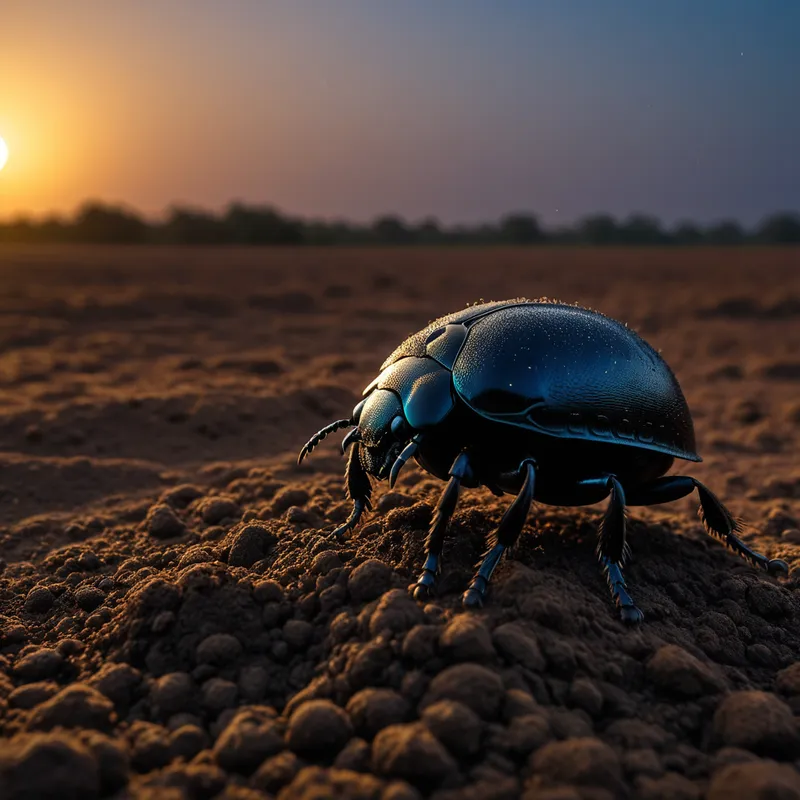
This was not a myth told in grand epics around evening fires, but one observed daily in the black soil of the Nile’s banks. The Egyptians were consummate naturalists, and in the humble dung beetle, Scarabaeus sacer, they witnessed a perfect, living hieroglyph. They saw the beetle roll a ball of dung many times its size, bury it, and from that ball, new life would emerge. They did not project a story onto nature; they recognized a divine pattern within it.
The myth of Khepri was thus embedded in the very fabric of life and death. It was carved onto heart scarabs placed on the chests of the mummified dead, a spell to ensure the heart did not testify against its owner in the [Weighing of the Heart](/myths/weighing-of-the-heart “Myth from Egyptian culture.”/). It was a promise: as the beetle creates life from waste, and as Khepri creates the sun from darkness, so too shall the soul create its new existence from the substance of its past. The scarab seal, worn in life, was a constant reminder of this self-generative power, making the myth a personal, psychological technology as much as a cosmological one.
Symbolic Architecture
At its core, the [scarab](/symbols/scarab “Symbol: The scarab symbolizes transformation, protection, and the cycle of life and death, often invoking feelings of awe and respect.”/) is the [archetype](/symbols/archetype “Symbol: A universal, primordial pattern or prototype in the collective unconscious that shapes human experience, behavior, and creative expression.”/) of autogenesis—self-creation from within. It contains a profound psychological [truth](/symbols/truth “Symbol: Truth represents authenticity, honesty, and the quest for knowledge beyond mere appearances.”/): transformation does not always come from acquiring something new from the outside, but from alchemically working with what is already, and often unglamorously, present.
The most profound creation is not ex nihilo, but ex materia—from the material of one’s own experience, however base it may seem.
The dung [ball](/symbols/ball “Symbol: The ball symbolizes playfulness, joy, and the cyclical nature of life, often representing the search for balance and wholeness.”/) is the central [symbol](/symbols/symbol “Symbol: A symbol can represent an idea, concept, or belief, serving as a powerful tool for communication and understanding.”/). It represents the raw, undigested [material](/symbols/material “Symbol: Material signifies the tangible aspects of life, often representing physical resources, desires, and the physical world’s influence on our existence.”/) of [life](/symbols/life “Symbol: The symbol of ‘Life’ represents a journey of growth, interconnectedness, and existential meaning, encompassing both the joys and challenges that define human experience.”/): our memories, failures, pains, and instincts—the “waste” we might wish to discard. The scarab does not avoid this material; it embraces it as the sole substance of its creative act. The sun-disk it pushes is not separate from this [ball](/symbols/ball “Symbol: The ball symbolizes playfulness, joy, and the cyclical nature of life, often representing the search for balance and wholeness.”/); it is its transmuted form. This symbolizes the [psyche](/myths/psyche “Myth from Greek culture.”/)‘s [ability](/symbols/ability “Symbol: In dreams, ‘ability’ often denotes a recognition of skills or potential that one possesses, whether acknowledged or suppressed.”/) to take the heaviest, most rejected aspects of [the self](/myths/the-self “Myth from Jungian culture.”/) and, through conscious engagement, roll them into a cohesive whole that contains the spark of new [consciousness](/symbols/consciousness “Symbol: Consciousness represents the state of awareness and perception, encompassing thoughts, feelings, and experiences.”/).
The eternal cycle—[dawn](/symbols/dawn “Symbol: The first light of day, symbolizing new beginnings, hope, and the transition from darkness to illumination.”/), [zenith](/symbols/zenith “Symbol: The highest point in the sky or life’s peak moment, representing spiritual culmination, achievement, and divine connection.”/), [dusk](/symbols/dusk “Symbol: A transitional period between day and night, symbolizing liminality, reflection, and the merging of opposites in artistic and musical contexts.”/), and the hidden renewal in the [underworld](/symbols/underworld “Symbol: A symbolic journey into the unconscious, representing exploration of hidden aspects of self, transformation, or confronting repressed material.”/)—maps the [human](/symbols/human “Symbol: The symbol of a human represents individuality, complexity of emotions, and social relationships.”/) process of consciousness rising, shining, setting (into the unconscious), and being reformed in the dark [night](/symbols/night “Symbol: Night often symbolizes the unconscious, mystery, and the unknown, representing the realm of dreams and intuition.”/) of the [soul](/symbols/soul “Symbol: The soul represents the essence of a person, encompassing their spirit, identity, and connection to the universe.”/). Khepri is the god of that hidden, [interior](/symbols/interior “Symbol: The interior symbolizes one’s inner self, thoughts, and emotions, often reflecting personal growth, vulnerabilities, and secrets.”/) labor where the self is remade.
The Dreamer’s Resonance
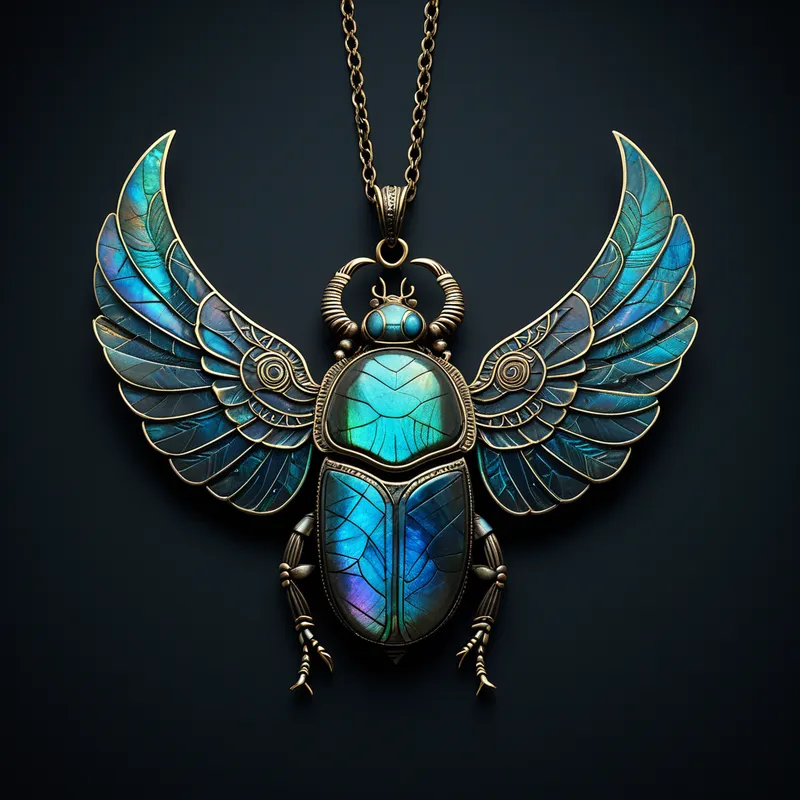
When the scarab appears in a modern dream, it rarely arrives with the fanfare of a solar deity. It is more likely to be sensed as a quiet, persistent movement in the dark soil of the dreamscape. It may appear as a small, iridescent beetle moving through a cluttered basement, a forgotten garden, or a pile of compost.
Somatically, this dream often accompanies a period of introspection, depression, or feeling “stuck” with the raw material of one’s life—a relationship ended, a career stalled, a grief unprocessed. The scarab’s presence is an unconscious affirmation that this very material is fertile. The psychological process is one of containment and slow, patient movement. The dream ego is being shown that [the way](/myths/the-way “Myth from Taoist culture.”/) forward is not to flee the mess, but to gather it, to form it into something one can work with, and to begin the slow, often solitary push toward a new orientation. The dream is an invitation to become the agent of one’s own rebirth, to trust the autogenic impulse within.
Alchemical Translation
The alchemical journey modeled by the scarab is the opus contra naturam—the work against nature—in its most grounded form. Here, “against nature” means against the natural impulse to reject our shadow, our failures, our “dung.” The scarab’s alchemy is one of humble, diligent circulation.
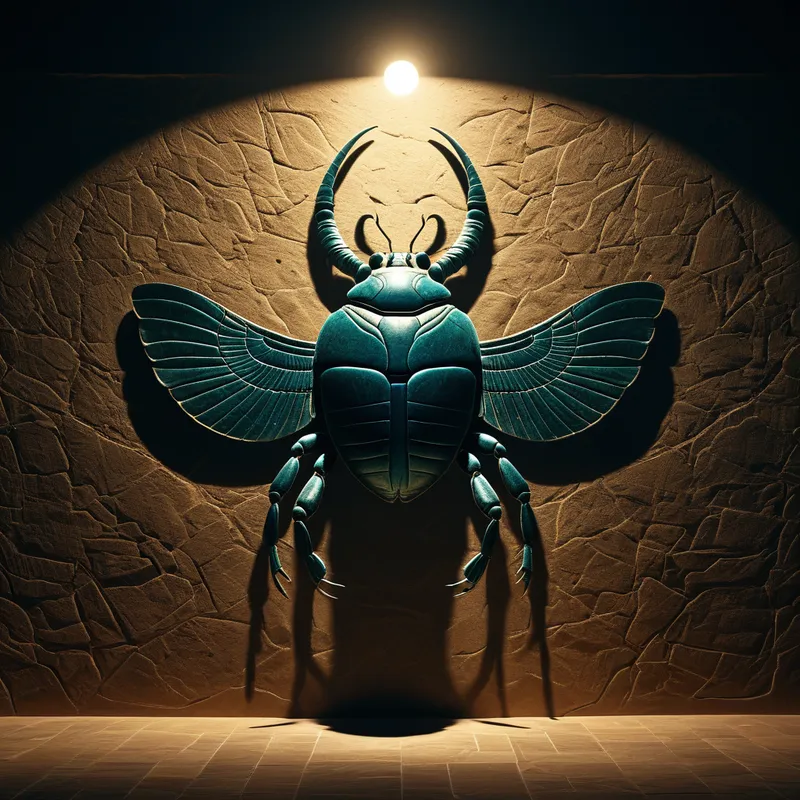
The nigredo, the blackening, is not a stage to be rushed through, but the essential substance. The black carapace of the beetle is the nigredo, and it is what contains and performs the work.
The modern individual engaged in this process must first gather their [prima materia](/myths/prima-materia “Myth from Alchemical culture.”/): the rejected, shameful, or painful experiences of life. This is the act of honest self-inventory, without judgment. Then comes the rolling—the constant, patient work of psychotherapy, journaling, art, or meditation that shapes this disparate matter into a cohesive narrative, a “ball” that can be moved. The pushing toward the eastern horizon is the act of bringing this newly integrated material into the light of consciousness, allowing it to become a source of energy and life (the sun), rather than a hidden source of decay.
Finally, the scarab teaches that this is not a one-time [triumph](/myths/triumph “Myth from Roman culture.”/). It is a perpetual cycle. Each day’s conscious light eventually sets and must be renewed from the depths. The individuated self, like Khepri, learns to dwell comfortably in both realms: acting in the bright world of the [persona](/myths/persona “Myth from Greek culture.”/), and laboring creatively in the dark, fertile world of the unconscious, forever generating the self anew from within.
Associated Symbols
Explore related symbols from the CaleaDream lexicon: