Saul/Paul on Damascus Road Myth Meaning & Symbolism
A zealous persecutor of a new faith is struck down by a divine light, blinded, and given a new name and purpose, becoming its greatest apostle.
The Tale of Saul/Paul on Damascus Road
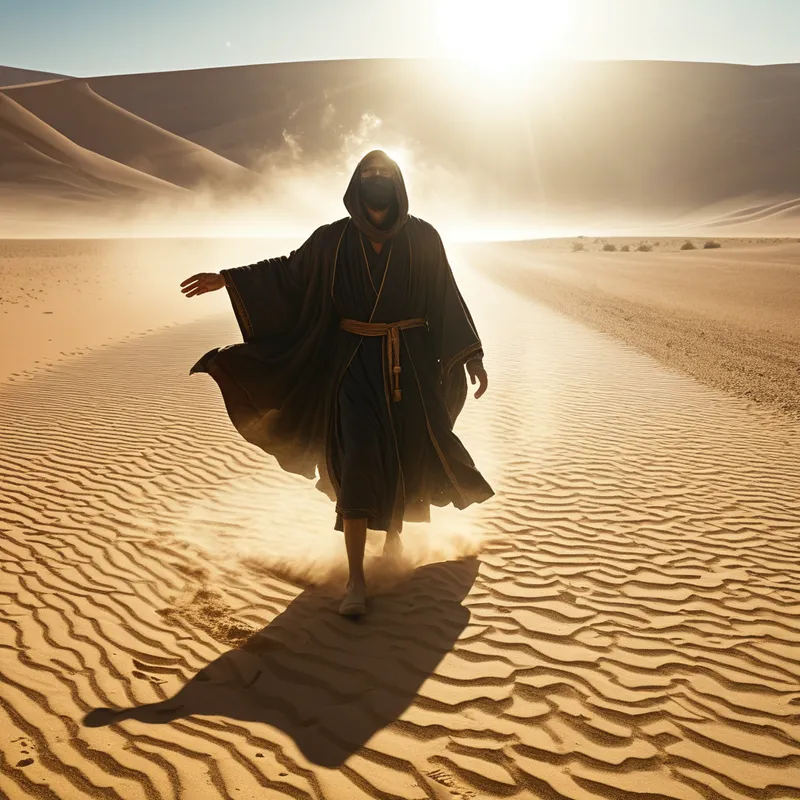
The sun was a hammer on the anvil of the Judean desert, beating the road to Damascus into a ribbon of white-hot dust. Upon it walked Saul of Tarsus, a man of letters and iron conviction. His breath was a prayer of fury, his hands clenched around parchments of condemnation. He moved with the terrible certainty of a storm, his purpose to bind and drag the followers of The Way back to Jerusalem in chains. The very air around him crackled with the heat of his zeal.
Then, at the zenith of day, the world inverted.
A light—not of the sun, but from beyond it—exploded from the heavens. It was not a thing seen, but a force felt, a soundless concussion of pure presence that threw Saul from his feet and pressed him into the blinding dust. It was a light that seared not the eyes, but the soul, dissolving the desert, the road, his very body into a single point of unbearable revelation. From within the light came a Voice, not in the ear, but in the marrow of his bones.
“Saul, Saul, why do you persecute me?”
Trembling, face in the dirt, the persecutor gasped, “Who are you, Lord?”
The Voice answered, “I am Jesus, whom you are persecuting.”
In that moment, the architecture of Saul’s world—Torah, tradition, his righteous cause—shattered. The enemy was not a heresy, but the living God. His life’s work was not piety, but profound sacrilege. The light receded, leaving not darkness, but a deeper blindness. When he staggered to his feet, his eyes were open yet saw nothing. The sun was gone. The world was a formless void. His companions led him by the hand, the fierce scholar rendered a helpless child, into the city he had meant to conquer.
For three days and nights, in a house on Straight Street, he sat in absolute darkness. He neither ate nor drank. The only reality was the echo of the Voice and the crumbling landscape of his former self. Then, a disciple named Ananias, trembling himself from a vision, came. He laid hands upon the blind man. “Brother Saul,” he said, a word of kinship that must have struck like a thunderclap, “the Lord Jesus, who appeared to you on the road, has sent me so that you may see again and be filled with the Holy Spirit.”
Something like scales fell from Saul’s eyes. The light returned, but it was a different light. It illuminated a new world, and in it, a new man. Paul was born in that room, not from a womb, but from a cataclysm of light and a long, silent darkness.
Cultural Origins & Context
This story originates from the first-century Mediterranean world, a crucible of Jewish apocalyptic expectation, Greco-Roman philosophy, and imperial power. It is recorded not as ancient legend, but as recent history in the text of The Acts of the Apostles and affirmed in Paul’s own letters. Its primary teller was Paul himself, who repeatedly referenced this foundational event to legitimize his radical apostolic authority, which was constantly under challenge because of his past.
The story functioned as a powerful apologia—a defense—within the early Christian community. It explained the inexplicable: how the movement’s most virulent enemy became its most prolific missionary. It served as a divine seal of approval, arguing that his gospel came not from human teaching but from direct revelation. Societally, it modeled a paradigm of radical mercy and the possibility of redemption, even for the most opposed. The myth was passed down orally within communities of faith before being codified in scripture, becoming the archetypal template for the concept of “conversion” in the Western world.
Symbolic Architecture
At its core, this is a myth of the psyche’s violent and necessary confrontation with its own shadow. Saul represents the conscious ego, identified completely with a rigid, moralistic, and persecutory complex—a structure of absolute certainty. The journey to Damascus is the ego’s purposeful, linear mission to eradicate what it perceives as threat.
The light that strikes is not illumination, but un-creation. It is the psyche’s own Self, the total personality, erupting into consciousness to dismantle a life built on a fundamental error.
The road is the symbol of one-directional purpose, shattered by a vertical, transcendent intervention. The blindness is not punishment, but a sacred necessity. It represents the collapse of the old paradigm of perception. One must be made empty, stripped of the tools of former judgment, to receive a new mode of being. The three days of darkness are a symbolic death and gestation in the womb of the unconscious.
The figure of Ananias is crucial—he represents the mediating function of the community, or the integrative capacity of the psyche itself, which must bridge the gap between the numinous shock and embodied life. He calls Saul “brother,” enacting the acceptance of the formerly rejected shadow. The restoration of sight is the birth of a new consciousness, one that integrates the revelation. The name change from Saul (a Hebrew king) to Paul (meaning “small”) signifies the death of the ego’s royal ambition and the birth of a servant identity, forged in humility.
The Dreamer’s Resonance
When this myth stirs in modern dreams, it rarely appears as a biblical pastiche. The dreamer may experience being halted on a path—a career track, a relationship trajectory, a deeply held belief. The “light” can manifest as a sudden, devastating insight, a panic attack that collapses a worldview, a diagnosis, a betrayal, or a profound moment of aesthetic or intellectual awe that reconfigures everything.
Somatically, it is often felt as a blow, a falling sensation, or a temporary paralysis. The accompanying blindness in the dream reflects a conscious state of confusion, depression, or the terrifying sense of not knowing how to proceed. The dreamer is in the “house on Straight Street”—a liminal space of forced inactivity, where the old identity is dead but the new one has not yet taken form. This dream pattern signals a profound psychic initiation. The ego is being compelled, often against its will, to release its identification with a persona or complex that has become tyrannical, even if it once felt righteous and secure.

Alchemical Translation
The alchemical process mirrored here is the nigredo—the blackening, the putrefaction, the darkest night of the soul. Saul’s assured, solar consciousness is reduced to ashes by a light more brilliant than its own. This is the necessary first step in the work of individuation: the brutal disillusionment with the conscious attitude.
The Damascus Road is the moment the lead of our conditioned life realizes it must die to become gold. The transformation is not self-improvement; it is a metamorphosis mandated by the Self.
The subsequent blindness and fasting are the albedo—the whitening, a purification in the void. In this sterile, silent space, the psychic material is washed clean of its former associations. Ananias represents the beginning of the rubedo—the reddening, the return of life and connection, but of a new kind. The healing touch is the integration of the transcendent experience into human relationship and embodied service.
For the modern individual, this myth does not counsel seeking cataclysmic visions. It maps the psychic truth that fundamental growth is often precipitated by crisis. It teaches that our most fervent convictions can be the very walls that separate us from our wholeness. The path to a deeper vocation, to a life aligned with the Self, may require the shocking, humbling collapse of the life we have so diligently built. We are asked to trade the certainty of the persecutor for the vulnerable, sightless journey of the seeker, trusting that in the depth of the blindness, a truer name—and a truer calling—is being prepared.
Associated Symbols
Explore related symbols from the CaleaDream lexicon: