Saturnalia Myth Meaning & Symbolism
A festival of winter chaos where slaves ruled, masters served, and the world turned upside-down to honor a deposed god of a lost golden age.
The Tale of Saturnalia
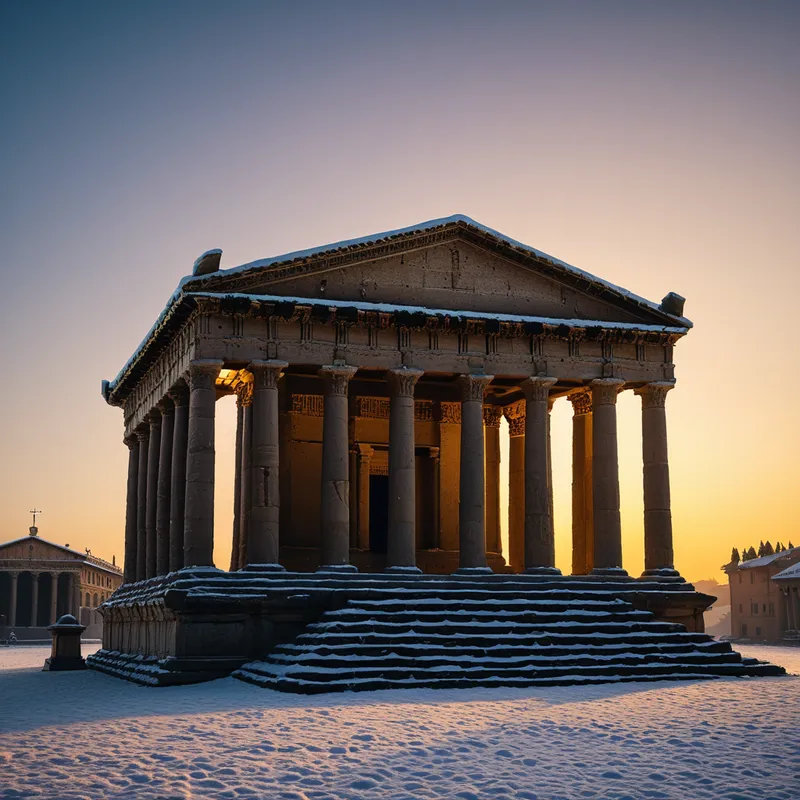
Listen, and let the cold wind carry you back. Before the marble settled, before the legions marched, there was only the long, grey twilight of a world in winter. The sun was a weak coin, low in [the sky](/myths/the-sky “Myth from Persian culture.”/), and [the earth](/myths/the-earth “Myth from Hindu culture.”/) slept a death-like sleep. In this season of endings, the people of Latium turned their faces not to the Capitol’s gleaming temples, but to a darker, older memory. They turned to the god who was, and is no more.
His name was [Saturn](/myths/saturn “Myth from Alchemical culture.”/). They said he once ruled in a [Golden Age](/myths/golden-age “Myth from Universal culture.”/), when the earth gave freely without the bite of the plough, when men knew no masters and no slaves, when the seasons were one eternal spring. But kings fall, even divine ones. Jupiter, his own son, rose and cast him down. [Saturn](/myths/saturn “Myth from Alchemical culture.”/) fled, a deposed king, and found refuge in this land of hills and rivers. Here, he taught the wild people the secrets of the seed and the sickle, of civilization itself, before vanishing into the mists of time or slumber.
But the memory of that lost freedom, that weightless world, would not die. It festered in the bone-deep cold of December. What if the natural order was not natural at all, but a cage? What if the master’s voice was just a habit, and the slave’s bowed head a temporary pose?
So, as the sun stood still at the solstice, they enacted a sacred madness. For days, [the world](/myths/the-world “Myth from Tarot culture.”/) turned inside out. The woolen bonds were removed from the statue of Saturn in his temple—a symbolic liberation of the bound god. The cry of “Io Saturnalia!” rang through the frosty air, and with it, the gates of custom were thrown open.
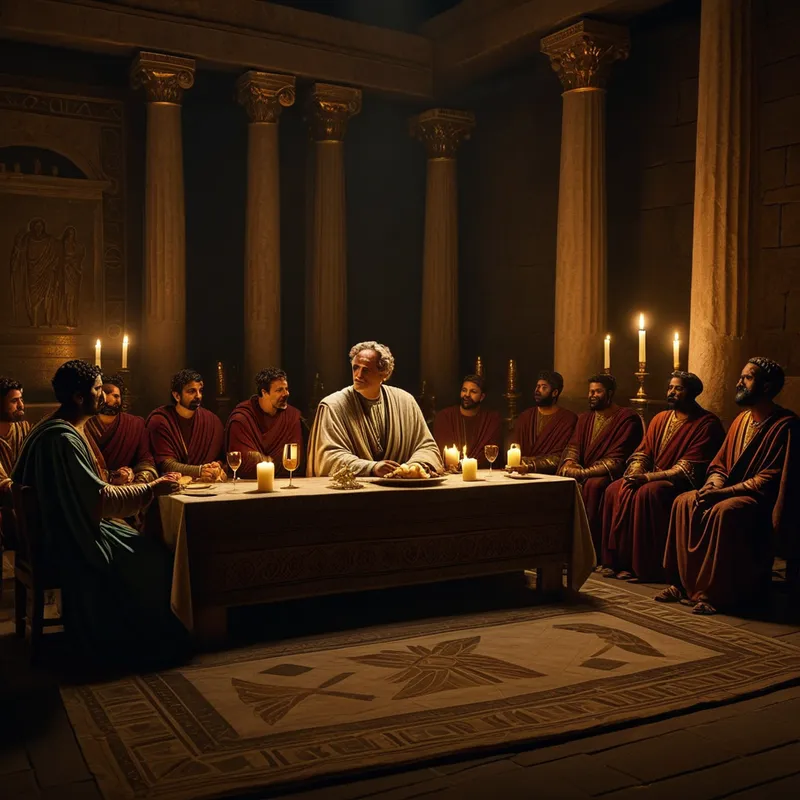
Masters served elaborate feasts to their slaves, who reclined on the couches in the place of honor. Gambling, forbidden year-round, echoed in the streets. A Saturnalicius Princeps, a Lord of Misrule, was crowned—often a lowly servant or a child—and his whimsical, absurd commands had to be obeyed. Gifts of wax candles and small clay figurines called sigillaria were exchanged, tiny lights against the great dark. All social rank, all political gravity, dissolved in wine and laughter. It was not anarchy, but a meticulously timed eruption of the world that might have been. For a fleeting moment, Saturn’s Golden Age returned, not as a distant memory, but as a living, breathing, chaotic present. Then, as the new solar year asserted itself, the bonds were gently retied, the masters resumed their places, and the ordinary world, perhaps slightly altered, settled back into place. The god was bound again, but the people had remembered.
Cultural Origins & Context
The Saturnalia was not merely a holiday; it was a vital social and cosmological pressure valve embedded in the heart of the Roman calendar. Its origins are shadowy, likely predating [the Republic](/myths/the-republic “Myth from Platonic culture.”/), rooted in ancient agricultural rites marking the winter sowing season and the solstice. The official public festival began on December 17th and expanded over centuries to a week-long celebration.
Its societal function was profound. Rome was a culture built on a rigid hierarchy of patronus and cliens, citizen and non-citizen, free and enslaved. This structure provided order but generated immense psychological and social tension. The Saturnalia institutionalized a temporary, ritualized release of that tension. By inverting the social order, it paradoxically reinforced it. The slave who played master for a day was, in a sense, more likely to accept his role for the rest of the year, having had his suppressed desires acknowledged and ceremonially fulfilled. The festival was a rite of passage for the entire community, moving from the decay of the old year into the potential of the new through a controlled explosion of chaos.
It was a story told not in epic verse, but in lived action. Every Roman, from the Emperor to the lowliest kitchen drudge, participated in its narrative. It was history as theater, where the foundational myth of Saturn’s lost reign was not recited but re-enacted by the entire body politic.
Symbolic Architecture
At its core, Saturnalia is a myth of the [Shadow](/symbols/shadow “Symbol: The ‘shadow’ embodies the unconscious, repressed aspects of the self and often represents fears or hidden emotions.”/). Saturn, the bound god, represents the repressed [foundation](/symbols/foundation “Symbol: A foundation symbolizes the underlying support systems, values, and beliefs that shape one’s life, serving as the bedrock for growth and development.”/)—the archaic, pre-ordinal state of [nature](/symbols/nature “Symbol: Nature symbolizes growth, connectivity, and the primal forces of existence.”/) and instinctual freedom that civilization must suppress to exist. He is the deposed [king](/symbols/king “Symbol: A symbol of ultimate authority, leadership, and societal order, often representing the dreamer’s inner power or external control figures.”/) living within the psychic [basement](/symbols/basement “Symbol: The basement in dreams often symbolizes the unconscious mind, where hidden fears, repressed memories, and unacknowledged aspects of the self reside.”/).
The festival is the ego’s conscious, temporary surrender to the Shadow’s rule. It is the recognition that the persona we wear is a garment, not the skin.
The inversion of roles is the central [symbol](/symbols/symbol “Symbol: A symbol can represent an idea, concept, or belief, serving as a powerful tool for communication and understanding.”/). The master serving the slave is the conscious ego serving the unconscious Shadow. The permitted gambling and license represent the loosening of the super-ego’s strictures. The Saturnalicius Princeps is the archetypal Jester or [Trickster](/symbols/trickster “Symbol: A boundary-crossing archetype representing chaos, transformation, and the subversion of norms through cunning and humor.”/), a figure who, through absurdity, reveals the arbitrary nature of all worldly power. The gifts of candles (cerei) are symbols of [consciousness](/symbols/consciousness “Symbol: Consciousness represents the state of awareness and perception, encompassing thoughts, feelings, and experiences.”/) and the returning sun, given in the [heart](/symbols/heart “Symbol: The heart symbolizes love, emotion, and the core of one’s existence, representing deep connections with others and self.”/) of darkness, acknowledging that light is born from an engagement with the dark, not from its perpetual denial.
The Dreamer’s Resonance
When the Saturnalia pattern stirs in the modern dreamer, it signals a profound somatic and psychological need for inversion. This is not a call to literal chaos, but to an internal recalibration.
You may dream of being at your workplace, but you are the one giving orders to your boss in a playful, yet unnerving, ceremony. You may dream of your childhood home, but the roles of parent and child are reversed. The somatic feeling is often one of dizzying, anxious exhilaration—a fear of falling mixed with a giddy sense of possibility. Psychologically, the dreamer is processing an over-identification with a role (the responsible ruler, the diligent worker, the perfect caregiver) that has become a prison. The [psyche](/myths/psyche “Myth from Greek culture.”/) is staging its own festival, forcing the dreaming ego to experience life from the perspective of its own suppressed parts—the lazy one, the rebellious one, the one who wants to be cared for. It is the unconscious demanding its temporal kingdom, its moment at the feast.
Alchemical Translation
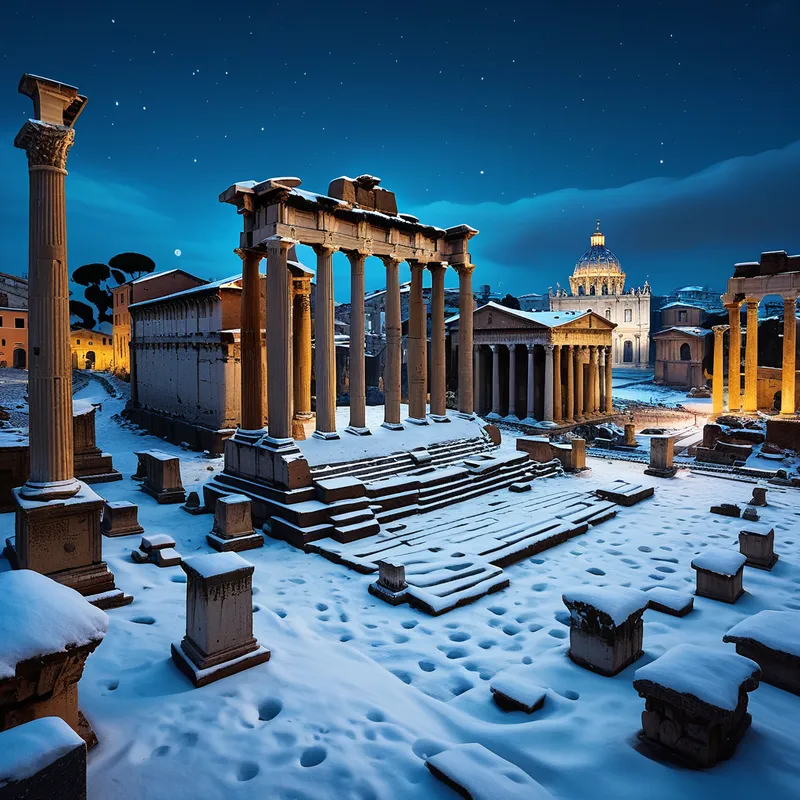
The alchemical journey modeled by Saturnalia is the [Nigredo](/myths/nigredo “Myth from Alchemical culture.”/)—the blackening, the descent into chaos and dissolution that is necessary for renewal. The rigid, leaden structures of the [persona](/myths/persona “Myth from Greek culture.”/) (the social hierarchy) must be dissolved in the acid of inversion.
The goal is not to live in perpetual Saturnalia, but to integrate its truth: that wholeness requires acknowledging and occasionally honoring the deposed king within.
The process begins with Conscious Permission (declaring the festival). The individual must consciously create a bounded space—through therapy, art, ritual, or retreat—where the normal rules are suspended. This is followed by Inversion & Encounter (the role reversal). Here, one actively engages with [the Shadow](/myths/the-shadow “Myth from Jungian culture.”/): the executive must play, [the ascetic](/myths/the-ascetic “Myth from Christian culture.”/) must indulge, the caregiver must be cared for. This leads to the Liberation of the Bound God (the laughter, the gift-giving). This is the release of creative or instinctual energy that was locked in service of the persona. Finally, there is Re-integration (the re-binding of Saturn’s statue). This is the crucial phase. The energy and insights from the chaotic interval are not rejected but woven back into a more flexible, conscious, and humane order. [The ego](/myths/the-ego “Myth from Jungian culture.”/) returns to its governance, but it is now a ruler who has served, a master who knows what it is to be a slave. The once-leaden identity is transmuted into a more golden, compassionate, and whole self, having made peace with the king in the cellar. The cycle of the year, and the psyche, can now turn forward.
Associated Symbols
Explore related symbols from the CaleaDream lexicon: