Saturn Return Myth Meaning & Symbolism
A celestial rite of passage where the planet Saturn completes its orbit, demanding the dissolution of the false self to forge the foundation of the true one.
The Tale of Saturn Return
Listen. The cosmos is not a silent clockwork. It is a story, told in the slow, grinding language of orbits. And the sternest teller of tales is the one who waits in the outer dark, the one who measures a life not in heartbeats, but in revolutions.
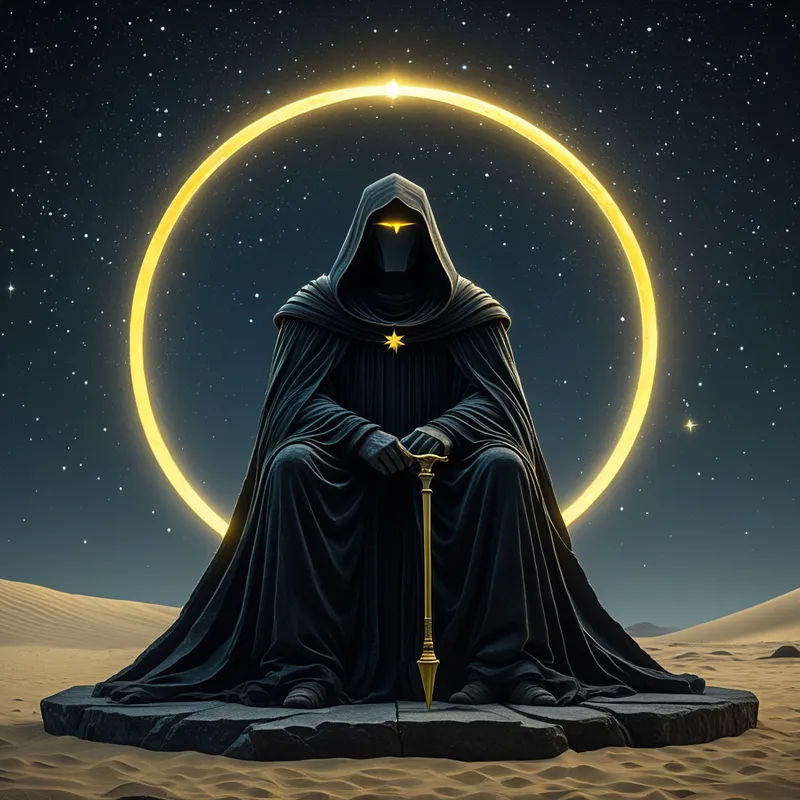
His name is Saturn. He is the Old King, the Lord of Limits, whose throne is a ring of cold stone and cosmic ice. For twenty-nine years, he watches you. You, a spark of spirit newly fallen to the clay of earth. In your first quarter-turn, you build a self from borrowed dreams and youthful clay. You fashion a castle of ambition, weave a tapestry of identity, plant gardens of relationship. You believe these constructions are eternal, that you are their master.
You do not hear the slow, deep breath from the dark. You do not feel the celestial gaze that has never wavered.
Then, the hour arrives. The great wheel of the zodiac completes its circuit. Saturn, from his distant perch, returns to the exact degree of sky he occupied at the moment of your first cry. This is the Saturn Return. It is not a transit. It is a summons.
The sky does not thunder. The stars do not fall. Instead, a profound silence descends upon your world. It is the silence of a judge entering a chamber. The foundations of your clay castle begin to subtly shift. The mortar you thought was strong shows its first hairline crack. A wind you never noticed before whispers through the halls of your achievements, and it carries a chill. The relationships you nurtured in softer soil feel strained, as if the ground beneath them is turning to stone, testing their roots.
This is Saturn’s method. He does not strike with lightning. He applies pressure. The career that once fit like a second skin now feels like a cage of someone else’s design. The dreams of your twenties reveal their childish outlines. The people around you begin to reflect back not your fantasy, but your reality—your avoidances, your compromises, your un-kept promises to yourself. It is a great and terrible disillusionment. The world you built, which you called “my life,” is found wanting. It was built on sand, on borrowed time, on unexamined hopes.
And in the heart of this crumbling, Saturn extends not a hand of mercy, but a tool: the scythe of dissolution. What cannot withstand the pressure must fall. Relationships that lack true foundation fracture. Careers that misalign with the soul’s purpose become unbearable. Illusions about who you are and what you are capable of shatter. It feels like loss, like failure, like the universe itself is your adversary.
But in the clearing of the rubble, in the stark landscape left after the harvest, you see it. The foundation. The bedrock that was always there, beneath the pretty, unstable soil. It is the shape of your true responsibility. The outline of your authentic authority. The raw, unadorned material of your character. Saturn, the Old King, does not destroy to be cruel. He clears the deadwood so the perennial tree of the self can find its true growth. He strips away the persona so the individual may stand revealed. The Return ends not with a celebration, but with a quiet, sober recognition. You are no longer the child of potential. You are the adult of actuality. The throne in the outer dark has, in truth, been preparing you to rule the inner kingdom.

Cultural Origins & Context
The myth of the Saturn Return is not found on ancient papyrus or carved in temple stone as a singular narrative. It is a myth written in the language of mathematics and observed in the fabric of human life. Its origins are woven into the practice of astrology, a system of meaning that blossomed in Babylon, was refined in Hellenistic Egypt, and transmitted through Islamic and Medieval European scholars.
In this culture, the planets were not dead rocks, but intelligences, divine forces expressing specific principles through their cyclical dances. Saturn, associated with the Greek Kronos, was the Greater Malefic, the great teacher through hardship. Astrologers observed that human lives often underwent profound crises and reorientations at roughly 29-year intervals, coinciding with Saturn’s orbital period. This was not mere coincidence; it was cosmic curriculum.
The myth was passed down not by bards around a fire, but by astrologers casting charts for rulers and commoners alike. Its societal function was one of meaning-making and preparation. It provided a container for the existential crises of early and late adulthood, framing them not as random suffering, but as a necessary, even sacred, developmental stage. It told people: Your struggle has a name, a timing, and a purpose. You are not being punished; you are being forged.
Symbolic Architecture
At its core, the Saturn Return myth is an archetypal drama of structure, time, and the ego. Saturn symbolizes the principle of limitation, which is the very mother of form and identity. Without a limit, there is no shape; without a boundary, there is no self.
The prison you rage against is first the womb that held you, and may become the crucible that transforms you.
Psychologically, Saturn represents the super-ego in its most mature form—not the punishing parental voice, but the internalized principle of reality, consequence, and integrity. The Return is the moment this inner judge holds a full audit of the life built by the youthful ego. The “crumbling castle” is the persona—the adaptable social self forged in our first adulthood. Saturn’s pressure tests its authenticity. The “bedrock” revealed is the core of the archetypal Self, the indestructible center of one’s being.
The scythe is not merely an instrument of death, but of harvest. It separates the wheat (enduring values, true talents, essential relationships) from the chaff (social conditioning, expired dreams, convenient lies). The rings of Saturn symbolize the beautiful, cold, and rigid structures we both create and are bound by—the cycles of karma, habit, and societal expectation.
The Dreamer’s Resonance
When this myth stirs in the modern unconscious, it manifests in dreams of profound structural change and sober reckoning. The dreamer may find themselves in an endless, bureaucratic building (the structure of their life) that is suddenly condemned, forcing them to evacuate. They may dream of losing all their teeth (a classic symbol of maturation and loss of youthful potency) or being tasked with repairing a massive, ancient clock whose workings they do not understand.
Somatically, this process is felt as a deep, often anxious pressure—a “weight of the world” on the shoulders. There can be a literal feeling of bones aching, of the body settling into its more permanent form. Psychologically, it is the process of ego disillusionment. The dreams are not gentle; they are insistent architects, showing the dreamer where their psychic building codes have been violated. A dream of a stern, silent father figure who measures the dreamer’s work is Saturn making his presence known. These dreams guide the necessary, painful dissolution, making the unconscious process visible so it can be consciously endured and integrated.

Alchemical Translation
The alchemical journey mapped by the Saturn Return is the opus of nigredo—the blackening, the descent into the leaden weight of reality. The youthful “gold” of potential must first be reduced to its base matter. This is the psychic transmutation at the heart of individuation.
To become who you are, you must cease to be who you are not. This cessation is the most creative, and most terrifying, act.
The modern individual undergoes this alchemy when they allow a life chapter to end, not with a bang, but with a sober acknowledgment of its limits. It is the end of a marriage that was a contract of convenience, the leaving of a career that provided status but not soul, the confrontation of a personal flaw long ignored. This is Saturn’s crucible.
The triumph is not a victory parade, but the earning of inner authority. The “Old King” Saturn is not overthrown; he is internalized. The external pressures become self-discipline. The harsh judgments become self-honesty. The limits become defining boundaries. The individual who has weathered their Return no longer looks for parental permission or societal blueprints. They have met the cold gaze of reality and, in doing so, have been granted the right to rule their own domain from a place of earned wisdom, resilience, and hard-won integrity. The lead of duty and limit is, through the long work of the cycle, slowly transmuted into the gold of authentic, responsible selfhood.
Associated Symbols
Explore related symbols from the CaleaDream lexicon: