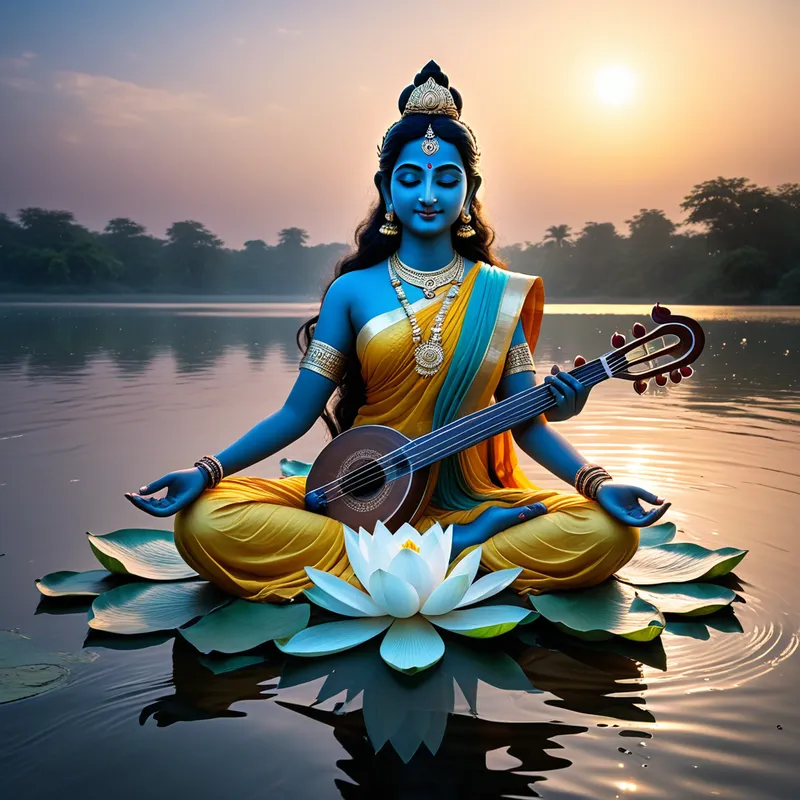
Saraswati's River Myth Meaning & Symbolism
The story of the celestial river Saraswati, who chose to flow underground, becoming the hidden stream of consciousness, wisdom, and unbroken tradition.
The Tale of Saraswati’s River
Listen. Before [the world](/myths/the-world “Myth from Tarot culture.”/) knew its own name, when [the sky](/myths/the-sky “Myth from Persian culture.”/) was a bowl of fresh milk and the mountains were young bones pushing through the skin of [the earth](/myths/the-earth “Myth from Hindu culture.”/), there flowed a river. Not of mere [water](/myths/water “Myth from Chinese culture.”/), but of sound. It was the [Saraswati](/myths/saraswati “Myth from Global/Universal culture.”/), born from the mind of Brahma, a torrent of pure consciousness given form. Her banks were not mud and reed, but the ears of the first sages. Her current was not a pull towards [the sea](/myths/the-sea “Myth from Greek culture.”/), but a pull towards the source.
She descended from the high Himalayas, a ribbon of silver speech, carving through the land they would call Sapta Sindhu. Where she flowed, the very soil became mantra. Trees bore leaves inscribed with hymns. Stones, when struck, rang with perfect notes. Her waters did not merely quench thirst; they ignited the inner fire of jnana. Kings performed the grandest sacrifices on her shores, and the smoke of their offerings carried promises to the gods.
But rivers, even divine ones, have their seasons. An age turned. The land grew weary. A great drought, some say of spirit more than rain, began to parch the world. The other great rivers, the Sindhu and the [Ganga](/myths/ganga “Myth from Hindu culture.”/), roared on, but Saraswati felt a change. She saw the sacred fires on her banks guttering out. She heard the hymns grow faint, replaced by the din of a different kind of striving.
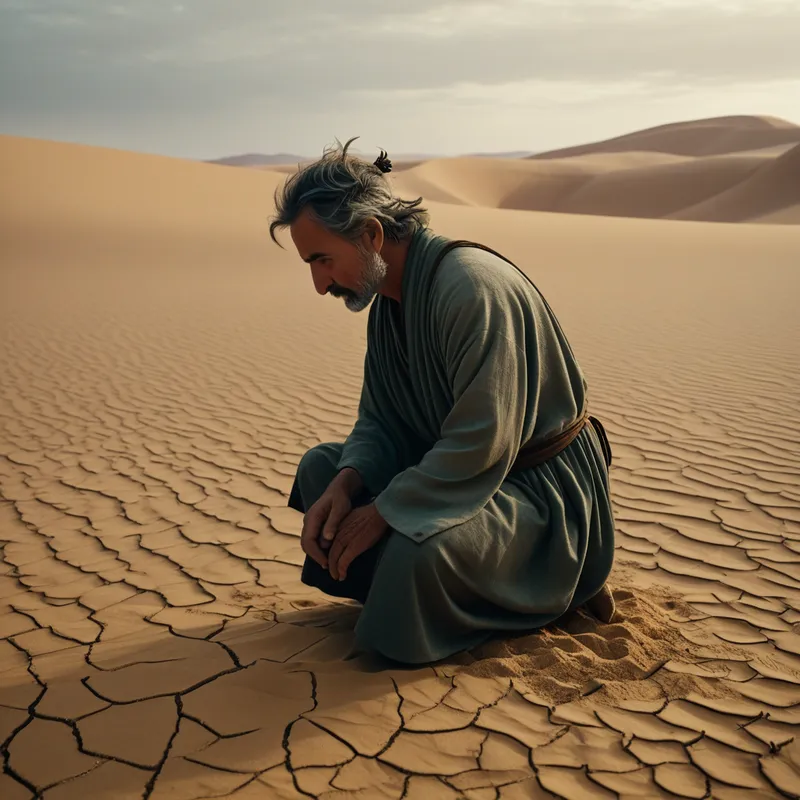
One fateful twilight, as the last agni of a great sage was about to be swallowed by [the wind](/myths/the-wind “Myth from Various culture.”/), Saraswati made her choice. She would not vanish. She would not die. But she would withdraw. With a sound like a universe sighing, her glorious, visible course began to diminish. The silver ribbon narrowed to a thread of light. Then, before the weeping eyes of the sages, she poured herself not into the ocean, but into [the desert](/myths/the-desert “Myth from Biblical culture.”/) sands at a place called Triveni. She did not disappear. She descended. She chose to flow underground, a hidden current, a secret beneath the world’s feet.
Her physical waters vanished from sight, merging with the subterranean depths. But her essence, her sound, did not cease. It became the anahata nada—the hum in the silence, the melody in the mind of a meditator, the perfect word waiting on the tip of a poet’s tongue. She became the stream you hear when you listen not with your ears, but with your soul.
Cultural Origins & Context
The myth of Saraswati’s River is not a single story from one text, but a tapestry woven from the oldest strands of Hindu tradition. Her praises are sung in the Rig Veda, where she is lauded as “the best of mothers, best of rivers, best of goddesses.” She is the Naditama, the greatest of rivers, central to the geography of the Vedic civilization. This was not merely poetic fancy; modern geology and satellite imagery suggest the historical existence of a major river system in the northwest Indian subcontinent that dried up millennia ago, lending a powerful, literal bedrock to the myth.
The story of her disappearance and subterranean flow evolved in the Puranas and later devotional texts. It functioned as a profound cultural metaphor for continuity in the face of cataclysmic change. As empires rose and fell, as languages evolved and rituals transformed, the myth assured the community that the source of wisdom was not lost, only internalized. It was told by priests to explain theological shifts, by poets to describe the mystery of inspiration, and by elders to teach that the most vital truths are often invisible, accessed only through deep listening (shravana) and introspection.
Symbolic Architecture
The [river](/symbols/river “Symbol: A river often symbolizes the flow of emotions, the passage of time, and life’s journey, reflecting transitions and movement in one’s life.”/) Saraswati is the archetypal [symbol](/symbols/symbol “Symbol: A symbol can represent an idea, concept, or belief, serving as a powerful tool for communication and understanding.”/) of conscious [knowledge](/symbols/knowledge “Symbol: Knowledge symbolizes learning, understanding, and wisdom, embodying the acquisition of information and enlightenment.”/), culture, and articulated [truth](/symbols/truth “Symbol: Truth represents authenticity, honesty, and the quest for knowledge beyond mere appearances.”/). Her visible, earthly [course](/symbols/course “Symbol: A course represents direction, journey, or progression in life, often choosing paths to follow.”/) represents the external manifestation of wisdom: scripture, art, [music](/symbols/music “Symbol: Music in dreams often symbolizes the harmony between the conscious and unconscious mind, illustrating emotional expression and communication.”/), law, and [ritual](/symbols/ritual “Symbol: Rituals signify structured, meaningful actions carried out regularly, reflecting cultural beliefs and emotional needs.”/). It is the wisdom that structures society and is accessible to all.
Her descent underground is the pivotal symbolic act. It represents the [movement](/symbols/movement “Symbol: Movement symbolizes change, progress, and the dynamics of personal growth, reflecting an individual’s desire or need to transform their circumstances.”/) of knowledge from the exoteric to the esoteric, from the public domain to the inner sanctum of the individual [psyche](/myths/psyche “Myth from Greek culture.”/). It is the process of internalization.
The most potent wisdom withdraws from the noisy marketplace of the world to become the silent, underground stream that nourishes the roots of being.
The desert she flows into, Triveni, symbolizes the point of transformation—where the three streams of the individual ([body](/symbols/body “Symbol: The body in dreams often symbolizes the dreamer’s self-identity, personal health, and the relationship they have with their physical existence.”/), mind, [spirit](/symbols/spirit “Symbol: Spirit symbolizes the essence of life, vitality, and the spiritual journey of the individual.”/)) or the three states of [consciousness](/symbols/consciousness “Symbol: Consciousness represents the state of awareness and perception, encompassing thoughts, feelings, and experiences.”/) (waking, dreaming, deep sleep) meet. Her merging with the Ganga and Yamuna there signifies that pure knowledge (Saraswati), [action](/symbols/action “Symbol: Action in dreams represents the drive for agency, motivation, and the ability to take control of situations in waking life.”/)/purification (Yamuna), and devotion/flow (Ganga) ultimately unite in the [human](/symbols/human “Symbol: The symbol of a human represents individuality, complexity of emotions, and social relationships.”/) [soul](/symbols/soul “Symbol: The soul represents the essence of a person, encompassing their spirit, identity, and connection to the universe.”/). The “lost” river is thus not lost at all; it has become the subconscious and unconscious [foundation](/symbols/foundation “Symbol: A foundation symbolizes the underlying support systems, values, and beliefs that shape one’s life, serving as the bedrock for growth and development.”/) of all creative and intellectual [life](/symbols/life “Symbol: The symbol of ‘Life’ represents a journey of growth, interconnectedness, and existential meaning, encompassing both the joys and challenges that define human experience.”/).

The Dreamer’s Resonance
When this myth stirs in the modern dreamer, it often signals a profound psychological process: the feeling that a once-clear source of meaning, identity, or creativity has dried up. You may dream of a once-great river now reduced to a cracked, arid bed. This is not a dream of mere failure, but of transition.
The somatic experience is one of thirst—a deep, spiritual thirst. There is a longing for the “water” of inspiration, clarity, or purpose. The conflict is between [the ego](/myths/the-ego “Myth from Jungian culture.”/)‘s desire for [the river](/myths/the-river “Myth from Buddhist culture.”/) to reappear in its old, familiar course, and the soul’s necessity for it to go underground. Dreams of listening to the ground, of hearing music from walls, or of finding secret, glowing water in basements or caves are direct manifestations of this mythic pattern. The psyche is learning to listen for the anahata nada, the inner sound. It is a process of shifting one’s orientation from seeking validation and knowledge externally to cultivating a receptive, inward attention.

Alchemical Translation
The alchemical journey modeled by Saraswati’s River is the heart of individuation: the [nigredo](/myths/nigredo “Myth from Alchemical culture.”/) or darkening, where conscious understanding blackens and appears to die, only to be secretly transmuted into a more durable, personal form of wisdom.
The initial, glorious river is the inherited tradition—the parental, cultural, and educational “scripts” that once gave our life meaning and flow. The drought is the inevitable crisis where these external structures no longer nourish the developing self. The heroic act, paralleling Saraswati’s own choice, is to consciously allow this old form to recede. This feels like a loss, a failure, a drying up.
The alchemical secret is that the river must be “lost” to the world so it can be found by the soul.
The underground flow is the slow, often unconscious, process of psychic reorganization. Knowledge is digested, stripped of its collective baggage, and reconstituted as personal insight. The ego must kneel at the desert of Triveni—the point of inner convergence—and learn to listen. What emerges is not the same river. It is the [prana](/myths/prana “Myth from Hindu culture.”/) (vital energy) of that river, now part of your own bloodstream. The creative output that eventually springs forth is no longer an imitation of tradition, but a unique welling-up from your personal, now-sacred, subterranean source. You do not quote the river; you become a new spring fed by its hidden, eternal current.
Associated Symbols
Explore related symbols from the CaleaDream lexicon: