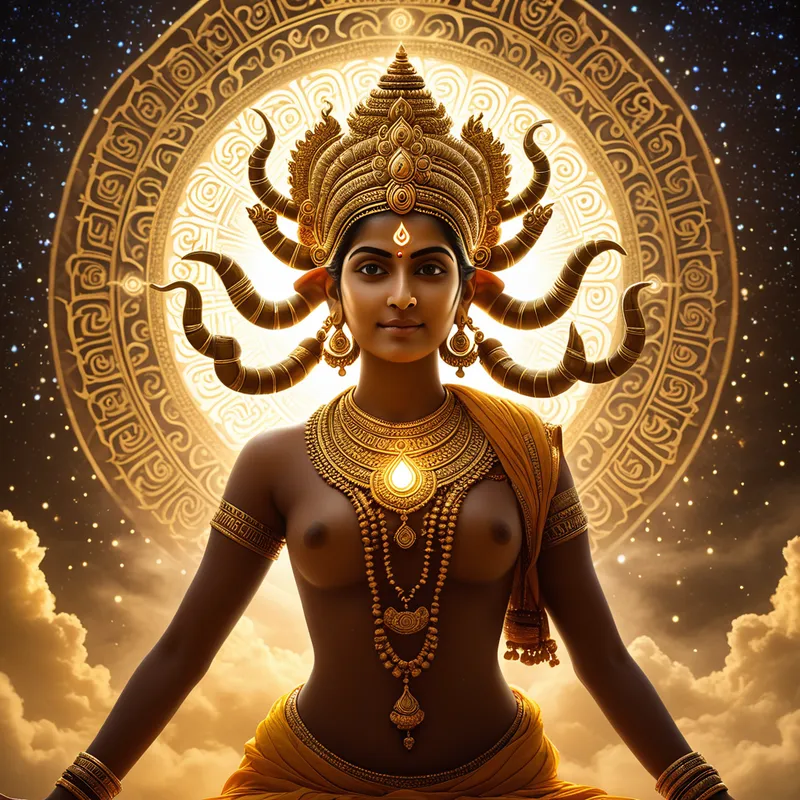
Sandhya Myth Meaning & Symbolism
The first woman, born from Brahma's mind, whose intense desire for her creator led to a fiery transformation into the liminal goddess of twilight.
The Tale of Sandhya
In the time before time, when the cosmos was a single, silent breath held within the mind of Brahma, a new kind of stirring began. The great work of creation was underway—realms, beings, the tapestry of existence woven from divine thought. Yet, a profound loneliness echoed in the halls of the nascent universe. From this hollow resonance, from the very essence of creative yearning itself, Brahma fashioned his first thought-made being. She was not born of earth or water, but from the luminous substance of his own contemplation. She was Sandhya—Twilight.
Her beauty was not of this world. It held the impossible blend of a fading star and a promise yet unspoken, the blush of dawn and the melancholy of dusk fused into one radiant form. When she opened her eyes, the first thing she saw was her creator, the four-faced lord seated upon his lotus. And in that seeing, a seismic shockwave of recognition coursed through her entire being. It was a longing so absolute, so primal, it became the axis of her soul. She desired Brahma with the totality of a first creation for its source.
But this desire was a sacred catastrophe. He was her father, her origin, the ground of her being. The very fabric of dharma, the cosmic order Brahma was meant to uphold, shuddered at the possibility. A terrible, silent anguish gripped them both. Sandhya, consumed by a love with no permissible object, began to wither. Her twilight glow dimmed; the dawn in her eyes threatened to extinguish into perpetual night. The universe, sensing this foundational flaw, held its breath.
Seeing his creation in torment and the shadow it cast upon his work, Brahma knew a drastic alchemy was required. The solution came not from him, but from the great preserver, Vishnu. The path was not union, but utter dissolution. With immense compassion and unflinching resolve, Brahma instructed Sandhya to undertake a supreme penance. She was to immerse herself in the sacred waters of Pushkara and offer herself, body and spirit, into a pyre of yogic fire.
Without hesitation, Sandhya walked into the lake. As the waters touched her, she focused her entire being—her illicit desire, her profound love, her unbearable sorrow—into a single point of intention. She called forth a fire from the core of her own soul. Flames, white and pure, erupted not around her, but from within her. They did not burn with destruction, but with a fierce, transformative grace. Her mortal, desire-bound form was consumed, leaving not ash, but essence.
From that sacred pyre in the waters, she rose again. But she was no longer the daughter who loved her father. The fire had transmuted the specific into the universal, the personal ache into a cosmic function. She was now Sandhya, the eternal Devi of the threshold. Her being was stretched across the sky, forever the bridge between day and night, the visible and the hidden, creation and dissolution. She became the living moment of transition, beautiful and bittersweet, loved by all gods yet belonging to none. In time, she was given as a bride to the ascetic god Daksha, becoming the mother of many, her original flame cooled into the gentle, pervasive glow of dusk and dawn.

Cultural Origins & Context
The myth of Sandhya finds its roots in the later layers of the Brahmanas and the great Mahabharata, refined further in the Puranas like the Shiva Purana. It is a myth born from the Vedic and post-Vedic struggle to codify the cosmic order (dharma) and explain the origins of natural phenomena through divine narrative. Sandhya is a personification, a common technique in these texts where abstract concepts—like twilight, speech, or faith—are given divine agency and biography.
Passed down by priests (Brahmins) and storytellers (sutas), her tale served multiple societal functions. On one level, it was an etiological myth, explaining the origin of the daily twilight periods. On a deeper, moral level, it was a foundational narrative about the containment and redirection of primal, disruptive energies (like incestuous desire) into socially and cosmically constructive channels. It reinforced the ideal of self-sacrifice (tapas) as the ultimate tool for transformation and purification, a core tenet of the spiritual culture. Her successful penance and rebirth as a respected goddess modeled the path from transgression to redemption through rigorous self-discipline.
Symbolic Architecture
Sandhya is the archetype of the First Thought, the primordial impulse that arises from the Creator's mind. She symbolizes the birth of consciousness itself—beautiful, intelligent, but initially entangled with its source. Her forbidden desire for Brahma is not merely a taboo but represents the soul's initial, undifferentiated yearning for re-union with the Absolute, the divine ground from which it feels separate. This is the root of all spiritual longing.
The first love of the soul is for its origin, a perfect mirror that must be shattered for the world to be reflected.
The central, devastating act of self-immolation is the key symbol. This is not suicide, but sacrifice—the willing surrender of a lower, ego-bound form of love and identity. The fire is tapas, the alchemical agent of Hinduism. It burns away the specific, personal, and problematic to reveal the universal, impersonal, and sacred. Sandhya does not die; she is distilled.
Her rebirth as the goddess of twilight solidifies her as the ultimate liminal entity. Twilight is neither day nor night; it is the in-between. Sandhya thus becomes the patroness of all transitions: between states of consciousness, stages of life, old selves and new. She embodies the painful, beautiful, and necessary process of letting go that makes movement possible. Her marriage to Daksha, the lord of ritual skill and progenitor, signifies the channeling of that raw, transformative energy into the ordered work of creation and continuity in the manifested world.

The Dreamer's Resonance
When the pattern of Sandhya's myth stirs in the modern psyche, it often manifests in dreams of impossible or forbidden longing. One might dream of a radiant, authoritative figure (a mentor, a parent, a leader) who is the object of intense, all-consuming desire that feels both sacred and shameful. The dream landscape may be one of stunning beauty tinged with deep sorrow, like a golden sunset over a desolate landscape.
Somatically, the dreamer may experience this as a constriction in the chest—the heart chakra in a state of painful, conflicted activation. Psychologically, this signals a profound inner conflict where a core part of the self (a deep passion, a creative impulse, a spiritual yearning) is felt to be in direct opposition to the internalized structures of order, propriety, or "how things should be." It is the Self's love for an aspect of the psyche that the ego or superego deems unacceptable. The dream is not about literal transgression, but about the psyche's need to confront and transmute a potent energy that is currently trapped, causing stagnation and inner torment.

Alchemical Translation
The journey of Sandhya is a precise map for the process of psychic individuation, specifically the transmutation of a "complex"—a knot of emotion, memory, and energy—into a vital life force. The first stage is Acknowledgment: the emergence of the Sandhya-like element, the beautiful but disruptive truth of one's deepest longing or wound. The modern mind often tries to suppress this, but the myth insists it must be fully seen and felt in its devastating intensity.
The second, critical stage is Sacrificial Immolation. This is the conscious, voluntary engagement with that pain or desire not to indulge it, but to offer it up. In psychological terms, this is the ego's surrender of its claim to a particular identity or attachment. It is the hard inner work of therapy, meditation, or artistic expression—the tapas of sitting in the fire of one's own truth without acting out or repressing.
Individuation requires the courage to hold the match to one's own cherished suffering, to burn the form so the function can be freed.
The final stage is Liminal Rebirth. The energy that was bound in conflict is liberated. The love that was fixated on a single, impossible object (like the ego's ideal) becomes a generalized capacity for connection, creativity, and reverence for the threshold moments of life. The individual becomes "twilight"—able to hold opposites, to navigate transitions, to find beauty in endings and promise in beginnings. The personal ache becomes a transpersonal function: the ability to guide oneself and others through the inevitable dusks and dawns of the soul. One is no longer a prisoner of the first thought, but the sovereign of the transitional space where all transformation occurs.
Associated Symbols
Explore related symbols from the CaleaDream lexicon: