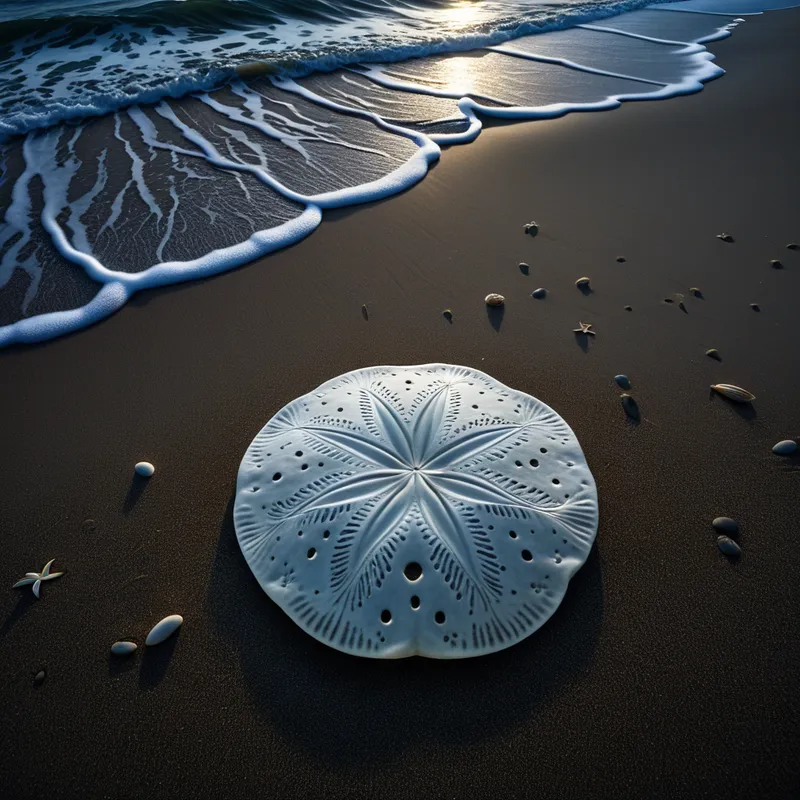
Sand Dollar Myth Meaning & Symbolism
A fallen star becomes a humble sea creature, its shell etched with the symbols of Christ's Passion, a hidden testament of faith washed ashore.
The Tale of the Sand Dollar
Listen, and let the salt air carry you to a forgotten shore, where the ocean whispers secrets to the sand. In the time before memory, when the sky wept for the sorrows of the world, a single, grieving star could bear the celestial weight no longer. It broke from its silver moorings and fell, a silent, burning tear, into the waiting arms of the sea.
The cold, dark waters quenched its fire but could not erase its light. The star’s essence, now a humble, round form, settled into the soft seabed. It was no longer a beacon for the heavens, but a creature of the deep, a sand dollar. Yet, the memory of the divine was etched upon its very being. Upon its bleached white shell, five precise apertures appeared, arranged like the petals of the Easter Lily. At its center, a perfect five-pointed star, the ghost of its former self, remained. On the opposite face, the outline of the Christmas Poinsettia was carved, and at its heart, a tiny, five-pointed star.
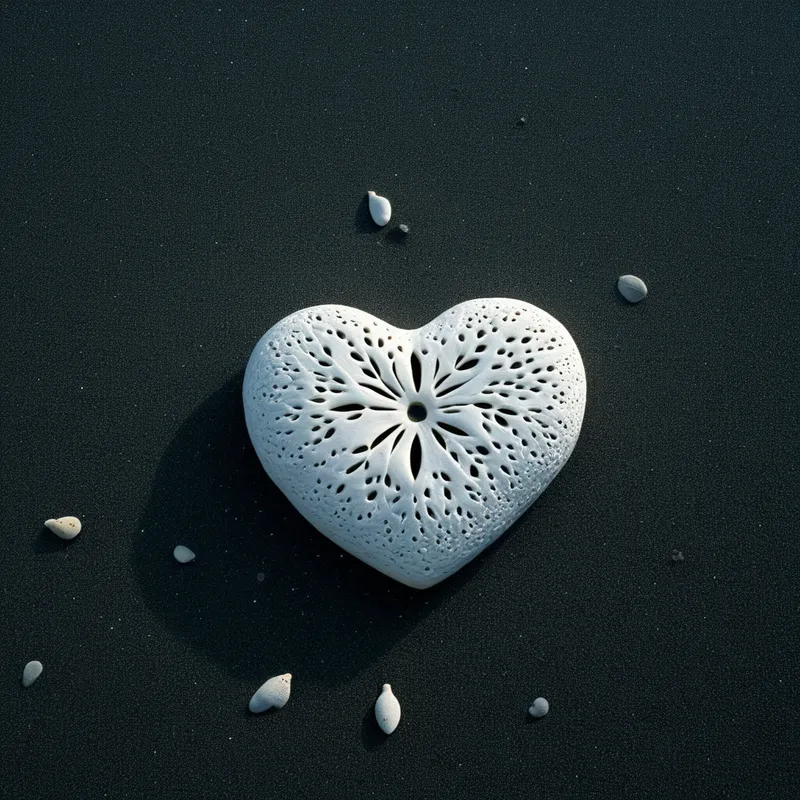
But the story does not end in the quiet dark. The sand dollar, in its silent life, became a living testament. When it perishes and is cast upon the shore, a final mystery is revealed. If you find this fragile disc and break it open with care, five small, winged pieces will tumble into your palm. They are not bones, but doves—pure, white, and ready for flight. They are the doves of peace, held within the tomb of the shell, waiting for the moment of release to carry their message to the world.
Thus, the fallen star became a hidden gospel, a parable written not on parchment, but on calcium and tide. It is a story told by the surf, found by the curious hand, and completed by the gentle crack that sets the spirit free.
Cultural Origins & Context
The myth of the Sand Dollar is a beautiful example of Christian semiotics woven into the fabric of coastal and rural folklore, primarily in North America and the British Isles. It belongs not to ancient scripture, but to the oral tradition of fishermen, sailors, and families who walked the shoreline, seeking meaning in the flotsam and jetsam of their world.
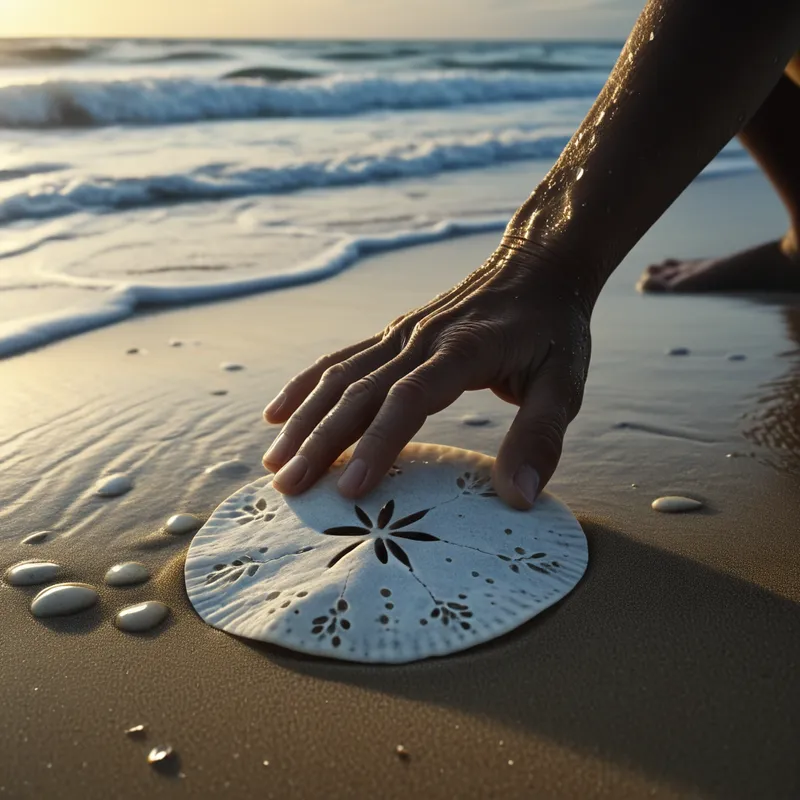
This narrative was passed down as a "shore story," a teaching tale often shared with children. A grandparent would place the strange, coin-like object in a child's hand and point out its markings, transforming a simple beachcombing find into a sacred relic. It served a dual societal function: it was a tool for covert catechism, embedding the symbols of Christ's Passion (the five wounds, the star of Bethlehem, the Easter lily) into everyday discovery, and it was an act of enchantment, revealing the divine hidden within the ordinary, mundane world. It affirmed that faith and mystery could be found anywhere, even at one's feet, requiring only the eyes to see and the lore to understand.
Symbolic Architecture
The Sand Dollar is a perfect hieros gamos of the celestial and the terrestrial, the eternal and the ephemeral. Its symbolism is a layered architecture of faith.
The fallen star represents divine grace descending into the material realm, the Incarnation made literal through nature. Its transformation into a living, then dead, creature speaks to the Kenosis—the self-emptying of Christ to take on mortal form. The shell itself is the body, the temporary vessel.
The most profound truths are not shouted from the heavens, but whispered through broken shells on forgotten shores.
The five apertures symbolize the five sacred wounds. The central five-pointed star is the Star of Bethlehem, guiding the way. The Easter lily on one side speaks of resurrection; the Poinsettia on the other of Nativity, thus containing the entire cycle of birth, death, and rebirth. Finally, the internal doves are the clearest symbol: the Holy Spirit, imprisoned within the suffering of the world (the hard shell), released only through an act of sacred breaking (the Resurrection). The entire object is a natural relic, a tactile rosary for the poor who could not afford gold or jewels, but who had the whole sea as their cathedral.

The Dreamer's Resonance
To dream of a sand dollar is to dream of a hidden truth seeking recognition. The dreamer is often in a state of processing a loss, a disappointment, or a feeling of having "fallen from grace" in some personal sphere—a lost job, a failed relationship, a faded ideal. The sand dollar in the dream represents that wounded, hardened part of the self that feels discarded and empty.
Finding one intact suggests a nascent awareness of this inner sacred geometry, a sense that within the current struggle lies a hidden, meaningful pattern. The act of breaking it open in a dream is profoundly significant. It mirrors the psychological necessity of breaking open one's defensive shell, one's rigid identity born of suffering, to release what is trapped inside. The doves are the liberated feelings, the peace, the creative spirit, or the love that was compartmentalized and protected during the time of hardship. The dream is a somatic message from the unconscious: the structure that once protected you is now a tomb. It is time to initiate the break, to trust that what emerges will not be dust, but wings.
Alchemical Translation
The myth of the Sand Dollar is a perfect map for the alchemical process of individuation. It begins with the nigredo, the blackening: the star falls, is extinguished, and becomes a creature of the dark seabed. This is the ego's necessary descent, the encounter with failure, shadow, and mortality.
The etching of the symbols upon the shell is the albedo, the whitening. It is the stage of analysis, of finding meaning and pattern in the suffering. The dreamer begins to see their wounds not as random scars, but as part of a sacred, purposeful geometry—the five apertures of their personal passion.
The final stage of the Great Work is not the creation of gold, but the liberation of spirit from the crucible of experience.
The washing ashore is the citrinitas, the yellowing, bringing this newly understood self-structure into the light of consciousness. But the work is not complete until the rubedo, the reddening. This is the final, courageous act of transmutation: the breaking of the shell. The ego-structure, now understood and valued for its symbolic role, must be voluntarily sacrificed. It is not destroyed, but transcended. What was solid (the calcified identity of one who suffered) becomes fragmented to release what is truly alive (the doves of spirit, insight, and renewed life). The modern individual undergoes this each time they consciously reframe a core wound, not as a story of victimhood, but as the necessary vessel for the birth of their deepest, most peaceful self. The sand dollar teaches that we are all fallen stars, bearing sacred markings, waiting for the tide of our own awareness to carry us to the point of sacred rupture and release.
Associated Symbols
Explore related symbols from the CaleaDream lexicon: