Samudra Manthan Myth Meaning & Symbolism
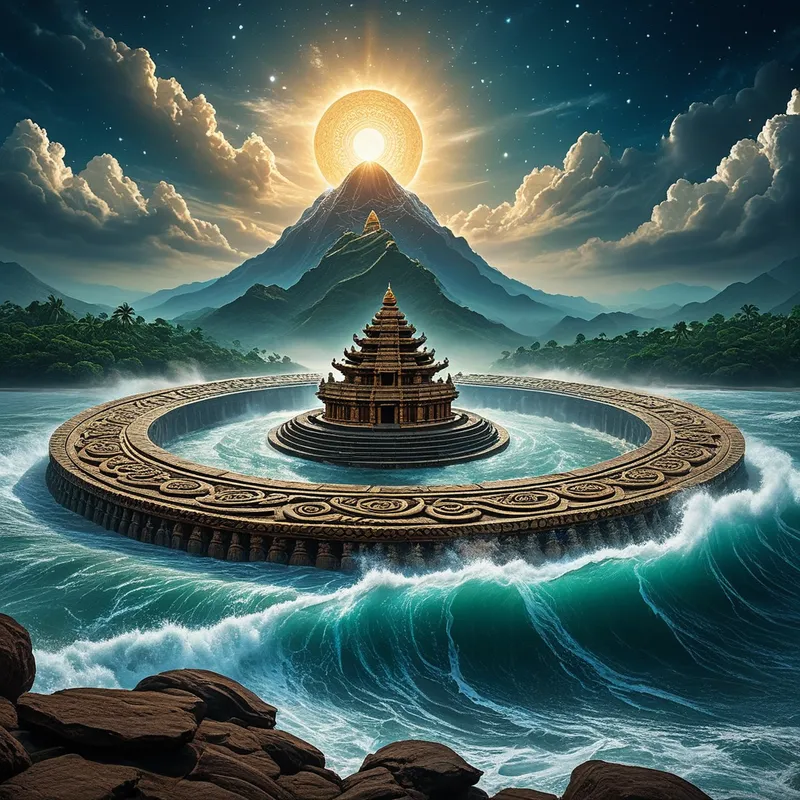
Gods and demons churn the cosmic ocean for the nectar of immortality, birthing both poison and divine treasures from the depths of chaos.
The Tale of Samudra Manthan
Listen. Before time was measured, when the universe was a vast, unformed sea of potential, a great weariness fell upon the realms. The Devas had grown weak, their radiance dimmed by the relentless strength of the Asuras. The cosmic balance, the very Dharma of existence, teetered on the edge of dissolution. Immortality was needed, a draught to restore the eternal order.
So, in council with the great preserver [Vishnu](/myths/vishnu “Myth from Hindu culture.”/), a plan was forged—a plan of profound audacity and necessary alliance. They would churn the cosmic ocean, the [Kshirasagara](/myths/kshirasagara “Myth from Hindu culture.”/), to bring forth Amrita. But such a task required the strength of both order and chaos, light and shadow. The Devas and Asuras, eternal enemies, would have to work as one.
They uprooted the mighty mountain Mandara to serve as their churn. The great serpent-king Vasuki offered himself as the rope. The Devas took the tail end; the Asuras, the head. And they began to pull. Back and forth, with groans that shook the foundations of the worlds, they churned the milky depths. The mountain began to sink, unable to bear its own weight in the soft ocean bed.
Then, from the depths, [Kurma](/myths/kurma “Myth from Hindu culture.”/) arose—the cosmic turtle, an incarnation of Vishnu himself. Upon his immense, unshakeable shell, Mount Mandara found its footing. The churning resumed, a titanic, rhythmic grinding of existence against itself.
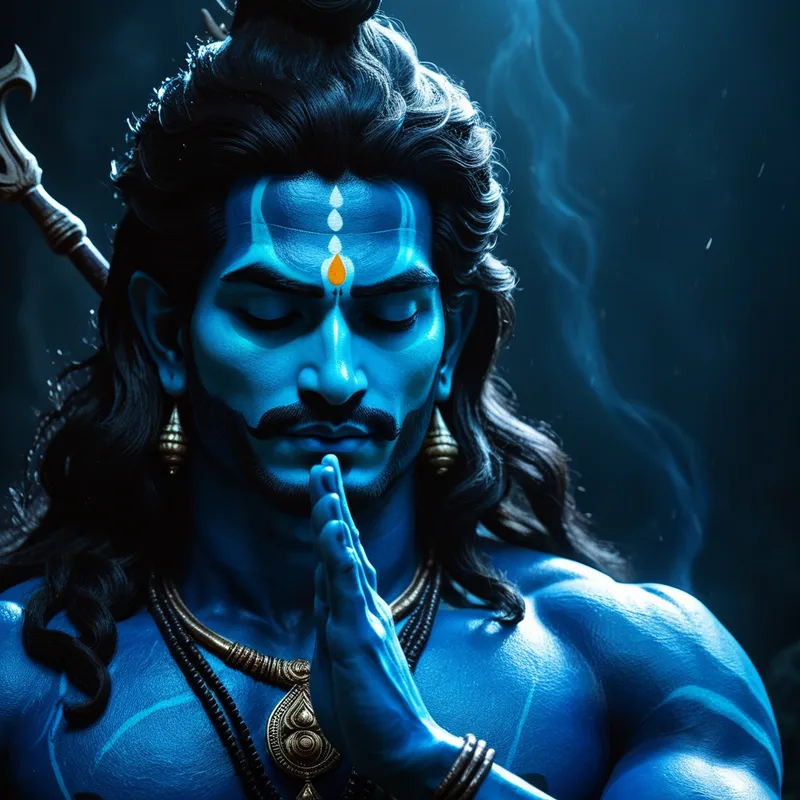
But the first fruit of this labor was not nectar. It was a thick, black, suffocating smoke that coalesced into a searing, world-annihilating poison—Halahala. It spread, threatening to consume all creation in its toxic fumes. In desperation, all turned to [the ascetic](/myths/the-ascetic “Myth from Christian culture.”/) god [Shiva](/myths/shiva “Myth from Hindu culture.”/), the great yogi who contains all opposites. Moved by compassion for a trembling universe, [Shiva](/myths/shiva “Myth from Hindu culture.”/) gathered the virulent poison and drank it. His consort, Parvati, gripped his throat to prevent the poison from descending. There it stayed, turning his throat a permanent, brilliant blue, earning him the name Neelakantha. The crisis was averted by an act of supreme containment.
Emboldened, the churning continued. And from the depths, wonders began to emerge. The celestial cow [Kamadhenu](/myths/kamadhenu “Myth from Hindu culture.”/), [the white elephant](/myths/the-white-elephant “Myth from Buddhist/Jataka Tales culture.”/) Airavata, the goddess of wine Varuni, [the moon](/myths/the-moon “Myth from Tarot culture.”/) Chandra, the divine tree [Kalpavriksha](/myths/kalpavriksha “Myth from Hindu culture.”/), and the goddess [Lakshmi](/myths/lakshmi “Myth from Hindu culture.”/), who arose in her splendor and chose Vishnu as her eternal consort.
Finally, the physician of the gods, Dhanvantari, emerged holding the glowing pot of Amrita. The Asuras, seeing the prize, seized it. Chaos erupted. Once more, Vishnu intervened, taking the form of the enchanting Mohini. Distracting the Asuras with divine allure, Mohini retrieved the pot and served the nectar only to the Devas, restoring their sovereignty and the balance of the cosmos. The great churning was complete. The ocean, once placid, had yielded both its darkest venom and its most radiant light.
Cultural Origins & Context
The myth of [the Samudra Manthan](/myths/the-samudra-manthan “Myth from Hindu culture.”/) is a foundational narrative within the Puranic literature, most prominently detailed in texts like the Mahabharata and the Vishnu Purana. It is not merely a story but a cosmological map, recited for millennia by priests and storytellers to explain the origin of various divine entities, natural phenomena, and the very structure of reality.
Its societal function was multifaceted. It served as an allegory for the Vedic ritual of sacrifice (Yajna), where the churning represents the arduous process of ritual action to produce spiritual merit. It reinforced the core Hindu concept of Dharma, illustrating that even eternal enemies (Devas and Asuras) must sometimes cooperate within a larger divine framework to achieve a cosmic goal. The myth also provided an etiological explanation for the origins of precious things—from the moon in [the sky](/myths/the-sky “Myth from Persian culture.”/) to the medicinal arts embodied by Dhanvantari—embedding the divine within the fabric of the everyday world.
Symbolic Architecture
At its [heart](/symbols/heart “Symbol: The heart symbolizes love, emotion, and the core of one’s existence, representing deep connections with others and self.”/), Samudra Manthan is a grand [allegory](/symbols/allegory “Symbol: A narrative device where characters, events, or settings represent abstract ideas or moral qualities, conveying deeper meanings through symbolic storytelling.”/) for the process of profound inner work. The cosmic [ocean](/symbols/ocean “Symbol: The ocean symbolizes the vastness of the unconscious mind, representing deeper emotions, intuition, and the mysteries of life.”/) is the vast, unconscious [psyche](/myths/psyche “Myth from Greek culture.”/)—the Kshirasagara, a sea of potential not yet differentiated into conscious thought. The churning is the deliberate, often painful, [effort](/symbols/effort “Symbol: Effort signifies the physical, mental, and emotional energy invested toward achieving goals and personal growth.”/) to engage with this [depth](/symbols/depth “Symbol: Represents profound layers of consciousness, hidden truths, or the unknown aspects of existence, often symbolizing introspection and existential exploration.”/).
The nectar of immortality lies buried beneath leagues of primordial sludge. One cannot be reached without disturbing the other.
The Devas and Asuras represent the eternal polarity within [the self](/myths/the-self “Myth from Jungian culture.”/): the aspirational, ordering principles ([consciousness](/symbols/consciousness “Symbol: Consciousness represents the state of awareness and perception, encompassing thoughts, feelings, and experiences.”/), light, [spirit](/symbols/spirit “Symbol: Spirit symbolizes the essence of life, vitality, and the spiritual journey of the individual.”/)) and the instinctual, chaotic drives (the unconscious, [shadow](/symbols/shadow “Symbol: The ‘shadow’ embodies the unconscious, repressed aspects of the self and often represents fears or hidden emotions.”/), [material](/symbols/material “Symbol: Material signifies the tangible aspects of life, often representing physical resources, desires, and the physical world’s influence on our existence.”/) desire). True transformation requires engaging both, not by vanquishing one, but by putting them to a common [task](/symbols/task “Symbol: A task represents responsibilities, duties, or challenges one faces.”/). The [mountain](/symbols/mountain “Symbol: Mountains often symbolize challenges, aspirations, and the journey toward self-discovery and enlightenment.”/) Mandara is the [axis](/symbols/axis “Symbol: A central line or principle around which things revolve, representing stability, orientation, and the fundamental structure of reality or consciousness.”/) mundi, the central pillar of the individual’s world, their [spine](/symbols/spine “Symbol: The spine symbolizes strength, support, and the foundational structure of one’s life and identity.”/) and resolve. The [serpent](/symbols/serpent “Symbol: A powerful symbol of transformation, wisdom, and primal energy, often representing hidden knowledge, healing, or temptation.”/) Vasuki is the coiled, primal [energy](/symbols/energy “Symbol: Energy symbolizes vitality, motivation, and the drive that fuels actions and ambitions.”/) ([Kundalini](/symbols/kundalini “Symbol: A dormant spiritual energy coiled at the base of the spine, representing untapped potential and awakening consciousness through ascension.”/)) that must be harnessed.
The first yield being the deadly poison is the myth’s most crucial psychological [truth](/symbols/truth “Symbol: Truth represents authenticity, honesty, and the quest for knowledge beyond mere appearances.”/). Any deep dive into the unconscious risks encountering the psychic toxins we have repressed: [trauma](/symbols/trauma “Symbol: A deeply distressing or disturbing experience that overwhelms the psyche, often manifesting in dreams as unresolved emotional wounds or psychological injury.”/), rage, [shame](/symbols/shame “Symbol: A painful emotion arising from perceived failure or violation of social norms, often involving exposure of vulnerability or wrongdoing.”/), and fear. This is the Halahala. Shiva’s act is the [archetype](/symbols/archetype “Symbol: A universal, primordial pattern or prototype in the collective unconscious that shapes human experience, behavior, and creative expression.”/) of conscious containment. He does not destroy the poison; he transforms it by holding it within his own being, neutralizing its destructive power through transcendent [awareness](/symbols/awareness “Symbol: Conscious perception of self, surroundings, or internal states. Often signifies awakening, insight, or heightened sensitivity.”/). This is the model for integrating [the shadow](/myths/the-shadow “Myth from Jungian culture.”/), not by expulsion, but by [assimilation](/symbols/assimilation “Symbol: The process of integrating new experiences, identities, or knowledge into one’s existing self, often involving adaptation and transformation.”/).
The treasures that follow—Lakshmi (inner [abundance](/symbols/abundance “Symbol: A state of plentifulness or overflowing resources, often representing fulfillment, prosperity, or spiritual richness beyond material needs.”/)), Kamadhenu (nourishment), Chandra ([clarity](/symbols/clarity “Symbol: A state of mental transparency and sharp focus, often representing resolution of confusion or attainment of insight.”/))—are the latent potentials and wholeness that become available only after facing and containing the poison. The final retrieval of the Amrita by Mohini signifies that the ultimate prize, Self-realization, often requires a transcendence of rigid, dualistic [identity](/symbols/identity “Symbol: Identity represents the sense of self, encompassing personal beliefs, cultural background, and social roles.”/) (male/female, god/[demon](/symbols/demon “Symbol: Demons often symbolize inner fears, repressed emotions, or negative aspects of oneself that the dreamer is struggling to confront.”/)) to be fully secured.
The Dreamer’s Resonance
When this myth stirs in the modern dreamer, it announces a period of intense psychic fermentation. You may dream of being on a vast, turbulent sea, engaged in a labor that feels both futile and utterly necessary. You might be pulling on a rope with an unseen “other,” or watching bizarre and wondrous objects emerge from murky [water](/myths/water “Myth from Chinese culture.”/).
Somatically, this can feel like a grinding tension in the body—a tightness in the jaw, shoulders, or gut—the physical correlate of the churning. Psychologically, it is the process of a long-held conflict or a deep-seated pattern finally coming to a head. The “poison” emerging in dreams could be a confrontation with a forgotten memory, a surge of inexplicable anger, or a profound anxiety. The dream is not a warning to stop, but an indication that you are in the middle of the alchemical process. The treasure and the toxin are being born together. The dream asks: Do you have a “Shiva” within—a capacity for witness consciousness that can hold this toxicity without being destroyed by it?

Alchemical Translation
For the individual on the path of individuation, Samudra Manthan is the ultimate blueprint for psychic transmutation. It models the journey from a state of weary, one-sided consciousness (the weakened Devas) to a more complete, resilient Self.
The first step is recognizing the need for the “nectar”—a longing for deeper meaning, vitality, or wholeness that your current conscious attitude cannot provide. This forces [the ego](/myths/the-ego “Myth from Jungian culture.”/) (the Deva) into an uneasy alliance with all it has rejected—the shadow, the complexes, the unruly passions (the Asura). You must consent to the churning: the therapy, the journaling, the difficult conversations, the silent meditation where repressed material surfaces.
The shell of the turtle is the grounded, embodied presence that prevents the psyche from collapsing into its own chaos during this work.
The emergence of the poison is inevitable. In alchemical terms, this is the [nigredo](/myths/nigredo “Myth from Alchemical culture.”/), the blackening, the descent into the darkest material. The modern individual must become their own Shiva, developing the capacity to “drink” this poison—to feel the full force of grief, rage, or fear without acting it out or being identified with it. This is the act of containment that turns lead into the first promise of gold.
The treasures that arise are the new psychic functions and attitudes: creative inspiration (Kalpavriksha), inner stability and sovereignty (Lakshmi), healing wisdom (Dhanvantari). Finally, the Amrita is the experience of inner timelessness, a connection to the Self that is beyond the ego’s petty wars. The Mohini episode reminds us that this final integration often requires a graceful, enchanting intelligence—a flexibility of consciousness that can outmaneuver the ego’s greed to claim the prize for itself alone.
The myth concludes not with the destruction of the Asuras, but with the restoration of balance. The churning stops, but the ocean remains, now richer for having been stirred. So too, the individuated Self is not a state where conflict ends, but one where the tension of opposites becomes the creative engine of a more conscious, complete, and immortal life.
Associated Symbols
Explore related symbols from the CaleaDream lexicon: