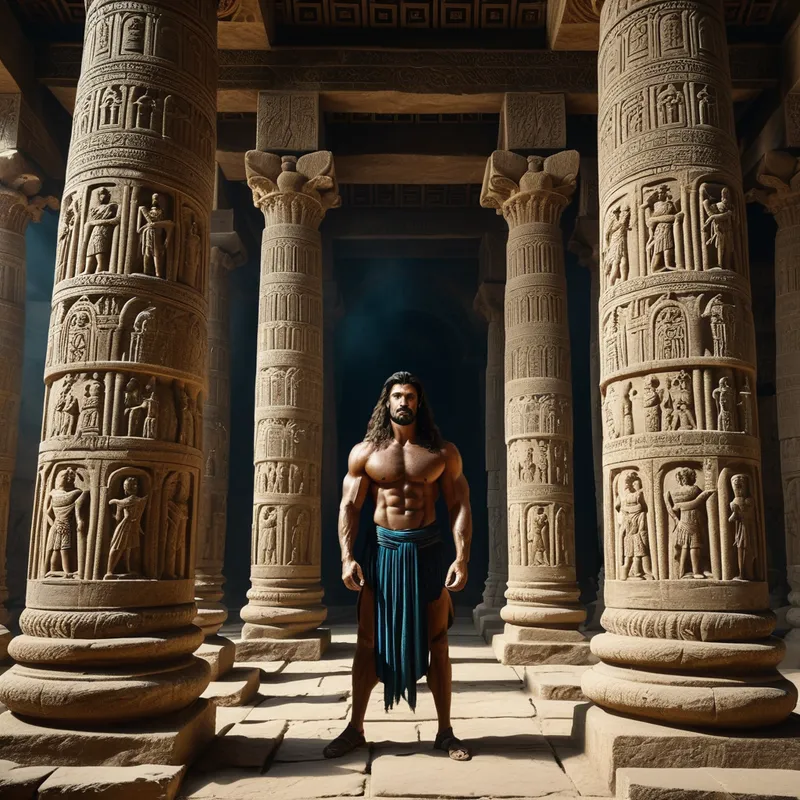
Samson and the Temple Pillars Myth Meaning & Symbolism
A blinded hero, betrayed by love, finds his strength one last time to bring down the temple of his enemies, sacrificing himself for his people's liberation.
The Tale of Samson and the Temple Pillars
Hear now the tale of the sun-born, the one whose strength was a secret river flowing from a sacred vow. His name was [Samson](/myths/samson “Myth from Biblical culture.”/), a judge in Israel, whose locks were seven cords of a covenant unshorn, and whose arms could rend a young lion as if it were a kid. Yet his heart was a battlefield, torn between his divine calling and the fire of his eyes for women of the Philistines.
First, there was the woman of Timnah, then the harlot of Gaza. But the final snare was Delilah, whose name means “delicate,” yet whose purpose was forged of iron and silver. The lords of the Philistines came to her, their whispers heavy with coin. “Entice him,” they said, “and see wherein his great strength lieth.”
Three times she wove her web of words—“Tell me, Samson, how might you be bound?”—and three times he wove a lie. With fresh bowstrings, with new ropes, with the weaving of his hair into a loom, he spoke false secrets, and each time he snapped his bonds like thread touched by flame. But her words were a constant drip, wearing down the stone of his resolve. “How can you say you love me,” she wept, “when your heart is not open to me?”
And so, wearied unto the soul, he told her all. “A razor has never come upon my head,” he confessed, the weight of his sacred Nazirite vow hanging in the air. “If I be shaven, then my strength will leave me, and I shall become weak like any other man.”
She laid his head upon her knee, a gesture of tender betrayal. As he slept, the shears whispered, and seven locks of his hair fell away. [The river](/myths/the-river “Myth from Buddhist culture.”/) of his strength ran dry. “The Philistines be upon thee, Samson!” she cried. He awoke, shaking himself as before, but the spirit of YHWH had departed from him. He did not know he was now merely flesh.
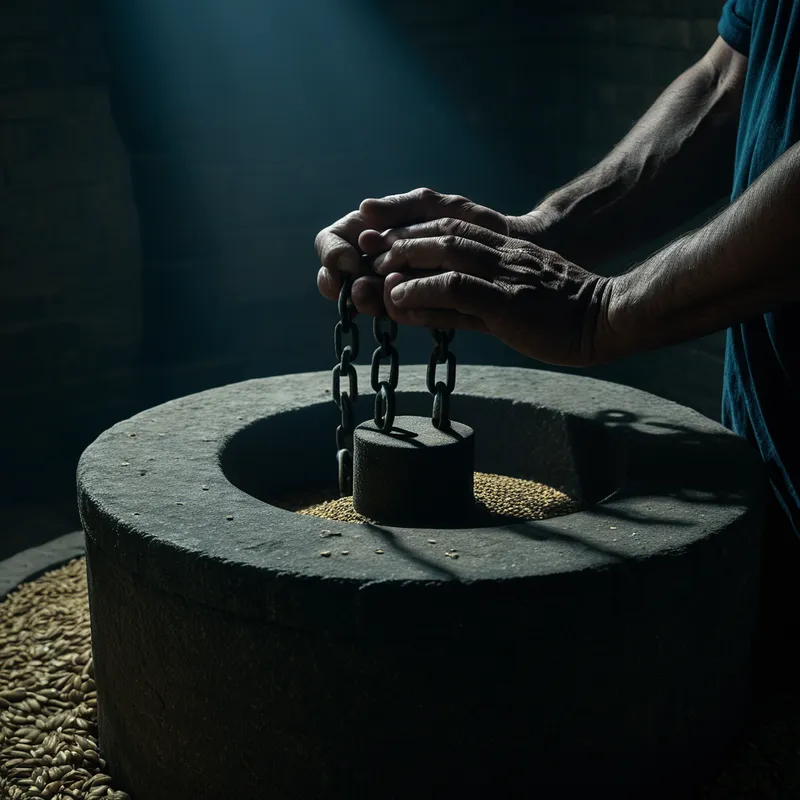
They seized him. They put out his eyes, the very organs of his fatal desire. They bound him with bronze fetters and led him down to Gaza, to a prison house of grinding stone. There, the man who once carried the gates of a city upon his shoulders now turned a millstone in endless, blind circles. His hair began to grow again, a silent, secret promise in the dark.
Then came the day of a great feast to Dagon, their god. “Our god has delivered our enemy into our hand,” they roared, their voices thick with wine and [triumph](/myths/triumph “Myth from Roman culture.”/). They called for Samson from the prison to make sport. A boy led the blind giant into [the temple](/myths/the-temple “Myth from Jewish culture.”/), a structure packed with lords and common folk alike, thousands upon the roof and in the court, laughing at the broken hero.
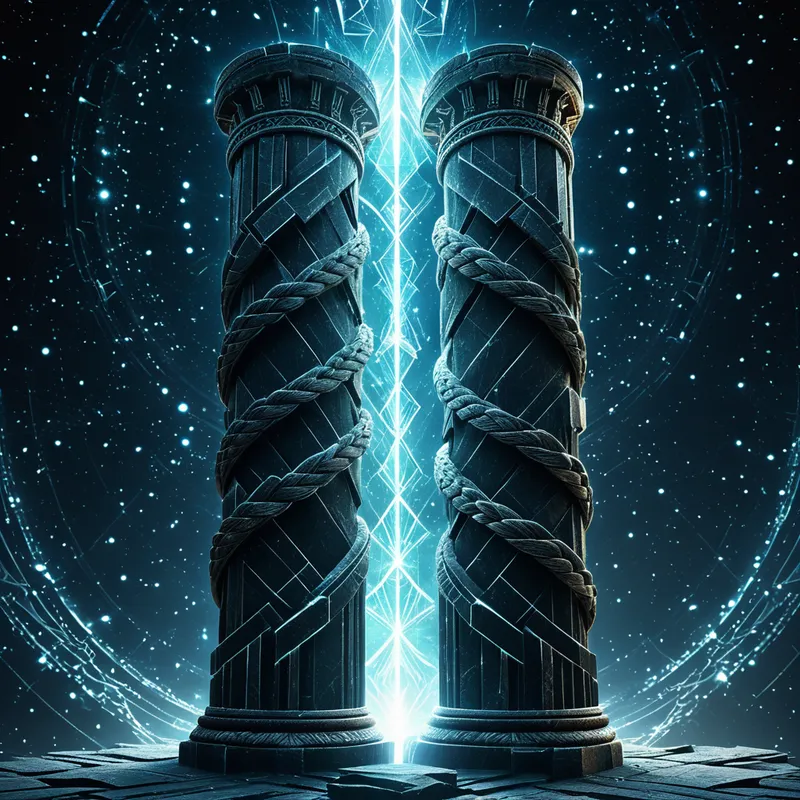
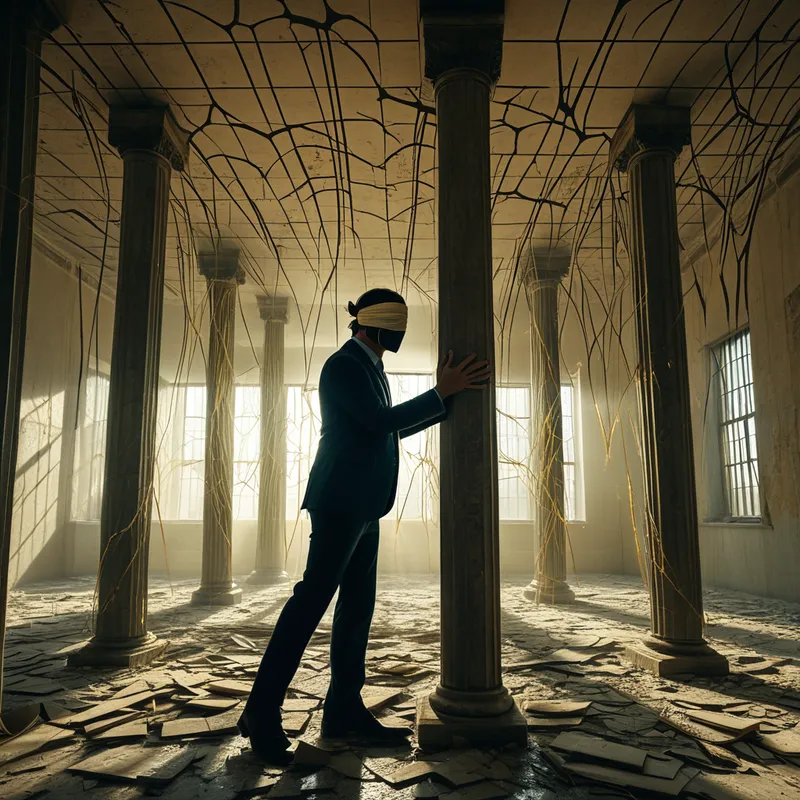
Samson felt the cool stone of the two central pillars that supported the house. He spoke to the boy, his voice low. “Let me feel the pillars whereupon the house standeth, that I may lean upon them.” The crowd jeered. He placed a hand on each massive column. Then, in that moment of ultimate isolation and clarity, he prayed a prayer not for life, but for vengeance and remembrance. “O Lord GOD, remember me, I pray thee, and strengthen me, I pray thee, only this once.”
He bowed himself with all his might. The pillars groaned. Stone grated against stone. A crack shot upward like lightning through marble. Then, with a roar that swallowed the screams of the crowd, the temple fell upon the lords and upon all the people within. The dead he slew at his death were more than he had slain in his life. In the rubble, the secret river of his strength, returned for one final, catastrophic flow, found its end and its purpose.
Cultural Origins & Context
This narrative is preserved in the Tanakh, within the Book of Judges (chapters 13-16). It belongs to a cycle of stories about charismatic, often flawed leaders who arose to deliver the tribes of Israel from oppression during a turbulent, pre-monarchic period. The tale of Samson functions as a complex folk-hero saga, blending elements of the superhuman strongman with profound theological and moral ambiguity.
It was an oral tradition long before it was codified, told around fires and in gatherings, serving multiple societal functions. On one level, it explained ongoing conflict with the Philistines. On another, it was a cautionary tale about the dangers of breaking sacred vows (nazir) and succumbing to personal desire over communal duty. Samson is no perfect prophet or pious king; he is a man of immense potential tragically compromised by his passions, making him a profoundly relatable and human figure within the biblical canon. His final act, however, reclaims his destiny within the divine framework, transforming personal failure into a collective, if cataclysmic, victory.
Symbolic Architecture
The myth is built upon a [foundation](/symbols/foundation “Symbol: A foundation symbolizes the underlying support systems, values, and beliefs that shape one’s life, serving as the bedrock for growth and development.”/) of potent, opposing symbols. Samson himself is the raw numinous force, a solar [hero](/symbols/hero “Symbol: A hero embodies strength, courage, and the ability to overcome significant challenges.”/) whose [strength](/symbols/strength “Symbol: ‘Strength’ symbolizes resilience, courage, and the ability to overcome challenges.”/) is paradoxically tied to his [hair](/symbols/hair “Symbol: Hair often symbolizes identity, power, and self-expression, reflecting how we perceive ourselves and how we wish to be perceived by others.”/)—a [symbol](/symbols/symbol “Symbol: A symbol can represent an idea, concept, or belief, serving as a powerful tool for communication and understanding.”/) of vitality, [life](/symbols/life “Symbol: The symbol of ‘Life’ represents a journey of growth, interconnectedness, and existential meaning, encompassing both the joys and challenges that define human experience.”/) force, and his sacred vow. His [blindness](/symbols/blindness “Symbol: Represents a lack of awareness, insight, or refusal to see truth, often tied to emotional avoidance or spiritual ignorance.”/) is not just physical [punishment](/symbols/punishment “Symbol: A dream symbol representing consequences for actions, often tied to guilt, societal rules, or internal moral conflicts.”/) but the symbolic state of one who has lived by external [sight](/symbols/sight “Symbol: Sight symbolizes perception, awareness, and insight, representing both physical and inner vision.”/) and desire, now forced into an inner darkness.
The pillars are the axis of the world. To pull them down is not mere destruction; it is the dissolution of a perceived, oppressive reality.
Delilah represents the [anima](/symbols/anima “Symbol: The feminine archetype within the male unconscious, representing soul, creativity, and connection to the inner world.”/) as betrayer, the personal love that becomes the [instrument](/symbols/instrument “Symbol: An instrument symbolizes creativity, communication, and the means by which one expresses oneself or influences the world.”/) of a collective or [shadow](/symbols/shadow “Symbol: The ‘shadow’ embodies the unconscious, repressed aspects of the self and often represents fears or hidden emotions.”/) force (the Philistines). The [temple](/symbols/temple “Symbol: A temple often symbolizes spirituality, sanctuary, and a deep connection to the sacred aspects of life.”/) of Dagon is the edifice of the [alien](/symbols/alien “Symbol: Represents the unknown, otherness, and the exploration of new ideas or experiences.”/) other, the psychological complex of values, beliefs, and powers that hold the individual or the [community](/symbols/community “Symbol: Community in dreams symbolizes connection, support, and the need for belonging.”/) in captivity. Samson’s grinding at the mill is the ultimate [image](/symbols/image “Symbol: An image represents perception, memories, and the visual narratives we create in our minds.”/) of enslaved potential, the [soul](/symbols/soul “Symbol: The soul represents the essence of a person, encompassing their spirit, identity, and connection to the universe.”/) forced into meaningless, repetitive labor.
His final [prayer](/symbols/prayer “Symbol: Prayer represents communication with the divine or a higher power, often reflecting inner desires and spiritual needs.”/) and act synthesize these symbols. His returning hair signifies the slow, unconscious [regeneration](/symbols/regeneration “Symbol: The process of renewal, restoration, and growth following damage or depletion, often representing emotional healing, transformation, or a fresh start.”/) of [the Self](/myths/the-self “Myth from Jungian culture.”/). His embrace of the pillars is an embrace of his [fate](/symbols/fate “Symbol: Fate represents the belief in predetermined outcomes, suggesting that some aspects of life are beyond human control.”/) and the foundational [structure](/symbols/structure “Symbol: Structure in dreams often symbolizes stability, organization, and the framework of one’s life, reflecting how one perceives their environment and personal life.”/) of his conflict. The collapse represents the necessary, apocalyptic destruction of the old [identity](/symbols/identity “Symbol: Identity represents the sense of self, encompassing personal beliefs, cultural background, and social roles.”/) and the oppressive [system](/symbols/system “Symbol: A system represents structure, organization, and interrelated components functioning together, often reflecting personal or social order.”/), from which no old form of life—including his own—can emerge intact.
The Dreamer’s Resonance
When this myth stirs in the modern dreamscape, it speaks of a [psyche](/myths/psyche “Myth from Greek culture.”/) at a point of catastrophic transformation. To dream of being a blinded strongman suggests a profound feeling that one’s guiding vision or life’s work has been betrayed, often by a trusted relationship or a personal weakness one refused to acknowledge. The dreamer may feel their strength is gone, that they are grinding through life in a prison of their own making.
Dreams of pulling down pillars or causing a building to collapse are not necessarily nightmares of anxiety, but somatic visions of necessary deconstruction. The psyche is announcing that a long-held structure—a career, a identity, a belief system, a relationship dynamic—has become a temple to a false god (ego, obligation, the expectations of others) and must fall. The feeling upon waking is often one of awe and terror mixed: the terror of the collapse, but the awe of a power, long dormant, reasserting itself for one definitive, cleansing act.
Alchemical Translation
The alchemical journey of Samson is the [nigredo](/myths/nigredo “Myth from Alchemical culture.”/) of the heroic path. His initial feats represent the inflated, unconscious possession by a divine gift. His betrayal and blinding are the crucial mortificatio—the humiliation, the dark night, the reduction to the bare, suffering essence in the mill of the soul.
The prison is the alchemical vessel. In that sealed darkness, with all outer sight removed, the true work of regeneration begins unseen.
His growing hair is the silent albedo, the whitening, the return of a purified life force not as brute strength, but as integrated will. The final scene in the temple is the [rubedo](/myths/rubedo “Myth from Alchemical culture.”/), the reddening, the culmination. Here, the conscious ego (the blinded Samson) consciously aligns with the regenerated Self (the returning strength/prayer to the divine) to enact the [solutio](/myths/solutio “Myth from Alchemical culture.”/)—the dissolution of the entire old paradigm.
For the modern individual, this myth does not counsel literal self-destruction, but the courage for psychic demolition. It is about the moment when one must lean into the very pillars of one’s suffering and compromise, and with a full-hearted, final effort, consent to their downfall. It is the archetypal pattern for breaking free from what enslaves us, even if the cost is the end of the person we have been. The liberation of the “people” (the other parts of the psyche, one’s true purpose) is bought at the price of the “hero” (the old, burdened identity). From that rubble, something new, though not yet told in this story, becomes possible.
Associated Symbols
Explore related symbols from the CaleaDream lexicon: