Samsara Myth Meaning & Symbolism
The endless cycle of birth, death, and rebirth driven by craving and ignorance, from which the Buddha discovered the path of liberation.
The Tale of Samsara
Listen. Before the first word was spoken, before the first mountain rose from the plain, the wheel was already turning. It is not a story with a beginning, but a condition, an atmosphere—the very fabric of what is.
In a realm beyond realms, where time folds upon itself like a serpent swallowing its tail, there stands a presence. It is Yama, the Lord of Death, but do not imagine a simple reaper. He is the principle of [impermanence](/myths/impermanence “Myth from Buddhist culture.”/) itself, a majestic and terrifying figure whose body is both skeleton and cosmos, whose gaze is [the void](/myths/the-void “Myth from Buddhist culture.”/) from which all forms arise and into which they dissolve. In his claws, he clutches not a scythe, but the entire wheel—the Bhavachakra.
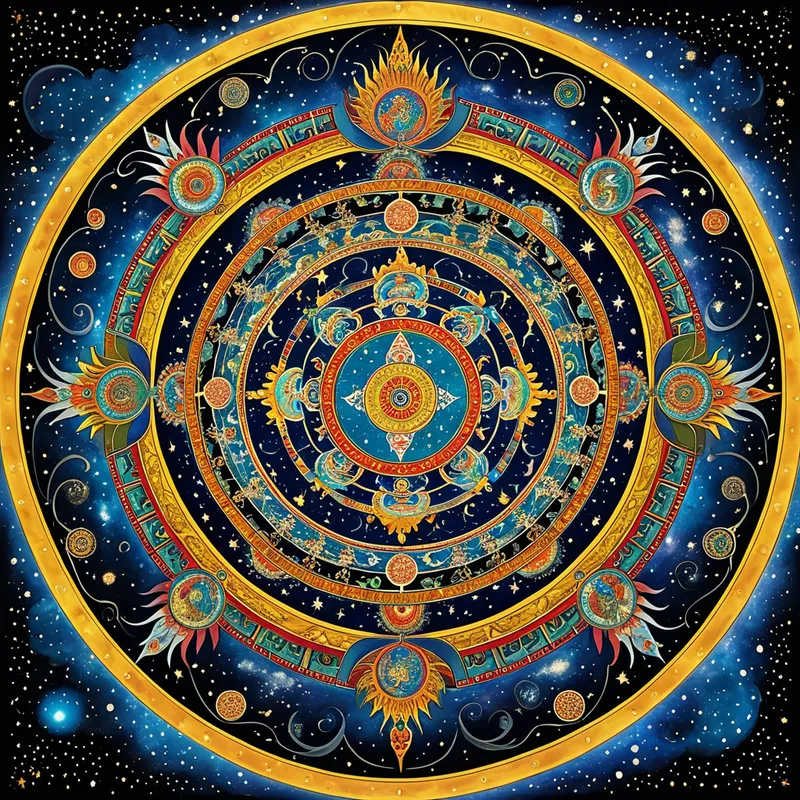
Look upon this wheel. Its hub burns with three creatures: a rooster, a pig, and a snake, each biting the tail of the other in an endless, blind circle of greed, ignorance, and hatred. From this fiery center, spokes radiate out, dividing the wheel into realms. Here is the realm of the gods, resplendent with pleasure but haunted by the slow drip of its inevitable end. There, the realm of the jealous titans, forever warring over the [nectar of the gods](/myths/nectar-of-the-gods “Myth from Greek culture.”/)’ tree. See the animal realm, all instinct and fear; the realm of [hungry ghosts](/myths/hungry-ghosts “Myth from Buddhist culture.”/), with bellies vast and throats needle-thin, eternally craving; and the hell realms, landscapes of pure, inventive agony.
And in the middle, the human realm. A realm of bittersweet mixture—of laughter that turns to tears, of love that seeds loss, of seeking that never finds lasting rest. This is the stage. Upon it, every being, from the highest god to the lowest worm, dances a puppet’s dance. The puppeteer is Pratityasamutpada. Ignorance leads to formations, formations to consciousness, to name and form, to the six senses, to contact, to feeling, to craving, to clinging, to becoming, to birth, to aging and death… and thus, back to ignorance. The wheel turns, powered by [the wind](/myths/the-wind “Myth from Various culture.”/) of [karma](/myths/karma “Myth from Hindu culture.”/)—every action, every thought, a seed sown for a future harvest of experience.
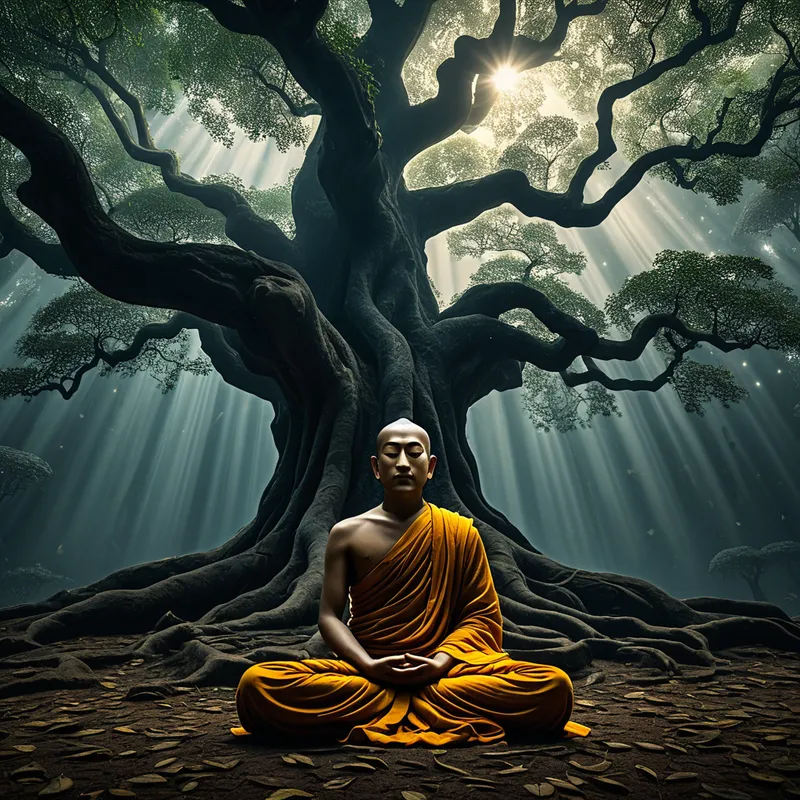
But in the human realm, in a grove of Bodhi trees by a river, a man sits. He has felt the wheel’s grind in his bones—the exquisite prison of the palace, the shocking revelation of sickness, old age, and death, the futile austerity of asceticism. He sits, vowing not to rise until he sees. And as he turns his awareness inward, the wheel manifests before him. He sees not just one turn, but countless turns. He witnesses his own past lives, a river of faces that were his. He sees the births and deaths of all beings, linked by threads of desire and consequence. He sees the entire machinery—the hub, the spokes, the rim.
And in seeing it wholly, with a heart utterly still, he finds the still point. The axle. The place where the wheel turns, but is not turned. He sees the cause of the turning—that thirst, that clinging—and in that perfect seeing, the cause unravels. The puppeteer’s strings fall slack. The three fiery animals in the hub grow quiet. The wheel is there, vast and terrible, but he is no longer upon it. He has stepped off. He is awake—a Buddha. And his first thought is of compassion for all those still spinning, still dreaming they are the dance.
Cultural Origins & Context
The mythic map of Samsara is not a single story told around a fire, but a cosmological framework that coalesced in the centuries following [the Buddha’s enlightenment](/myths/the-buddhas-enlightenment “Myth from Buddhist culture.”/) (circa 5th century BCE). It synthesized existing Indian concepts of rebirth (Samsara), moral causality (Karma), and liberation ([Moksha](/myths/moksha “Myth from Hindu culture.”/)) into a precise, diagnostic model of existential suffering. It was passed down orally by monks and nuns, not as mere doctrine, but as a meditative visualization—a tool for insight.
Its most iconic representation, the Bhavachakra painting, served as a teaching aid for a largely non-literate populace. A traveling monk might unfurl a thangka and use its vivid, terrifying imagery to explain the human predicament and the path out. Its societal function was profoundly psychological: to provide a complete etiology of suffering, stripping it of randomness and injustice, and replacing it with a system of understandable, if daunting, cause and effect. It offered both a warning and a profoundly hopeful map: your situation is the result of your own mind’s habits, and therefore, it can be changed.
Symbolic Architecture
Samsara is the ultimate [symbol](/symbols/symbol “Symbol: A symbol can represent an idea, concept, or belief, serving as a powerful tool for communication and understanding.”/) of the unconscious, automated [life](/symbols/life “Symbol: The symbol of ‘Life’ represents a journey of growth, interconnectedness, and existential meaning, encompassing both the joys and challenges that define human experience.”/). It is not a place, but a process—the process of identification. We mistake the transient contents of [consciousness](/symbols/consciousness “Symbol: Consciousness represents the state of awareness and perception, encompassing thoughts, feelings, and experiences.”/) (thoughts, feelings, sensations, roles) for a permanent self, and from that fundamental ignorance, the entire wheel of becoming spins.
The wheel turns not in the world, but in the mind that grasps the world as separate from itself.
The six realms are not literal destinations but archetypal states of being, psychological territories we inhabit [moment](/symbols/moment “Symbol: The symbol of a ‘moment’ embodies the significance of transient experiences that encapsulate emotional depth or pivotal transformations in life.”/) to moment. The god [realm](/symbols/realm “Symbol: The symbol of ‘Realm’ often signifies the boundaries of one’s consciousness, experiences, or emotional states, suggesting aspects of reality that are either explored or ignored.”/) is the [psychology](/symbols/psychology “Symbol: Psychology in dreams often represents the exploration of the self, the subconscious mind, and emotional conflicts.”/) of blissful denial and narcissistic [inflation](/symbols/inflation “Symbol: A dream symbol representing feelings of diminishing value, loss of control, or expansion beyond sustainable limits in one’s life or psyche.”/). The hell [realm](/symbols/realm “Symbol: The symbol of ‘Realm’ often signifies the boundaries of one’s consciousness, experiences, or emotional states, suggesting aspects of reality that are either explored or ignored.”/) is the psychology of unprocessed rage and self-[torment](/symbols/torment “Symbol: A state of intense physical or mental suffering, often representing unresolved inner conflict, guilt, or psychological distress.”/). [The hungry ghost](/myths/the-hungry-ghost “Myth from Buddhist culture.”/) [realm](/symbols/realm “Symbol: The symbol of ‘Realm’ often signifies the boundaries of one’s consciousness, experiences, or emotional states, suggesting aspects of reality that are either explored or ignored.”/) is the psychology of bottomless addiction and emotional starvation. The [human](/symbols/human “Symbol: The symbol of a human represents individuality, complexity of emotions, and social relationships.”/) [realm](/symbols/realm “Symbol: The symbol of ‘Realm’ often signifies the boundaries of one’s consciousness, experiences, or emotional states, suggesting aspects of reality that are either explored or ignored.”/) is the mixed blessing of self-reflective consciousness, where the pain of the wheel is most acutely felt, and thus where the possibility of awakening is most potent.
Yama, clutching the wheel, is the [archetype](/symbols/archetype “Symbol: A universal, primordial pattern or prototype in the collective unconscious that shapes human experience, behavior, and creative expression.”/) of the [Shadow](/symbols/shadow “Symbol: The ‘shadow’ embodies the unconscious, repressed aspects of the self and often represents fears or hidden emotions.”/) in its most absolute form: the fact of our own [mortality](/symbols/mortality “Symbol: The awareness of life’s finitude, often representing transitions, impermanence, or existential reflection in dreams.”/), the impermanence of all we hold dear. To deny Yama is to be spun by him. To face him, to look into his empty eyes, is to begin the process of stopping the wheel.
The Dreamer’s Resonance
When Samsara appears in modern dreams, it rarely comes as a painted wheel. It manifests as the experience of being trapped in a loop. The dreamer may be running down the same hallway, having the same frustrating conversation, missing the same train, or reliving a minor humiliation on an infinite repeat. This is the somatic signature of karma—the felt sense of a psychic pattern too deep for words, replaying itself.
Dreams of being a spectator to one’s own life, or of watching versions of oneself in different scenarios, touch on the rebirth motif. A dream where one is simultaneously a child, an adult, and an elder points to the continuum of becoming. These are not prophecies of past lives, but revelations of the [psyche](/myths/psyche “Myth from Greek culture.”/)‘s fluid, non-linear nature. The “hell realms” appear in dreams as landscapes of profound shame or terror; the “hungry ghost” realm as dreams of insatiable shopping, eating, or searching. The dream is showing the dreamer which realm their unconscious psyche is currently inhabiting, which karmic pattern is seeking recognition and release.
Alchemical Translation
The alchemical work modeled by the Samsara myth is the opus contra naturam—the work against nature. Here, “nature” is the ingrained, automatic pattern of craving and aversion. The goal is not to improve the wheel, to get a better rebirth on a nicer spoke, but to cease producing the momentum that turns it.
Individuation is the process of moving from being a passenger on the wheel to becoming its unmoved center.
The first step is Naming the Wheel: Withdrawing projections and recognizing how one’s own unconscious reactions (the three animals in the hub) create a personal reality of suffering. This is shadow work.
The second is Tracing the Spokes: Meditative self-observation, seeing the chain of Pratityasamutpada in real-time. A feeling arises, and instead of blindly reacting, one watches the impulse to cling or reject form. This breaks the causal chain.
The final, transformative stage is Abiding in the Axle: This is the integration of [the Self](/myths/the-self “Myth from Jungian culture.”/), the psychoid center that transcends [the ego](/myths/the-ego “Myth from Jungian culture.”/). It is not a state of blank nothingness, but of profound, compassionate engagement without attachment. The wheel of life continues—emotions, relationships, successes, failures—but one is no longer defined by them. One acts, but is not acted upon. The energy once used to spin the wheel now fuels conscious life. The myth of Samsara thus maps the most profound journey: from being a character in a repetitive dream to becoming, fully, the dreamer who can wake up.
Associated Symbols
Explore related symbols from the CaleaDream lexicon: