Samhain Feast Myth Meaning & Symbolism
A myth of a king's sacred feast at the world's edge, where hospitality to a stranger becomes a test of sovereignty and a pact with the Otherworld.
The Tale of Samhain Feast
Listen. The wind carries the scent of woodsmoke and dying leaves. The sun, a pale coin, sinks into the west, and the world holds its breath. This is Samhain. The féth fiada, the spirit-veil, is thin as a spider’s silk. On the high hill of Tara, the fires are being lit, but our tale does not begin there. It begins at the edge, where the known world frays into the wild.
A king, a true rí, prepares a feast. Not in his great hall, but on the open mound, the sidhe mound that hums with ancient song. He orders the finest ale brewed from the last barley, the white bó bán roasted, the wild apples gathered. His purpose is profound: to host not just his warriors, but the Unseen. For on this night, the Aos Sí walk abroad, and a king’s sovereignty is measured by his hospitality to all beings, seen and unseen.
The feast is laid. The fire roars, a beacon in the deepening blue dark. The king stands, cup in hand, and makes the invocation. He offers the first portion to the land, the second to the ancestors, the third to the gods of the Tír na nÓg. As the last words leave his lips, the air grows cold. From the tree line, a figure emerges.
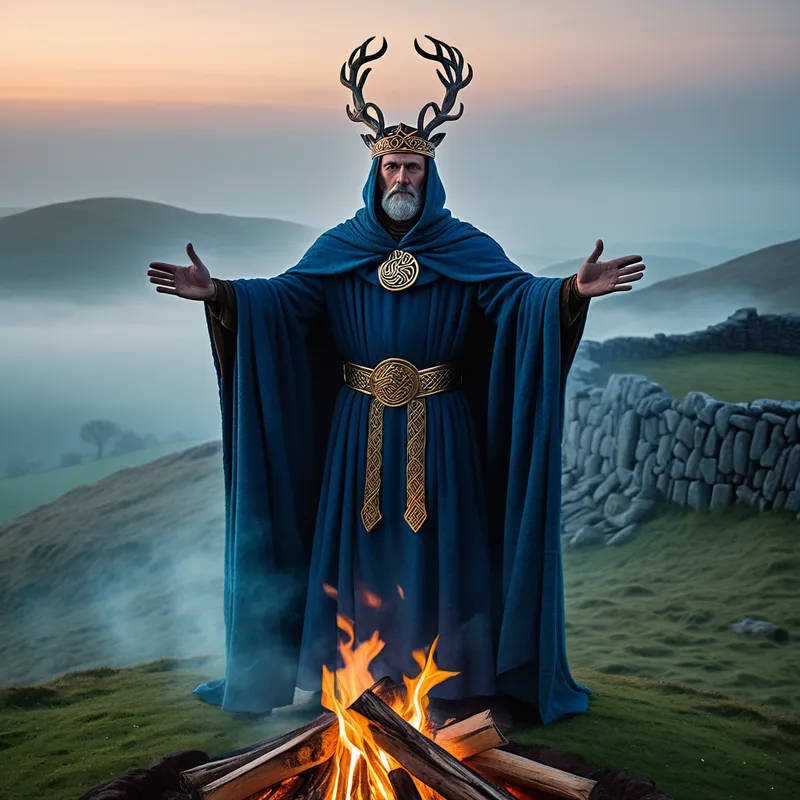
He is tall, wrapped in a cloak of shadows and grey mist. His face is long, wise, and sorrowful. Upon his brow rests not a crown, but great, branching antlers, like a stag of the oldest forest. He is Cernunnos, the Antlered One, Lord of the Threshold. He says nothing, but his eyes, deep as peat pools, hold the king’s gaze.
The king feels a chill that is not of the air. This is the test. To refuse hospitality is to break fled cro, to invite blight and dishonor. To offer it to such a one is to bind one’s fate to the wild, untamed heart of the world. The king does not hesitate. He steps forward, his own cup extended. “Welcome,” he says, his voice steady. “The feast is yours as much as mine.”
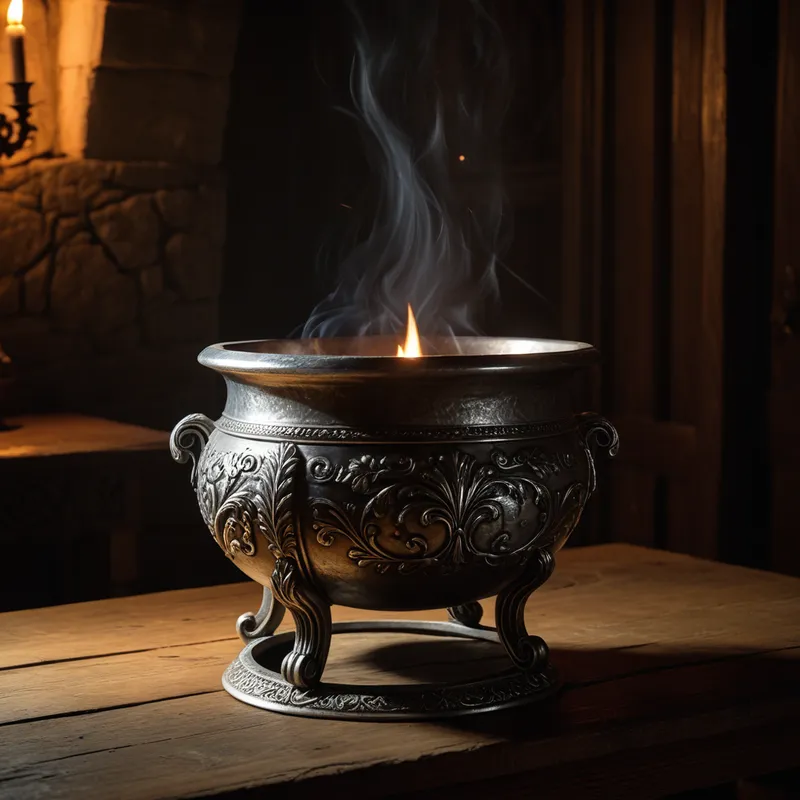
The Antlered One accepts. He sits not at the foot, but at the head of the table, a place of honor. He eats sparingly, but when he drinks, the ale in the cauldron does not diminish. He speaks then, his voice the sound of wind through bare branches and water over stone. He speaks of a pact. The land is sick, he says. The balance between the world of tribe and tillage and the world of forest and spirit is fraying. The king’s people take too much, honor too little.
The king listens, his heart a drum. He knows the truth of it. The Antlered One offers a choice. A sacrifice. Not of blood, but of sovereignty itself. The king must agree to rule not as a conqueror, but as a steward. He must dedicate one feast each year, this Samhain feast, to the Wild. He must leave the gates of his fort unbarred this one night, allowing the old powers to walk among his people, to remind them of the world that exists beyond their walls.
The king looks from his hall, symbol of order and safety, to the dark, teeming forest, symbol of chaos and vitality. He looks at the serene, demanding face of the god. His kingship, his very identity as a ruler of men, trembles on the edge of a blade. To agree is to acknowledge a power greater than his own. It is a terrifying humility.
He closes his eyes. He sees not ruin, but reciprocity. He sees the land green again, the herds fertile, the stories flowing. He opens his eyes and meets the god’s gaze. “I agree,” he says. “The pact is made.”
The Antlered One nods. From his cloak, he produces a single, perfect hazelnut, the fruit of the hazel. He drops it into the king’s ceremonial cup. “Let this be our seal,” he says. “So long as you and your heirs keep this pact, the land will not forget you.” Then, as the first hint of dawn greys the east, the god rises, melts into the mist, and is gone. The king is left alone with the embers of the fire, the empty cup, and the impossible nut. And he knows, in his bones, that everything has changed.
Cultural Origins & Context
The myth of the Samhain Feast is not a single, codified story from one manuscript, but a tapestry woven from fragments of early Irish literature, medieval Welsh lore, and the enduring practices of the Gaelic festival of Samhain. It is a reconstruction of a core narrative pattern observed in tales like the Fled Bricrenn and the symbolic encounters in the Tochmarc Étaíne. Its primary tellers were the filid, the poet-seers who acted as custodians of history, law, and sacred story.
Societally, this myth functioned as the psychic and social architecture for the most important night of the Celtic year. Samhain was the end of the pastoral year, a time of accounting, slaughter, and the return of the herds. But more profoundly, it was the moment the cosmic order inverted. The myth provided a sacred script for this inversion. It explained why the doors were left unlocked, why food was left on the table for unseen visitors, and why the community gathered on the boundaries of settlement. It taught that true leadership (ríg) was not dominance, but a sacred contract involving three parties: the people, the king, and the land/Otherworld. The king’s agreement with the Antlered One models the necessary, terrifying dialogue a community must have with the unknown, the wild, and the ancestral past to ensure its future fertility.
Symbolic Architecture
At its heart, this myth is about the psychology of the threshold and the paradox of sovereignty. The king represents the conscious ego, the organizing principle of a psyche (or a society) that values order, boundary, and identity. The Antlered One is the personification of the Self in its wild, untamed, and transpersonal aspect—the psychic force of the unconscious, instinct, and the non-human world.
The feast is the prepared consciousness, but the true guest is the unexpected, numinous content that arrives unbidden from the depths.
The Samhain setting is crucial. It symbolizes any critical liminal period in life—a major transition, a crisis, a moment where old structures die and new potentials are formless. The “thin veil” is the permeability of the psyche in such states, where repressed contents, creative inspirations, or deep fears can easily cross into awareness. The king’s initial feast is an act of order, but its completion requires the surrender of that order to the archetypal Wild. The hazelnut, symbol of concentrated wisdom and poetic inspiration from the Otherworld, is the reward for this surrender—a seed of new consciousness planted in the vessel of the old identity.
The Dreamer’s Resonance
When this myth pattern stirs in the modern dreamer, it often manifests as dreams of hosting a party or dinner where an unsettling, powerful, or awe-inspiring stranger arrives. The dreamer, as host, feels a profound obligation to accommodate this figure, despite fear. The guest may be animalistic, silent, regal, or impossibly ancient. Somatic sensations are key: a chilling of the air, a feeling of gravity or pressure in the room, or a paradoxical warmth in the chest upon making the choice to welcome them.
Psychologically, this signals a process of encountering a major content of the unconscious—often what Jung termed a “complex” or an archetypal image—that demands recognition. The “feast” is the dreamer’s current psychological attitude or life structure. The “stranger” is an aspect of the Self that does not fit this structure: perhaps a buried talent (the Creator), a necessary wildness or anger (the Rebel), or a deep, instinctual wisdom (the Sage). The dream rehearses the critical inner action: will the ego-consciousness (the host) rigidly defend its territory, or will it practice a sacred hospitality, making space for this disruptive, vital guest? The anxiety and eventual resolution in the dream map the somatic cost and ultimate liberation of this inner pact.

Alchemical Translation
The alchemical process mirrored here is nigredo followed by the albedo. The king’s old understanding of rule (the conscious identity) is dissolved in the dark night (nigredo) of Samhain, through the encounter with the shadowy god. This is the death of the ego’s illusion of total control.
Individuation is not about building a fortified self, but about becoming a skilled and gracious host to the totality of one’s being.
The pact is the crucial moment of coniunctio, the marriage of opposites: conscious and unconscious, order and chaos, human and nature. This agreement is the white stage (albedo), the illumination. The king does not become the god; he enters into relationship with him. He transmutes his kingship from autocracy to stewardship, his identity from a solitary ruler to a mediating threshold figure.
For the modern individual, the “Samhain Feast” is any deliberate, courageous act of creating a container (the feast) in a time of transition, and then willingly inviting in the very thing that frightens or challenges one’s current self-concept. It is the writer inviting creative chaos into a rigid outline. It is the leader seeking counsel from voices of dissent. It is the individual in therapy facing a traumatic memory. The “hazelnut” received is the nascent, condensed insight—the new symbol or perspective—that can only emerge from this sacred hospitality. It is the gift of the Self, granted when the ego consents to serve a sovereignty greater than its own.
Associated Symbols
Explore related symbols from the CaleaDream lexicon: