Samhain Myth Meaning & Symbolism
The myth of Samhain marks the Celtic new year, a night when the veil between worlds thins, the dead return, and chaos offers a chance for profound renewal.
The Tale of Samhain
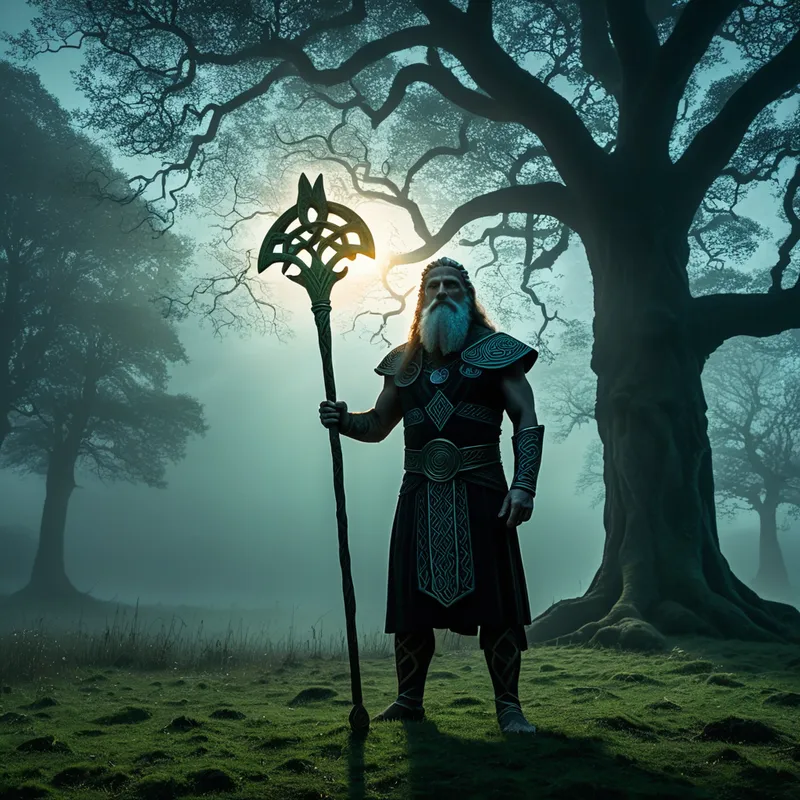
Listen, and hear the tale of the year’s turning, when the sun’s fire wanes and the world holds its breath. It is not a night like others. It is Samhain, the hinge of the year, when the great wheel of Imbolc, Beltane, Lughnasadh, and Samhain groans to its final stop. The cattle have been brought from the high pastures, their breath steaming in the chill air. The harvest is in, a bounty of golden grain and red apple, but the fields now lie fallow and silvered with the first frost.
On this night, the great Tuatha Dé Danann, the People of the Goddess Danu, who now dwell in the sídhe, find their mounds aglow with an inner light. The doors of the Otherworld stand ajar. The great god, the Dagda, feels the ancient law of the universe shift. The veil that separates the realms of the living and the dead, of order and chaos, grows thin as a spider’s silk. It trembles. It parts.
From the mist-shrouded hills and the dark, still lakes, they come. Not as fearsome wraiths, but as the ancestors, the beloved dead, their forms shimmering with the memory of life. They walk the familiar paths, drawn by the hearth-smoke and the scent of the final feast. But with them comes the unshaped potential of chaos—spirits of mischief, omens of the year to come, and the raw, untamed magic of a world between states.
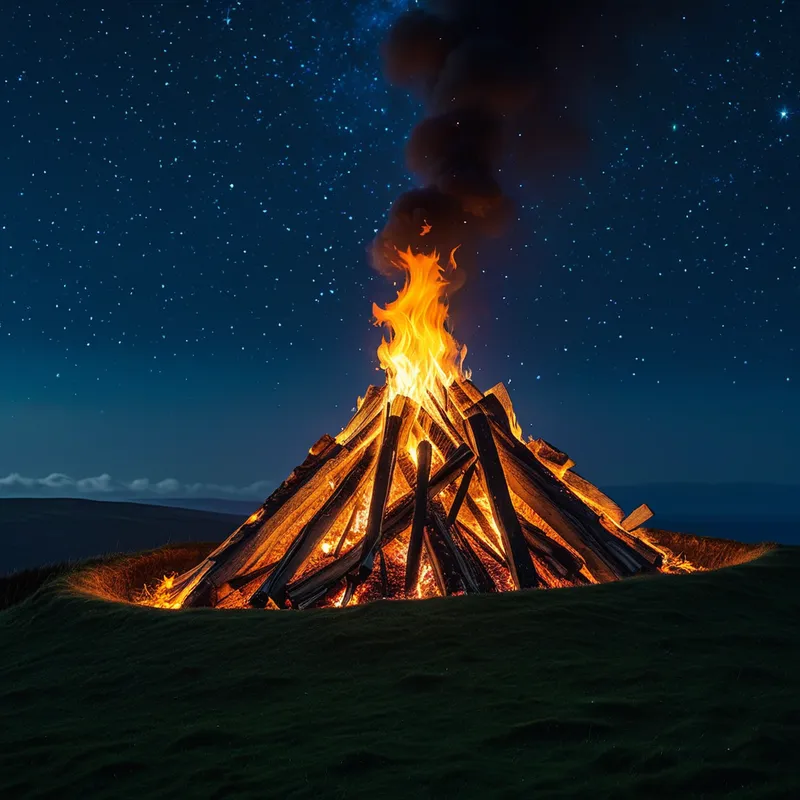
At the great assembly of Tara, the fires are extinguished. Darkness, profound and complete, swallows the land. This is the death of the old year. In this sacred dark, the community gathers on the hilltop, their breath a collective prayer in the cold. Then, with sacred rites known only to the druids, the new fire is struck from flint and oak. A single, defiant flame leaps into the void. From this sacred source, every hearth in the land will be re-lit. It is a spark struck in the belly of darkness, a promise that light will return.
But first, one must pass through the night. Offerings of food and drink are left at thresholds for those who walk unseen. Tales are told, not of great battles, but of those who have passed, weaving their memory back into the fabric of the clan. The people don disguises, not in jest, but as a sacred ruse to walk among the spirits without being claimed. They face the chaos, the thinning veil, and the presence of the dead not with terror alone, but with the solemn courage of those who know that to honor an ending is to bless a beginning. As the first grey light of the new year touches the eastern hills, the veil thickens once more. The dead return to their mounds. The world is remade, having faced its own shadow and survived.
Cultural Origins & Context
Samhain (pronounced SOW-in) was the paramount festival of the ancient Celtic year, celebrated from sunset on October 31st into November 1st. Our understanding of it is pieced together from early medieval Irish literature, such as the Ulster Cycle, and from later folk practices recorded by ethnographers. The Celts were a pastoral people, and their calendar was deeply tied to the rhythms of cattle. Samhain marked the end of the grazing season and the beginning of winter, a time when herds were culled and the community relied on stored provisions.
This was not merely a practical transition but a cosmological one. The druids, as the custodians of sacred knowledge, would have presided over the ceremonies. The extinguishing and relighting of communal fires was a act of symbolic death and rebirth for the entire tribe. The feast was a communal act of propitiation and hospitality, extending to the invisible guests from the Otherworld. The mythic tales told were not simple entertainment; they were a means of transmitting law, history, and moral codes, and of reaffirming the tribe’s connection to its ancestral past and the land itself. Samhain functioned as a societal pressure valve and a profound rite of passage, guiding the people through the psychological terror of the dark season by formalizing it, honoring it, and integrating it into the sacred order.
Symbolic Architecture
At its core, Samhain is the archetypal myth of the Threshold. It represents the necessary dissolution of structure so that a new, more authentic order may emerge.
The veil thins not to frighten us, but to remind us that what we call ‘solid’ and ‘separate’ is a temporary agreement with reality. Wholeness requires acknowledging the ghosts we host within.
The Extinguishing of the Fires symbolizes the ego’s surrender. Our conscious identity, our daily routines and certainties (the “hearth fire”), must be allowed to die so that we may contact a deeper, more universal source. The New Fire struck in the collective darkness is the spark of individual consciousness re-ignited from the primal, unconscious ground of being. It is the emergent Self, born from confrontation with the unknown.
The Ancestors represent the personal and collective unconscious—the repository of all that has shaped us, both the wisdom and the wounds of our personal and genetic lineage. The Chaotic Spirits symbolize the unintegrated aspects of the psyche: repressed desires, forgotten traumas, and creative potentials that have not yet found form. The ritual of Guising (disguising) is a profound psychological act: by wearing a mask, we can safely encounter these shadow elements without being overwhelmed by them, allowing for observation and eventual integration.
The Dreamer’s Resonance
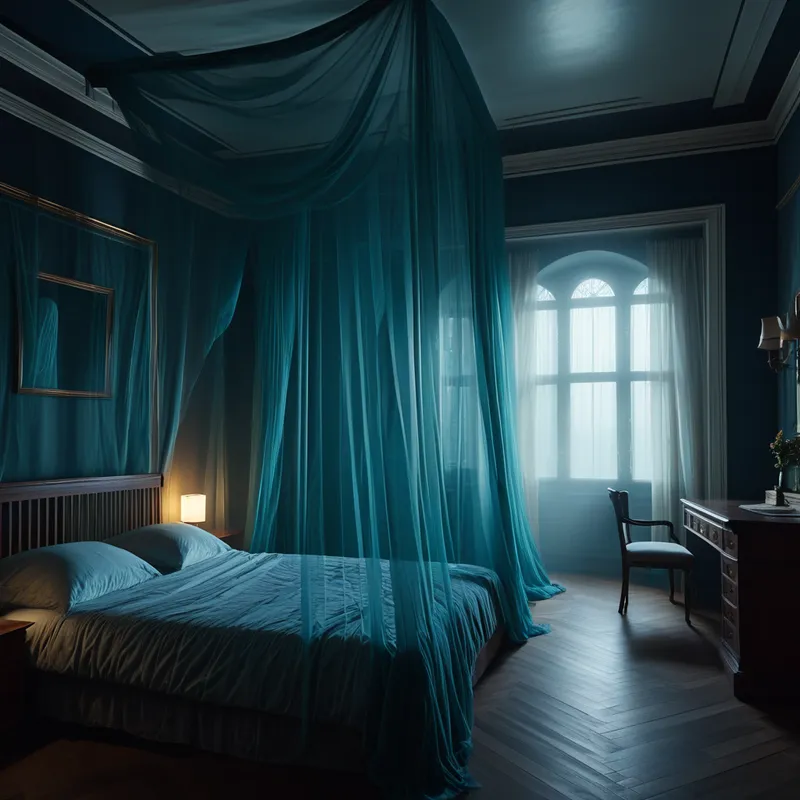
When the pattern of Samhain stirs in the modern dreamer, it signals a profound interior transition. You may dream of your childhood home, but it is empty, filled with a significant silence, or populated by deceased relatives who seem to want to communicate. Doors in the dream house won’t stay closed, or walls become translucent. These are images of the “thinning veil”—the boundaries of your conscious identity are becoming permeable.
Somatically, this process can feel like a deep fatigue, a “wintering” of the soul, or a sense of anxiety that has no specific object. It is the psyche preparing for a descent. Dreams of being lost in fog, of attending a silent feast, or of trying to light a fire that keeps going out all speak to this liminal state. The psyche is in the “darkness between fires,” having left an old way of being but not yet having arrived at the new. The emotional tone is often one of sacred melancholy mixed with anticipation. The dream is initiating you into a necessary ending, asking you to sit with the ghosts of past selves, unresolved grief, or abandoned potentials before you can move forward.
Alchemical Translation
The alchemical journey mirrored in Samhain is the Nigredo, the blackening, the descent into the prima materia of the soul. For the modern individual pursuing individuation, Samhain models the non-negotiable first step: confronting the shadow and the ancestral baggage stored in the personal and collective unconscious.
The sacred bonfire is not lit to banish the dark, but to see by its light what the dark contains. Integration, not eradication, is the goal.
The process begins with the Extinguishing: a voluntary or crisis-induced breakdown of a rigid persona or life structure. This is the “dark night of the soul.” Then comes the Facing: sitting at the proverbial threshold, leaving out the psychic “offerings,” and allowing the contents of the unconscious—the grief, the shame, the forgotten talents—to approach. This is not passive; it is the active, courageous work of shadow integration, of recognizing “that too is me.”
Finally, the Striking of the New Fire. This is the emergence of a new, more resilient consciousness, tempered by the encounter with the void. The light that is re-kindled is not the innocent, naive light of the “innocent” archetype, but the wise, tempered light of the sage. It is a light that knows the dark intimately and thus can illuminate without blinding. The individual who undergoes this Samhain process does not return to “normal.” They are initiated. They carry within them the knowledge that life, death, chaos, and order are not opposites, but partners in the eternal cycle of becoming whole. They have learned to find the sacred spark not in spite of the darkness, but within it.
Associated Symbols
Explore related symbols from the CaleaDream lexicon: