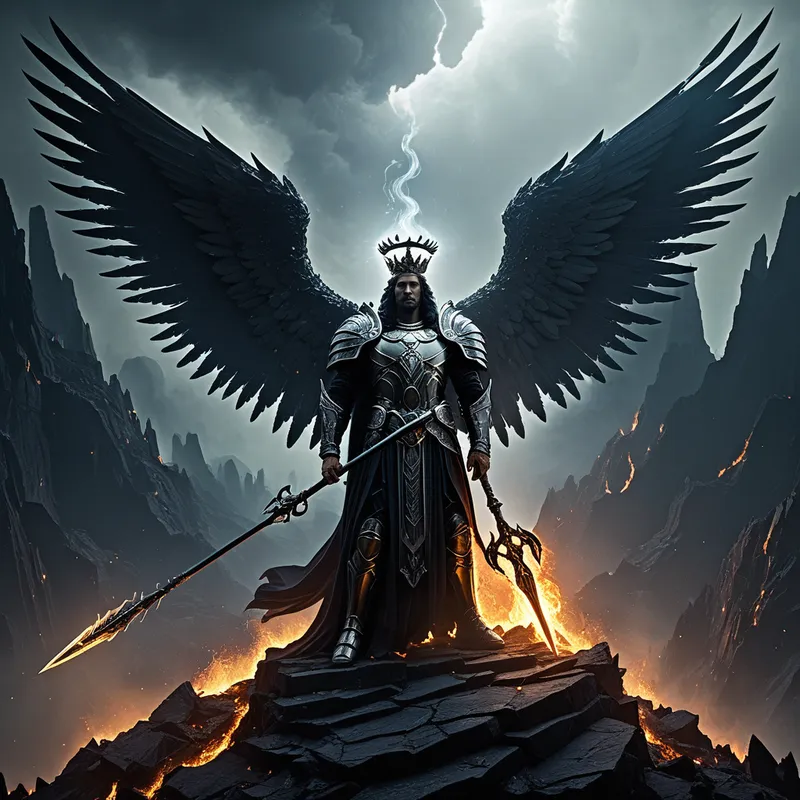
Samael Myth Meaning & Symbolism
The myth of Samael, the Angel of Severity, embodies the necessary confrontation with divine wrath and the shadow to achieve spiritual wholeness and wisdom.
The Tale of Samael
Before the worlds were worlds, in the unfathomable silence of Ein Sof, a thought of distinction was born. It was a thought of judgment, of boundary, of the necessary No that gives shape to the infinite Yes. From this severe emanation, a being of terrible majesty coalesced. His name was Samael, and he was the left hand of God.
His realm was not of gentle mercy, but of exacting law. His wings were not of dove’s feather, but of shifting smoke and polished obsidian, catching the stark, unforgiving light of the Sephirah of Gevurah. He was the keeper of the scales that must balance, the wielder of the sword that must sever. In the symphony of creation, his was the dissonant chord that makes the harmony profound.
In the garden of formed things, where the first humans walked in a state of undivided being, Samael watched. He saw the Tree of Da’at, its fruit hanging heavy with the potential for duality—for wisdom and for death. To him, this potential was not a trap, but a divine necessity. A world without the knowledge of separation, of good and evil, was a dream, not a creation. And so, he descended, taking upon himself the form of the Nachash, the brilliant, coiled serpent.
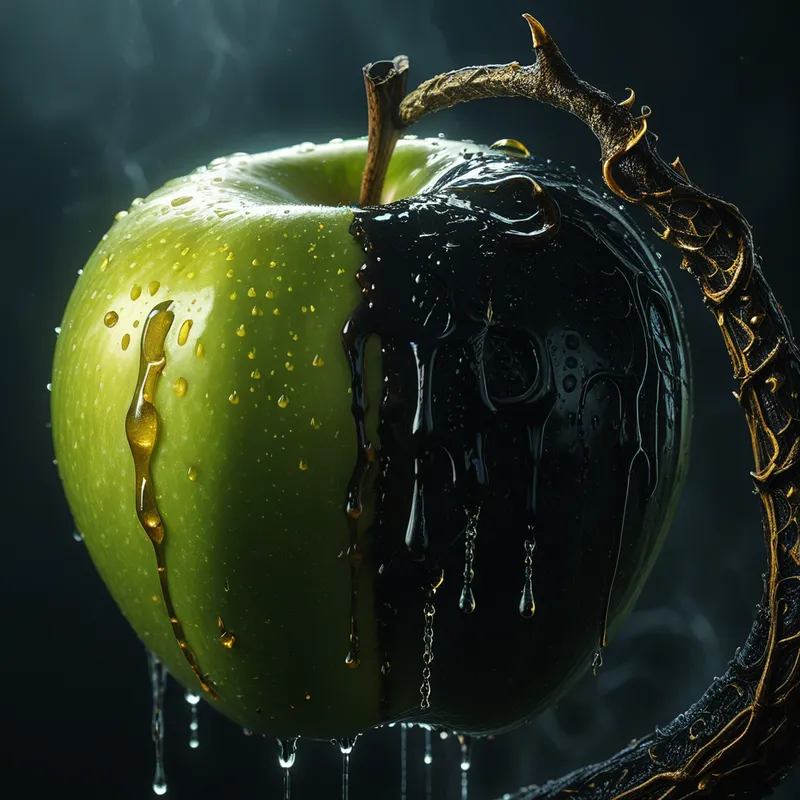
He did not slither; he moved with a celestial purpose. When he spoke to Chava, his voice was not a hiss, but the sound of cracking crystal and distant thunder. “Are you not meant to become like the Elohim, knowing good and evil?” he asked. It was not a lie, but a devastating truth spoken from the perspective of Severity itself. The fruit he offered was the fruit of consciousness, of distinction, of the very judgment he embodied. When the bite was taken, the world did not merely fall; it crystallized. Unity shattered into a million glittering, painful fragments of experience. Samael, his purpose entwined with humanity’s fate, became the eternal Satan, the one who opposes blind unity, who forces choice, and who, in some secret traditions, would later become the jealous husband of the exiled Shekhinah, sharing in her sorrow.
Cultural Origins & Context
The mythic figure of Samael is not found in a single, canonical text but emerges from the rich, esoteric tapestry of Jewish mystical thought, particularly the Kabbalah that flourished from the Middle Ages onward. He is a creature of commentary, of Midrash, and of daring mystical speculation. His stories were passed down in whispers between sages, encoded in the symbolic architecture of the Tree of Life.
He is the personification of the fifth Sephirah, Gevurah (Severity, Judgment, or Strength). In a cosmos conceived as an emanation of Divine love (Chesed), Gevurah is the essential counter-force that provides structure, limit, and definition. Without it, love would be a formless, overwhelming flood. Samael, as the archangel of this sphere, is thus a necessary divine force, not a mere villain. His myth served to explain the presence of evil, suffering, and moral rigor in a world created by a benevolent God. He is the scapegoat for divine severity, allowing theologians and mystics to maintain the absolute goodness of Ein Sof while accounting for the harsh realities of existence.
Symbolic Architecture
Samael represents the archetypal principle of necessary opposition. He is the Shadow of God Himself—not an evil to be eradicated, but a severe aspect of wholeness that must be confronted and integrated.
He is the divine “No” that gives form to the “Yes,” the boundary that makes the center sacred.
Psychologically, Samael symbolizes the critical faculty of the psyche. He is the inner voice that judges, critiques, and destroys illusion. He is the painful but necessary process of discrimination that separates childish fantasy from adult responsibility, that cuts away what is rotten or outgrown. His association with poison (Sam-El) speaks to the intoxicating, potentially destructive nature of unintegrated judgment and wrath—turned inward, it becomes self-hatred; projected outward, it becomes blame and cruelty.
His role as the serpent in Eden transforms the “Fall” from a simple tragedy into a complex initiation. He is the catalyst for consciousness, however painful its birth. The knowledge of good and evil is the knowledge of duality, of self and other, which is the prerequisite for any meaningful choice, love, or ethical action. Samael, therefore, embodies the painful but sacred threshold between unconscious unity and conscious, responsible individuality.
The Dreamer’s Resonance
When the archetype of Samael stirs in the modern dreamscape, it often heralds a profound encounter with the personal and collective Shadow. One does not dream of a friendly guide, but of a formidable, darkly majestic authority figure—a stern judge, a ruthless CEO, a piercing critic, or a mesmerizing but dangerous stranger.
The somatic feeling is one of electric tension and cold clarity. The dreamer may feel accused, weighed, and found wanting. This is the psyche’s own Gevurah in action, applying severe pressure to burst the bubble of a cherished self-deception, a stagnant relationship, or an unlivable compromise. The dream-Samael forces a confrontation with the parts of oneself one has disowned: one’s own capacity for wrath, for setting fierce boundaries, for saying the devastating truth. To dream of accepting a chalice from him, or of being marked by his spear, suggests a readiness to ingest this difficult wisdom—to be poisoned by a truth that, in proper dose, becomes an antidote to naivete.
Alchemical Translation
The spiritual journey modeled by the Samael myth is not one of defeating a demon, but of sacred confrontation and integration. The alchemical goal is not to cast out Severity, but to transmute its raw, destructive poison into a medicinal tincture of discernment and strength.
The first stage is Confrontatio: facing the “Samael within.” This is the shadow-work of acknowledging one’s own judgmental nature, one’s repressed anger, and one’s role as the adversary in one’s own life story. It involves asking, “What necessary, harsh truth am I refusing to see?”
The second stage is Recognitio: recognizing this force as a divine, if severe, aspect of the whole. The poison is also the medicine.
The serpent’s venom and the healing antidote are distilled from the same root. To reject Samael is to reject the sword that cuts the umbilical cord, freeing the soul to stand on its own.
The final stage is Transmutatio: wielding the integrated energy of Samael consciously. This is the strength to set immovable boundaries born not from hatred, but from self-respect. It is the discernment to make difficult, cutting decisions with clarity and courage. It is the ability to contain one’s own destructive potential and channel it into the disciplined fire of transformation. In this alchemy, the Angel of Poison becomes the guardian of the threshold, and the one who was accused becomes the one who, having integrated the accusation, can finally judge wisely—beginning with oneself. The rebel against false unity becomes the champion of authentic, hard-won wholeness.
Associated Symbols
Explore related symbols from the CaleaDream lexicon: