Samadhi Myth Meaning & Symbolism
The mythic journey into meditative absorption, where consciousness dissolves into luminous stillness, revealing the unconditioned nature of reality.
The Tale of Samadhi
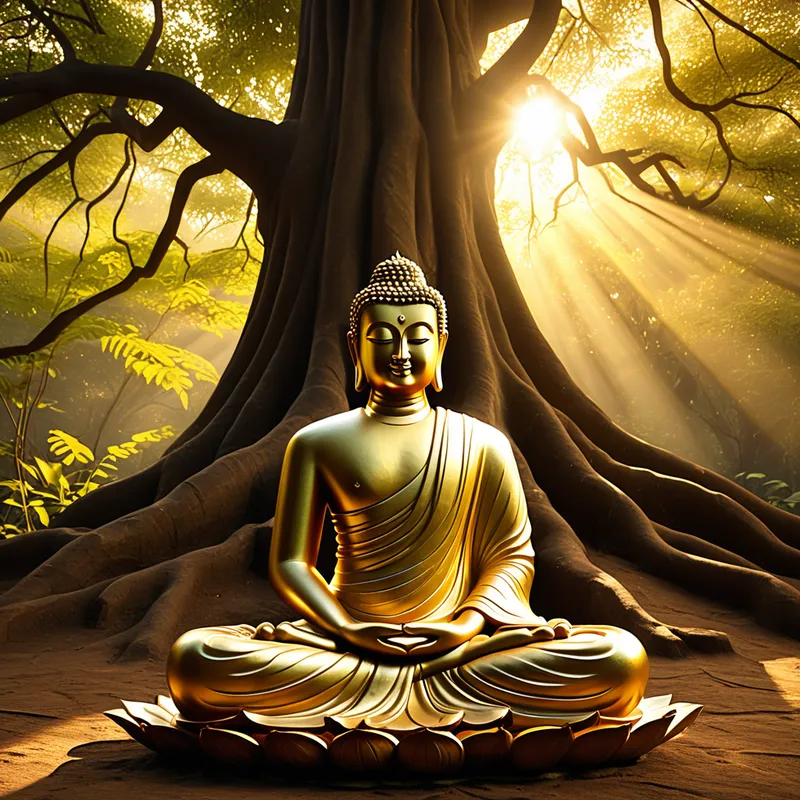
Listen. Before [the world](/myths/the-world “Myth from Tarot culture.”/) was as you know it, before the clamor of ten thousand thoughts, there was a silence so deep it was a kind of sound. It was in this pregnant quiet, under the spreading arms of the Bodhi tree, that a prince turned wanderer sat. His name was Siddhartha, but [the earth](/myths/the-earth “Myth from Hindu culture.”/) knew him as one who sought an end to suffering. The night was vast, a velvet cloak pinned with cold stars. Mara, the great tempter, the lord of illusion, had come and gone. His armies of desire, fear, and doubt had crashed against [the wanderer](/myths/the-wanderer “Myth from Taoist culture.”/)’s unwavering resolve like waves against a diamond cliff, falling back into the darkness.
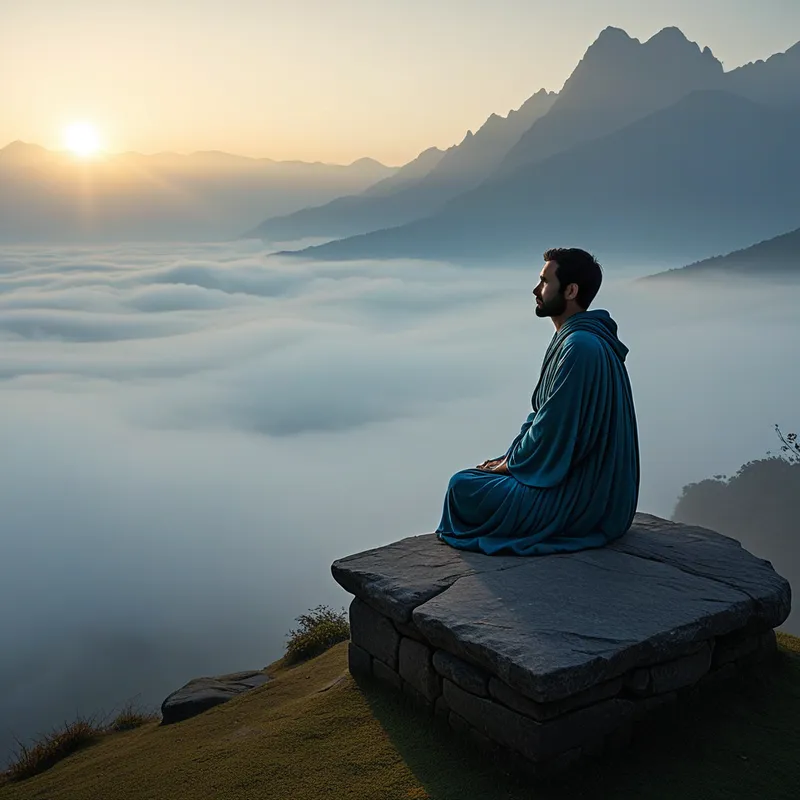
Now, alone with the universe, the real work began. It was not a battle, but a sinking. A letting go. He turned his awareness inward, following the breath—not the air, but the principle of breath, the rising and falling that is the pulse of life itself. He descended, layer by layer, through the strata of his own being. The chatter of the mind, the stories of “I” and “mine,” began to still, like settling silt in a pond. Sensations arose and passed, noted but not clung to. Memories flickered like distant lightning, holding no power here.
He entered the first jhana, where thought is applied and sustained, a rapturous joy born of seclusion. But he did not stop. He released the applied thought, entering the second jhana, where joy becomes a unified, bubbling spring from within. Deeper still, into the third, where even joy refined into a serene, mindful equanimity. And finally, into the fourth jhana, where all that remained was pure, bright awareness resting in utter equanimity—a mind like a polished mirror, reflecting nothing, yet capable of reflecting everything.
This was the gateway. From this pinnacle of form, he cast his awareness beyond. He recollected his past lives, seeing the endless chain of becoming. He saw beings passing away and re-arising according to their deeds. And then, in the last watch of the night, he directed that purified, diamond-like mind to the fundamental truths of existence. He saw with direct, unmediated knowledge: Dukkha, its origin, its cessation, and the path to its cessation. The Three Marks were not concepts, but the very fabric of reality laid bare.
In that moment, the final fetter of ignorance shattered. The constructed self, the atman, was seen for what it was: a process, not a [thing](/myths/thing “Myth from Norse culture.”/). A confluence of conditions, empty of inherent existence. There was no “one” who attained anything. There was only the attaining itself—the universe knowing itself, clearly, without distortion. The first light of dawn touched [the horizon](/myths/the-horizon “Myth from Various culture.”/), and the man who sat was now a Buddha, the Awakened One. He had touched [Nirvana](/myths/nirvana “Myth from Buddhist culture.”/). He had realized Samadhi not as a state, but as the very ground of being.
Cultural Origins & Context
The mythic narrative of Samadhi is not a single story with characters and plot, but the archetypal scaffolding of the Buddhist path itself, drawn from the earliest Sutta texts like the Mahāsatipaṭṭhāna Sutta and the Jhana Suttas. It originates in the historical context of 5th-century BCE India, a time of intense philosophical and ascetic inquiry into the nature of consciousness and liberation. This was an oral tradition, passed down by monks and nuns who memorized the discourses verbatim. The “tale” was relived in meditation halls and [forest monasteries](/myths/forest-monasteries “Myth from Buddhist culture.”/), not merely recited.
Its societal function was dual. For the monastic community, it was a precise map of inner territory—a phenomenological guide to the stages of meditative absorption (jhanas) that lead to liberating insight (vipassana). For the lay community, it served as a powerful symbol of human potential, a testament that the highest freedom was attainable through disciplined mental cultivation. It democratized the mystical, offering a structured path out of suffering that was based on direct experience rather than dogma or divine grace.
Symbolic Architecture
Samadhi represents the complete [integration](/symbols/integration “Symbol: The process of unifying disparate parts of the self or experience into a cohesive whole, often representing psychological wholeness or resolution of internal conflict.”/) of [consciousness](/symbols/consciousness “Symbol: Consciousness represents the state of awareness and perception, encompassing thoughts, feelings, and experiences.”/). It is not an escape from the world, but a profound immersion into its true [nature](/symbols/nature “Symbol: Nature symbolizes growth, connectivity, and the primal forces of existence.”/). The [journey](/symbols/journey “Symbol: A journey in dreams typically signifies adventure, growth, or a significant life transition.”/) through the jhanas symbolizes the systematic deconstruction of [the ego](/myths/the-ego “Myth from Jungian culture.”/)’s scaffolding—first quieting discursive thought, then pacifying emotional [turbulence](/symbols/turbulence “Symbol: A state of violent disturbance or agitation, often representing emotional chaos, creative disruption, or life transitions in dreams.”/), and finally arriving at a luminous, panoramic [awareness](/symbols/awareness “Symbol: Conscious perception of self, surroundings, or internal states. Often signifies awakening, insight, or heightened sensitivity.”/).
Samadhi is the mind returned to its source, like a river finding the ocean. In that merging, the river loses its name and form, but discovers its true, boundless nature.
The Mara figure is crucial. He represents not an external devil, but the totality of the [psyche](/myths/psyche “Myth from Greek culture.”/)’s [resistance](/symbols/resistance “Symbol: An object or tool representing opposition, struggle, or the act of pushing back against external forces or internal changes.”/)—our attachments, fears, and the deeply held belief in a separate self. His defeat is not a violent conquest, but a seeing-through. The [Bodhi tree](/symbols/bodhi-tree “Symbol: The sacred fig tree under which Siddhartha Gautama attained enlightenment, symbolizing awakening, wisdom, and the interconnectedness of all life.”/) is the [axis](/symbols/axis “Symbol: A central line or principle around which things revolve, representing stability, orientation, and the fundamental structure of reality or consciousness.”/) mundi, the still point at the center of the psychic storm. The [dawn](/symbols/dawn “Symbol: The first light of day, symbolizing new beginnings, hope, and the transition from darkness to illumination.”/) that breaks upon the [Buddha](/symbols/buddha “Symbol: The image of Buddha embodies spiritual enlightenment, peace, and a quest for inner truth.”/)’s awakening symbolizes the irreversible dispelling of ignorance; consciousness itself becomes self-illuminating.
Psychologically, Samadhi symbolizes the state where the conscious ego surrenders its executive control, allowing the deeper, transpersonal layers of the psyche—what Jung might call [the Self](/myths/the-self “Myth from Jungian culture.”/)—to emerge and integrate. It is the end of the ego’s compulsive commentary and the beginning of authentic being.
The Dreamer’s Resonance
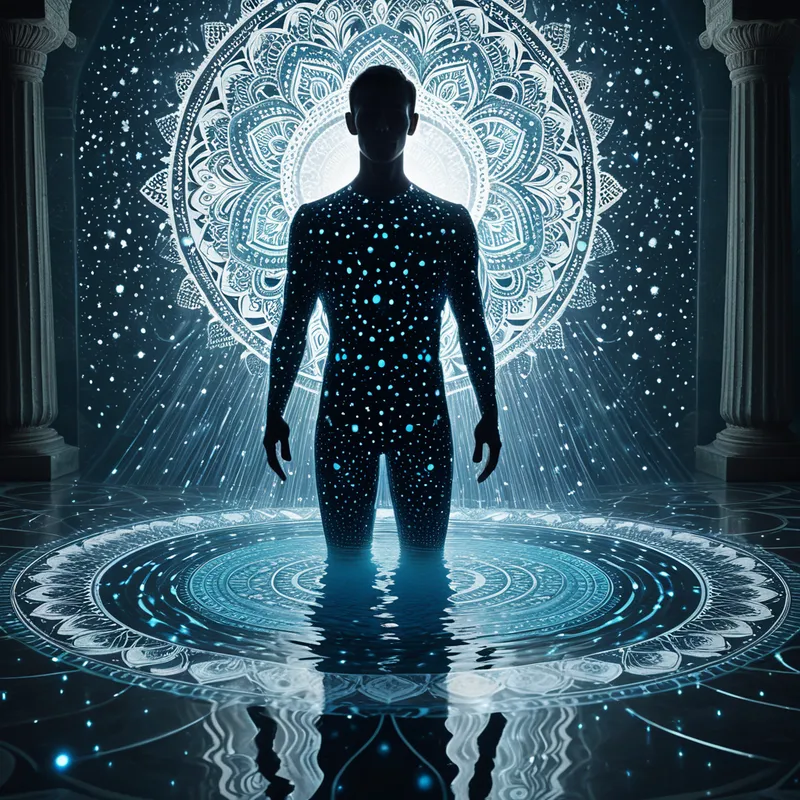
When this mythic pattern stirs in the modern dreamer, it often manifests not as a linear story, but as profound somatic and spatial experiences. One may dream of being in a room that grows increasingly still and silent, where even the dust motes in the air stop moving. Another might dream of diving deep into a perfectly clear, still pool, descending through layers of warm and cool [water](/myths/water “Myth from Chinese culture.”/) until they are suspended in a silent, blue void, weightless and without breath, yet utterly at peace.
These dreams signal a psychological process of involution—a turning inward so complete that the usual boundaries of the personality begin to soften. The dream ego is not acting, but witnessing. It is a somatic experience of the nervous system settling, of the psychic energy that usually fuels anxiety, planning, and desire withdrawing and consolidating at the core. The dreamer is encountering the pre-verbal, pre-egoic ground of their own consciousness. It can feel like dying, because it is the dissolution of a familiar mode of being. The conflict in such dreams is rarely with a monster, but with the residual fear of letting go, of surrendering the illusion of control.
Alchemical Translation
The alchemical process mirrored in the Samadhi myth is the [solve et coagula](/myths/solve-et-coagula “Myth from Alchemical culture.”/)—dissolve and coagulate—applied to the psyche. The journey through the jhanas is the solve: the careful, disciplined dissolution of the complex of habits, identifications, and reactions we call “I.” The sensual world, emotional turbulence, and discursive thought are not rejected, but seen through and allowed to fall away, like stages of a rocket boosting a capsule into space.
The ultimate alchemy is not turning lead into gold, but turning identification into awareness. The base metal of the ego-personality is dissolved in the acid of mindful observation, revealing the gold of pure, non-dual consciousness.
The awakening under [the Bodhi tree](/myths/the-bodhi-tree “Myth from Buddhist culture.”/) is the coagula: the re-coagulation, not back into the old ego, but into a new, integrated totality. This is the Self realized. The individual does not become a blank void, but returns to the world with that luminous, equanimous awareness intact. Perception is transfigured; the world is seen as it is—impermanent, interdependent, and empty of separate self—which allows for compassion to flow without obstruction.
For the modern individual, this models the path of individuation as a movement from ego-centricity to Self-centricity. It is not about acquiring new qualities, but about unlearning—stripping away everything that is not essential until only the essential, which was there all along, remains. The struggle is to sit through the “night” of our personal Maras—our addictions, neuroses, and despair—with unwavering commitment to truth. The [triumph](/myths/triumph “Myth from Roman culture.”/) is not a trophy, but a homecoming to a peace that was never lost, only overlooked.
Associated Symbols
Explore related symbols from the CaleaDream lexicon: