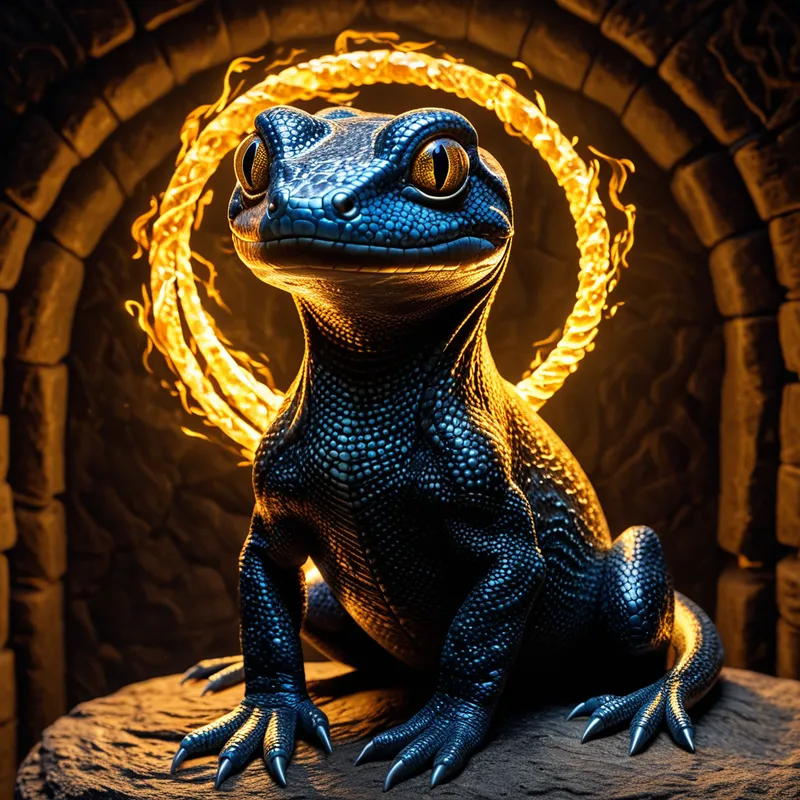
Salamander in fire Myth Meaning & Symbolism
A myth of a creature born of flame, symbolizing the soul's ability to be purified and reborn through the fires of profound experience.
The Tale of Salamander in fire
Listen, and let the smoke of memory carry you back. Not to a time of kings and battles, but to the silent, stone-chambered hours where the world is remade in secret. The air is thick with the scent of sulphur and longing, of mercury’s silver promise and salt’s enduring tears. In this perpetual twilight, lit only by the hungry dance of the furnace, the Alchemist labors. His is a work of centuries, a grief of failed vessels and corrupted matter. He seeks the Philosopher’s Stone, but his hands know only the weight of lead, the dullness of unawakened earth.
One night, in the depth of his despair, when the fire in the athanor had burned down to a bed of perfect, whispering coals, he saw it. Not a beast of scale and claw from fable, but a slow, impossible coalescence of the flame itself. From the most concentrated point of heat, where matter should cease to be, a form began to persist. It was a creature of living luminosity, its skin the color of a banked forge—deep black shot through with veins of pulsating orange and gold. It moved not through the fire, but as the fire, a serene, self-contained embodiment of the element. This was the Salamander.
The Alchemist fell to his knees, not in fear, but in recognition. Here was no beast to be captured, but a mystery to be witnessed. He watched for nights unnumbered as the Salamander dwelt in the crucible, the very vessel where he had sought to force change upon dead metal. The creature slept in the inferno, fed on the pure essence of the flame, and in its tranquil presence, the nature of the fire began to change. The roaring, destructive yellow tongues softened into a steady, purifying white-gold radiance. The air, once choked with ash, grew clear and sharp, charged with a potential that made the very stones of the laboratory hum.
The conflict was not one of claws and teeth, but of understanding. The Alchemist’s old desire—to dominate, to extract, to force the secret from matter—withered in this new light. He had to unlearn his own striving. The rising action was a profound stillness, a sacrifice of his will upon that same altar of coals. He ceased his frantic manipulations. He simply tended the fire, ensured its purity, and observed the Salamander’s sovereign existence.
And in that resolution of surrendered effort, the transmutation occurred. Not in the lead within the crucible, but within the Alchemist himself. The radiant, calm heat of the Salamander’s fire reflected in his own eyes. He understood: the First Matter to be worked was not in the retort, but in the soul. The creature was both the keeper and the symbol of the inextinguishable spark that could live through any conflagration, not by resisting it, but by being of its essential nature. When the vision finally faded, the Salamander dissolving back into the mundane flame, the laboratory was unchanged. Yet everything was different. The Alchemist held the secret not in his hand, but in his breath. He had seen the fire that does not consume, but reveals.
Cultural Origins & Context
The myth of the Salamander is not a folktale with a single origin, but a persistent archetype that crystallized within the esoteric traditions of Medieval and Renaissance Europe. It finds its most articulate home in the cryptic manuscripts and symbolic engravings of the alchemical tradition. Here, it was less a story told by bards and more a diagrammed truth passed between initiates, encoded in the Mutus Liber—the “wordless book.”
Its societal function was dual. Exoterically, it was a piece of natural philosophy, explaining the (then-credible) belief that some creatures could be born of or live within elemental fire. Esoterically, and more importantly, it served as an allegory for the alchemist’s own spiritual journey. The myth was a map, indicating that the true goal of the Magnum Opus was not metallurgical, but psychological. It was taught to novices not as a fantasy, but as a literal truth about the nature of reality and spirit, a guiding image to hold during the long, dark, and often fruitless-seeming “nigredo” phase of their work.
Symbolic Architecture
At its core, the Salamander represents the inviolable spirit, the essential Self, that exists within and is nourished by the very experiences that appear to destroy the ego.
The Salamander does not survive the fire; it is the part of the soul that is born from the correct relationship to it.
The Fire is the central symbol. It is not merely destruction, but the necessary agent of purification, the fervor of emotional ordeal, the burning away of dross and illusion. It is the painful but essential process of individuation. The Crucible or furnace is the contained vessel of this transformation—the psyche itself, or the specific life situation (a crisis, a depression, a period of intense introspection) that applies the heat.
The Alchemist represents the conscious ego, initially separate and striving. His journey from trying to control the fire to learning from the Salamander mirrors the ego’s necessary shift from identifying as the master of the psyche to becoming the witness and servant of the deeper Self. The Salamander is that Self—not created by the ego, but revealed when the ego’s defenses are burned away.
The Dreamer’s Resonance
When this myth stirs in the modern unconscious, it often manifests in dreams of fire that is not terrifying, but awe-inspiring or strangely comforting. One might dream of walking through flames unscathed, finding a precious object in a hearth, or tending a small, vital fire in a dark place. Somaticly, this can correlate with a sensation of “inner fire”—a surge of energy, a “burning” conviction, or the warm flush of a profound insight breaking through.
Psychologically, these dreams signal a process of psychic purification. The dreamer is likely enduring a period of intense stress, moral reckoning, grief, or passionate creativity. The Salamander dream is the psyche’s affirmation: you are in the fire, but there is a part of you that is of the fire. It is an image of resilience, indicating that the current ordeal is not annihilating the core self, but forcing it to define itself against the blaze. The conflict in the dream is often the residual fear of the ego, mirroring the Alchemist’s initial panic, while the resolution is the serene presence of the creature, symbolizing the emerging, more authentic identity.
Alchemical Translation
For the modern individual seeking wholeness, the myth models the process of psychic transmutation with elegant precision. We all, at times, find ourselves in the crucible—a career collapse, the end of a relationship, a health crisis, or a simple, profound existential despair. Our first instinct, like the Alchemist’s, is to fight the fire: to numb the pain, to flee the situation, to desperately try to fix or control it from our old, ego-centric position.
The work is not to put out the fire, but to discover what in you is Salamander.
The myth instructs us to shift from resistance to observation. This is the “tending the fire” stage. It means turning toward the discomfort with curiosity, journaling about the feelings, engaging in mindful somatic awareness, or seeking therapeutic container (the modern crucible). As we do, we slowly differentiate our burning, suffering ego-identity from the essential, witnessing consciousness beneath it. That consciousness is the Salamander.
The triumph is not an escape from the fire, but a realization of non-separation from it. The transformed individual is not someone who avoided the ordeal, but one who has been fundamentally clarified by it. Leaden, confused aspects of the personality are burned away, leaving behind a more refined, resilient, and authentic golden nature. The “Philosopher’s Stone” that is attained is not a magical object, but the integrated Self—the person who knows, from experience, that their core spirit can not only endure the transformative fires of life, but requires them for its ultimate revelation. The Salamander, once a mythic vision, becomes the living truth of one’s own tempered spirit.
Associated Symbols
Explore related symbols from the CaleaDream lexicon: