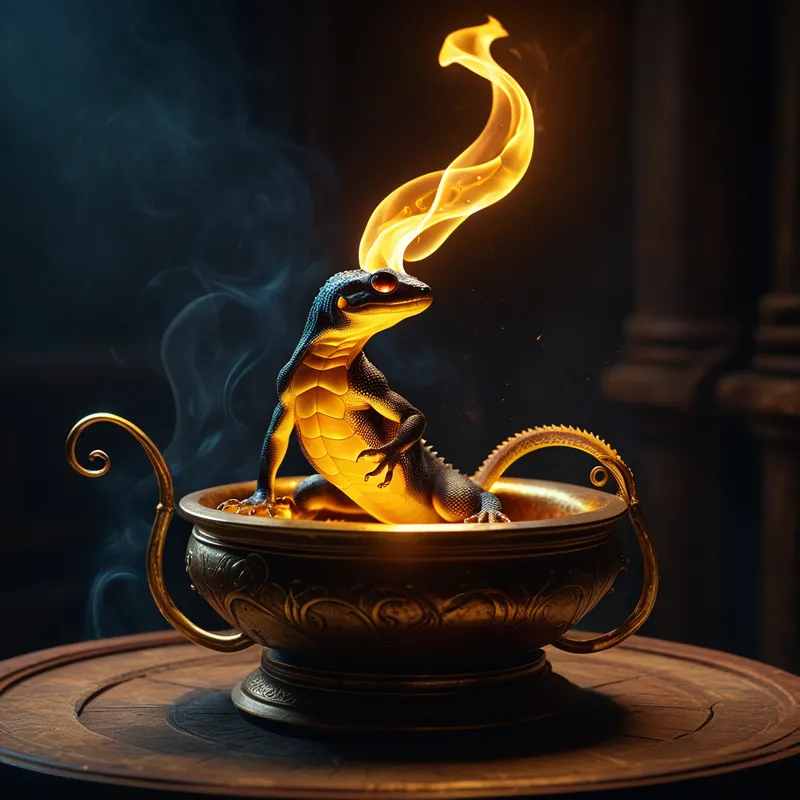
Salamander Myth Meaning & Symbolism
The myth of the Salamander, an elemental spirit that lives in and purifies fire, embodying the soul's trial by flame to achieve immortal essence.
The Tale of Salamander
Listen, and feel the heat of the tale. In the silent, stone-cold heart of the world, where shadows are born and matter sleeps, there existed a longing. It was a longing for light, for a principle of change so fierce it could unmake the very bones of the earth and birth something new from the ashes. This longing took form not in flesh, but in potential—a spark waiting in the deepest, darkest ore, in the frozen heart of the mountain, in the stagnant waters of the primeval swamp.
Then came the Alchemist, not a man of name, but a figure of will. In a chamber sealed from the wind, lit only by the glow of a single, stubborn candle, he worked. His tools were not mere iron and glass, but patience and desperation. He gathered the raw, chaotic Prima Materia—the leaden weight of the soul, the confused mud of being. Into the sacred vessel, the Vas Hermeticum, it went.
He called the fire. Not the fire of the hearth, but the secret fire, the Fire of the Philosophers. As the furnace roared to life, a terror filled the chamber. This was the Nigredo, the blackening. The matter screamed in silence, cracking, smoking, dissolving into a foul and formless night. It seemed a failure, a death without promise.
But in that absolute blackness, in that utter dissolution, a miracle was conceived. From the core of the calcined waste, a faint, persistent glow emerged. It was not a reflection of the furnace flame, but a light born from within the matter itself. It stirred, it swam. And then, it lived.
It was the Salamander. At first, a mere shimmer in the heat haze, then a sinuous, graceful form woven from the flame itself. It had no scales, but facets of captured sunlight; no blood, but a circulating liquid gold. Its eyes were two steady stars in the inferno. It did not burn the vessel; it married the fire, becoming its sovereign and its soul. The Alchemist watched, his breath stilled. This was the Albedo—the whitening, the washing in this celestial fire.
The Salamander danced. Its dance was the work. It coiled around the impurities, not destroying them, but subjecting them to its essence until they, too, began to glow with an inner light. The black mass turned grey, then white as the first snow. The heat was unbearable, a trial of the spirit. For days and nights that blurred into eternity, the Alchemist endured, feeding the fire, sustaining the vessel, holding the sacred space for the spirit of the flame to perform its liturgy.
And then, at the zenith of the ordeal, as the white matter began to blush with a rosy hue—the Rubedo—the Salamander’s dance changed. It became slower, more profound, a spiral turning inwards. It began to pour itself back into the matter in the vessel, not vanishing, but transfusing. The flame and the matter became one. The glow intensified into a blinding, peaceful gold that filled the chamber not with heat, but with a sublime, warming intelligence.
When the Alchemist finally dared to look, the fire was dead, the furnace cold. But in the vessel lay a single, perfect grain of a substance that held its own soft, eternal light. The Salamander was gone, and yet it was everywhere—it was the light in the grain. The spirit of the flame had not perished; it had achieved its true work: the creation of an essence that could endure all things, the Philosopher’s Stone incarnate in a speck of dust. The chamber was silent, but ringing with the echo of a transformation now complete.
Cultural Origins & Context
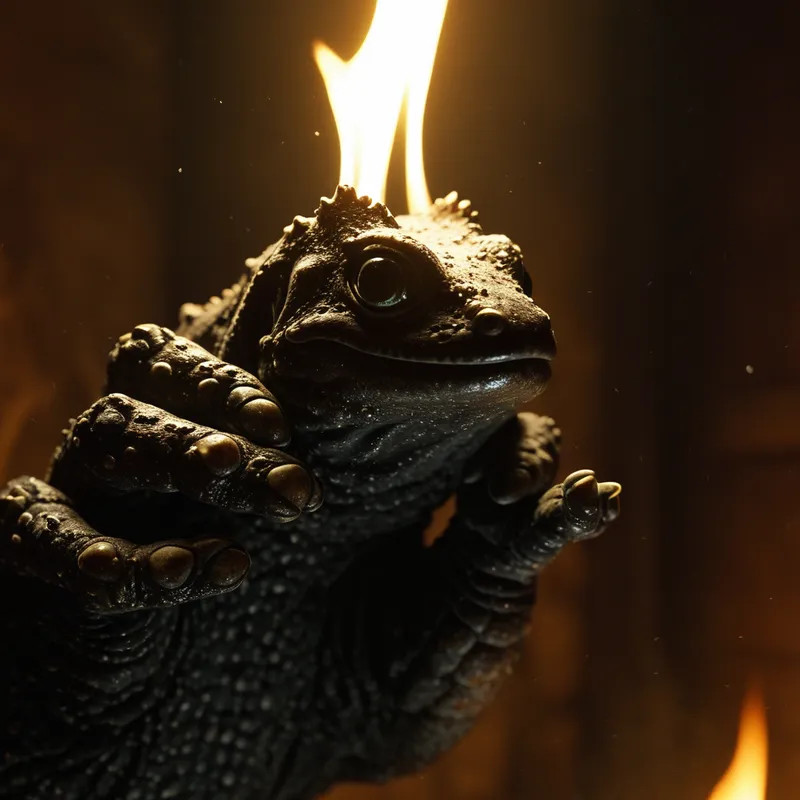
The Salamander, as an alchemical entity, does not spring from a single, unified mythic cycle like those of Greece or Egypt. Its lineage is woven from threads of natural observation, classical philosophy, and medieval esoteric synthesis. Ancient naturalists like Pliny the Elder noted the creature’s legendary association with fire, a belief likely born from seeing real salamanders flee burning logs, their moist skin creating a brief, sizzling resistance to the flames. This observation was lifted from the physical realm into the symbolic by Hermetic and alchemical thinkers.
Within the secretive, manuscript-based culture of European alchemy (spanning roughly the 12th to the 17th centuries), the Salamander was codified as one of the four elemental spirits, alongside the Undine, the Sylph, and the Gnome. Its myth was not told in public squares but whispered in laboratories, encoded in cryptic woodcuts and dense, allegorical texts like the Atalanta Fugiens. The “tale” was the laboratory process itself. The alchemist, through the rigorous, dangerous work of distillation, calcination, and sublimation, was not just manipulating chemicals but ritually invoking and cooperating with the spirit of the Salamander. Its story was a lived experience of risk, despair, and hoped-for transcendence, serving the societal function of providing a symbolic framework for humanity’s quest to master nature—both external and internal—and achieve spiritual perfection.
Symbolic Architecture
At its core, the Salamander represents the active principle of transformation through ordeal. It is not merely fire, but the soul of fire—the intelligent, purifying agency within the destructive force.
The Salamander is the promise that within the very agent of our dissolution lies the architect of our renewal.
Psychologically, it symbolizes the libido—not in a solely sexual sense, but as the fundamental psychic energy and will to live that must be confronted and harnessed. The dark, chaotic Prima Materia is the unconscious, shadow-laden psyche. The roaring furnace is the heat of consciousness applied to this shadow material, a process that is inherently painful and destabilizing (the Nigredo, or dark night of the soul).
The birth of the Salamander from this blackness is the critical moment of insight. It represents the emergence of a new, autonomous complex from the unconscious—a guiding spirit or inner authority (what Jung might call a symbol of the Self) that is specifically equipped to handle the fire of transformation. It is the part of us that can not only survive the heat of our own truth, shame, or passion but can use that heat as its native element to purify and refine.
The Dreamer’s Resonance
When the myth of the Salamander stirs in the modern unconscious, it often manifests in dreams of intense, transformative fire. This is not the fire of catastrophic house fires (which may signal panic or trauma), but a more contained, significant flame. One might dream of a small, controlled fire in a hearth or crucible that feels sacred, or of a beautiful, non-threatening creature of flame moving through a dark landscape.
Somatically, the dreamer may be processing a “fiery” life phase—a period of intense stress, passionate creativity, purging illness, or a “baptism by fire” in a new endeavor. The psyche is using the Salamander symbol to communicate that this heat is not merely destructive; it has an intelligence and a goal. The dream is an assurance from the depths: you are in the alchemical vessel. The feeling of being tested, burned, or dissolved is part of a process overseen by an inner, resilient spirit. The appearance of the Salamander signals that the purifying, whitening stage (Albedo) is underway, even if waking life feels like a chaotic Nigredo.
Alchemical Translation
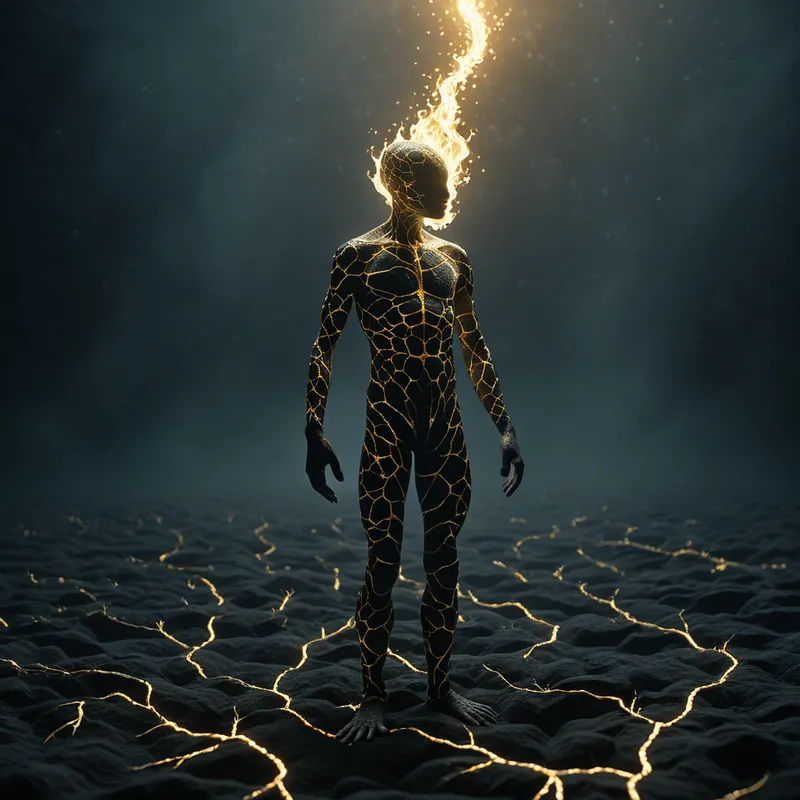
For the modern individual seeking psychic wholeness or individuation, the myth of the Salamander provides a powerful model for psychic transmutation. The “laboratory” is one’s own life and mind. The “base metal” is our unresolved complexes, inherited traumas, and un-lived potentials—the heavy, leaden aspects of our personality.
The first step is the courageous application of the fire of conscious attention to this material. This is the hard work of self-examination, therapy, shadow work, or any discipline that brings the heat of awareness to our inner darkness. It is painful and often feels like a dissolution of identity (the blackening).
The crucible of transformation is sealed not by lead, but by the courage to remain present to one’s own burning.
The emergence of the “Salamander” is the experience of discovering an innate resilience and wisdom within that very process. It is the realization that you have a core that relates to the ordeal not as a victim, but as a participant and guide. This might feel like a sudden intuition, a surge of creative energy from the pain, or a calm, fierce determination that arises from rock bottom.
The final stage, where the Salamander infuses itself into the matter to create the golden grain, is the integration. The fiery ordeal is no longer something that happened to you; its spirit has become a permanent part of your being. You have been tempered. The outcome is a psychological “Stone”—a newfound stability, authenticity, and enduring value that was forged in the heart of the flame. You have not avoided the fire; you have, like the Salamander, learned to live within it and, in doing so, turned its destructive power into the very source of your incorruptible essence.
Associated Symbols
Explore related symbols from the CaleaDream lexicon: