Sal Sapientiae Myth Meaning & Symbolism
The myth of the Salt of Wisdom, a primal substance born from the tears of the World Soul, sought by alchemists for its power to purify and grant true knowledge.
The Tale of Sal Sapientiae
Listen, and hear the tale whispered in the heat of [the crucible](/myths/the-crucible “Myth from Alchemical culture.”/) and the silence of [the alembic](/myths/the-alembic “Myth from Alchemical culture.”/)’s drip. Before the first philosopher’s stone was dreamed, before the elements learned their dance, there was only the great, yearning void of the Anima Mundi. And [the World Soul](/myths/the-world-soul “Myth from Various culture.”/) wept.
Its tears were not of [water](/myths/water “Myth from Chinese culture.”/), but of a substance more profound—a condensation of pure, unmediated knowing and the bitter ache of separation. These tears fell through the dark, not as rain, but as a slow, crystalline precipitation. They settled in the deepest veins of [the earth](/myths/the-earth “Myth from Hindu culture.”/), in places untouched by sun or root, and there they coalesced. This was the birth of Sal Sapientiae, the Salt of Wisdom. It was not a mineral, but a memory; not a [thing](/myths/thing “Myth from Norse culture.”/), but a testament.
For eons, it slept in the dark, a hidden heart of knowing. But its presence was a song that hummed through the bedrock, a vibration that called to those who could hear the earth’s dreams. The first to hear were the Alchemists of the Inner Flame. They were not mere chemists, but seekers whose laboratories were as much in their souls as in their towers. They sensed a lacuna in [the great work](/myths/the-great-work “Myth from Alchemical culture.”/), a missing principle that could bind the volatile [Mercurius](/myths/mercurius “Myth from Alchemical culture.”/) to the fixed Sulphur. They sought the Third, the Salt.
Their quest was not a digging, but a dissolution. They descended into their own [Nigredo](/myths/nigredo “Myth from Alchemical culture.”/), the blackening, facing the shadows of ignorance and the chaos of unmade self. Legends speak of Master Aloysius, who sat for forty days in a cell of his own doubt, and of Soror Mira, who let her carefully constructed theories crumble to ash. They learned that the path to the Salt was not through acquisition, but through attrition; not through adding knowledge, but through surrendering it.
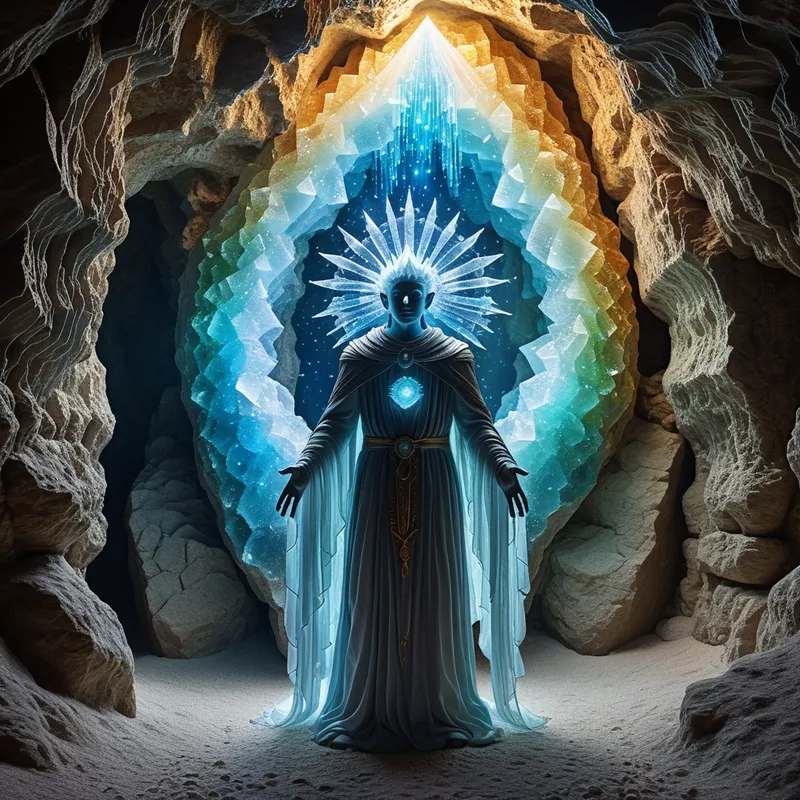
The myth tells that when an alchemist’s pride was fully dissolved, when their certainty had wept away, a single tear of true humility would fall onto their athame or into their crucible. And where that human tear met the longing of the earth, a portal would shimmer—a fissure leading to the Salt’s chamber. There, they would not find a hoard to be claimed. They would stand before the Sal Sapientiae, and it would pose a silent question, not to the mind, but to the very essence of their being. To receive a grain of it was to accept the full weight of what one truly was, and the profound sorrow of what one was not. Many turned away, for the wisdom offered was inseparable from its cost.
But for those who remained, who answered with their whole, broken self, a miracle occurred. A single, perfect crystal would detach and float into their hand. It did not glitter. It held a soft, inner luminescence, the light of the first tears. With it, their work was transformed. The Coniunctio was achieved, not as a violent fusion, but as a graceful crystallization of spirit and matter, forever bound by the essence of soul. [The alchemist](/myths/the-alchemist “Myth from Various culture.”/) emerged, not as a master of elements, but as a witness to the unity they had always contained.

Cultural Origins & Context
The myth of Sal Sapientiae originates not from a single text, but from the oral tradition of practical alchemists working in medieval and Renaissance Europe. It was a “laboratory legend,” passed between master and apprentice during the long, silent watches of the night vigil by the furnace. It was never intended for public grimoires; its transmission was a rite in itself, a seeding of the concept in the aspirant’s mind.
Its societal function was deeply psychological and initiatory. In a culture where alchemy was the scientia scientiarum (the science of sciences), the myth served as a crucial corrective to mere technical ambition. It taught that the true catalyst for transformation was not an exotic material, but an inner condition of humbled openness. It framed the alchemical opus as a journey of the soul, where the ultimate treasure was self-knowledge, crystallized from the tears of one’s own failures and insights. The myth bound the community of seekers together not through shared secret recipes, but through a shared understanding of the profound emotional and spiritual ordeal required.
Symbolic Architecture
At its core, Sal Sapientiae symbolizes [the principle](/symbols/the-principle “Symbol: A fundamental truth, law, or doctrine that serves as a foundation for a system of belief, behavior, or reasoning, often representing moral or ethical standards.”/) of essence, the irreducible core of meaning that remains after all illusions are washed away. It is the caput mortuum that is not dead, but vitally alive—the precious precipitate of experience.
Salt preserves, flavors, and creates thirst. So too does true wisdom: it preserves the integrity of the self, gives flavor to existence, and creates an unending thirst for deeper, more authentic being.
Psychologically, it represents the emergent Self, the [nucleus](/symbols/nucleus “Symbol: The core or central part of something, often representing the essence of self, foundational identity, or the source of emotional energy.”/) of individuation that forms from the conscious confrontation with the unconscious. The tears of the [Anima](/symbols/anima “Symbol: The feminine archetype within the male unconscious, representing soul, creativity, and connection to the inner world.”/) Mundi symbolize the inherent suffering of [consciousness](/symbols/consciousness “Symbol: Consciousness represents the state of awareness and perception, encompassing thoughts, feelings, and experiences.”/)—the pain of duality, of knowing oneself as separate, which is the very precondition for seeking wholeness. The alchemist’s [journey](/symbols/journey “Symbol: A journey in dreams typically signifies adventure, growth, or a significant life transition.”/) is [the ego](/myths/the-ego “Myth from Jungian culture.”/)’s descent into its own foundational [grief](/symbols/grief “Symbol: A profound emotional response to loss, often manifesting as deep sorrow, yearning, and a sense of emptiness.”/) and limitation, which alone can yield the [crystal](/symbols/crystal “Symbol: Crystals often symbolize clarity, purity, and the amplification of energy and intentions within dreams.”/) of genuine [identity](/symbols/identity “Symbol: Identity represents the sense of self, encompassing personal beliefs, cultural background, and social roles.”/).
The Dreamer’s Resonance
When this myth stirs in the modern dreamer, it often manifests as dreams of searching in deep, earthy places—cellars, caves, or forgotten underground rooms. The dreamer may be seeking a lost, precious object that is white, crystalline, or somehow “essential.” There is a somatic quality of density and gravity to these dreams; the dream-body feels heavy, pulled downward.
Psychologically, this signals a process of psychic precipitation. The conscious mind is saturated with experiences, emotions, and half-formed understandings. The dream is the process of this saturated solution descending into the dark (the unconscious) to allow the essential pattern—the core insight or truth about oneself—to crystallize out. It is a deeply non-linear, patient process. Dreaming of finally holding the crystal often coincides with a moment of sober, unsentimental self-acceptance in waking life, a knowing that feels earned and solid, not euphoric.

Alchemical Translation
For the modern individual, the myth of the Salt models the path of individuation not as a glorious ascent, but as a sacred descent. Our culture prizes the volatile Mercurius (endless possibility, speed, ideas) and the fixed Sulphur (status, identity, material success), but often lacks the binding principle of Salt—the essence that gives life meaning and cohesion.
The “operation” begins with our personal Nigredo: the dissolution of a life structure, a cherished identity, or a belief system. This is the bitter, dark night where things fall apart. The myth instructs us not to rush this stage, but to honor the tears—the genuine grief, frustration, and humility it brings.
The crucible of transformation is sealed not by fire, but by the willingness to be authentically dissolved. Wisdom is not the flame, but the crystal that forms in the cool silence after the blaze.
The receiving of the “grain” is the moment of integration. It is when we can hold a complex truth about ourselves—our capacity for both love and cruelty, our strength and our fragility—without it destroying us or needing to be explained away. This crystallized awareness becomes the permanent, grounding center, the Sal Sapientiae, around which the mercurial energies of our spirit and the sulphurous drives of our passions can finally organize into a coherent, unique, and resilient whole. We become, at last, both the alchemist and the perfected work.
Associated Symbols
Explore related symbols from the CaleaDream lexicon: