
Sakshi Myth Meaning & Symbolism
The myth of Sakshi reveals the eternal, silent witness within, observing the grand drama of existence without attachment or judgment.
The Tale of Sakshi
Listen, and let [the veil](/myths/the-veil “Myth from Various culture.”/) of time grow thin. In an age when kings were as gods and sages walked [the earth](/myths/the-earth “Myth from Hindu culture.”/), there arose a dispute of such ferocity it threatened to sunder the very kingdom. Two royal brothers, their hearts poisoned by ambition, laid claim to the same ancestral throne. Words became accusations, accusations became threats, and [the shadow](/myths/the-shadow “Myth from Jungian culture.”/) of war loomed over the land like a vulture.
The council of elders, wise but weary, could find no resolution in law or lineage. In desperation, they sought the counsel of a rishi who dwelled in the deep forest, one said to perceive truth as a hawk sees a mouse in tall grass. The rishi listened to their pleas, the air thick with the scent of fear and blooming [jasmine](/myths/jasmine “Myth from Persian culture.”/). “The truth is not in scrolls or memory,” he whispered, his voice like dry leaves. “It is etched in the ether itself. We must call upon the Sakshi.”
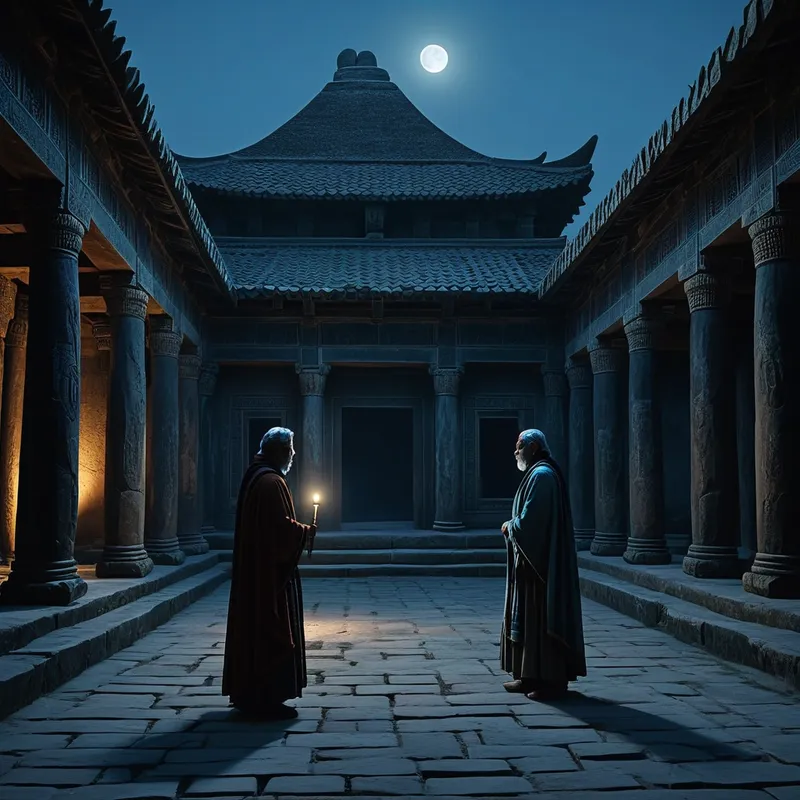
A profound silence fell. The rishi guided the feuding brothers, the elders, and a gathered crowd to a silent courtyard as the sun began to bleed into [the horizon](/myths/the-horizon “Myth from Various culture.”/). He did not chant mighty mantras nor build a fiery altar. Instead, he asked for utter stillness. He instructed the brothers to stand before one another and, with all their passion, to declare their case once more—not to the people, not to the judges, but to the very space that contained them.
The first king stepped forward, his voice thunderous, painting a saga of his rightful inheritance, his voice echoing off the ancient stones. As he spoke, a strange heaviness settled in the air. His words, once so potent, seemed to hang before him, tangible yet empty, like dust motes in a sunbeam. He faltered, feeling a gaze upon him—a gaze that was not from any eye in the crowd. It was the gaze of the courtyard itself, of the ancient banyan tree, of the very sky. It was the gaze of Sakshi.
The second brother then rose, his tone sharp with grievance and wounded pride. But as his story unfolded, the same invisible presence attended. He spoke of betrayal, but the silent witness showed him only his own clinging fear. He spoke of [justice](/myths/justice “Myth from Tarot culture.”/), and the witness reflected back his hidden desire for domination. His voice dwindled to a murmur, then to silence. Under that impartial, all-seeing awareness, the polished armor of their self-justifications melted away, leaving only the raw, trembling truth of their own hearts.
No voice from heaven declared a verdict. No divine hand pointed to the rightful king. Yet, in the resonant silence that followed, an understanding bloomed like a night flower. The brothers looked at each other, not as rivals, but as men seen—truly seen—for the first time. The complex web of “my story” and “your story” dissolved under the simple, devastating light of what is. Without a word, they bowed to each other, and the dispute ended not with a decree, but with a shared, humbled exhale. The Sakshi had borne witness, and in its mirror, illusion could not stand.
Cultural Origins & Context
The concept of Sakshi is not a singular myth from one epic, but a profound philosophical thread woven through the tapestry of Vedic and Vedantic thought. It is [the cornerstone](/myths/the-cornerstone “Myth from Biblical culture.”/) of Jnana Yoga. This “myth” is less a story told around a fire and more a living truth transmitted from guru to disciple in the forest hermitages and later codified in texts like the Upanishads and the Yoga Sutras.
Its societal function was revolutionary. In a culture with intricate social duties (dharma) and complex rituals, the teaching of Sakshi provided the ultimate internal anchor. It taught that beyond one’s role as a king, warrior, merchant, or servant, there existed an immutable core of pure consciousness that was untouched by the drama of life. This knowledge was the great liberator, offering peace not through changing external circumstances, but through realizing one’s true nature as the changeless witness of those circumstances.
Symbolic Architecture
Sakshi is the ultimate [archetype](/symbols/archetype “Symbol: A universal, primordial pattern or prototype in the collective unconscious that shapes human experience, behavior, and creative expression.”/) of pure [consciousness](/symbols/consciousness “Symbol: Consciousness represents the state of awareness and perception, encompassing thoughts, feelings, and experiences.”/). It is not a god who intervenes, but the fundamental ground of being upon which the play (lila) of the [universe](/symbols/universe “Symbol: The universe symbolizes vastness, interconnectedness, and the mysteries of existence beyond the individual self.”/) unfolds.
Sakshi is the silent screen upon which the movie of the self is projected. The drama may be tragic or comic, but the screen remains unchanged, luminous, and empty.
Psychologically, Sakshi represents the observing ego, the part of consciousness that can step back from identification with thoughts, emotions, and sensory experiences. The two arguing kings symbolize the conflicted contents of the [psyche](/myths/psyche “Myth from Greek culture.”/)—our competing inner narratives, our [victim](/symbols/victim “Symbol: A person harmed by external forces, representing vulnerability, injustice, or sacrifice in dreams. Often symbolizes powerlessness or moral conflict.”/) and perpetrator [stories](/symbols/stories “Symbol: Stories symbolize the narratives of our lives, reflecting personal experiences and collective culture.”/), our pride and our [shame](/symbols/shame “Symbol: A painful emotion arising from perceived failure or violation of social norms, often involving exposure of vulnerability or wrongdoing.”/). The [resolution](/symbols/resolution “Symbol: In arts and music, resolution refers to the movement from dissonance to consonance, creating a sense of completion, release, or finality in a composition.”/) does not come from one content defeating another, but from the [emergence](/symbols/emergence “Symbol: A process of coming into being, rising from obscurity, or breaking through a barrier, often representing birth, transformation, or revelation.”/) of a third position: [the witness](/symbols/the-witness “Symbol: A figure observing events without direct participation, representing conscience, memory, or societal judgment.”/). This is the [birth](/symbols/birth “Symbol: Birth symbolizes new beginnings, transformation, and the potential for growth and development.”/) of [meta](/symbols/meta “Symbol: A self-referential concept or layer about the nature of reality, systems, or the self. In gaming, it refers to the optimal strategies and knowledge above the game’s basic rules.”/)-[awareness](/symbols/awareness “Symbol: Conscious perception of self, surroundings, or internal states. Often signifies awakening, insight, or heightened sensitivity.”/), where we are no longer in the anger, but we are aware that we are angry. This shift from identification to observation is the first and most critical step in any [depth](/symbols/depth “Symbol: Represents profound layers of consciousness, hidden truths, or the unknown aspects of existence, often symbolizing introspection and existential exploration.”/) psychological work or spiritual awakening.

The Dreamer’s Resonance
When the archetype of Sakshi stirs in the modern unconscious, it often manifests in dreams of being observed or of observing oneself from a detached vantage point. You may dream of watching your own life from a ceiling corner, or seeing yourself in a play. You might encounter a calm, silent figure in your dream who simply watches you navigate a chaotic scenario without offering help or judgment.
Somatically, this can correspond to a feeling of “spaciousness” amidst emotional turmoil—a sudden, quiet center in a psychological storm. It signals a process of dis-identification. The psyche is beginning to differentiate the transient contents of consciousness (fears, desires, social personas) from the eternal context of consciousness itself. This can initially feel alienating or dissociative, as the familiar anchors of “I am my job” or “I am my pain” begin to loosen. But it is the necessary precursor to authentic self-knowledge, a somatic unfurling from the clenched fist of ego into the open palm of awareness.

Alchemical Translation
The alchemical journey modeled by the Sakshi myth is the opus contra naturam—the work against one’s own habitual nature. Our default state is identification: “I am my body, my history, my successes, my failures.” The alchemical fire is the practice of sustained, non-judgmental awareness.
The transmutation occurs not in the content, but in the relationship to the content. Leaden identification becomes golden witnessing.
[The first stage](/myths/the-first-stage “Myth from Alchemical culture.”/) ([nigredo](/myths/nigredo “Myth from Alchemical culture.”/)) is the “dispute of the kings”—the chaos of conflicting inner voices, [the dark night of the soul](/myths/the-dark-night-of-the-soul “Myth from Christian Mysticism culture.”/) where old identities clash. The second stage (albedo) is the invocation of the witness—the washing in the pure [water](/myths/water “Myth from Chinese culture.”/) of observation, where these contents are seen clearly, in their whiteness, stripped of their emotional charge. The final stage ([rubedo](/myths/rubedo “Myth from Alchemical culture.”/)) is not the victory of one king, but the realization of the kingdom itself—the red dawn where one identifies not with any passing thought or feeling, but with the vast, red-gold sky of consciousness that contains them all. This is individuation in its deepest sense: not becoming a better, shinier ego, but realizing [the Self](/myths/the-self “Myth from Jungian culture.”/) (Atman) that was never born and will never die, the eternal Sakshi within. The modern seeker’s task is to cultivate this inner witness, to sit in the courtyard of their own mind and allow all inner claimants to speak, until only the radiant, silent truth of being remains.
Associated Symbols
Explore related symbols from the CaleaDream lexicon: