Saint Francis of Assisi Myth Meaning & Symbolism
A wealthy youth renounces everything to wed Lady Poverty, preaching to birds and wolves, embodying a love that dissolves the boundary between self and world.
The Tale of Saint Francis of Assisi
Listen, then, to the tale of the one who danced with fire and spoke with stone. In the green heart of Umbria, under a sky the color of old wine, there lived a son of wealth named Francesco. His world was silk and song, the clink of coin and the admiration of peers. He dreamed of glory, of knightly valor, but a sickness seized him in a Perugian dungeon, a fever that did not burn the body but the soul. It left him hollow, hearing a different music.
The call came in the broken silence of the San Damiano chapel. Before a painted Crucifix, the very wood seemed to breathe. A voice, not with sound but with substance, filled the emptiness: “Francis, go and repair my house, which, as you see, is falling into ruin.” He felt the command in his marrow. He took bolts of fine cloth from his father’s warehouse, sold them, and laid the coins at the feet of a bewildered priest. His father, Pietro</abrandone, raged, dragging him before the Bishop. There, in the public square, Francis performed the ultimate severance. He stripped himself naked, casting the fine garments back at his father, his skin pale against the cobblestones. “Until now I have called you father on earth,” he declared, “but now I can say without reserve, ‘Our Father who art in heaven.’” He walked away, clothed only in the Bishop’s rough cloak, a man reborn into terrifying freedom.
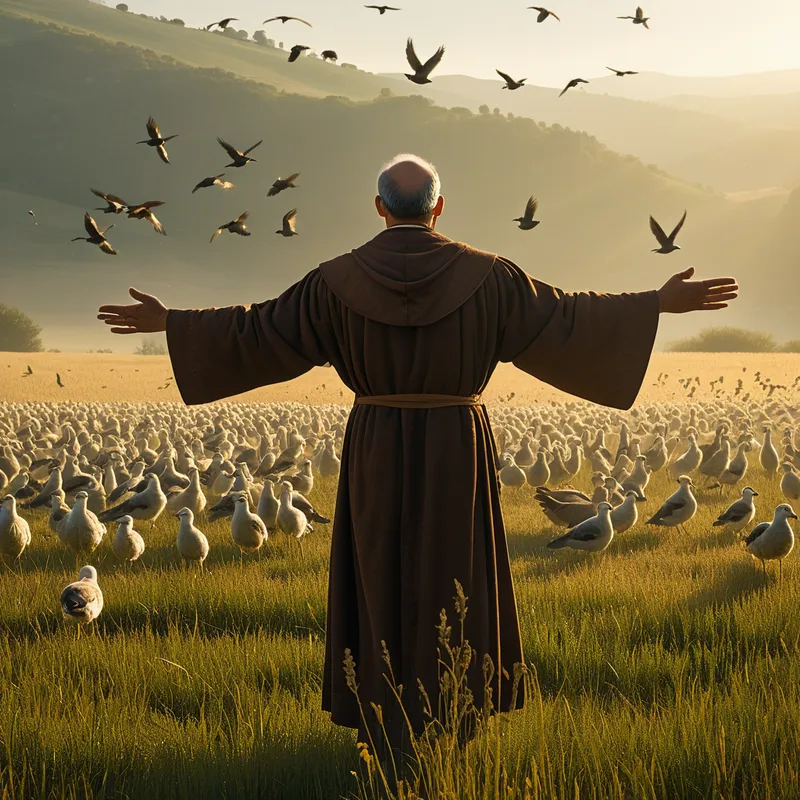
He became a fool for a new love, Lady Poverty. He mended stones with his own hands, begged for crusts, and found in lack an unimaginable wealth. [The world](/myths/the-world “Myth from Tarot culture.”/), once a marketplace, became a cathedral. In the woods of La Verna, he preached to a congregation of birds, who listened in rapt silence, a feathered cloud upon the grass. In the town of Gubbio, he faced not a knight, but a great, starving wolf that terrorized the people. He walked out, unarmed, and spoke to the beast as a brother, striking a pact: food from the town in exchange for peace. The wolf laid its head in his hand.
His love grew so fierce it etched itself upon his flesh. On the mountain, in a vision of a six-winged Seraph crucified, he received the ultimate seal: the [Stigmata](/myths/stigmata “Myth from Christian culture.”/). His hands, feet, and side bore the wounds of the Christ he adored, a body now fully translated into a living prayer of suffering and joy. Worn, blind, and in pain, he sang his final “Canticle of the Creatures,” blessing “Brother Sun” and “Sister Death,” before he was laid, naked once more, upon the bare earth, returning his spirit to the cosmos from which he believed it came.
Cultural Origins & Context
The myth of Francis emerged in the late 12th and early 13th centuries, a time of profound social upheaval. The rise of mercantile capitalism in Italian city-states like Assisi created new wealth and new poverty, straining the traditional feudal and ecclesiastical orders. Francis’s story was not an ancient legend but a contemporary event, witnessed and documented by his brothers in the Friars Minor. The primary sources, like the Little Flowers of Saint Francis and biographies by [Thomas](/myths/thomas “Myth from Christian culture.”/) of Celano and Bonaventure, were crafted to promote a specific spiritual ideal within a Church grappling with heresy and calls for reform.
The myth was propagated orally by the friars themselves—wandering, begging preachers who embodied the tale they told. Its societal function was multifaceted: it was a radical critique of materialistic society, a model of apostolic purity for a Church perceived as corrupt, and a soothing, integrative force. By making a pact with the wolf of Gubbio, Francis didn’t slay the external threat; he tamed it, modeling how the fearful “other” (be it nature, poverty, or heresy) could be brought into a sacred covenant. The myth offered a new, emotionally accessible spirituality centered on joy, humility, and direct experience of the divine in creation, which resonated deeply with a populace weary of dry scholasticism.
Symbolic Architecture
At its core, the myth of Francis is a masterclass in the [psychology](/symbols/psychology “Symbol: Psychology in dreams often represents the exploration of the self, the subconscious mind, and emotional conflicts.”/) of inversion. The central symbolic act is not acquisition, but divestment. The [hero](/symbols/hero “Symbol: A hero embodies strength, courage, and the ability to overcome significant challenges.”/)’s [journey](/symbols/journey “Symbol: A journey in dreams typically signifies adventure, growth, or a significant life transition.”/) is [inward](/symbols/inward “Symbol: A journey toward self-awareness, introspection, and the exploration of one’s inner world, thoughts, and unconscious mind.”/) and downward, into the [valley](/symbols/valley “Symbol: A valley often symbolizes a period of transition or a place of respite between two extremes.”/) of humility, not up the [mountain](/symbols/mountain “Symbol: Mountains often symbolize challenges, aspirations, and the journey toward self-discovery and enlightenment.”/) of [achievement](/symbols/achievement “Symbol: Symbolizes success, mastery, or reaching a goal, often reflecting personal validation, social recognition, or overcoming challenges.”/).
The true treasure is found not in the counting house, but in the hollow space left behind when all coin is spent.
Francis represents the Dying and Reviving God figure, but with a distinctly [Christian](/symbols/christian “Symbol: The symbol represents the faith, teachings, and cultural values associated with Christianity, including themes of love, salvation, and morality.”/) and psychological twist. His “[death](/symbols/death “Symbol: Symbolizes transformation, endings, and new beginnings; often associated with fear of the unknown.”/)” is a voluntary ego-death. Stripping naked before the [Bishop](/symbols/bishop “Symbol: A high-ranking religious figure symbolizing spiritual authority, moral guidance, and institutional power within hierarchical structures.”/) is the ultimate [ritual](/symbols/ritual “Symbol: Rituals signify structured, meaningful actions carried out regularly, reflecting cultural beliefs and emotional needs.”/) of [persona](/symbols/persona “Symbol: The social mask or outward identity one presents to the world, often concealing the true self.”/) [dissolution](/symbols/dissolution “Symbol: The process of breaking down, dispersing, or losing form, often representing transformation, release, or the end of a state of being.”/). He sheds the [identity](/symbols/identity “Symbol: Identity represents the sense of self, encompassing personal beliefs, cultural background, and social roles.”/) of “son of Pietro” to claim his true Self, symbolized by the divine [Father](/symbols/father “Symbol: The father figure in dreams often symbolizes authority, protection, guidance, and the quest for approval or validation.”/). [Lady](/symbols/lady “Symbol: The symbol of the ‘Lady’ often signifies femininity, grace, and the complexities of the female experience, representing aspects of nurturing, intuition, and empowerment.”/) [Poverty](/symbols/poverty “Symbol: A state of lacking material resources or essential needs, often symbolizing feelings of inadequacy, vulnerability, or spiritual emptiness in dreams.”/) is the [anima](/symbols/anima “Symbol: The feminine archetype within the male unconscious, representing soul, creativity, and connection to the inner world.”/) as transformative [vessel](/symbols/vessel “Symbol: A container or structure that holds, transports, or protects something essential, representing the self, emotions, or life journey.”/); by wedding her, he marries the rejected, empty, and “poor” parts of his own [psyche](/myths/psyche “Myth from Greek culture.”/) and the world.
The preaching to the birds and the taming of the [wolf](/symbols/wolf “Symbol: Wolves in dreams symbolize instinct, intelligence, freedom, and a deep connection to the wilderness and primal instincts.”/) symbolize the [redemption](/symbols/redemption “Symbol: A theme in arts and music representing transformation from failure or sin to salvation, often through creative expression or cathartic performance.”/) of the instinctual and [shadow](/symbols/shadow “Symbol: The ‘shadow’ embodies the unconscious, repressed aspects of the self and often represents fears or hidden emotions.”/) realms. The birds represent the airy, spiritual thoughts that are often scattered; he gathers them to him. The [wolf](/symbols/wolf “Symbol: Wolves in dreams symbolize instinct, intelligence, freedom, and a deep connection to the wilderness and primal instincts.”/) is the untamed, predatory shadow—the aggression, fear, and raw [survival instinct](/symbols/survival-instinct “Symbol: The survival instinct represents primal intuition and the deep-seated drive to protect oneself and thrive in challenging circumstances.”/) that terrorizes the [community](/symbols/community “Symbol: Community in dreams symbolizes connection, support, and the need for belonging.”/) (the psyche). Francis does not kill it; he recognizes its [hunger](/symbols/hunger “Symbol: A primal bodily sensation symbolizing unmet needs, desires, or emotional voids. It represents craving for fulfillment beyond physical nourishment.”/), names it “[Brother](/symbols/brother “Symbol: In dreams, a brother often symbolizes kinship, support, loyalty, and shared experiences, reflecting the importance of familial and social bonds.”/),” and negotiates a [peace](/symbols/peace “Symbol: Peace represents a state of tranquility and harmony, both internally and externally, often reflecting a desire for resolution and serenity in one’s life.”/). This is the [integration](/symbols/integration “Symbol: The process of unifying disparate parts of the self or experience into a cohesive whole, often representing psychological wholeness or resolution of internal conflict.”/) of the [shadow](/symbols/shadow “Symbol: The ‘shadow’ embodies the unconscious, repressed aspects of the self and often represents fears or hidden emotions.”/), not its annihilation.
The [culmination](/symbols/culmination “Symbol: A point of completion or climax in a process, often marking the end of a cycle and the achievement of a goal.”/), the [Stigmata](/symbols/stigmata “Symbol: Spontaneous appearance of wounds resembling those of Christ’s crucifixion, often interpreted as a sign of divine connection, suffering, or spiritual transformation.”/), is the ultimate [symbol](/symbols/symbol “Symbol: A symbol can represent an idea, concept, or belief, serving as a powerful tool for communication and understanding.”/) of participation mystique—a state where the [boundary](/symbols/boundary “Symbol: A conceptual or physical limit defining separation, protection, or identity between entities, spaces, or states of being.”/) between self and [archetype](/symbols/archetype “Symbol: A universal, primordial pattern or prototype in the collective unconscious that shapes human experience, behavior, and creative expression.”/) dissolves. The [image](/symbols/image “Symbol: An image represents perception, memories, and the visual narratives we create in our minds.”/) of the crucified God is so wholly internalized that it manifests on the [body](/symbols/body “Symbol: The body in dreams often symbolizes the dreamer’s self-identity, personal health, and the relationship they have with their physical existence.”/). It is the psyche’s most profound [statement](/symbols/statement “Symbol: A statement in a dream can symbolize the need to express one’s thoughts or beliefs, reflecting a desire for honesty or clarity.”/): the [path](/symbols/path “Symbol: The ‘path’ symbolizes a journey, choices, and the direction one’s life is taking, often representing individual growth and exploration.”/) of deepest love and identification leads to a sharing in the world’s fundamental wound.
The Dreamer’s Resonance
When this myth stirs in the modern dreamer, it often signals a profound crisis of value and a call to radical simplification. To dream of giving away all one’s possessions, especially in a joyous, liberating manner, points to a psyche straining under the weight of a false or burdensome identity—the “father’s cloth” that no longer fits. The dream ego may be preparing for an essential shedding.
Dreams of communicating with animals—particularly wild animals like wolves approaching in peace, or birds listening intently—suggest the dreamer is in a process of reconnecting with instinctual wisdom and integrating shadow material. The animal represents an autonomous complex, a powerful drive or fear that is asking not to be fought, but to be understood and brought into relationship.
A dream of receiving a wound that is also a mark of honor, or of one’s body transforming to reflect an inner conviction, mirrors the Stigmata. This is a somatic manifestation of a psychological truth too powerful to remain unconscious. It indicates the dreamer is being irrevocably marked by an encounter with [the Self](/myths/the-self “Myth from Jungian culture.”/), a transformative suffering that carries the signature of the sacred. The body in the dream is saying what the mind cannot yet articulate.
Alchemical Translation
The alchemical journey of Francis models the opus contra naturam—the work against nature, which in psychological terms means against [the ego](/myths/the-ego “Myth from Jungian culture.”/)’s natural tendency to accumulate, defend, and inflate. His life is a recipe for the transmutation of leaden, worldly identity into the gold of the liberated Self.
[The first stage](/myths/the-first-stage “Myth from Alchemical culture.”/), [nigredo](/myths/nigredo “Myth from Alchemical culture.”/) (the blackening), is his sickness, imprisonment, and the dark night of confusion in San Damiano. It is the dissolution of his old life. The public stripping is the [separatio](/myths/separatio “Myth from Alchemical culture.”/), violently dividing the spirit’s claim from the father’s worldly expectations. His life of begging and manual labor is the mortificatio, the humbling and “killing” of pride.
The philosopher’s stone is not a thing to be found, but a mode of seeing that is achieved when one has nothing left to look with but love.
His communion with nature represents the albedo (whitening), the washing clean in the waters of unconscious, instinctual life, leading to illumination. He finds his “white stone” in Brother Sun and Sister Moon. Finally, the [rubedo](/myths/rubedo “Myth from Alchemical culture.”/) (reddening) is achieved in the fiery, painful, and ecstatic union symbolized by the Seraph and the Stigmata. This is the coniunctio, the marriage of heaven and earth, spirit and matter, within [the vessel](/myths/the-vessel “Myth from Alchemical culture.”/) of his own body. The final “Canticle” is the projectio, the giving back of the perfected substance—a life fully realized as praise—to the cosmos.
For the modern individual, the myth does not prescribe literal poverty, but a radical poverty of spirit: the willingness to identify and divest the psychic “wealth” that isolates us—our rigid identities, our defended positions, our alienation from the “wolf” of our own wild nature. It calls for a sacred pact with all that we have deemed lowly, fearful, or “other” within and without, promising that in that covenant lies not loss, but the recovery of a forgotten, and holy, kinship.
Associated Symbols
Explore related symbols from the CaleaDream lexicon: