Saint Dunstan Myth Meaning & Symbolism
A 10th-century monk, Saint Dunstan, seizes the Devil's nose with glowing tongs, forging a legend of spiritual resistance and the alchemy of the soul.
The Tale of Saint Dunstan
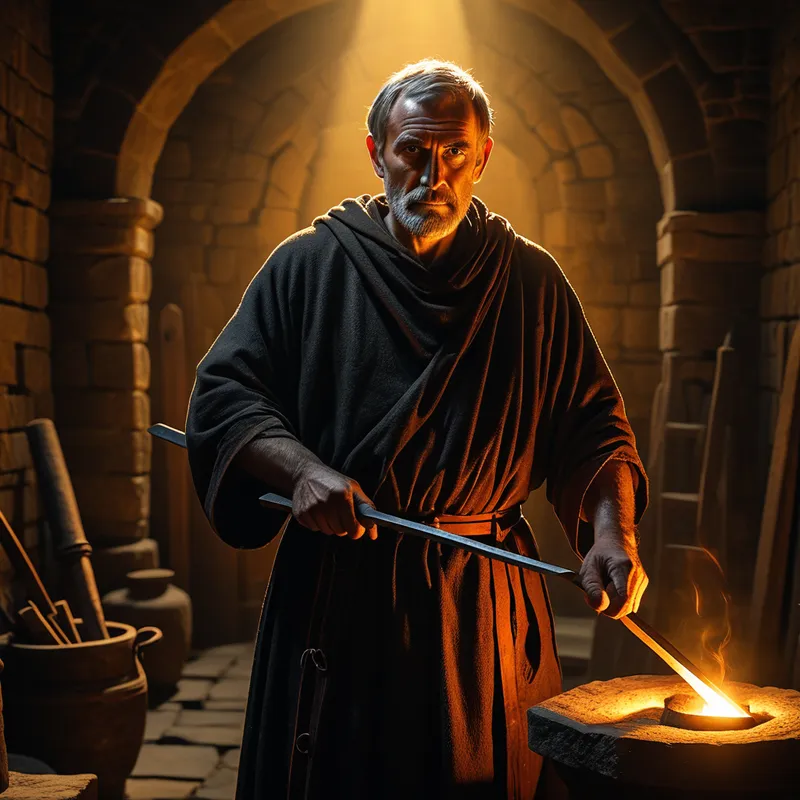
In the deep, quiet heart of the tenth century, when England’s green land was stitched with prayer and shadow, there lived a man of fire and iron. His name was Dunstan, and his sanctuary was not only the chapel but the smithy. The air in his workshop at Glastonbury was thick with the scent of charcoal and ozone, the silence broken by the sacred rhythm of hammer on anvil, a psalm sung in steel.
One evening, as the last crimson light of day died in the west and the forge’s heart pulsed with a sullen, red glow, Dunstan labored alone. He was crafting a chrismal, his hands steady, his mind fixed on divine geometry. It was then the presence announced itself—not with a clap of thunder, but with a creeping chill that slithered up the spine of the stone walls. The shadows in the corner of the workshop thickened, coalescing into a form of elegant malice.
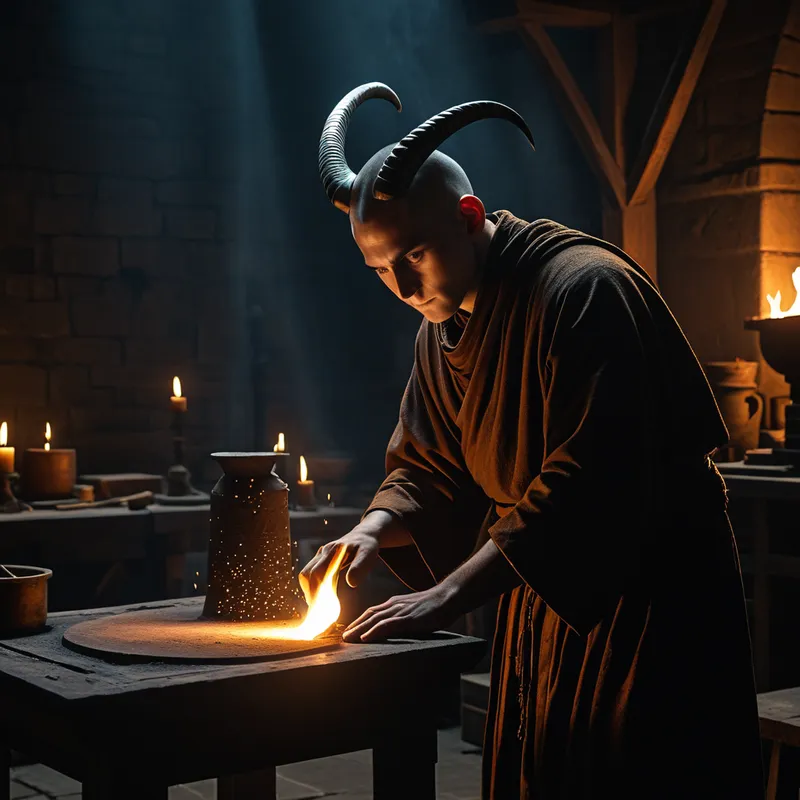
He appeared as a handsome nobleman, yet his eyes held [the void](/myths/the-void “Myth from Buddhist culture.”/) of a starless night. It was the Devil himself, come to Glastonbury. With a voice like honey poured over broken glass, he praised Dunstan’s skill. “Such fine work for the God who hides in silence,” the fiend whispered, slinking closer. “But imagine the glory your hands could win in [the world](/myths/the-world “Myth from Tarot culture.”/)’s bright courts. Leave this damp cell. I offer you kingdoms of influence, treasures that gleam, pleasures that sing.” The temptations wove through the clang of the hammer, each one a perfect, poisoned note.
Dunstan did not look up from his work. His hand, however, drifted from the delicate silver to the heavy, iron tongs resting in the coals. The fiend, thinking the monk’s silence was consideration, leaned in closer, his breath a foul miasma against Dunstan’s cheek. “Your piety is a chain. Let me break it.”
In that moment, Dunstan moved. It was not the slow turn of a scholar, but the swift, sure motion of a master craftsman. His hand shot out, not with a cross, but with the tool of his earthly vocation. He seized the glowing tongs, their jaws white-hot from the belly of the forge. And as the Devil leaned in to whisper one final, damning promise, Dunstan clamped those fiery jaws not on cold iron, but on the creature’s long, taunting nose.
A scream, not of this earth, shattered the monastic quiet. It was a sound of pure, incredulous agony. The handsome visage melted into something grotesque and primal. The Devil thrashed and howled, the smell of burning [sulfur](/myths/sulfur “Myth from Alchemical culture.”/) filling the smithy, but Dunstan held fast with the strength of a conviction forged in solitude and prayer. He held the embodiment of temptation itself by its most prominent feature, the instrument of its sneering pride, and he forged it in the fire of his resolve.
Only when the beast begged and swore a frantic oath to never trouble that holy place again did Dunstan, with deliberate calm, release him. The creature fled, a comet of pain and humiliation, vanishing into the night with a wail that echoed over the Somerset levels. Dunstan returned the tongs to the fire, picked up his hammer, and resumed his work. The only sound was the ringing of metal, now a hymn of [triumph](/myths/triumph “Myth from Roman culture.”/). The saint had not merely resisted evil; he had taken its measure with his own hands and found it wanting.
Cultural Origins & Context
The legend of Saint Dunstan is a fascinating alloy of historical fact and folkloric imperative. The historical Dunstan (c. 909 – 988 AD) was a central figure in the English Benedictine Reform, a zealous Archbishop of Canterbury, and a renowned statesman. He was also, by contemporary accounts, a skilled metalworker, illuminator, and musician—a true Renaissance man centuries before the Renaissance.
This myth did not emerge from dusty theological tracts, but from the oral traditions of the common people and the monastic communities that venerated him. It was a story told by firelight, repeated by travelers, and cherished by guilds of blacksmiths, goldsmiths, and bell-founders who took Dunstan as their patron saint. Its societal function was multifaceted: it affirmed the holiness of manual labor and craft, it provided a vivid, memorable model of resistance against temptation (especially for monks in their isolated cells), and it localized the cosmic Christian struggle between good and evil into a tangible, dramatic event. The Devil was not an abstract concept but a being who could be physically confronted and defeated, not by a warrior with a sword, but by a craftsman with his tools.
Symbolic Architecture
At its core, the myth is a masterclass in symbolic [resistance](/symbols/resistance “Symbol: An object or tool representing opposition, struggle, or the act of pushing back against external forces or internal changes.”/) and the [alchemy](/symbols/alchemy “Symbol: A transformative process of purification and creation, often symbolizing personal or spiritual evolution through difficult stages.”/) of [attention](/symbols/attention “Symbol: Attention in dreams signifies focus, awareness, and the priorities in one’s life, often indicating where the dreamer’s energy is invested.”/). Dunstan does not argue with the Devil; he does not debate theology. He acts, using the very instruments of his earthly, focused labor.
The forge is the crucible of the soul, where base instincts are heated in the fire of conscious attention until they can be shaped.
The [tongs](/symbols/tongs “Symbol: Tongs symbolize control and the ability to grasp or release elements in one’s life, often representing the balancing act between restraint and indulgence.”/) represent the faculty of discrimination—the [ability](/symbols/ability “Symbol: In dreams, ‘ability’ often denotes a recognition of skills or potential that one possesses, whether acknowledged or suppressed.”/) to grasp, hold, and examine a tempting or destructive [impulse](/symbols/impulse “Symbol: A sudden, powerful urge or drive that arises without conscious deliberation, often linked to primal instincts or emotional surges.”/) without being consumed by it. They are an extension of the will. The forge is the intense heat of spiritual or psychological ordeal, the necessary suffering of transformation. The Devil’s [nose](/symbols/nose “Symbol: The nose often represents perception, intuition, and the ability to confront emotions and truths.”/) is brilliantly chosen; it is the [organ](/symbols/organ “Symbol: An organ symbolizes vital aspects of life and health, often representing one’s emotional or physical state.”/) that sniffs out weakness, that intrudes into spaces where it does not belong. By seizing it, Dunstan symbolically seizes the [source](/symbols/source “Symbol: The origin point of something, often representing beginnings, nourishment, or the fundamental cause behind phenomena.”/) of the temptation’s power—its [ability](/symbols/ability “Symbol: In dreams, ‘ability’ often denotes a recognition of skills or potential that one possesses, whether acknowledged or suppressed.”/) to “get up in your [business](/symbols/business “Symbol: Dreaming of ‘business’ often symbolizes the dreamer’s ambitions, desires for success, and management of resources in their waking life.”/),” to distract and probe at vulnerabilities.
Psychologically, Dunstan represents the integrated ego that does not flee from the [shadow](/symbols/shadow “Symbol: The ‘shadow’ embodies the unconscious, repressed aspects of the self and often represents fears or hidden emotions.”/) (the repressed, tempting, or destructive aspects of [the self](/myths/the-self “Myth from Jungian culture.”/)) but turns to face it, using the skills and strengths one has already developed (his craftsmanship) to deal with it.
The Dreamer’s Resonance
When this mythic pattern stirs in the modern unconscious, it often manifests in dreams of confrontation within a workspace. One might dream of being in an office, laboratory, or studio when a chaotic, seductive, or threatening force disrupts the work. The dreamer may find themselves reaching not for a weapon, but for a tool of their trade—a pen, a wrench, a keyboard—to fend off the intrusion.
The somatic experience is one of sudden, adrenalized focus. There is a shift from anxiety to a potent, channeled rage or determination. This dream signals that the [psyche](/myths/psyche “Myth from Greek culture.”/) is engaging in a process of containment. An overwhelming emotion, a addictive lure, or a paralyzing fear has become personified and is now being “grabbed by the nose”—confronted directly with the tools of one’s conscious mind and vocation. The dream is an enactment of [the ego](/myths/the-ego “Myth from Jungian culture.”/) strengthening itself, learning to hold the hot, painful, or tempting content of the unconscious without letting go and without being burned.

Alchemical Translation
The journey of Saint Dunstan is a perfect map for the individuation process. It models the stage where the individual must move from passive suffering of inner conflicts to active engagement.
The first step is [Nigredo](/myths/nigredo “Myth from Alchemical culture.”/): the blackening, the dark night in the [monastic cell](/myths/monastic-cell “Myth from Christian culture.”/), the presence of [the shadow](/myths/the-shadow “Myth from Jungian culture.”/) (the Devil) in the midst of one’s sacred work. The temptation to abandon the difficult, isolating work of self-development for the glittering promises of the outer world (status, numbing pleasure, escape) is acute.
Dunstan’s act initiates Albedo: the whitening. The red-hot tongs become white-hot through focused intent. This is the moment of conscious realization and application of will. He does not destroy the Devil; he transforms his relationship to it. By grasping the temptation, he brings it into the light of consciousness (the glow of the forge), where its power to manipulate from the shadows is nullified.
The ultimate product of this psychic alchemy is not the defeat of an enemy, but the forging of a stronger, more resilient vessel for the spirit—the Self.
The final oath sworn by the Devil is crucial. It represents the [Rubedo](/myths/rubedo “Myth from Alchemical culture.”/), the reddening or culmination. The integrated shadow is compelled to swear fealty to the new order of the psyche. The troublesome complex, once faced and mastered, loses its autonomous, demonic power and is relegated to its proper place. It no longer “troubles that holy place”—the integrated center of the individual. The saint returns to his work, but he is no longer the same man. He has used the fire of confrontation to temper his soul, and every subsequent stroke of his hammer rings with the authority of one who has forged his own integrity.
Associated Symbols
Explore related symbols from the CaleaDream lexicon: