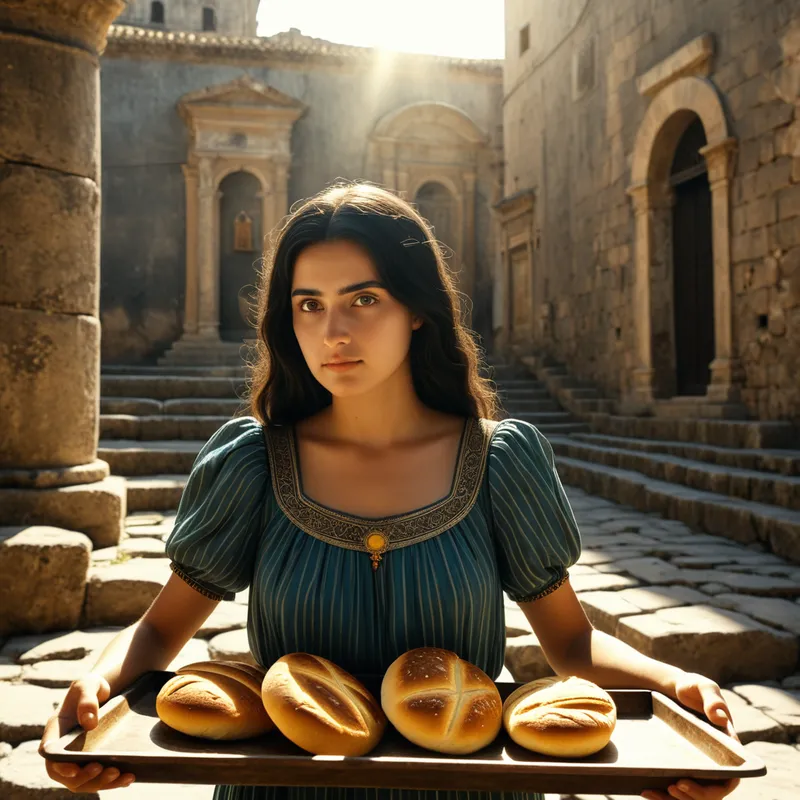
Saint Agatha of Sicily Myth Meaning & Symbolism
A young Christian woman in Roman Sicily endures horrific torture for her faith, her severed breasts miraculously restored, becoming an eternal symbol of defiance and healing.
The Tale of Saint Agatha of Sicily
Hear now a tale from the sun-baked stone and sea-spray of Sicily, in the days when the eagle’s shadow was long and its law was iron. In the city of Catania, there lived a maiden named Agatha, whose beauty was not merely of form, but of spirit—a quiet, deep well of faith in the God who whispers to the heart, not the gods who demand public spectacle.
Her peace was shattered by the arrival of Quintianus, the Roman prefect, a man whose authority was a brittle mask for lust and pride. He saw Agatha, and desire coiled within him, not for her person, but for the conquest she represented. He summoned her, demanding she renounce her faith and yield to him. But Agatha’s soul was a citadel. “My body is consecrated,” she declared, her voice steady as the mountain, Etna, that watched over her home. “You have no power over it.”
Fury, cold and calculated, replaced Quintianus’s desire. He handed her to Aphrodisia, a brothel-keeper, believing a month among corrupted souls would break her purity. Yet in that house of shadows, Agatha’s light only burned brighter, untainted, a flame that would not be smothered by darkness. Enraged by her unwavering spirit, Quintianus brought her before his tribunal. The conflict was no longer about possession, but annihilation. He would break the symbol to break the faith it represented.
The sentence was torture. She was stretched on the rack, her joints screaming. She was scourged, her back laid open. Yet from her lips came not pleas for mercy, but prayers of gratitude for her constancy. Then, in a act of symbolic violence meant to utterly defile and unmake her, Quintianus ordered her most sacred attribute—her breasts—to be severed with iron shears. The hot Sicilian air filled with the scent of iron and agony. They cast her, broken and bleeding, into a dark cell, intending her to die in shame and solitude.
But in that deepest darkness, a light visited. An old man, bearing a salve and a lamp, entered her cell. He tended her wounds, and when he left, Agatha found not only relief from pain, but wholeness. Her flesh was restored. Four days later, Quintianus, in a final, petty fury, ordered her rolled over live coals and broken pottery. As [the earth](/myths/the-earth “Myth from Hindu culture.”/) trembled—some say with the anger of Etna itself—a final prayer left her lips, and her spirit was released. The tyrant’s power ended at the edge of her soul, which he could never touch.

Cultural Origins & Context
This story emerges from the volatile crucible of the 3rd century Roman Empire, during the persecution of Decius. Sicily, a rich and strategic province, was a microcosm of the empire’s struggle between entrenched pagan authority and the rising, subversive tide of Christianity. The tale of Agatha is not a formal history but a passio, a narrative of martyrdom crafted to inspire, instruct, and solidify communal identity.
It was passed down orally among the clandestine Christian communities before being codified. Its tellers were the faithful, gathering in hidden places, using Agatha’s story as a psychological and theological weapon against fear. Societally, it functioned as a radical counter-narrative to Roman values of imperial power and physical perfection. It redefined strength, locating it not in the legions or the body’s integrity, but in the unassailable will of a young woman. Her cult spread rapidly, and she became one of the most venerated Canonical [Saints](/myths/saints “Myth from Christian culture.”/), a specific protector against fires (linking her to Etna’s eruptions) and diseases of the breast. Her feast day, February 5th, became a cornerstone of Sicilian identity, a celebration of resilience against all forms of oppression.
Symbolic Architecture
The myth’s power lies not in its historical veracity, but in its profound symbolic [architecture](/symbols/architecture “Symbol: Architecture in dreams often signifies structure, stability, and the framing of personal identity or life’s journey.”/). Agatha represents the inviolable core of [the Self](/myths/the-self “Myth from Jungian culture.”/), the Self, confronting the crushing, devouring demands of the outer world, the collective [shadow](/symbols/shadow “Symbol: The ‘shadow’ embodies the unconscious, repressed aspects of the self and often represents fears or hidden emotions.”/) embodied by Quintianus.
The ultimate rebellion is not against a ruler, but against the tyranny of meaning assigned to your own flesh.
Her breasts are the central, multivalent [symbol](/symbols/symbol “Symbol: A symbol can represent an idea, concept, or belief, serving as a powerful tool for communication and understanding.”/). In the Roman context, their removal was meant to destroy her [fertility](/symbols/fertility “Symbol: Symbolizes creation, growth, and abundance, often representing new beginnings, potential, and life force.”/), her femininity, her very [life](/symbols/life “Symbol: The symbol of ‘Life’ represents a journey of growth, interconnectedness, and existential meaning, encompassing both the joys and challenges that define human experience.”/)-giving essence—to make her a monstrous negation. Yet in the myth’s [alchemy](/symbols/alchemy “Symbol: A transformative process of purification and creation, often symbolizing personal or spiritual evolution through difficult stages.”/), this act of violation transforms them. They become detached, sacred objects, presented on a [tray](/symbols/tray “Symbol: A tray symbolizes organization, receptivity, and the act of offering or sharing.”/). They are no longer vulnerable flesh but eternal symbols. They represent spiritual nourishment, the “milk of doctrine,” and the paradoxical [triumph](/myths/triumph “Myth from Roman culture.”/) where what is meant to [shame](/symbols/shame “Symbol: A painful emotion arising from perceived failure or violation of social norms, often involving exposure of vulnerability or wrongdoing.”/) becomes the [emblem](/symbols/emblem “Symbol: A symbolic design representing identity, authority, or ideals, often used in heraldry, logos, or artistic expression.”/) of sanctity. The restoration by the mysterious old man (often interpreted as [Saint Peter](/myths/saint-peter “Myth from Christian culture.”/)) signifies that what [the ego](/myths/the-ego “Myth from Jungian culture.”/)-world destroys, the deeper, transpersonal [psyche](/myths/psyche “Myth from Greek culture.”/) can heal and return, not as it was, but sanctified by the ordeal.

The Dreamer’s Resonance
When this myth stirs in the modern dreamer, it signals a profound psychological crisis of integrity. To dream of mutilation, specifically of the chest or heart center, often parallels Agatha’s ordeal. It is not a literal fear, but a somatic expression of feeling one’s core identity, values, or creative life-force (“what nourishes you”) is under brutal attack.
The attacker in the dream—a boss, a partner, a faceless authority—is the Quintianus complex: an internalized voice demanding conformity, demanding you sever your own “nourishing principles” to fit in, to be acceptable, to survive in a system that feels hostile to your true nature. The dream cell is the depression or isolation that follows such self-betrayal or external violation. The appearance of a healer figure, or the dream-image of wounds glowing or being sealed with light, marks the beginning of the miraculous restoration—the psyche’s innate movement toward wholeness, initiating a process of reclaiming what was seemingly lost.

Alchemical Translation
The myth of Agatha is a stark map of the individuation process, specifically its most painful phase: the [nigredo](/myths/nigredo “Myth from Alchemical culture.”/), or blackening. The conscious ego, holding fast to its sacred commitment (to authenticity, a vocation, a truth), is confronted and systematically broken down by the demands of the outer world. The severing of the breasts is the ultimate [separatio](/myths/separatio “Myth from Alchemical culture.”/)—the forcible separation of the individual from what society says defines them.
The tray that carries the severed parts is the crucible. It holds the pain, isolating it, making it an object of contemplation rather than a site of pure suffering.
This is the alchemical key. The ordeal forces a terrifying but necessary detachment. You are no longer identified with your nourishing role, your creativity, your vulnerability. You see it as something that can be attacked, and thus, something that can also be sacred and separate from your eternal core. The miraculous healing is the albedo—the dawn that follows the darkest night. It represents the realization that the core Self is indestructible. The restored breasts are not the same; they are now symbolic, resilient, and radiant. They signify that the individual returns to life not merely healed, but initiated. Their capacity to nourish—themselves and others—is no longer a fragile biological fact, but a conscious, spiritual power, forged in defiance and sanctified by unbreakable will. The martyr becomes the rebel who has integrated her sacrifice, offering not her death, but her transformed life as the ultimate testimony.
Associated Symbols
Explore related symbols from the CaleaDream lexicon: