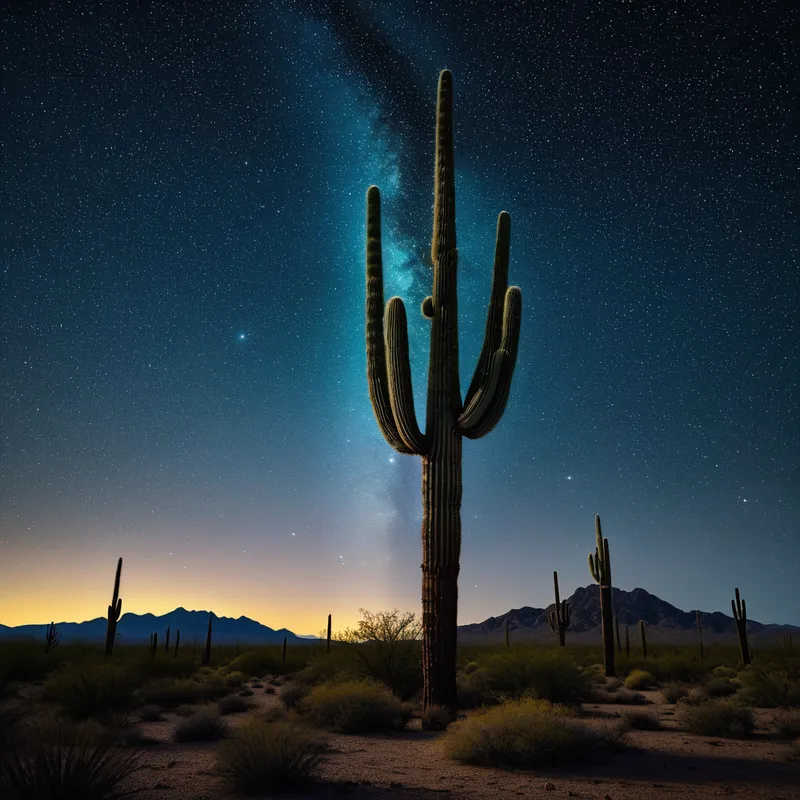
Saguaro Cactus Myth Meaning & Symbolism
A sacred story of a man who sacrificed himself to become the first Saguaro, gifting his people with life-giving fruit and water in the harshest desert.
The Tale of Saguaro Cactus
In the time before memory, when the world was still speaking its first words, the Tohono O'odham walked a land of fierce beauty and fiercer thirst. The sun, I'itoi, watched from his mountain, and the rain was a shy, distant relative who visited rarely. The people lived, but they thirsted. They hunted, but their bellies often knew the hollow song of hunger when the rabbits were scarce and the mesquite pods few.
There was a man among them, known not for his strength in battle, but for the depth of his heart. He watched the children’s lips crack, saw the elders grow frail, and felt the land’s silent plea. One day, as the summer heat lay upon the desert like a heavy hand, a resolve settled in his bones, colder and more certain than any winter wind. He walked away from the village, away from the worried calls of his family, into the heart of the baked valley where the earth was hardest and the sky most vast.
He stood there, feeling the sun sear his skin. He raised his arms not in defiance, but in offering—a bridge between the desperate earth and the withholding sky. He began to sing, a low, grinding song that was not made of words, but of need. He sang of the children’s thirst, of the people’s hunger, of love that was deeper than any well.
As he sang, his feet rooted. They pushed down, down through the dry crust, seeking the secret, silent water far below. A great stillness entered him. His skin tightened, toughened, and turned a dusty green, forming pleats and ribs like a garment of stone. His arms, still raised, thickened and stretched toward the heavens. His flesh became woody, his form immense and patient. The man was gone. In his place stood a new being: tall, columnar, and silent.
The people, searching, found him thus transformed. They wept, thinking him lost. But as the cruel summer reached its peak, a miracle budded on his high arms. Crowns of white flowers, waxy and fragrant like night stars, bloomed under the moon. Then, as the rains finally whispered back, those flowers swelled into great, crimson fruits, splitting open to reveal a sweet, red pulp and a bounty of black seeds.
They understood then. This was no death, but a transformation. The man had not left them; he had become a covenant. He had turned his very body into a vessel, a living cistern holding the monsoon’s gift, and a tower offering food when all else was barren. He became Ha:san, the gentle giant, the steadfast provider. From his sacrifice, the people learned to harvest, to celebrate, and to live in grateful reciprocity with the desert that now sustained them through its newest and most sacred child.

Cultural Origins & Context
This profound myth originates from the Tohono O'odham Nation, whose ancestral homeland spans the Sonoran Desert of what is now southern Arizona and northern Mexico. For them, the Saguaro (Ha:san) is not merely a plant; it is a person, a relative, and a central pillar of cultural and physical life. The story is part of a rich oral tradition known as O'odham Himdag, the "Desert People’s Way."
The myth was traditionally passed down by elders and storytellers, often during the Ha:san Bak Masad, the saguaro harvest season in early summer. This timing is critical—the telling of the story directly precedes and sanctifies the practical act of harvesting, weaving the spiritual origin into the material sustenance. The story functioned as a sacred charter: it explained the origin of their most vital food source, established the ethical framework for its use (taking only what is needed, with respect and gratitude), and reinforced the core cultural value of sacrifice for the community. It taught that life in the harsh desert was not a battle to be won, but a relationship to be nurtured, beginning with a primordial act of selfless love.
Symbolic Architecture
At its heart, the myth is a masterful symbol of the alchemy of limitation into abundance. The desert represents the harsh, unforgiving conditions of life—the psychological "arid zones" of deprivation, challenge, and existential thirst. The transforming man embodies the archetypal principle of the Caregiver, but in its most radical, self-annihilating form.
The ultimate nourishment does not come from taking, but from a willing transformation of the self into a vessel for life.
His act is not one of conquest, but of profound embodiment. He does not summon rain from the sky; he becomes the structure that can catch, store, and metabolize it. His raised arms symbolize both supplication and bestowal, a conduit between the divine (the sky/rain) and the human (the community). The fruit, with its vibrant red pulp and countless seeds, is a perfect symbol of the heart’s yield—the tangible, sweet result of inner sacrifice, containing within it the potential for endless future generations (the seeds). The Saguaro’s pleated skin, which expands to hold water, represents the psychological capacity to endure and expand in the face of scarcity, to become more resilient by embracing one’s constraints.

The Dreamer's Resonance
When this myth pattern stirs in the modern dreamer, it often signals a profound somatic and psychological process of resource generation through self-reconfiguration. To dream of becoming a tree or a plant, particularly one like the Saguaro, is not a dream of escape, but of deep grounding and purposeful transformation.
The dreamer may be experiencing a life phase that feels barren, draining, or emotionally parched—a "desert period." The psyche, through the dream, is proposing a radical solution: instead of seeking an external savior or fleeing the desert, the dreamer is called to become the oasis. This manifests somatically as a felt sense of needing to "stand one’s ground," to root down into one’s core values and inner reserves (the deep aquifer). Psychologically, it is the process of converting a personal "thirst" or need—be it for love, purpose, or creativity—into the very structure that can eventually satisfy it for oneself and others. It is the unconscious urging toward a stance of patient, resilient giving, born from a place of deep inner conversion.

Alchemical Translation
The myth models the individuation process as one of sacrificial embodiment. For Jung, individuation is the process of becoming the unique, integrated individual one is meant to be, which often requires the "sacrifice" of the ego’s immediate desires for the sake of the whole Self.
Individuation is not about acquiring more to the self, but about the self becoming a vessel for meaning that transcends it.
The man’s journey into the desert valley mirrors the necessary withdrawal from collective norms and comforts to confront the arid, lonely truth of one’s own psyche (the nigredo or blackening phase of alchemy). His transformation is the albedo (whitening)—the purification and restructuring of his very substance. He does not fight the desert sun (his condition); he incorporates it, letting it bake him into a new, durable form. The blooming and fruiting represent the rubedo (reddening)—the culmination where the transformed personality bears fruit, offering its unique "crimson harvest" to the world.
For the modern individual, this translates to the courage to face one’s personal "desert"—a period of isolation, austerity, or emotional drought—not as a curse, but as the necessary crucible. The alchemical work is to stand firm within that scarcity and consciously undertake the inner transformation: to root one’s identity in deeper, often unseen resources (values, faith, inner knowing), and to restructure one’s life so that it can catch and hold the "rain" when it comes, eventually transforming it into sustenance. One becomes, like the Saguaro, a self-contained ecosystem of meaning, where sacrifice and gift are revealed as a single, enduring act of creation.
Associated Symbols
Explore related symbols from the CaleaDream lexicon: