Sacred Wells Myth Meaning & Symbolism
A journey into the myth of Celtic sacred wells, where water holds memory, guardians test the soul, and the seeker finds transformation in the depths.
The Tale of Sacred Wells
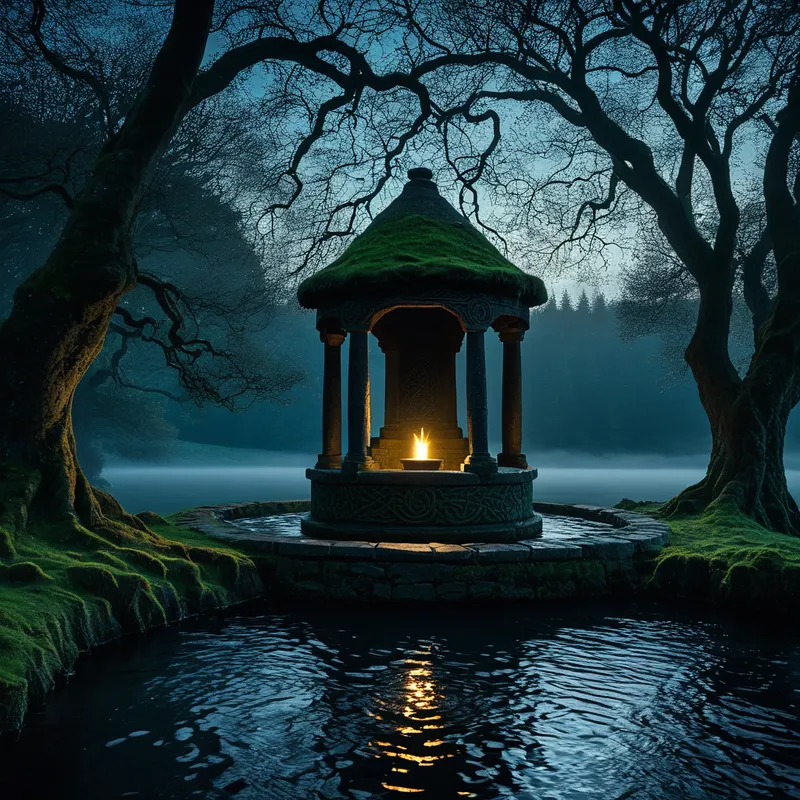
Listen. The land remembers. Beneath the green mantle of the [Sídhe](/myths/sdhe “Myth from Celtic / Irish culture.”/), in the quiet hollows where the [hawthorn](/myths/hawthorn “Myth from Celtic culture.”/) bleeds white in spring, the waters sleep. They are not mere [water](/myths/water “Myth from Chinese culture.”/). They are the Anam of [the earth](/myths/the-earth “Myth from Hindu culture.”/) itself, pooled in stone and clay. And they are guarded.
Her name is not spoken lightly. She is the Banshee of the spring, the woman of the Sídhe, the keeper of [the threshold](/myths/the-threshold “Myth from Folklore culture.”/). You will know her by the chill that walks your spine before you see her, by the sudden silence of the birds. She is old as the bedrock, draped in grey and green, her eyes holding the depth of the pool she tends. Some say she is the well, and the well is her.
A seeker comes. Perhaps a warrior, his soul scarred by the clangor of battles, seeking a cure for a wound that will not close. Perhaps a poet, whose words have dried to dust, in need of the imbas. He is drawn by rumor, by dream, by a thirst that no common stream can slake. The path is overgrown, a test in itself. The air grows thick, heavy with the scent of damp earth and blooming elder.
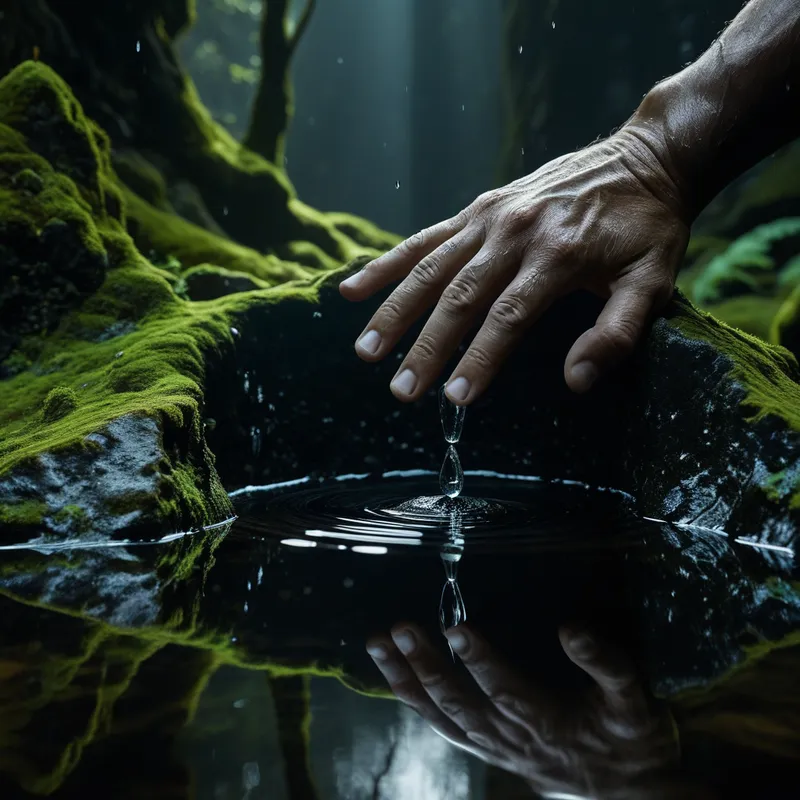
He finds the clearing. The well is a dark eye in the earth, circled by moss-slick stones. The water is black, yet it glints with a secret light. And she is there, waiting. No greeting passes her lips. Her demand is the first and only law: a sacrifice. Not of gold or weapon, but of self. A truth must be spoken aloud, one that shames the speaker. A cherished belief must be surrendered to the water. A memory, sweet and poisonous, must be confessed.
The seeker hesitates. The price feels like death. To offer his pride, his secret, his story—it is to become naked before [the world](/myths/the-world “Myth from Tarot culture.”/)’s dark eye. But the thirst, the need, is greater. With a voice that cracks, he pays the toll. He speaks his cowardice. He renounces his grudge. He whispers the name of the one he wronged.
Then, silence. The guardian’s gaze is unreadable. She gestures to the water. The seeker kneels, his reflection a stranger’s face. He cups his hands or takes the proffered vessel—a simple bowl of wood or silver. He drinks.
The world dissolves. The water is cold fire. It is not a drink, but a drowning and a birth. Visions surge: not of the future, but of the past—his own past, the land’s past, the tangled roots of cause and effect. He sees the source of his wound. He hears the forgotten song. The knowledge is not gentle; it is a flood that scours the channel of his soul clean.
When he surfaces, gasping, the clearing is just a clearing. The guardian is gone. The well is still. But he is changed. The wound, if not vanished, is understood; its poison drawn. The poet’s mind is a rushing spring. He leaves an offering—a strip of cloth tied to the tree, a simple stone placed with care—and departs, carrying the well’s silence within him. The water now flows in his own veins.
Cultural Origins & Context
The sacred well was not a backdrop for myth but a central pillar of Druidic and, later, folk practice. These were liminal sites where the three realms—Land, Sea, and Sky—converged in [the underworld](/myths/the-underworld “Myth from Greek culture.”/)’s upward reach. They were known as Tobar Beannaithe, but their sanctity predated Christianity, often being rededicated to [saints](/myths/saints “Myth from Christian culture.”/) like Brigid or Columba while retaining their primal function.
The myths were not written but performed, woven into the local topography by the seanchaí. Each well had its own seanchas—its story-history—linking it to a local deity, a heroic feat, or a miraculous healing. The telling was an act of preservation and participation, a way to map the invisible spiritual geography onto the physical world. Societally, these sites functioned as portals for petition and transformation. They were places for tarbfeis, for healing rituals, and for seasonal festivals like Bealtaine, where the well’s waters were used for blessing and protection. The myth encoded the proper protocol for engaging with a dangerous, numinous power: approach with respect, offer truth, receive insight.
Symbolic Architecture
At its core, the well symbolizes the unconscious itself—the hidden, nourishing, and potentially overwhelming [depths](/symbols/depths “Symbol: Represents the subconscious, hidden emotions, or foundational aspects of the self, often linked to primal fears or profound truths.”/) of the [psyche](/myths/psyche “Myth from Greek culture.”/). The still, dark [water](/symbols/water “Symbol: Water symbolizes the subconscious mind, emotions, and the flow of life, representing both cleansing and creation.”/) represents the collective and personal [memory](/symbols/memory “Symbol: Memory symbolizes the past, lessons learned, and the narratives we construct about our identities.”/), holding everything that has been forgotten, repressed, or yet to be realized.
The well is the eye of the earth, seeing not out, but in—reflecting the seeker’s own depths back at him, if he dares to look.
The [guardian](/symbols/guardian “Symbol: A protector figure representing safety, authority, and guidance, often embodying parental, societal, or spiritual oversight.”/) [spirit](/symbols/spirit “Symbol: Spirit symbolizes the essence of life, vitality, and the spiritual journey of the individual.”/) is the personification of the threshold to this unconscious content. She is the [Anima](/symbols/anima “Symbol: The feminine archetype within the male unconscious, representing soul, creativity, and connection to the inner world.”/) in her wise, demanding [aspect](/symbols/aspect “Symbol: A distinct feature, quality, or perspective of something, often representing a partial view of a larger whole.”/), or [the psychopomp](/myths/the-psychopomp “Myth from Various culture.”/) who guides [the ego](/myths/the-ego “Myth from Jungian culture.”/) into the [underworld](/symbols/underworld “Symbol: A symbolic journey into the unconscious, representing exploration of hidden aspects of self, transformation, or confronting repressed material.”/) of [the self](/myths/the-self “Myth from Jungian culture.”/). Her demand for a sacrifice is non-negotiable; it is [the law](/symbols/the-law “Symbol: Represents external rules, societal order, moral boundaries, and the tension between personal freedom and collective structure.”/) of psychic exchange. One cannot gain new [life](/symbols/life “Symbol: The symbol of ‘Life’ represents a journey of growth, interconnectedness, and existential meaning, encompassing both the joys and challenges that define human experience.”/) (water, [insight](/symbols/insight “Symbol: A sudden, deep understanding of a complex situation or truth, often arriving unexpectedly and illuminating hidden connections.”/)) without surrendering the old (ego-attachments, false narratives). The act of drinking is the symbolic [integration](/symbols/integration “Symbol: The process of unifying disparate parts of the self or experience into a cohesive whole, often representing psychological wholeness or resolution of internal conflict.”/) of unconscious content. It is not a passive [receipt](/symbols/receipt “Symbol: A receipt symbolizes proof of transaction, accountability, and the tangible record of choices made, often representing validation or the burden of past decisions.”/) of wisdom but an active, somatic ingestion of [truth](/symbols/truth “Symbol: Truth represents authenticity, honesty, and the quest for knowledge beyond mere appearances.”/), which always alters the [structure](/symbols/structure “Symbol: Structure in dreams often symbolizes stability, organization, and the framework of one’s life, reflecting how one perceives their environment and personal life.”/) of [the self](/myths/the-self “Myth from Jungian culture.”/).
The Dreamer’s Resonance
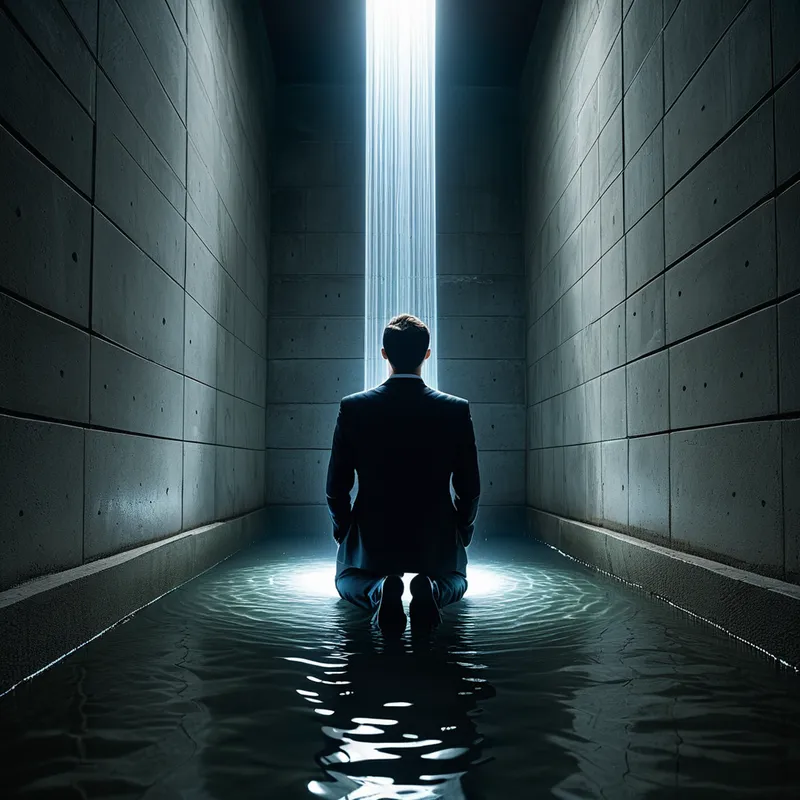
When a modern dreamer encounters a well, spring, or deep pool, it often signals a summons from the unconscious to engage in a process of emotional or psychological cleansing. The somatic feeling is crucial: is the water stagnant, inviting disgust? This may point to neglected emotional “toxins.” Is it clear and inviting, yet frighteningly deep? This suggests ripe but daunting self-discovery.
The dream may feature a guide or an obstructive figure at the well’s edge—a modern refraction of the guardian. This figure tests the dreamer’s readiness. Are they being asked to confess something, to release a long-held grievance, or to acknowledge a hidden vulnerability? The act of drawing water, or failing to, mirrors the dreamer’s current capacity to access their own inner resources. To dream of drinking from such a well and being flooded with visions indicates a powerful, ongoing process of individuation, where buried memories, talents, or truths are rising to the surface, often with disruptive but ultimately liberating force.
Alchemical Translation
The myth of the sacred well is a precise map for the alchemical [Nigredo](/myths/nigredo “Myth from Alchemical culture.”/)—the descent into the dark, chaotic [prima materia](/myths/prima-materia “Myth from Alchemical culture.”/) of the soul. The journey to the remote well is the conscious decision to engage with one’s shadow. The confrontation with the guardian is the ego’s encounter with the Self’s authority, which demands the sacrifice of [persona](/myths/persona “Myth from Greek culture.”/) and pride.
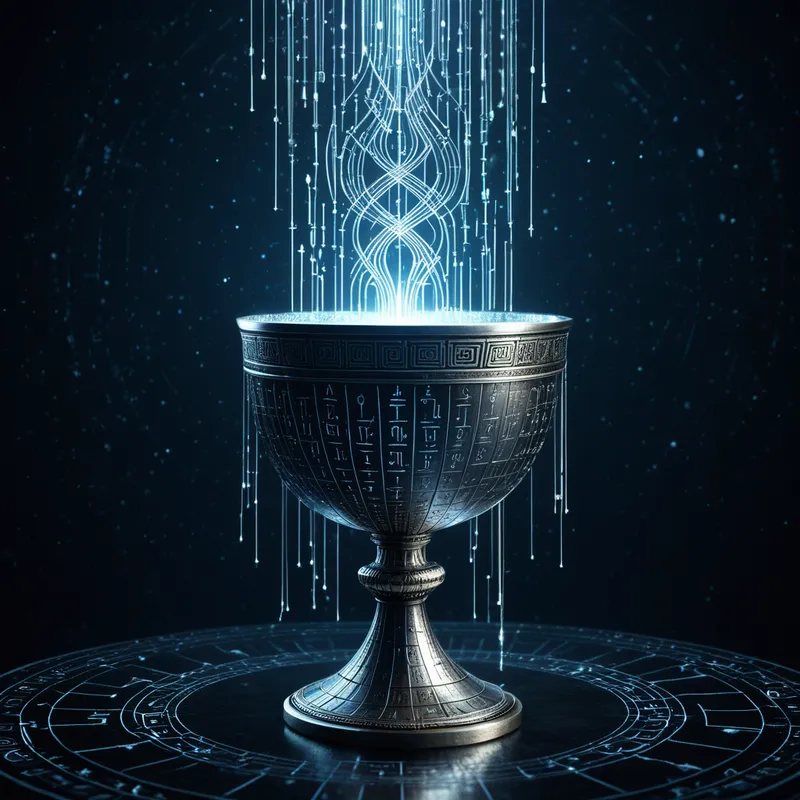
The silver cup offered is the vessel of the conscious mind, which must be made empty and clean before it can hold the dark water of the unconscious.
The spoken confession is the calcinatio, the burning away of illusion by the fire of shameful truth. The drinking of the vision-inducing water is the [solutio](/myths/solutio “Myth from Alchemical culture.”/)—a dissolution of old structures followed by the coniunctio, where the conscious mind (the seeker) and the unconscious (the well’s spirit) are united. The transformation is not about becoming someone new, but about becoming fully who one is, by integrating the forgotten waters of one’s own depths. The healed warrior or inspired poet who emerges is the individual who has allowed the psyche’s own ancient, nourishing source to flow into the arid landscapes of daily life, achieving a state of psychic circulation where nothing is wasted, and every experience, even the painful, becomes part of the soul’s sacred hydrology.
Associated Symbols
Explore related symbols from the CaleaDream lexicon: