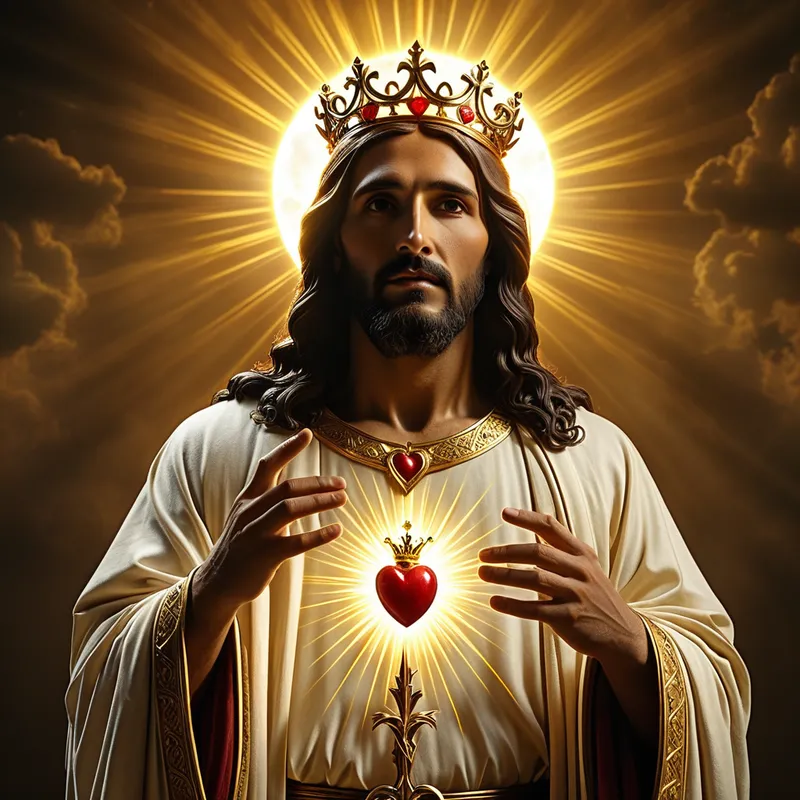
Sacred Heart of Jesus Myth Meaning & Symbolism
A divine heart, wounded yet radiant, offers an eternal covenant of love and mercy, transforming suffering into a furnace of compassion.
The Tale of Sacred Heart of Jesus
Listen, and let [the veil between worlds](/myths/the-veil-between-worlds “Myth from Celtic culture.”/) grow thin. In an age of stone and spirit, when the very air trembled with the memory of a sacrifice that shook the foundations of creation, a vision was granted. It came not to the mighty in their towers, but to a soul in a quiet cloister, a woman named Marguerite-Marie Alacoque.
[The world](/myths/the-world “Myth from Tarot culture.”/) outside was cold, a tapestry of war and want. But in the silence of her cell, a warmth began to bloom—a presence older than the stars, yet intimately near. It was He, the Christos, the one who had walked the dust and drunk the vinegar. But He appeared not in the glory of [the Transfiguration](/myths/the-transfiguration “Myth from Christian culture.”/), nor the agony of the [Golgotha](/myths/golgotha “Myth from Christian culture.”/). He appeared as a living mystery.
His chest was open, not as a ghastly wound, but as a sacred revelation. There, where the soldier’s lance had pierced, burned a heart. But this was no muscle of flesh as we know it. It was a sun contained, a furnace of love, crowned with a twisting wreath of thorns that bit into its luminous substance. Flames leapt from its apex, not to consume, but to illuminate all shadows. From this radiant core spilled a light so tender it could unmend and remake the hardest soul. And at its center, the wound—a deep, dark aperture, a gateway to the divine abyss of compassion.
His voice was the sound of a river of honey and myrrh. “Behold,” He said, and the words were not sounds but sensations, “this Heart which has loved humanity so deeply. It burns with an unquenchable fire for them, yet it receives in return only ingratitude, forgetfulness, contempt.” The thorns tightened with each word, a visible echo of a love perpetually wounded by the indifference of its beloved.
Yet, the promise was not of retribution, but of an everlasting covenant. This exposed, vulnerable Heart offered itself as a refuge, a fountain of mercy for the parched, a sanctuary for the weary. He asked for a devotion of love in return—a love made tangible in reparation, in communion, in the keeping of a sacred hour. The vision was not a spectacle to be merely seen; it was an invitation to be entered, to have one’s own stony heart warmed and broken open by its proximity.
The nun, overwhelmed by the unbearable weight of this divine vulnerability and its staggering offer, became [the vessel](/myths/the-vessel “Myth from Alchemical culture.”/) for the tale. The vision faded, leaving not darkness, but a permanent afterglow upon the soul of the world. The story of [the Sacred Heart](/myths/the-sacred-heart “Myth from Christian culture.”/) was now seeded in time, a myth not of the distant past, but a living, pulsing reality waiting to be felt.

Cultural Origins & Context
The visual and devotional seeds of the Heart as a symbol are ancient, stretching back to patristic meditations on the wound in Christ’s side as the source of the Church and Sacraments. However, the myth as a distinct, narrative devotion crystallized in the 17th century, a period of immense upheaval following the Reformation and during the rise of rationalist philosophy.
In this climate, the Catholic Church emphasized emotional, personal piety. The visions of Marguerite-Marie Alacoque at the Visitation Monastery in Paray-le-Monial provided a potent counter-narrative to a world growing cold with skepticism. Promoted vigorously by the Jesuits, the devotion spread as a grassroots movement of the heart, literally and figuratively. It was a myth passed not only from pulpit to pew but through holy cards, family prayers, and the establishment of the First Fridays.
Its societal function was multifaceted. For the institution, it reinforced the centrality of [the Eucharist](/myths/the-eucharist “Myth from Christian culture.”/) and the authority of the Church as the guardian of this divine love. For the individual, especially the common person, it offered an accessible, intimate relationship with the divine—a God whose love was physically, visibly wounded by human failings, yet endlessly forgiving. It transformed abstract theology into a tangible, emotional covenant.
Symbolic Architecture
At its core, the myth presents a profound symbolic [paradox](/symbols/paradox “Symbol: A contradictory yet true concept that challenges logic and perception, often representing unresolved tensions or profound truths.”/): [strength](/symbols/strength “Symbol: ‘Strength’ symbolizes resilience, courage, and the ability to overcome challenges.”/) in [vulnerability](/symbols/vulnerability “Symbol: A state of emotional or physical exposure, often involving risk of harm, that reveals authentic self beneath protective layers.”/), glory in wounding, infinite power expressed as limitless exposure.
The [Heart](/symbols/heart “Symbol: The heart symbolizes love, emotion, and the core of one’s existence, representing deep connections with others and self.”/) itself is the ultimate [symbol](/symbols/symbol “Symbol: A symbol can represent an idea, concept, or belief, serving as a powerful tool for communication and understanding.”/) of the center—the [axis](/symbols/axis “Symbol: A central line or principle around which things revolve, representing stability, orientation, and the fundamental structure of reality or consciousness.”/) mundi of the divine-[human](/symbols/human “Symbol: The symbol of a human represents individuality, complexity of emotions, and social relationships.”/) [relationship](/symbols/relationship “Symbol: A representation of connections we have with others in our lives, often reflecting our emotional state.”/). It represents the seat of love, will, and courage, but here, completely exteriorized. It is not hidden within the divine [body](/symbols/body “Symbol: The body in dreams often symbolizes the dreamer’s self-identity, personal health, and the relationship they have with their physical existence.”/) but offered [outward](/symbols/outward “Symbol: Movement or orientation away from the self or center; expansion, expression, or externalization of inner states into the world.”/), making the [interior](/symbols/interior “Symbol: The interior symbolizes one’s inner self, thoughts, and emotions, often reflecting personal growth, vulnerabilities, and secrets.”/) [life](/symbols/life “Symbol: The symbol of ‘Life’ represents a journey of growth, interconnectedness, and existential meaning, encompassing both the joys and challenges that define human experience.”/) of God visible. The flames signify love’s transformative, purifying, and unending [nature](/symbols/nature “Symbol: Nature symbolizes growth, connectivity, and the primal forces of existence.”/). The thorns represent how this divine love is constricted and pained by [human](/symbols/human “Symbol: The symbol of a human represents individuality, complexity of emotions, and social relationships.”/) sin and [indifference](/symbols/indifference “Symbol: A state of emotional detachment or lack of interest, often signaling avoidance, protection, or disconnection from feelings or situations.”/)—a love that chooses to feel the consequences of the beloved’s actions.
The wound is not a flaw, but the gateway. It is through the place of piercing that mercy flows and into which human suffering can be surrendered.
The wound, perhaps the most critical symbol, is multifaceted. It is the [memory](/symbols/memory “Symbol: Memory symbolizes the past, lessons learned, and the narratives we construct about our identities.”/) of historical crucifixion, the permanent scar of incarnation. Psychologically, it represents the divine [capacity](/symbols/capacity “Symbol: A measure of one’s potential, limits, or ability to contain, process, or achieve something, often reflecting self-assessment or external demands.”/) to hold suffering without being destroyed by it—to integrate the [shadow](/symbols/shadow “Symbol: The ‘shadow’ embodies the unconscious, repressed aspects of the self and often represents fears or hidden emotions.”/) of [betrayal](/symbols/betrayal “Symbol: A profound violation of trust in artistic or musical contexts, often representing broken creative partnerships or artistic integrity compromised.”/) and violence into a broader economy of love. It is an [open door](/symbols/open-door “Symbol: The open door symbolizes new opportunities and the potential for change, inviting individuals to step into new experiences.”/), suggesting that divinity is not impervious but permeable, accessible precisely through its point of greatest injury.

The Dreamer’s Resonance
When this mythic pattern surfaces in modern dreams, it often signals a critical juncture in the dreamer’s emotional or spiritual life. One might dream of a glowing light in one’s own chest, a heart of crystal that is cracked yet luminous, or an encounter with a figure whose compassionate gaze feels overwhelmingly exposing.
Such dreams point to a process of profound emotional vulnerability and the awakening of compassion—both for oneself and others. The somatic sensation is often one of warmth, pressure, or aching openness in the chest cavity. Psychologically, the dreamer is likely grappling with a wound—a betrayal, a loss, a deep personal failure—and the unconscious is presenting a mythic template for its transformation.
The dream asks: Can you bear to have your heart, your emotional core, so exposed? Can you acknowledge the thorns—the constraints, resentments, and fears—that currently constrict your capacity to love? The radiant heart in the dream does not deny the wound; it sanctifies it, suggesting that the dreamer’s deepest point of pain may become the source of their greatest empathy and connection.

Alchemical Translation
The alchemical journey modeled by the [Sacred Heart](/myths/sacred-heart “Myth from Christian culture.”/) is the transmutation of passio (suffering) into compassio (suffering-with). For the individual seeking wholeness, or individuation, the myth outlines a precise operation.
First, there is the revelation (the vision): the conscious acknowledgment of one’s own emotional and psychic center—the heart of one’s being. This is often precipitated by a wounding event (the lance) that feels like a violation of one’s core self.
Second, the exposure: Unlike [the ego](/myths/the-ego “Myth from Jungian culture.”/)’s desire to hide vulnerability, the process requires one to “exteriorize the heart”—to courageously bring one’s authentic feelings, wounds, and capacity for love into the light of consciousness and relationship. This is the painful crowning with thorns, as old defenses and patterns resist this opening.
The alchemical fire is not for destruction, but for distillation. It burns away the armor to reveal the gold of genuine connection beneath.
Third, the ignition: The flames represent the application of conscious attention and acceptance to this wounded center. This is the loving observation of one’s own pain without identification or repression. It is the slow, often painful, kindling of self-compassion.
Finally, the transmutation: The wound, once a source of shame and isolation, becomes a vessel. It becomes the very means through which one connects to the universal human experience of suffering. The personal heart, having integrated its own thorns and fire, becomes a sacred heart—a center that no longer merely feels, but understands; no longer just aches, but holds. The individual’s life energy is no longer bound by self-protection but is liberated as a radiating, compassionate presence in the world. The myth thus charts the path from a heart of stone to a heart of flesh, and finally, to a heart of transformative, wounded light.
Associated Symbols
Explore related symbols from the CaleaDream lexicon: