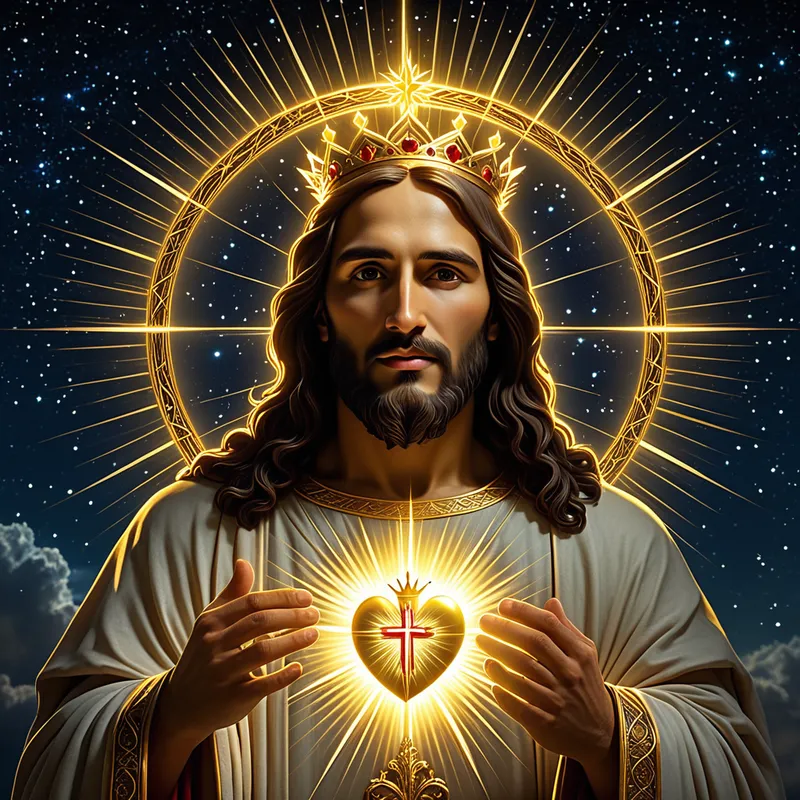
Sacred Heart Myth Meaning & Symbolism
A myth of divine love made vulnerable, a heart wounded yet radiant, offering a covenant of compassion that transforms suffering into grace.
The Tale of Sacred Heart
Listen, and let the silence between the words speak. In the deep night of [the world](/myths/the-world “Myth from Tarot culture.”/), when [the veil](/myths/the-veil “Myth from Various culture.”/) between heaven and earth was worn thin by longing, there walked a man who was also a god. He was called Yeshua, and his footsteps left prints of light upon the dust. His life was a song of radical love, a melody so pure it threatened every wall built by fear.
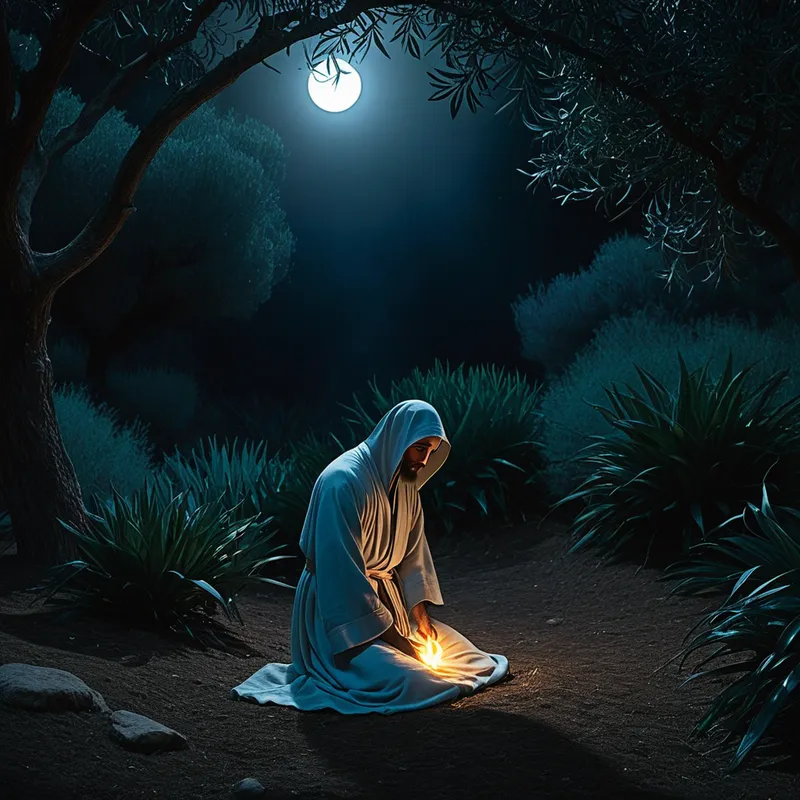
But the world, in its great slumber, knows not what to do with a living heart that refuses to armor itself. So it sharpened its tools. In a garden heavy with the scent of olives and impending sorrow, the man knelt. The weight of every loneliness, every betrayal, every cry of despair pressed upon him like a physical stone. And in that moment of supreme agony, his human heart did not harden. It broke open. It became a furnace, burning with a compassion so vast it could hold the world’s shadow.
They led him to the hill of the skull. There, they nailed his hands and feet to rough wood, lifting him between earth and sky. The crowd jeered, the soldiers cast lots for his clothes, and his mother wept at the foot of the cross. As his body labored for breath, a soldier, perhaps in haste or final cruelty, thrust a spear into his side. And from the wound flowed not just blood and [water](/myths/water “Myth from Chinese culture.”/), but an invisible torrent—a final, complete offering of his spirit.
Yet, this was not the end. It was the great turning. Three days in the tomb, a heart silent in the belly of [the earth](/myths/the-earth “Myth from Hindu culture.”/). Then, at dawn, the stone rolled away. He appeared, not as a ghost, but more vividly real, the wounds upon his hands and side now not marks of defeat, but seals of a terrible, beautiful victory. And to a disciple named [Thomas](/myths/thomas “Myth from Christian culture.”/), who doubted, he said, “Place your finger here; see my hands. Reach out your hand and put it into my side.” The heart that had been pierced was now the proof of life eternal.
Later, to a mystic in a cloistered cell, this heart appeared again. Not as a muscle of flesh, but as a sun, crowned with thorns, aflame with love, wounded yet pouring forth rays of unquenchable light. It spoke without words a covenant: Here is my heart, given for you. Take it, and let your own heart learn to beat in this rhythm.
Cultural Origins & Context
The myth of the Sacred Heart did not spring fully formed from the Gospels. Its seeds are in the Johannine imagery of blood and water flowing from Christ’s side, and in early Church Fathers who meditated on the wound as a fountain of grace. However, its crystallization into a distinct devotional form occurred in the late Middle Ages, a period obsessed with the humanity and physical suffering of Christ.
The vision received by Marguerite Marie Alacoque in the 17th century was the catalyst. In the quiet of her convent in Paray-le-Monial, France, the heart appeared to her repeatedly, expressing a divine sorrow at human ingratitude and a desire for reparative love. This private revelation was systematized and promoted by the Jesuits, becoming a powerful tool of the Counter-Reformation. It offered a tangible, emotional focus for piety—a heart to love in return. Societally, it functioned as a call to intimate, personal relationship with the divine, countering abstract theology with a symbol of vulnerable, passionate love that could be visualized in art, worn in lockets, and honored in feast days.
Symbolic Architecture
At its core, the Sacred [Heart](/symbols/heart “Symbol: The heart symbolizes love, emotion, and the core of one’s existence, representing deep connections with others and self.”/) is not merely an [organ](/symbols/organ “Symbol: An organ symbolizes vital aspects of life and health, often representing one’s emotional or physical state.”/) but the symbolic center of [the self](/myths/the-self “Myth from Jungian culture.”/), the seat of love, will, and courage. Its [symbolism](/symbols/symbolism “Symbol: The use of symbols to represent ideas or qualities, often conveying deeper meanings beyond literal interpretation. In dreams, it’s the language of the unconscious.”/) is a profound [paradox](/symbols/paradox “Symbol: A contradictory yet true concept that challenges logic and perception, often representing unresolved tensions or profound truths.”/), a unified field of opposites that defines the deepest mysteries of existence.
The wound is not a flaw in the design, but the very aperture through which the infinite pours into the finite.
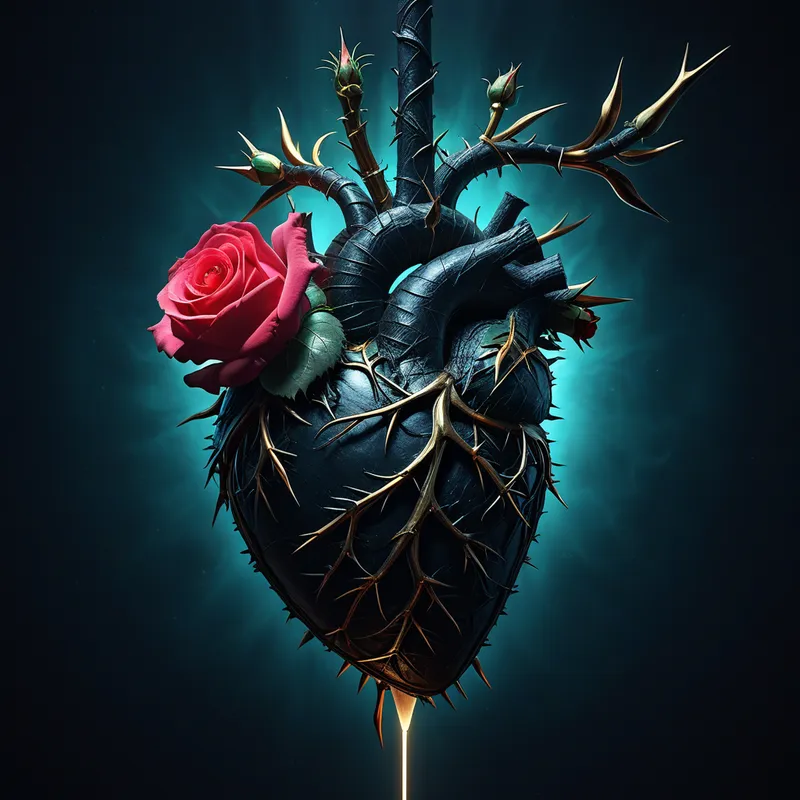
The [Crown](/symbols/crown “Symbol: A crown symbolizes authority, power, and achievement, often representing an individual’s aspirations, leadership, or societal role.”/) of Thorns represents the suffering inherent in conscious existence, the psychological and spiritual burdens of [awareness](/symbols/awareness “Symbol: Conscious perception of self, surroundings, or internal states. Often signifies awakening, insight, or heightened sensitivity.”/). The Flames signify transformative, purifying love—a love that consumes ego but illuminates the [soul](/symbols/soul “Symbol: The soul represents the essence of a person, encompassing their spirit, identity, and connection to the universe.”/). The Wound, often shown with the [spear](/symbols/spear “Symbol: The spear often symbolizes power, aggression, and the drive to protect or conquer.”/) still embedded or as a gash, is the central [mystery](/symbols/mystery “Symbol: An enigmatic, unresolved element that invites curiosity and exploration, often representing the unknown or hidden aspects of existence.”/). It symbolizes the necessary [vulnerability](/symbols/vulnerability “Symbol: A state of emotional or physical exposure, often involving risk of harm, that reveals authentic self beneath protective layers.”/) of true love, which must be open to being affected, to being hurt, to give itself away. It is the sacred [rupture](/symbols/rupture “Symbol: A sudden break or tear in continuity, often representing abrupt change, separation, or the shattering of established patterns.”/) that makes exchange possible. The Radiant Light emanating from the heart is the grace that flows from this surrendered state, the creative and healing power released when one’s center is given over to something greater than itself.
Psychologically, this represents the [integration](/symbols/integration “Symbol: The process of unifying disparate parts of the self or experience into a cohesive whole, often representing psychological wholeness or resolution of internal conflict.”/) of the [shadow](/symbols/shadow “Symbol: The ‘shadow’ embodies the unconscious, repressed aspects of the self and often represents fears or hidden emotions.”/). The heart does not hide its wounds; it displays them as its glory. It is the ultimate [symbol](/symbols/symbol “Symbol: A symbol can represent an idea, concept, or belief, serving as a powerful tool for communication and understanding.”/) of the coincidentia oppositorum—the coincidence of opposites: [human](/symbols/human “Symbol: The symbol of a human represents individuality, complexity of emotions, and social relationships.”/) and divine, suffering and joy, [death](/symbols/death “Symbol: Symbolizes transformation, endings, and new beginnings; often associated with fear of the unknown.”/) and [life](/symbols/life “Symbol: The symbol of ‘Life’ represents a journey of growth, interconnectedness, and existential meaning, encompassing both the joys and challenges that define human experience.”/), vulnerability and invincible [strength](/symbols/strength “Symbol: ‘Strength’ symbolizes resilience, courage, and the ability to overcome challenges.”/), all held in a single, beating center.
The Dreamer’s Resonance
When this myth stirs in the modern dreamer, it often signals a profound crisis or invitation at the core of the personality—the psychic heart. To dream of a radiant, wounded heart, whether it appears in one’s own chest, floating in space, or as an icon, points to a process of cardiac awakening.
Somatically, the dreamer may report sensations of pressure, warmth, or aching in the chest upon waking, a literal embodiment of the heart chakra’s activation or distress. Psychologically, this dream pattern emerges when one’s old ways of protecting the heart—through cynicism, emotional withdrawal, or over-identification with intellect—are failing. The heart is demanding recognition. It may appear wounded because the dreamer is confronting past emotional trauma, betrayal, or their own capacity to cause hurt. The flames suggest a painful but necessary purification of sentimental or possessive love (eros) into a more selfless, compassionate love (agape).
This dream is a call to courage: to make one’s own heart the altar, to acknowledge its wounds not as sources of shame but as sites of potential transformation and connection. It asks the dreamer, “What spear has pierced you, and what light seeks to pour forth from that very place?”
Alchemical Translation
The myth of [the Sacred Heart](/myths/the-sacred-heart “Myth from Christian culture.”/) is a precise map of the alchemical opus, [the great work](/myths/the-great-work “Myth from Alchemical culture.”/) of individuation. It models the transmutation of base leaden suffering into golden consciousness.
The process begins with Calcinatio—the burning. The flames of life’s trials, disappointments, and passions burn away the dross of the superficial personality. This is [the agony in the garden](/myths/the-agony-in-the-garden “Myth from Christian culture.”/), the feeling of being consumed. Next is Mortificatio—the piercing. The lance of fate, crisis, or deep self-knowledge strikes at the very core. [The ego](/myths/the-ego “Myth from Jungian culture.”/)’s defenses are punctured; one is laid open. This is the crucifixion, the ultimate surrender of the ego’s control.
The alchemical vessel is the heart itself, cracked so the divine solvent can enter.
From this death comes [Separatio](/myths/separatio “Myth from Alchemical culture.”/), where blood (life force, passion) and water (spirit, emotion) flow out, distinguishing what is essential from what is not. Then, in the silent tomb of [Nigredo](/myths/nigredo “Myth from Alchemical culture.”/)—[the dark night of the soul](/myths/the-dark-night-of-the-soul “Myth from Christian Mysticism culture.”/)—the mysterious inner marriage occurs. The human heart rests in [the womb](/myths/the-womb “Myth from Various culture.”/) of the unconscious, integrating [the shadow](/myths/the-shadow “Myth from Jungian culture.”/).
Finally, [Rubedo](/myths/rubedo “Myth from Alchemical culture.”/)—the reddening, [the resurrection](/myths/the-resurrection “Myth from Christian culture.”/). The heart emerges, not as it was, but glorified. Its wounds are now sacred seals, proof of the transformation. The individual no longer lives from a defended, isolated ego-center, but from a heart that has become a conduit. It has learned the alchemical secret: that one’s greatest point of vulnerability, when fully accepted and offered, becomes the seat of one’s greatest power and connection. The covenant is fulfilled within: the human heart, having passed through its own passion, now beats in rhythm with the heart of the world.
Associated Symbols
Explore related symbols from the CaleaDream lexicon: