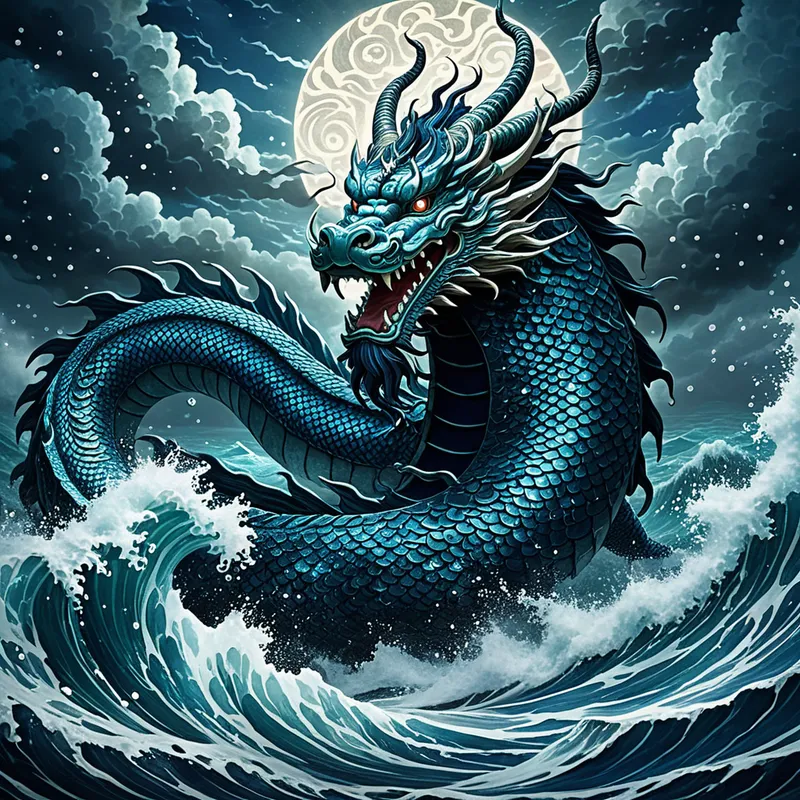
Ryūjin Myth Meaning & Symbolism
The myth of the Dragon God Ryūjin, ruler of the sea and keeper of the tide jewels, embodies the profound power of the deep unconscious and the sovereignty of the soul.
The Tale of Ryūjin
Beneath the restless skin of [the world](/myths/the-world “Myth from Tarot culture.”/), where the light of the sun is but a forgotten memory and the pressure of [the abyss](/myths/the-abyss “Myth from Kabbalistic culture.”/) shapes the bones of mountains, lies Ryūgū-jō. Its gates are carved from coral and [pearl](/myths/pearl “Myth from Chinese culture.”/), its halls lit by the cold fire of bioluminescent creatures. Here, in the absolute silence of the deep, dwells the sovereign of all waters: Ryūjin.
His form is the rhythm of the ocean itself—a serpentine dragon whose scales hold the shifting colors of the deep sea, from abyssal black to the sudden flash of silver from a passing school of fish. His face is that of an ancient, bearded sage, eyes holding the patience of millennia and the fury of typhoons. In his possession are the Kanju and Manju, jewels of unimaginable power. One commands the tide to rise, to flood the land with the generative, chaotic waters of life. The other commands the tide to recede, to reveal secrets hidden in the mud and grant passage.
The tales whisper of a time when a humble fisherman, Urashima Tarō, saved a turtle from torment. In gratitude, [the turtle](/myths/the-turtle “Myth from Chinese culture.”/)—a servant of [the Dragon](/myths/the-dragon “Myth from Chinese culture.”/) God—carried him on its back down, down, down into the crushing, beautiful dark, to the glittering palace. For three days, which were three years in the world above, Tarō was a guest of honor. He feasted, marveled at the dancing Otohime, and walked gardens where seasons passed in the sway of kelp. He was given a tamatebako as a parting gift, a box he was told never to open.
But upon his return, he found his home gone, his loved ones dust. In his despair, he forgot the warning. He lifted the lid of the lacquered box. Not treasure, but a pale, swift mist—the years he had not aged—escaped and consumed him in an instant, leaving only an old man’s robes upon the sand. [The sea](/myths/the-sea “Myth from Greek culture.”/) had been generous, but its time is not our time; its gifts are often veiled in paradox.
In another breath of the myth, the great hero [Yamato Takeru](/myths/yamato-takeru “Myth from Japanese culture.”/) was trapped on a burning plain, his enemies setting the grass ablaze around him. With a sword gifted by a priestess, he cut the grass and turned the fire against his foes. But later, adrift on a calm sea, a sudden storm rose, a capricious fury sent by a wrathful deity. It was Ryūjin, angered by a slight. The hero’s wife, Ototachibana-hime, saw the divine anger in the waves. To placate the Dragon God and save her husband, she made the ultimate offering. She spoke a prayer to the sea, and then leaped into the raging waters, a sacrifice to sink into the dark halls of Ryūgū-jō. The storm ceased at once. The sea grew calm, holding her forever, having accepted its due.

Cultural Origins & Context
The myth of Ryūjin is not a single story but a deep current running through Japanese cultural consciousness, emerging from the animistic bedrock of Shintō. He is a kami of the most powerful order, a personification of the sea’s dual nature: life-giver and life-taker. Fishermen, coastal villagers, and eventually the imperial court all paid him homage, for he controlled the harvest of the sea and the fury of the storms that could erase villages from the shore.
These narratives were carried in the oral traditions of storytellers and in the formalized collections like the Kojiki and Nihon Shoki, where dragon deities often interact with ancestral and imperial figures. Ryūjin’s mythology served a crucial societal function: it codified a relationship of profound respect, fear, and negotiation with an environment that was both the source of sustenance and an existential threat. Rituals and offerings were acts of diplomacy with a sovereign whose moods were the weather and whose law was the tide.
Symbolic Architecture
Ryūjin is the archetypal ruler of the [collective unconscious](/symbols/collective-unconscious “Symbol: The Collective Unconscious refers to the part of the unconscious mind shared among beings of the same species, embodying universal experiences and archetypes.”/). His [palace](/symbols/palace “Symbol: A palace symbolizes grandeur, authority, and the pursuit of one’s ambitions or dreams, often embodying a desire for stability and wealth.”/), Ryūgū-jō, is not merely a physical [location](/symbols/location “Symbol: The symbol of ‘Location’ signifies a sense of place, context, and the environment in which experiences unfold.”/) but the psychic [structure](/symbols/structure “Symbol: Structure in dreams often symbolizes stability, organization, and the framework of one’s life, reflecting how one perceives their environment and personal life.”/) of the deep self—ordered, majestic, and operating under laws [alien](/symbols/alien “Symbol: Represents the unknown, otherness, and the exploration of new ideas or experiences.”/) to the conscious ego. The sea he rules is the primordial, undifferentiated [psyche](/myths/psyche “Myth from Greek culture.”/) itself, teeming with [life](/symbols/life “Symbol: The symbol of ‘Life’ represents a journey of growth, interconnectedness, and existential meaning, encompassing both the joys and challenges that define human experience.”/) and potential, yet dark, overwhelming, and dangerous to navigate without [permission](/symbols/permission “Symbol: Permission symbolizes the granting of authority to act or make decisions, often relating to one’s sense of agency.”/) or sacrifice.
The Tide Jewels are the ultimate symbols of psychic polarity and dynamic balance. The jewel that raises the waters (Kanju) represents the flooding of consciousness by unconscious contents—intuition, emotion, forgotten memories, creative inspiration. The jewel that lowers them (Manju) represents the power of consciousness to order, analyze, and reveal what was hidden, granting passage through previously impassable inner terrain.
The tragic tales associated with him—Urashima Tarō’s lost time and Ototachibana-hime’s sacrifice—are not punishments but profound lessons in the [nature](/symbols/nature “Symbol: Nature symbolizes growth, connectivity, and the primal forces of existence.”/) of this [realm](/symbols/realm “Symbol: The symbol of ‘Realm’ often signifies the boundaries of one’s consciousness, experiences, or emotional states, suggesting aspects of reality that are either explored or ignored.”/). Tarō’s [story](/symbols/story “Symbol: The symbol of ‘Story’ represents the narrative woven through our lives, embodying experiences, lessons, and emotions that shape our identities.”/) warns that the gifts of the deep self (the tamatebako) come with their own timeless [logic](/symbols/logic “Symbol: The principle of reasoning and rational thought, often representing order, structure, and intellectual clarity in dreams.”/); to treat them with the naivete of [the ego](/myths/the-ego “Myth from Jungian culture.”/) is to be undone by them. The [princess](/symbols/princess “Symbol: The symbol of a princess embodies themes of power, privilege, and feminine grace, often entailing a journey of self-discovery.”/)’s sacrifice illustrates that engagement with this inner sovereignty often requires the surrender of something precious to the conscious [personality](/symbols/personality “Symbol: Personality in dreams often symbolizes the traits and characteristics of the dreamer, reflecting how they perceive themselves and how they believe they are perceived by others.”/)—a cherished [identity](/symbols/identity “Symbol: Identity represents the sense of self, encompassing personal beliefs, cultural background, and social roles.”/), a controlling [attitude](/symbols/attitude “Symbol: Attitude symbolizes one’s mental state, perception, and posture towards life, influencing emotions and actions significantly.”/)—to appease its power and gain its [favor](/symbols/favor “Symbol: ‘Favor’ represents the themes of acceptance, goodwill, and the desire for approval from others.”/).

The Dreamer’s Resonance
When Ryūjin surfaces in modern dreams, he rarely appears as a literal dragon. He is the feeling of being pulled into a vast, emotional undertow. He is the dream of a house with previously unknown, flooded basement rooms. He is the sudden, awe-inspiring yet terrifying wave that rises on a calm beach. He is the wise but intimidating figure met in a deep, dark place who offers a glowing object of unclear purpose.
These dreams signal a process of encountering inner sovereignty. The dreamer is being confronted by an aspect of their own psyche that is ancient, powerful, and utterly indifferent to their ego’s plans. The somatic experience is often one of pressure, of being in over one’s head, or of a profound, unsettling calm in the depths. Psychologically, it marks a confrontation with [the Self](/myths/the-self “Myth from Jungian culture.”/) (the central, organizing archetype of the whole psyche) in its form as the inner ruler who demands recognition. The conflict is between the ego’s desire for control and the deep self’s requirement for respect and integration.

Alchemical Translation
The individuation process modeled by the Ryūjin myth is not one of heroic conquest, but of diplomatic recognition and calibrated exchange. The ego-hero does not slay this dragon; he learns its laws and negotiates for its power.
The first alchemical stage is descensus ad inferos—the descent into the deep. This is the willingness to engage with one’s own emotional depths, repressed memories, and instinctual life (the journey to Ryūgū-jō). It requires courage to face the pressure and the strange beauty of what has been ignored.
The second stage is the recognition of sovereignty. The ego must relinquish its fantasy of total autonomy and acknowledge that it is not the sole ruler of the psyche. It meets the inner Ryūjin—the core of one’s own nature and destiny—and must pay its respects. This often feels like accepting a fundamental truth about oneself that is non-negotiable.
The final transmutation is the acquisition of the Tide Jewels. This is the integration of the deep self’s power into conscious life. It is the ability to consciously allow the tides of feeling to rise for generative purposes (compassion, creativity, intimacy) and to consciously make them recede for clarity, boundary-setting, and revelation. The individual gains fluidity and authority, not by dominating the inner sea, but by holding the jewels that command its essential rhythm. They become, in a sense, the steward of their own depths, ruling their life with the wisdom of the deep, having made peace with the dragon at the foundation of the world.
Associated Symbols
Explore related symbols from the CaleaDream lexicon: