Ryōan-ji Temple Garden Myth Meaning & Symbolism
A Zen master creates a garden of fifteen stones, where the unseen sixteenth stone exists only in the viewer's mind, embodying the void from which all form arises.
The Tale of Ryōan-ji Temple Garden
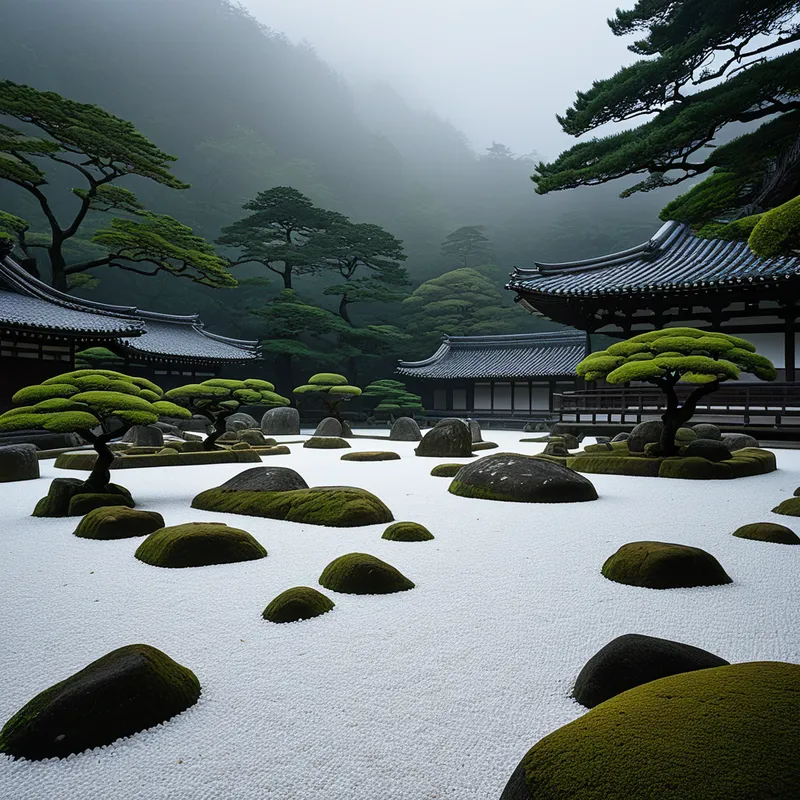
Listen. There is a place where the world is not made, but unmade. A rectangle of pure potential, bordered by an earthen wall stained by centuries into the color of twilight. Within this frame lies a sea of crushed white stone, painstakingly combed into waves that flow around islands—fifteen islands of dark rock, wearing crowns of deep green moss.
They say the master, Musō Soseki, or perhaps a nameless monk who followed, did not build this garden. He listened for its silence. The stones did not come from a quarry, but from a dream of the mountain’s bones. Each one was a stubborn, sleeping god, heavy with the memory of volcanoes and ice. The master walked among them for days, touching their cold skin, hearing their slow thoughts. He did not choose fifteen stones. He recognized them. They were the ones that agreed to wake.
The conflict was not of armies, but of mind. The human eye, desperate for pattern, for story, for a face in the clouds. It would look upon the stones and try to count them, to group them, to force them into a shape it could own. But the master raked the gravel not as decoration, but as a spell against certainty. The lines were rivers of time, flowing around the eternal. From the veranda, the holy viewing platform, one could never see all fifteen stones at once. One was always hidden, occluded by another. The seeker would count, and count again—four, five, three, two, one—and always arrive at fourteen. The fifteenth stone was a ghost in the periphery, a truth that existed only when the seeker stopped looking for it.
The resolution was not an answer, but a dissolution. The weary seeker, exhausted by counting, would finally surrender. The gaze would soften. The mind’s chatter would still. And in that moment of letting go, the garden would change. It was no longer a puzzle of rocks, but a single, breathing entity. The white gravel was not empty space, but a luminous field—the śūnyatā from which all forms briefly emerge. The unseen stone was now felt, not seen; it was the stone one stood upon, the stone of one’s own being, completing the pattern from within. The garden became a mirror, and in its reflection, the seeker saw not a face, but the vast and peaceful sky.
Cultural Origins & Context
The garden of Ryōan-ji belongs to the kare-sansui tradition, which flourished in the Muromachi period (1336–1573). This was an era of civil war and social upheaval, where the austere, disciplined philosophy of Zen Buddhism offered a path to stability not in the external world, but in the mind’s own ground. The garden was not meant for leisure, but for zazen—a meditation aid for monks.
Its myth was not passed down through epic poetry, but through silent transmission from master to disciple, and through the direct, wordless experience of the garden itself. Its “story” is its effect. The societal function was deeply pedagogical: to short-circuit the analytical intellect and induce a state of kenshō, a glimpse of one’s true nature. It served as a kōan in physical form, a riddle without an answer that, when engaged properly, dissolves the riddle-maker—the ego itself.
Symbolic Architecture
The garden is a meticulously constructed map of the psyche. The fifteen stones are not random; they are arranged in five groups—two of five, two of three, and one of two. This asymmetry rejects worldly balance and harmony, pointing instead to a deeper, dynamic order.
The stones are the archetypal contents of the psyche—complexes, memories, drives—seemingly separate and solid. The raked gravel is the ground of consciousness itself, vast, receptive, and in constant, gentle motion.
The eternal “missing” stone is the most potent symbol. It represents the unconscious self, the shadow, or the transcendent function that can never be fully objectified or possessed. It completes the pattern, but only from a perspective that includes the viewer. Thus, the garden teaches that wholeness is not found “out there” in the arrangement of objects, but “in here,” in the integration of the perceiver into the perceived. The stained earthen wall, which frames the view, symbolizes the mortal, temporal body and mind—the necessary vessel through which the infinite is glimpsed.

The Dreamer’s Resonance
When this myth appears in modern dreams, it rarely manifests as a literal garden. More often, one dreams of an incomplete set—fourteen books on a shelf of fifteen spaces, a clock with fourteen numbers, a gathering where one crucial friend is always absent. The somatic feeling is one of quiet anxiety, a nagging sense of near-perfection that is just out of reach.
This dream signals a psychological process of confronting the “hidden stone” within. The dreamer is being confronted by an aspect of themselves they have systematically excluded from view—a talent, a grief, a desire, or a flaw. The compulsive counting in the dream mirrors the ego’s attempt to manage the psyche through inventory and control, an effort doomed to fail because the self is not an aggregate of parts, but a unified field. The resolution in the dream, if it comes, is a shift from visual seeking to a felt sense of presence. The dreamer stops counting and simply is in the space, and in that moment, the missing element is intuited, not seen. It is the process of the conscious mind beginning to acknowledge and make room for the autonomy of the unconscious.

Alchemical Translation
The alchemical process modeled here is the solve et coagula—dissolve and coagulate—applied to the psyche. The ego’s solid world-view (the initial perception of separate rocks) is first dissolved in the acid of paradox (the inability to see the whole pattern). The gravel, representing the prima materia or the unconscious ground, is stirred into motion by the rake of attention.
The triumph of the myth is not in finding the sixteenth stone, but in realizing you are the vessel that holds all fifteen and the space between. This is the coagulation: the birth of the conscious individual who is no longer identified with a single complex (one stone) but who stands as the awareness that contains the totality.
For the modern individual, the “garden” is one’s own life. The “stones” are our fixed identities—parent, professional, victim, hero. The “raked gravel” is the flow of daily experience, often seen as meaningless filler. The alchemical work is to cease trying to rearrange the stones into a more pleasing configuration (changing jobs, relationships, locales) and instead, to rake the gravel. That is, to bring mindful, rhythmic, accepting attention to the mundane ground of being. In doing so, the solidity of our problems (the stones) begins to soften. They become features in a larger, flowing landscape. We discover that the missing piece, the source of our dissatisfaction, was never another stone to acquire, but the acceptance of the void that gives the stones their meaning. This is the individuation journey: from seeking completion in the world to embodying it as your fundamental nature.
Associated Symbols
Explore related symbols from the CaleaDream lexicon: