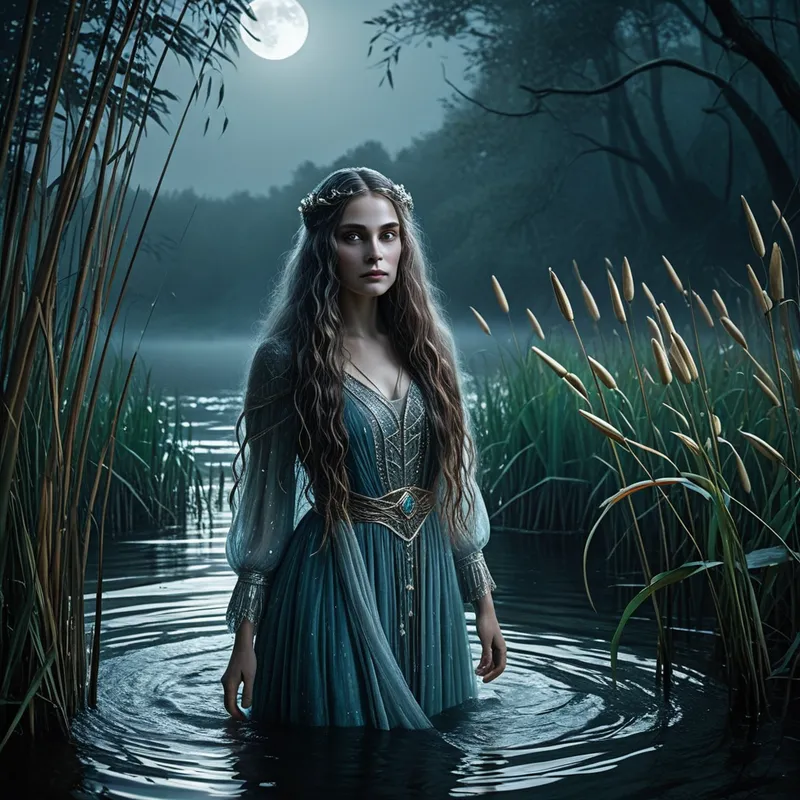
Rusalka/Vila Myth Meaning & Symbolism
A spirit of water and forest, born from a woman's untimely death, eternally caught between vengeance and longing, embodying nature's wild, untamed soul.
The Tale of Rusalka/Vila
Listen, and let the twilight settle. In the deep, dark woods where the birch trees whisper secrets to the moss, and in the still, black pools where [the moon](/myths/the-moon “Myth from Tarot culture.”/) drowns its silver face, there dwells a spirit. She was not born of [the earth](/myths/the-earth “Myth from Hindu culture.”/), but of a broken promise. She is the Rusalka, the Vila.
Once, she was a maiden, a daughter of the village. Her laughter was the sound of the spring thaw, and her steps were lighter than a fawn’s. But love, that sharp and double-edged blade, found her heart. She gave it freely to a young man with eyes like the summer sky. They pledged themselves by the old oak, their vows swallowed by [the wind](/myths/the-wind “Myth from Various culture.”/). But [the sky](/myths/the-sky “Myth from Persian culture.”/) in his eyes clouded. Another bride was chosen for him—one with a richer dowry, a straighter path. Her love turned to grief, and her grief to a terrible, silent weight. One evening, as the frogs began their chorus, she walked into the deepest part of [the river](/myths/the-river “Myth from Buddhist culture.”/), her wedding gown filling with [water](/myths/water “Myth from Chinese culture.”/), and let the current take her breath.
This was not an end, but a terrible transformation. The water, which received her sorrow, refused her peace. The forest, which heard her final sigh, claimed her soul. On the third night, she rose again. Not as a ghost, but as a new and dreadful creature of the borderlands. Her skin took on the pallor of water lily petals, her hair the length and green of riverweed. Her eyes, once warm, now held the cold, reflective depth of the pool. She was bound to the place of her death, a spirit of the meadow-water and the shadowy grove.
Now, she sings. On moonlit nights, her voice drifts from the reeds, a melody of such unbearable sweetness and loneliness that it pulls at the very core of any man who hears it. It is the echo of the love she lost, twisted into an enchantment. She dances in forest clearings, her form a blur of white among the silver birch trunks, her dance both captivating and feverish. To see her is to forget home, hearth, and heart.
Men are drawn to her, lured by the song that promises to fill the hollow space she herself knows too well. They follow the sound to the water’s edge. Some she embraces, her cold arms offering a semblance of the warmth she seeks, only to drag them down into the murky depths to join her in her watery grave. Others she tickles to death with her eerie laughter. Yet, on the holy days of Rusalnaya Week, she may wander to the fields, and where her feet touch, the crops grow tall and lush. She is both life-giver and soul-taker, a perpetual reminder of what happens when love is betrayed and nature is denied its due.
Cultural Origins & Context
The myth of the Rusalka is not a single story but a living tapestry woven from pre-Christian Slavic animism and the harsh realities of agrarian life. These beings were originally likely benevolent spirits of fertility and moisture, bereginy, associated with rivers and fields. With the coming of Christianity, narratives of sin, punishment, and the restless dead were grafted onto these ancient figures. [The Rusalka](/myths/the-rusalka “Myth from Slavic culture.”/) became specifically a spirit of a woman who died an “unclean” death—by suicide, murder, or drowning, often before marriage or childbirth.
The tales were kept alive by oral tradition, told by grandmothers at [the hearth](/myths/the-hearth “Myth from Norse culture.”/) and by villagers warning their children away from lonely ponds. They functioned as profound societal safeguards: enforcing community norms (against broken vows), explaining natural phenomena (drownings, unexpectedly fertile land), and providing a narrative container for the collective fear of the wild, untamed aspects of both nature and the feminine. The rituals of Rusalnaya Week, involving offerings, remembrance, and symbolic banishment, were a way for the community to ritually manage this potent, ambivalent force.
Symbolic Architecture
At its core, the Rusalka is the [archetypal image](/symbols/archetypal-image “Symbol: A universal, primordial symbol from the collective unconscious that transcends individual experience and carries profound spiritual or mythic meaning.”/) of the unintegrated [anima](/symbols/anima “Symbol: The feminine archetype within the male unconscious, representing soul, creativity, and connection to the inner world.”/)—the unconscious feminine [aspect](/symbols/aspect “Symbol: A distinct feature, quality, or perspective of something, often representing a partial view of a larger whole.”/) within the [psyche](/myths/psyche “Myth from Greek culture.”/) that has been wounded, betrayed, and cast out. She represents emotional [truth](/symbols/truth “Symbol: Truth represents authenticity, honesty, and the quest for knowledge beyond mere appearances.”/) that was drowned because it was inconvenient to the conscious ego’s plans (the societal [marriage](/symbols/marriage “Symbol: Marriage symbolizes commitment, partnership, and the merging of two identities, often reflecting one’s feelings about relationships and social obligations.”/), the “straight [path](/symbols/path “Symbol: The ‘path’ symbolizes a journey, choices, and the direction one’s life is taking, often representing individual growth and exploration.”/)”).
She is the feeling that was not allowed to live, and so it cannot truly die.
Her domain—the [forest](/symbols/forest “Symbol: The forest symbolizes a complex domain of the unconscious mind, representing both mystery and potential for personal growth.”/) pool, the riverbank—is the liminal [space](/symbols/space “Symbol: Dreaming of ‘Space’ often symbolizes the vastness of potential, personal freedom, or feelings of isolation and exploration in one’s life.”/) itself. She is the [guardian](/symbols/guardian “Symbol: A protector figure representing safety, authority, and guidance, often embodying parental, societal, or spiritual oversight.”/) of [the threshold](/myths/the-threshold “Myth from Folklore culture.”/) between [life](/symbols/life “Symbol: The symbol of ‘Life’ represents a journey of growth, interconnectedness, and existential meaning, encompassing both the joys and challenges that define human experience.”/) and [death](/symbols/death “Symbol: Symbolizes transformation, endings, and new beginnings; often associated with fear of the unknown.”/), love and hatred, creativity and destruction. Her dual [nature](/symbols/nature “Symbol: Nature symbolizes growth, connectivity, and the primal forces of existence.”/) is key: she drowns the unwary, yet makes the crops grow. This symbolizes the dual potential of the unconscious. Ignored or approached with naive fascination (the lured [traveler](/symbols/traveler “Symbol: A person on a journey, representing movement, transition, and the search for new experiences or self-discovery.”/)), it can overwhelm and drown [the ego](/myths/the-ego “Myth from Jungian culture.”/). But approached with respect and [ritual](/symbols/ritual “Symbol: Rituals signify structured, meaningful actions carried out regularly, reflecting cultural beliefs and emotional needs.”/) acknowledgment (the [community](/symbols/community “Symbol: Community in dreams symbolizes connection, support, and the need for belonging.”/) offerings), its energies can be tremendously fertile and [life](/symbols/life “Symbol: The symbol of ‘Life’ represents a journey of growth, interconnectedness, and existential meaning, encompassing both the joys and challenges that define human experience.”/)-giving.
Her song is the [siren](/symbols/siren “Symbol: The siren symbolizes temptation, danger, and the duality of beauty and peril, often representing alluring yet treacherous situations.”/) call of unresolved [grief](/symbols/grief “Symbol: A profound emotional response to loss, often manifesting as deep sorrow, yearning, and a sense of emptiness.”/) and abandoned [passion](/symbols/passion “Symbol: Intense emotional or physical desire, often linked to love, creativity, or purpose. Represents life force and deep engagement.”/). It is hypnotic because it speaks to the same buried [material](/symbols/material “Symbol: Material signifies the tangible aspects of life, often representing physical resources, desires, and the physical world’s influence on our existence.”/) in the listener. To heed it without [consciousness](/symbols/consciousness “Symbol: Consciousness represents the state of awareness and perception, encompassing thoughts, feelings, and experiences.”/) is to be assimilated by the complex. Her eternal state is one of suspended transformation—she is neither alive nor dead, [human](/symbols/human “Symbol: The symbol of a human represents individuality, complexity of emotions, and social relationships.”/) nor [spirit](/symbols/spirit “Symbol: Spirit symbolizes the essence of life, vitality, and the spiritual journey of the individual.”/), but forever in the painful, beautiful process of becoming something else.
The Dreamer’s Resonance
When the Rusalka pattern emerges in modern dreams, she rarely appears as a literal nymph. She manifests as the compelling yet dangerous allure of a past relationship that ended in betrayal, as a profound creative block that feels like drowning, or as a somatic sensation of coldness and isolation despite being surrounded by life.
Dreaming of still, dark water where something beautiful and frightening lurks just below the surface signals that a deep pool of unfelt emotion—likely grief, rage, or abandoned love—is demanding attention. The dream ego standing at the water’s edge represents a conscious standpoint being drawn toward this material. The Rusalka’s dance in a forest clearing might appear as a mesmerizing but chaotic period of life or art that feels enchanting yet utterly disconnected from one’s grounded identity.
These dreams indicate that a part of the psyche has been “drowned”—cut off from the air of consciousness because its expression was once too painful or socially unacceptable. This complex now operates autonomously, both attracting and threatening the conscious self. The psychological process is one of reclamation—not of the lost love object from the story, but of the lost capacity to feel deeply, to be wild, to honor the promises the soul makes to itself.
Alchemical Translation
The myth of the Rusalka models the alchemical stage of [nigredo](/myths/nigredo “Myth from Alchemical culture.”/)—the descent into the murky waters of the unconscious to confront the material that has been left to rot. The individuation journey here is not about slaying the spirit, but about transforming the relationship to her.
The first step is recognition. The conscious ego (the village) must acknowledge that a part of the soul was betrayed and cast out. This is the psychological equivalent of the community rituals during Rusalnaya Week—naming the loss, making an offering of attention to the pain.
The goal is not to bring the Rusalka back to the village, but to build a sacred hut at the edge of her woods, where dialogue can begin.
The second is containment. One must learn to hear her song without being lured into the depths. This means developing the ego strength to feel the powerful emotions she represents—the grief, the rage, the wild love—without being identified with them or drowning in them. It is the difference between being the enchanted traveler and becoming the respectful visitor who brings a gift and sits at the shore.
The final, ongoing process is integration of the duality. The Rusalka’s fertile aspect—her power to make crops grow—can only be harnessed when her destructive potential is consciously held. For the modern individual, this translates to allowing one’s creative or emotional depths to be sources of immense vitality, while respecting their power. The transformed relationship results not in a “happy ending” where the spirit is laid to rest, but in a sacred tension. The individual learns to live with the song in their soul, to dance the wild dance without losing themselves, and to draw nourishment from the very waters that once threatened to pull them under. They become, in a sense, the guardian of their own borderland.
Associated Symbols
Explore related symbols from the CaleaDream lexicon: