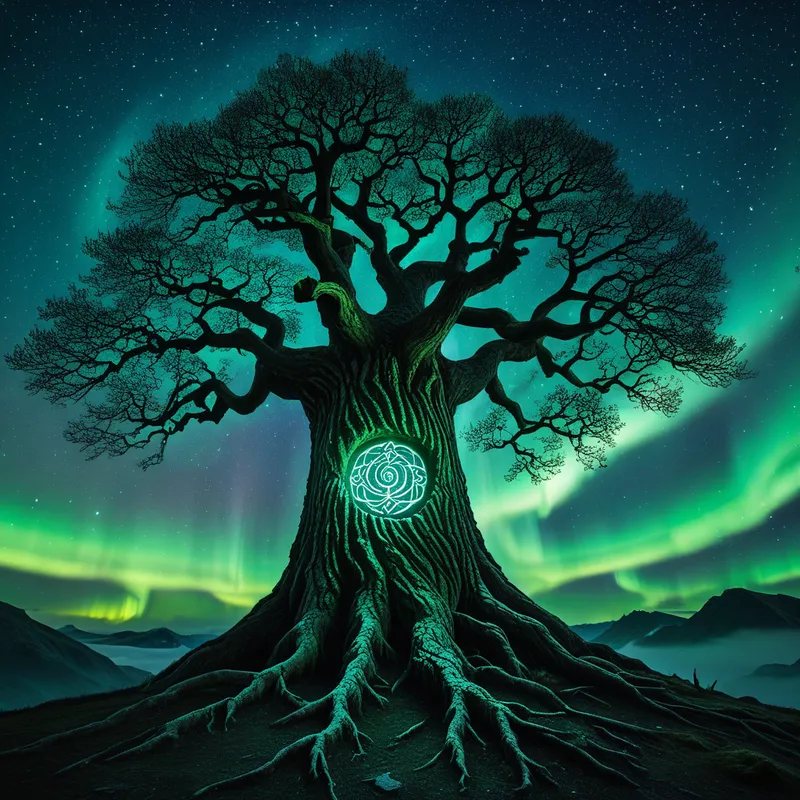
Runes on Yggdrasil Myth Meaning & Symbolism
Odin hangs himself on the World Tree, pierced by his own spear, to gain the secret wisdom of the runes, the primal alphabet of reality.
The Tale of Runes on Yggdrasil
Listen. [The wind](/myths/the-wind “Myth from Various culture.”/) does not just blow through the branches of the great ash. It whispers secrets, the oldest of secrets, carved into the very bones of [the world](/myths/the-world “Myth from Tarot culture.”/). This is the tale of how those secrets were won, and the price that was paid.
In the time before memory, when the worlds were young and the well of fate was deep, there was a hunger. It was not a hunger for meat or mead, but a hunger that gnawed at the soul of the All-Father himself. Odin had one eye, given for a drink from [Mimir’s Well](/myths/mimirs-well “Myth from Norse culture.”/). But one draught was not enough. He knew of a power deeper than [water](/myths/water “Myth from Chinese culture.”/), older than the gods—the power of the [runes](/myths/runes “Myth from Norse culture.”/). They were not letters to be written, but living forces, the hidden roots of all that is, all that was, and all that could be. They slept, woven into the heartwood of [Yggdrasil](/myths/yggdrasil “Myth from Global/Universal culture.”/), [the World Tree](/myths/the-world-tree “Myth from Celtic culture.”/) that holds the nine realms in its branches and roots.
No plea, no bargain, no threat could coax them forth. They demanded a sacrifice of a different order. So Odin, the spear-god, [the wanderer](/myths/the-wanderer “Myth from Taoist culture.”/), went to the place where the Tree’s roots drink from the wells of fate and memory. He took his own spear, [Gungnir](/myths/gungnir “Myth from Norse culture.”/), and with a cry that was both a command and a surrender, he drove it through his own side. He hung himself upon that sacred gallows, a willing offering to himself. For nine nights and nine days, a number of becoming and ending, he hung.
The winds of the worlds tore at him. The cold of [Niflheim](/myths/niflheim “Myth from Norse culture.”/) seeped into his bones. The eagle at [the crown](/myths/the-crown “Myth from Various culture.”/) of the Tree shrieked. He stared down into the murky waters of the well, his single eye seeing nothing but [the abyss](/myths/the-abyss “Myth from Kabbalistic culture.”/) of his own agony. He was a corpse offered to the cosmos, suspended between life and death, heaven and earth, knowing and oblivion. He let go of his godhood, his power, his very name. He became the sacrifice.
And on the ninth night, as the final veil of self was torn away, a vision shattered his darkness. A light, not from above, but from within the very wood he was nailed to. [The runes](/myths/the-runes “Myth from Norse culture.”/) stirred. They did not float before him; they unfolded from the grain of the Tree, from the patterns of his own blood on the bark, from the spaces between the stars. They revealed themselves—Fehu, the mobile force of cattle and wealth; Uruz, the raw, untamed strength of the aurochs; Thurisaz, the thorn and the giant, a power of conflict and defense. One by one, the primal forces of existence showed him their faces.
With the last of his strength, a strength born of utter emptiness, he reached out. Not with his hand, but with his spirit. He grasped them. He knew them. The pain did not vanish; it was transmuted. The gallows became a seat of wisdom. He fell from the Tree, not as a broken [thing](/myths/thing “Myth from Norse culture.”/), but as one reborn, heavy with a knowledge that was also a terrible burden. He had died to himself, and returned with the keys to the universe in his silent, knowing gaze.
Cultural Origins & Context
This myth, known as the Hávamál (The Sayings of the High One), is preserved in the Poetic Edda. It is Odin himself who recounts it in the first person, a rare and powerful narrative device. This was not a story told lightly around the fire for mere entertainment; it was esoteric knowledge, passed down by skalds (poets) and possibly within initiatory contexts. Its societal function was multifaceted. On one level, it established the divine origin of the runes, sanctifying their use in divination, magic, and inscription. On a deeper level, it presented a radical model for the acquisition of wisdom. In a culture that valued strength, action, and oral prowess, this myth declared that ultimate power (megin) comes not from conquest, but from a willing confrontation with suffering, limitation, and [the void](/myths/the-void “Myth from Buddhist culture.”/). It framed wisdom (fröðr) as something earned through a harrowing, personal ordeal, a concept that would resonate with the harsh realities of the Norse world.
Symbolic Architecture
The myth is a perfect symbolic map of a profound psychological and spiritual process. Yggdrasil is not merely a [tree](/symbols/tree “Symbol: In dreams, the tree often symbolizes growth, stability, and the interconnectedness of life.”/); it is the [axis](/symbols/axis “Symbol: A central line or principle around which things revolve, representing stability, orientation, and the fundamental structure of reality or consciousness.”/) of all [reality](/symbols/reality “Symbol: Reality signifies the state of existence and perception, often reflecting one’s understanding of truth and life experiences.”/), the [structure](/symbols/structure “Symbol: Structure in dreams often symbolizes stability, organization, and the framework of one’s life, reflecting how one perceives their environment and personal life.”/) of the [psyche](/myths/psyche “Myth from Greek culture.”/) itself, connecting the conscious [crown](/symbols/crown “Symbol: A crown symbolizes authority, power, and achievement, often representing an individual’s aspirations, leadership, or societal role.”/) (Asgard) with the [unconscious depths](/symbols/unconscious-depths “Symbol: The hidden, primordial layers of the psyche containing repressed memories, instincts, archetypes, and collective wisdom beyond conscious awareness.”/) (Hel, Niflheim). Odin’s act is the ultimate act of ego-[suspension](/symbols/suspension “Symbol: A state of being held in limbo, neither progressing nor regressing, often representing unresolved tension or transitional phases in life.”/).
To gain the language of the soul, one must first let the familiar self be translated into silence.
The [spear](/symbols/spear “Symbol: The spear often symbolizes power, aggression, and the drive to protect or conquer.”/), Gungnir, is his own will and focused intent turned [inward](/symbols/inward “Symbol: A journey toward self-awareness, introspection, and the exploration of one’s inner world, thoughts, and unconscious mind.”/), piercing the illusions of the [persona](/symbols/persona “Symbol: The social mask or outward identity one presents to the world, often concealing the true self.”/). The nine nights represent a full cycle of [dissolution](/symbols/dissolution “Symbol: The process of breaking down, dispersing, or losing form, often representing transformation, release, or the end of a state of being.”/) and [gestation](/symbols/gestation “Symbol: A period of development and preparation before a significant birth or emergence, symbolizing potential, transformation, and the journey toward manifestation.”/). He does not “learn” the runes; he undergoes them. Each [rune](/symbols/rune “Symbol: Ancient alphabetic symbols used in Germanic languages, often associated with divination, magic, and ancestral wisdom.”/) represents a fundamental archetypal force—a building block of reality and the psyche. To “know” them is to move from being subject to these forces to being in conscious [relationship](/symbols/relationship “Symbol: A representation of connections we have with others in our lives, often reflecting our emotional state.”/) with them. The runes are the original code, the symbolic DNA of existence, and Odin’s sacrifice is the [initiation](/symbols/initiation “Symbol: A symbolic beginning or transition into a new phase, status, or awareness, often involving tests, rituals, or profound personal change.”/) required to access this level of reality.
The Dreamer’s Resonance
When this myth stirs in the modern dreamer, it often manifests as dreams of suspension, piercing, or cryptic inscriptions. You may dream of hanging in a vast, dark space, feeling a sharp pain that is also clarifying. You might see strange symbols carved into your skin, the walls of your home, or the bark of a lone, significant tree. These are somatic signals of a deep psychological process: [the ego](/myths/the-ego “Myth from Jungian culture.”/)’s necessary ordeal.
The psyche is signaling that a old way of knowing, a old identity, must be offered up. The “spear” might be a piercing insight, a devastating loss, or a depression that forces introspection. The dreamer is in the “nine nights”—a period of feeling stuck, in pain, and in the dark, where conscious control is useless. This is not pathology, but a profound initiation into a deeper layer of [the self](/myths/the-self “Myth from Jungian culture.”/). The runes that appear are personal; they are the emerging, often unsettling, patterns and truths of one’s own inner architecture beginning to surface from the unconscious, demanding to be acknowledged and integrated.

Alchemical Translation
For the modern individual on the path of individuation, Odin’s ordeal is the quintessential model of psychic transmutation. The [prima materia](/myths/prima-materia “Myth from Alchemical culture.”/) (base material) is the ego, the conscious personality with its attachments and certainties. The mortificatio (mortification) is the voluntary hanging—the acceptance of a crisis, a depression, or a sacrifice that feels like a death. This is the dissolution of what you thought you were.
The gallows of Yggdrasil is the crucible where the lead of the ego is exposed to the fire of the Self, hoping to yield the gold of wisdom.
The [separatio](/myths/separatio “Myth from Alchemical culture.”/) (separation) occurs as old identifications fall away. The illuminatio (illumination) is the revelation of the runes—not as foreign knowledge, but as the inherent, archetypal patterns of your own authentic being. Finally, the coniunctio (union) is the return, not as the same person, but as one who carries this hidden knowledge within. You are reintegrated, but now you speak a second, quieter language. You understand that true power lies in relationship with these deeper forces, not in domination over the external world. The myth teaches that wisdom is not found in avoiding the wound, but in understanding that the wound itself, consciously borne, can become the very aperture through which a vaster reality is perceived.
Associated Symbols
Explore related symbols from the CaleaDream lexicon: