Rumpelstiltskin Myth Meaning & Symbolism
A desperate bargain with a trickster spirit reveals the ultimate power of naming the unnamable, forcing a confrontation with the shadow.
The Tale of Rumpelstiltskin
Listen, and hear a tale spun in the dark of the hearth, a whisper from the time when promises were iron and names were power. There was a miller, poor in sense but rich in pride, who boasted to the king that his daughter could spin straw into gold. Greed, that ancient hunger, lit a fire in the king’s eyes. He commanded the girl be brought to his castle and locked in a tower room heaped high with straw. “Spin this into gold by dawn,” he declared, “or you will die.”
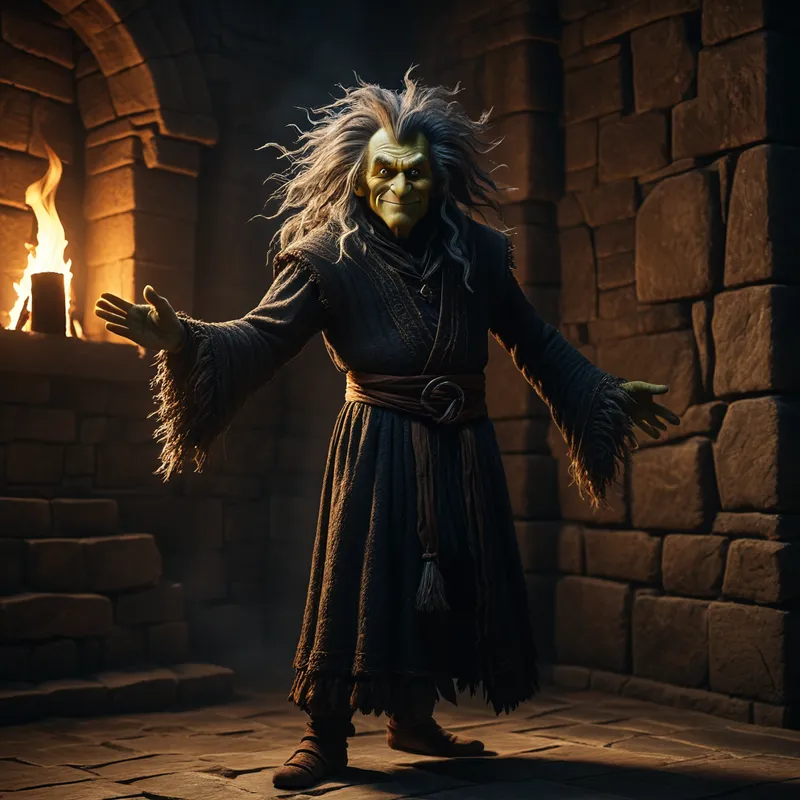
The girl wept, for the task was impossible. The straw was dead, dry grass, and her hands knew only simple work. As her tears fell upon the stone floor, the very air in the room grew thick and strange. From the shadows, a figure coalesced—a small, wizened man with eyes that held the glint of things long forgotten. “Good evening, miller’s daughter,” he crackled. “Why do you weep so?”
“I must spin this straw into gold,” she sobbed, “and I do not know how.”
The little man’s smile was a thin curve in the gloom. “What will you give me if I do it for you?”
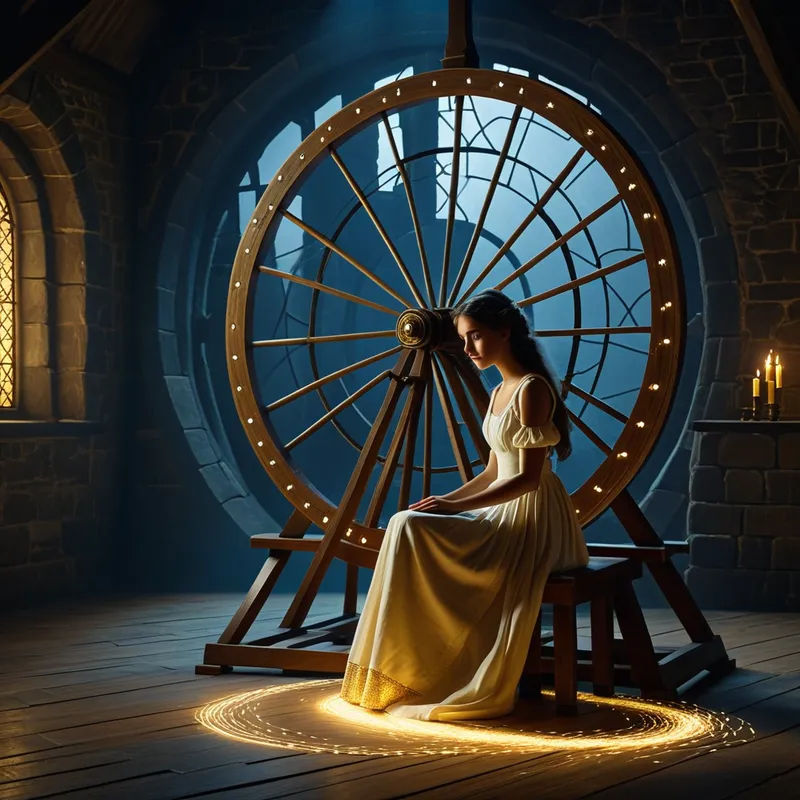
Desperate, she offered her necklace. He took it, sat at the spinning wheel, and with a whirr and a hum that was not of this world, the straw began to twist and shimmer, transforming into coils of perfect, radiant gold. By morning, the room gleamed. The king, astonished and inflamed with greater avarice, led her to a larger room, filled with even more straw. “Again,” he commanded. “And if you succeed, you shall be my queen.”
Once more, in the lonely dark, the little man appeared. This time, she had nothing but the ring on her finger. He took it, and again the wheel sang its metallic song, filling the room with treasure. The king, true to his word and his greed, married her.
But a king’s hunger is a bottomless pit. He brought his new queen to the grandest room yet, a chamber mountainously full of straw. “One last time,” he said. “Spin this, and your firstborn child shall sit upon my throne.” Then he locked the door.
When the little man came a third time, the queen had nothing left to give. “I have no jewels,” she wept.
The creature leaned close, his breath like old leaves and cold earth. “Then promise me. Promise me the child you will bear. I will care for it well.”
In the terror of the moment, with death the only other choice, she promised. The wheel spun a final, furious time, and the deed was done. The king was satisfied, and in time, the queen bore a beautiful child.
The little man returned to claim his prize. The queen, shattered with grief, offered him all the riches of the kingdom. He laughed, a sound like stones tumbling. “Something living is dearer to me than all the treasures in the world.” Yet, moved by her tears—or perhaps by a deeper game—he offered a riddle: “I will give you three days. If, within that time, you can guess my name, you may keep your child.”
For two days, the queen sent messengers across the land, collecting every strange name they could find. She listed them all: Caspar, Melchior, Balthazar, Ribsofbeef, Muttonchops… but to each, the little man only shrieked, “That is not my name!”
On the third day, a messenger returned with a wild tale. Deep in the dark forest, he had seen a fire, and around it danced a bizarre little man, singing a chilling song to himself: “Today I bake, tomorrow I brew, / The next I’ll have the young queen’s child. / Ha! Glad am I that no one knew / That Rumpelstiltskin I am styled!”
That evening, when the creature came for his due, the queen, her heart a drum of hope and dread, asked coyly, “Is your name, perhaps… Rumpelstiltskin?”
The silence that followed was absolute and terrible. The little man stamped his foot upon the ground with a fury that shook the castle. “The Devil told you that! The Devil told you that!” he screamed. And in his rage, he stamped so hard that his right foot drove deep into the earth. He seized his left leg with both hands and, in a grotesque, furious effort, tore himself in two. And he was never seen again.
Cultural Origins & Context
The tale of Rumpelstiltskin belongs to the great oral tradition of European folk tales, collected and published by the Brothers Grimm in the 19th century. Its roots, however, wind much deeper into the pre-modern psyche. This was a story told not in courts, but in cottages and around fires, often by women to children. Its primary audience was not the powerful king, but the vulnerable miller’s daughter.
Its societal function was multifaceted: a cautionary tale about the dangers of parental boasting and the catastrophic chain of events it can set in motion; a stark depiction of the transactional nature of survival for women in patriarchal systems, where their bodies and offspring are currency; and a folk-memory of older, animistic beliefs in household spirits and the potent magic of true names. The story validates cunning and perseverance over brute force, and ultimately, it is a tale of the commoner outwitting the supernatural through luck and cleverness, a deeply reassuring narrative for a peasant class living at the mercy of forces both natural and feudal.
Symbolic Architecture
At its core, this is a myth of alchemical projection and reclamation. The impossible task—spinning straw into gold—represents a demand from the outer world (the King, the Father, Society) for the protagonist to perform a miracle of transformation she does not believe she can achieve. It is the unbearable pressure to be more than she is.
The shadow is not the enemy; it is the unintegrated self, waiting in the locked tower of the psyche, demanding recognition and a name.
Rumpelstiltskin is the personification of her own latent, unacknowledged power, her creative daimon. He emerges from the shadows when conscious resources fail. Yet, this power is not free. It operates on a ruthless, archaic logic of exchange. The necklace and ring symbolize superficial identities (daughter, maiden) given away. The promised firstborn is far more profound: it is the nascent, future self, the new life or creation born of this forced transformation. To bargain it away is to promise one’s own potential, one’s psychic future, to the unconscious.
The guessing of the name is the pivotal act of individuation. In magical tradition, to know a being’s true name is to have power over its essence. The queen, by discovering “Rumpelstiltskin,” does not destroy her shadow; she defines it. She brings it into the light of consciousness. The creature’s self-destruction is not a victory of good over evil, but the dissolution of the autonomous complex once it is named and integrated. The power it held is now, theoretically, available to the queen.
The Dreamer’s Resonance
When this myth pattern stirs in modern dreams, it signals a profound psychological negotiation. Dreaming of being in a room with an impossible task (often work-related, but also creative or relational) points to a feeling of fraudulent overwhelm, the “imposter syndrome” made manifest. The looming authority figure (the King) is the internalized critic or societal superego, demanding gold where there seems only to be straw.
The appearance of the strange helper—a bizarre coworker, a frightening yet compelling animal, a mysterious guide—is the psyche’s own archetypal resource emerging. The dreamer may feel they are making a terrible bargain, promising something precious (their time, health, integrity, a relationship) for short-term relief. The somatic experience is often one of trapped anxiety giving way to a frantic, desperate search.
The climax of such a dream-cycle is the discovery of the “name.” This might translate to a sudden, waking insight: the true nature of one’s anxiety, the name of a long-held pattern (“perfectionism,” “need for approval,” “fear of success”), or the core identity of an internal persecutor. The resolution is not a battle, but a revelation that causes the oppressive force to lose its power, often simply vanishing or transforming.

Alchemical Translation
The myth of Rumpelstiltskin is a precise map for the alchemy of the Self. The prima materia, the base substance, is the “straw”—the raw, undervalued, seemingly worthless aspects of one’s own experience: our insecurities, our mundane struggles, our perceived failures. The King’s demand is the cruel but necessary pressure of life that forces us to attempt the transmutation.
To spin straw into gold is not to falsify the base material, but to recognize the latent value woven into the very fiber of one’s struggles.
The first stage (nigredo) is the despair in the locked tower, the confrontation with the impossible. The appearance of the shadow-helper (Rumpelstiltskin) marks the beginning of the albedo, the whitening. Here, we must bargain with parts of ourselves we’d rather disown. We pay with our old identities (necklace, ring) and risk our future potential (the child). This is the dangerous, necessary dialogue with the unconscious.
The final, crucial operation (rubedo, the reddening) is the guessing of the name. This is the act of conscious integration. It is the hard-won insight that allows us to say, “This rage is mine. This creativity is mine. This trickster energy is mine. I name you, and in naming you, I take back my power.” The shadow’s violent dissolution is the end of its autonomy; its energy is subsumed back into the whole psyche. The gold, then, is not merely external reward (the queen’s title), but the achieved integrity of a Self that has faced its own darkness, named it, and in doing so, unlocked the genuine creative power that was there all along, waiting in the straw.
Associated Symbols
Explore related symbols from the CaleaDream lexicon: