Rudra Myth Meaning & Symbolism
The story of Rudra, the primal howler, born from the fury of creation itself, embodying the terrifying and necessary power of dissolution and renewal.
The Tale of Rudra
In the beginning, before the world knew its own name, there was a silence so profound it was a pressure. Prajapati, the architect of life, had poured himself into the act of generation. From his essence sprang the creatures of the earth, the birds of the air, the fish of the deep. But creation is not a gentle act. It is a tearing, a splitting, a violent expenditure of primal force. And from the exhaustion, the fever-heat, the excess of this cosmic effort, a residue gathered. It was not waste, but concentrated potency—the unspent fury of becoming, the anguished cry of separation, the raw, untamed power that creation had left behind.
This residue coalesced in the highest heaven, a knot of seething, incandescent rage. It had no form, only a sound—a low, building roar that shook the pillars of space. The Vedas themselves trembled at its birth-cry. The gods, those established lords of order, looked on in dread. “What is this terrible thing?” they whispered. “It is the Howler,” said Prajapati, his voice heavy with a father’s dread. “He is my son, born of my tapas, my fervor. His name is Rudra.”
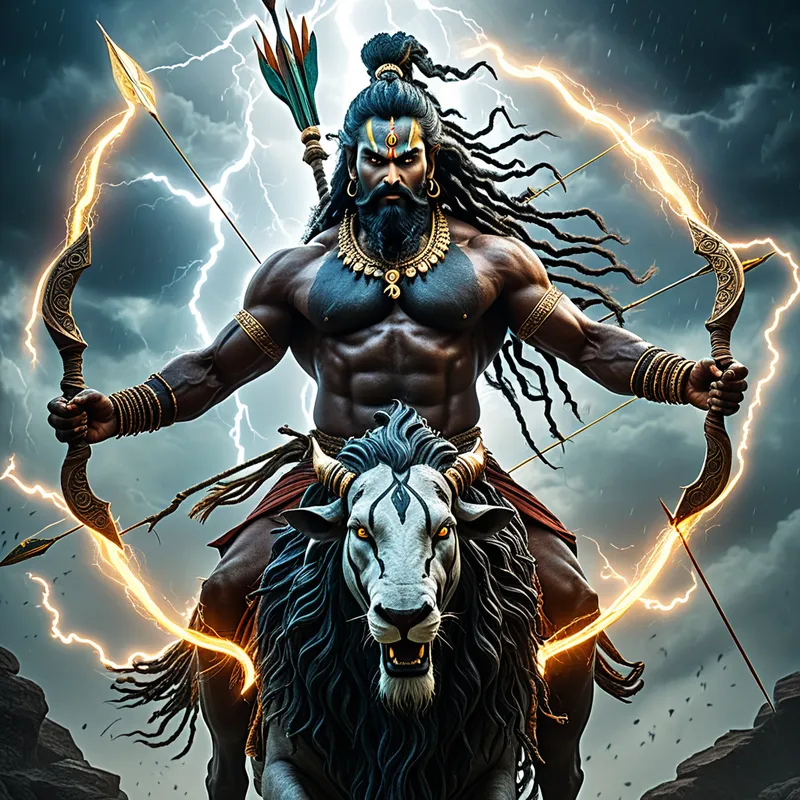
And Rudra descended. He was not a god of palaces but of the wild, liminal spaces—the crossroads, the forest’s edge, the cremation ground. His hair was a storm of matted locks, his throat blue with swallowed poison and cosmic fire. In his hands, he did not hold a scepter, but a bow made of black wind and strung with thunder. His arrows were not of mere wood; they were fever, convulsion, and the sudden, piercing insight that shatters the mind. He saw his father, Prajapati, who in his creative fervor had transgressed a boundary, and the Howler’s wrath was absolute. He took aim, and his arrow flew true, wounding the very source of creation.
A great stillness fell. Creation, wounded, began to falter. The gods, realizing that this fury was not mere chaos but a fundamental law—the necessary check, the fever that purges—approached him not with war, but with desperate supplication. “O Mighty One,” they implored, “you who strike, you must also heal. The one who wounds holds the secret of the cure. Do not let your father, the womb of all, perish.”
Rudra, the solitary archer, looked upon the suffering his necessary justice had wrought. The fury in his heart did not abate, but it turned inward, becoming a cool, focused power. He became Shiva, the Auspicious. He laid his hands upon the wound, and where his touch fell, the fever broke, the flesh knit, and a deeper, more resilient order was born. He did not ask for a throne in the city of the gods. He turned and walked back to his mountains, to his meditations, becoming the Lord of Beasts and the Supreme Ascetic, the destroyer who is the only true healer, forever holding within him the terrifying, dual song of the storm and the silence that follows.
Cultural Origins & Context
The myth of Rudra is not a single story but a seismic shift recorded in the bedrock of Hindu thought, found primarily in the Rig Veda and elaborated in the Brahmanas and Yajur Veda. He is a pre-classical, Vedic deity, older and wilder than the more systematized gods of the later Puranic pantheon. His hymns were likely composed and chanted by Rishis who lived close to the raw forces of nature—the violent monsoon storm that destroys crops but replenishes rivers, the sudden plague that decimates a village, the awe of the untamed wilderness.
Rudra’s function was societal in its stark honesty. He represented the uncontrollable, ambivalent forces that ancient agrarian and pastoral societies feared and needed to appease. He was the god you invoked not for boons, but for avoidance—“O Rudra, do not slay our children, our cattle, our men.” His worship was an acknowledgment that life is surrounded by potent, capricious energies that must be respected. The myth served as a cosmological explanation for disease, natural disaster, and death, not as evil, but as an intrinsic, terrifying aspect of the creative process itself, personified in a deity who had to be integrated, not defeated.
Symbolic Architecture
Rudra is the archetypal embodiment of the unintegrated shadow of creation. He symbolizes the necessary, violent negation that makes affirmation possible. He is not evil opposing good; he is the law of entropy opposing the law of generation. His symbolism is a masterclass in divine paradox.
He is the arrow that pierces the heart of the father, severing the unchecked creative impulse, forcing a crisis that leads to a higher synthesis.
His bow and arrows represent targeted, disruptive force—the sudden illness, the devastating insight, the crisis that dismantles a stagnant structure. His matted locks (Jata) are the unbound, chaotic energy of the ascetic, the one who stands outside societal order, containing the storm within his own being. The blue throat (a trait later fully attributed to Shiva) tells of his capacity to hold poison, to internalize and transform toxicity into a protective power. Most profoundly, Rudra represents the fusion of terror (Rudra) and auspiciousness (Shiva), teaching that true healing is not the absence of the wound, but the transformation wrought by passing through it. He is the archetype of the Rebel who dismantles a system not for chaos, but because the system has become incestuous, self-congratulatory, and blind to its own excesses.
The Dreamer’s Resonance
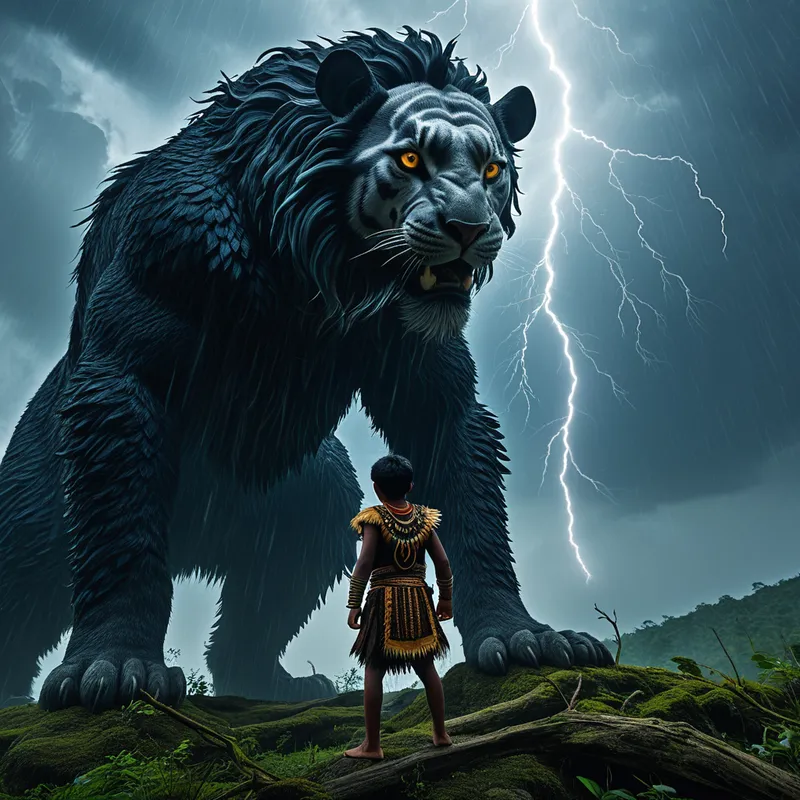
When the pattern of Rudra stirs in the modern psyche, it often manifests in dreams of violent weather—being caught in a purifying, terrifying storm, or witnessing a lightning bolt strike a familiar, stable structure (one’s home, workplace, a childhood tree). It may appear as a fierce, wild figure at the edge of a dream-city, observing with unsettling calm, or as the sudden onset of a “fever” in the dream-body—a burning sensation that feels destructive yet strangely clarifying.
Somatically, this corresponds to a psychological process of necessary dissolution. The dreamer is likely at a point where an old identity, a long-held belief, or a life structure has become a “Prajapati”—a creative force that has over-extended, become rigid, or corrupt in its self-perpetuation. The Rudra energy rises from the unconscious as the embodied “no.” It is the psyche’s own immune response, launching a crisis (a breakdown, a conflict, a burning anger) to break the psychic fever of a stagnant status quo. The process is not intellectual but visceral, often felt as anger, deep grief, or a rebellious urge that feels alien to the conscious personality.
Alchemical Translation
The alchemical journey modeled by Rudra is the transmutation of raw fury into sovereign healing power. For the individual, the myth maps the path of Individuation through confrontation with one’s own destructive capacity.
The first stage is the Birth of the Howler: acknowledging the repressed rage, the critical voice, the disruptive energy within that feels “monstrous” and antithetical to one’s self-image as a creator or maintainer. This is not a flaw, but latent potency born from the exhaustion of over-adaptation.
The second is the Aimed Arrow: consciously directing this energy toward the internal “Prajapati”—the outdated parental complex, the inflated ego, the compulsive pattern that once served creation but now stifles it. This is the courageous act of psychological rebellion, allowing a necessary breakdown.
The climax of the opus is not the destruction, but the moment the gods implore the destroyer to heal. This is the ego’s surrender, asking the fierce, unconscious force for integration.
The final stage is Becoming the Healer: The Rudra energy, having performed its cathartic function, is not exiled but integrated. Its fury cools into the penetrating insight of the ascetic; its disruptive force becomes the capacity to dissolve psychic blockages. The individual no longer fears their own anger or critical power but wields it with the precision of a surgeon and the compassion of a physician. They become, like Rudra-Shiva, a sovereign entity who dwells in their own inner mountains, at peace with the storm and the silence, capable of both destroying illusions and healing the wounds that truth inevitably reveals.
Associated Symbols
Explore related symbols from the CaleaDream lexicon: