Ruach Elohim Myth Meaning & Symbolism
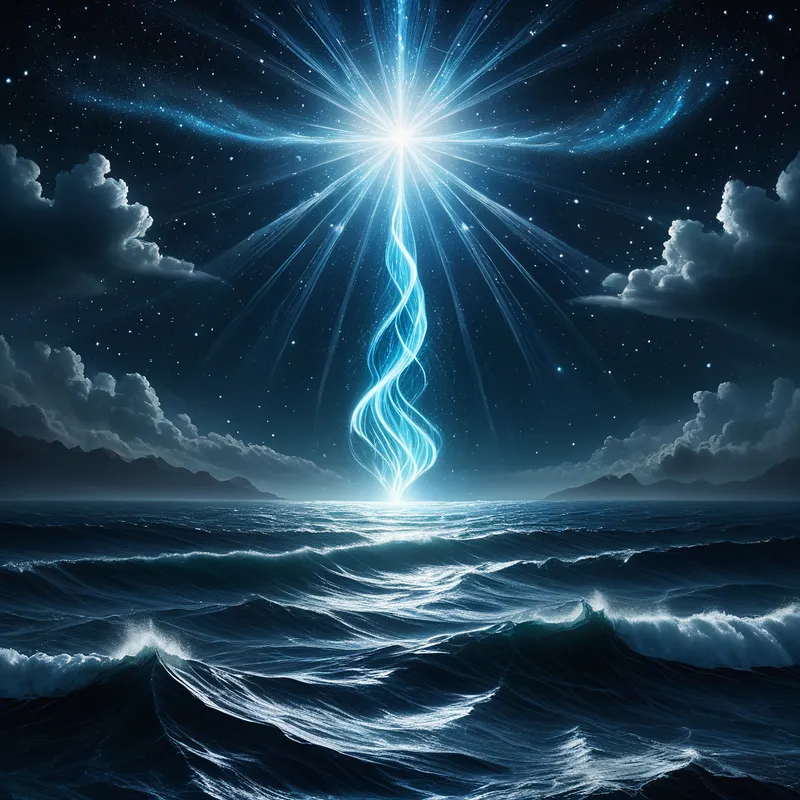
The story of the divine breath moving over the formless deep, bringing order from chaos and life from the void through a sacred, creative presence.
The Tale of Ruach Elohim
In the beginning, there was no beginning as we know it. There was no east or west, no up or down, no then or now. There was only the tohu wa-bohu—a seething, silent, and sightless deep. A watery abyss, tehom, lay shrouded in a darkness so profound it was a substance, a weight upon the soul. This was the unformed potential of all things, the chaos before the song, the silence before [the word](/myths/the-word “Myth from Biblical culture.”/).
And over the face of these waters, there moved… a presence. Not a hand, not a face, but a breath. The [Ruach](/myths/ruach “Myth from Hebrew culture.”/) Elohim. It was not a storm, though it had a storm’s potential power. It was not a whisper, though it carried a whisper’s intimacy. It was the divine exhale, a hovering, brooding, nurturing movement across the face of the deep. Imagine the gentle, inevitable pressure of an eagle’s wings as it prepares its nest, a vast, tender, and focused energy suspended between the unformed below and the source above.
The deep did not recoil; it waited. The darkness was not banished; it was attended to. The Ruach moved—merachefet—a word that holds the sense of shaking, fluttering, and cherishing all at once. In that patient, dynamic hovering, a relationship was established. Chaos was not destroyed; it was courted. [The void](/myths/the-void “Myth from Buddhist culture.”/) was not ignored; it was seen by the unseen. And in that seeing, in that sacred attention, the first tension was born: the tension between what is and what could be.
Then, from the source of that breath, came a sound that was not a sound—a vibration that was the first law. A word: Yehi ’or. And there was light. Not the light of sun or star, but the light of distinction, of consciousness itself, separating itself from the uniform dark. The Ruach did not cease. It was the carrier of that word, the medium through which potential received its first command to become. Where it had brooded, creation now stirred. The waters began to know their boundaries; the formless began to dream of form. [The great work](/myths/the-great-work “Myth from Alchemical culture.”/) had begun, not with a clash of titans, but with the patient breath of spirit upon the waiting deep.
Cultural Origins & Context
This foundational narrative opens the book of Bereshit (Genesis). It is the prologue to all prologues in the Abrahamic traditions—Judaism, Christianity, and Islam. Its telling was not for entertainment but for orientation. Priestly custodians in ancient Israel shaped this cosmogony, likely during or after the Babylonian Exile, a period of profound national disorientation and chaos. The story served as an anchor: before there were empires and exiles, there was a formless deep, and over it, a divine purpose moved.
Its societal function was multifaceted. It established a theology of a transcendent God who creates through sovereign word and spirit, distinct from the chaotic, battling gods of neighboring Mesopotamian myths like the Enuma Elish. It also provided a template for order. Just as the Ruach brought order from cosmic chaos, so too did the divine law (Torah) bring order from social and moral chaos. The myth was recited, studied, and meditated upon as a reminder that the creative, ordering principle was the first and ultimate reality, a comfort in times of personal or collective “tohu wa-bohu.”
Symbolic Architecture
The myth’s power lies in its sparse, profound [symbolism](/symbols/symbolism “Symbol: The use of symbols to represent ideas or qualities, often conveying deeper meanings beyond literal interpretation. In dreams, it’s the language of the unconscious.”/). The tohu wa-bohu represents the unformed [psyche](/myths/psyche “Myth from Greek culture.”/), the raw [material](/symbols/material “Symbol: Material signifies the tangible aspects of life, often representing physical resources, desires, and the physical world’s influence on our existence.”/) of the unconscious with all its potentials and terrors. It is the internal [chaos](/symbols/chaos “Symbol: In Arts & Music, chaos represents raw creative potential, uncontrolled expression, and the breakdown of order to forge new artistic forms.”/) that precedes any act of genuine creation or change.
The tehom is not the enemy; it is the raw material of the self. Salvation lies not in fleeing the deep, but in learning to hover over it.
The Ruach Elohim symbolizes the archetypal creative principle. It is not the [Creator](/symbols/creator “Symbol: A figure representing ultimate origin, divine power, or profound authorship. Often embodies the source of existence, innovation, or personal destiny.”/) in full manifestation, but the Creator’s attentive, animating [presence](/symbols/presence “Symbol: Presence in dreams often signifies awareness or acknowledgment of something significant in one’s life.”/)—the function of [consciousness](/symbols/consciousness “Symbol: Consciousness represents the state of awareness and perception, encompassing thoughts, feelings, and experiences.”/) itself when it turns toward the inner chaos without judgment, with a nurturing focus. Its “hovering” (merachefet) is the key [action](/symbols/action “Symbol: Action in dreams represents the drive for agency, motivation, and the ability to take control of situations in waking life.”/): a sustained, engaged [attention](/symbols/attention “Symbol: Attention in dreams signifies focus, awareness, and the priorities in one’s life, often indicating where the dreamer’s energy is invested.”/) that does not force, but fertilizes. It represents the necessary state of psyche where something new can be conceived.
The resulting Light is the [birth](/symbols/birth “Symbol: Birth symbolizes new beginnings, transformation, and the potential for growth and development.”/) of consciousness, the first act of distinction. It is the “I” that can observe the “not-I,” the [ability](/symbols/ability “Symbol: In dreams, ‘ability’ often denotes a recognition of skills or potential that one possesses, whether acknowledged or suppressed.”/) to differentiate and, ultimately, to name and bring order to one’s inner world.
The Dreamer’s Resonance
When this myth activates in the modern psyche, it often manifests in dreams of vast, ambiguous spaces—standing on the shore of a dark, endless ocean; floating in the void of space; or being in an empty, derelict building that represents [the self](/myths/the-self “Myth from Jungian culture.”/). The mood is not always terror, but often a profound, pregnant stillness. The dreamer may feel they are waiting, or that something immense is about to happen.
Somatically, this can correlate with the breath. One might dream of breathing underwater, or of a wind moving through them while they sleep. Psychologically, this dream pattern signals a pre-creative or pre-transformative state. The old structures of the personality have dissolved or are dissolving (tohu wa-bohu). [The ego](/myths/the-ego “Myth from Jungian culture.”/) is in the dark, unsure of its footing. The dream is an expression of the Self (the total psyche) initiating a process of re-creation. The discomfort of the “void” is the necessary clearing of the slate. The dreamer is being invited not to panic and fill the space prematurely, but to learn to “hover”—to observe the inner chaos with a curious, patient, and ultimately creative attention.

Alchemical Translation
The alchemical process mirrored here is the [prima materia](/myths/prima-materia “Myth from Alchemical culture.”/), the first matter—often depicted as a chaotic, black substance ([nigredo](/myths/nigredo “Myth from Alchemical culture.”/)). This is the tohu wa-bohu of the soul: the unresolved grief, [the shadow](/myths/the-shadow “Myth from Jungian culture.”/) material, the confused passions. The individuation journey begins not by rejecting this, but by applying the Ruach Elohim—the spirit of conscious attention.
Individuation is not building a castle on solid ground. It is learning to brood creatively over the ocean of oneself until islands of meaning begin to rise.
The modern individual translates this myth by practicing a form of psychic hovering. In meditation, therapy, or active imagination, one learns to suspend judgment and simply observe the inner chaos—the swirling thoughts, the raw emotions, the formless anxieties. This attentive, non-grasping presence is the human analogue of the divine breath. It is the act that separates light from darkness within.
The command “Let there be light” is the moment of insight, the spontaneous arising of a new understanding, a new perspective, or a creative solution that was not available to the forcing, controlling ego. It is the birth of a more complex consciousness from the marriage of focused spirit (Ruach) and raw potential (the deep). The [triumph](/myths/triumph “Myth from Roman culture.”/) of the myth is a model for every act of personal renewal: order is not imposed from outside, but invited forth from within through the sacred, patient attention of one’s own spirit to one’s own depths.
Associated Symbols
Explore related symbols from the CaleaDream lexicon: