Rta Myth Meaning & Symbolism
The eternal, invisible principle of cosmic order and truth that upholds all creation, from the turning of stars to the rhythm of the human heart.
The Tale of Rta
Before the first name was spoken, before the distinction of day and night, there existed a hum. It was not a sound heard by ears, but a vibration felt in the marrow of potentiality. This was the primordial pulse, the first rhythm. From this hum, a pattern emerged—inexorable, flawless, silent. This was Rta.
The gods themselves were born into its current. Varuna, the all-seeing sovereign of the celestial waters, became its first guardian. His throne was the vault of heaven, his eyes were the stars, and with those eyes, he watched. He watched the paths of the sun chariot, ensuring its wheel did not waver a hair's breadth from its ordained track. He measured the breath of the winds and the journey of the rivers to the sea. His gaze was the net that held the cosmos in its rightful place.
But Rta is not a chain; it is the dance. It is the reason the dawn, Ushas, unveils her rosy fingers each morning without fail. It is the hidden force that pulls the sap up the trunk of the world tree and guides the bee to the flower. The seasons turn at its command, not with the harsh crack of a whip, but with the gentle, inevitable persuasion of a truth too deep to deny.
Yet, shadows gather. The demonic forces, the Asuras, born of the same primordial stuff, crave chaos. They whisper to the winds to blow backwards, they tempt the sun to stand still in pride, they seek to clog the arteries of the world with stagnation and falsehood. When their influence grows, the hum falters. The rivers flood their banks, the rains forget the earth, and the hearts of men turn to deceit.
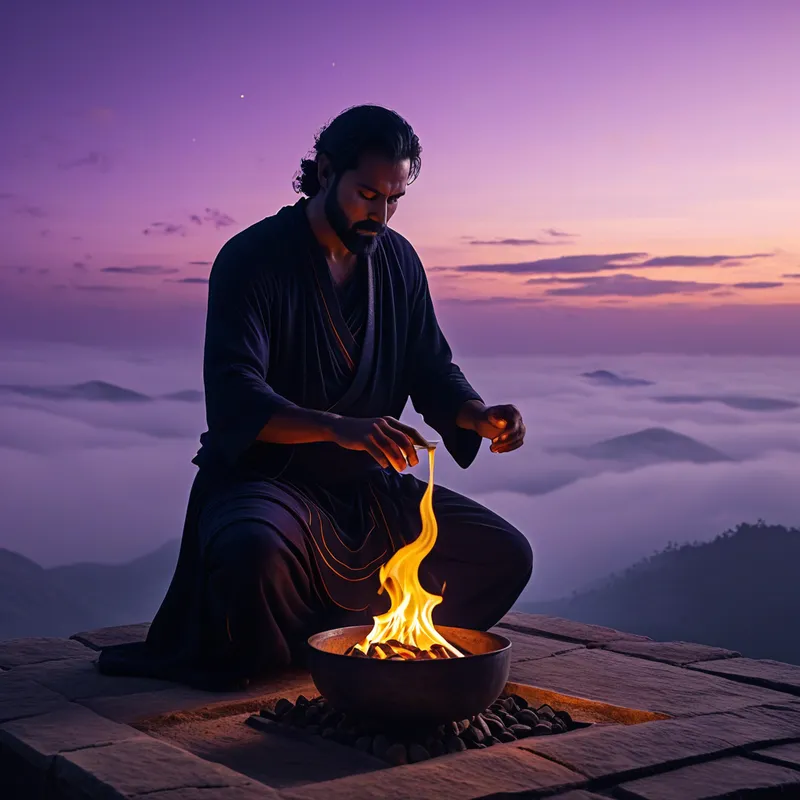
Then the great sacrifice must be performed. The god Agni, the flame, is summoned. He is the tongue of the gods, the consumer, the transformer. Into his bright mouth are poured the sacred offerings: the clarified butter, the soma nectar, the whispered hymns of the Rishis. This is no mere ritual; it is cosmic maintenance. Agni, crackling with devotion, carries the essence of the offering upward on pillars of scented smoke. It is food for the gods, and in return, they pour down their vigor, their tejas, to reinforce the fabric of Rta.
The conflict is eternal, the resolution never final. Varuna watches. Agni burns. The Rishis chant. And the great wheel, turning on the axle of Rta, continues its flawless, silent roll through eternity, its hum the bedrock of all that is, was, and will be.
Cultural Origins & Context
The myth of Rta is not a single story with a beginning and end, but the foundational atmosphere of the earliest Hindu thought, preserved in the Vedas, particularly the Rigveda. It was not "told" in the way of later epics but invoked and perceived by the Vedic seers, the Rishis. These poet-priests were not inventors but discoverers; through intense meditation and ritual precision, they listened to the universe and heard its underlying order, which they named Rta.
Its societal function was paramount. Vedic society was a participatory cosmology. The king's duty (dharma) was to uphold Rta in the human realm. The priest's duty was to maintain it through exact ritual (yajna). The farmer's timely sowing was an act in harmony with Rta. Every truthful speech, every fulfilled promise, every correctly measured action was a brick in the edifice of cosmic order. Rta was the ultimate justification for morality, law, and social structure—it was how humanity kept the world from sliding back into chaos. It was the sacred contract between the human, the natural, and the divine.
Symbolic Architecture
Rta represents the archetypal principle of Order itself. It is not a moral law imposed from without, but the intrinsic, dynamic pattern of existence. Psychologically, it symbolizes the deep, unconscious ordering principle of the psyche—what Carl Jung termed the Self. It is the blueprint for wholeness.
Rta is the truth that exists before it is spoken, the harmony that is felt before it is played. It is the pattern in the chaos, the grammar of becoming.
Varuna symbolizes the aspect of consciousness that can perceive this order—the observing, judging, and integrating faculty. His "net" is the discerning mind that recognizes connections and consequences. Agni represents the transformative energy—libido, psychic fire—required to align with this order. Sacrifice (yajna) is the symbolic act of surrendering the lower, disordered, or egoistic elements (the offering) to be transformed by this inner fire into something that sustains the greater whole. The ever-present Asuras are not mere external monsters; they are the innate entropy of the psyche—the laziness, deceit, narcissism, and chaos that constantly threaten to disrupt internal harmony.
The Dreamer's Resonance
When the archetype of Rta stirs in the modern unconscious, it often manifests in dreams of profound symmetry, geometric patterns, or cosmic clocks. One might dream of a machine of impossible complexity working flawlessly, of finding a hidden room in their house that is perfectly ordered, or of hearing a foundational musical note that makes everything else make sense.
Somatically, this can coincide with a felt sense of "getting into flow," where actions and outcomes align effortlessly. Conversely, its disturbance—the rebellion of the Asuras—might appear as dreams of crumbling architecture, broken mechanisms, tangled webs, or being lost in a labyrinth with no center. This signals a psychological state where one's life feels out of sync—where actions lack purpose, words feel hollow, and a sense of fundamental disharmony pervades. The psyche is dreaming of a lost or damaged order, craving realignment with its own intrinsic truth.

Alchemical Translation
The individuation process is, at its core, the discovery of one's personal Rta—the unique and authentic pattern of one's being. The modern individual often begins in a state of anrita (falsehood, disorder), living by external scripts, societal expectations, or compulsive patterns that are out of sync with the inner law.
The alchemical work is to become both the Rishi who discerns the pattern, Agni who burns away the dross, and Varuna who faithfully upholds the revealed order in one's own life.
The "sacrifice" is the continual letting go of attitudes, identities, and behaviors that no longer serve the truth of the Self. This could be sacrificing the need to be perpetually liked, the comfort of victimhood, or the tyranny of a perfectionistic persona. This material is offered into the inner fire of honest self-reflection and conscious suffering. The "libation" that results is renewed energy, clarity, and a sense of authentic purpose—the soma of psychological integration.
The Asuric forces are not to be annihilated but recognized as part of the whole. One's chaotic impulses, shadow aspects, and rebellious energies must be acknowledged and given a conscious place, lest they sabotage the order from the shadows. The ultimate goal is not a rigid, static perfection, but a dynamic, flowing harmony where one's personal rhythm resonates with the wider rhythm of life. To live in accordance with your Rta is to find your unique note in the cosmic hum, and in doing so, to help sustain the song of the world itself.
Associated Symbols
Explore related symbols from the CaleaDream lexicon: