Rosetta Stone Myth Meaning & Symbolism
A tale of a sacred stone that held the lost language of the gods, buried by time and rediscovered to bridge the chasm between the human and the divine.
The Tale of Rosetta Stone
Listen. The sands remember what men forget.
In the time when the Pharaoh was the beating heart of the Two Lands, and the voice of Thoth still whispered in the halls of scribes, there existed a knowing deeper than the Nile. It was the Sacred Word, the heka that shaped reality, carved into temple walls and painted on papyrus scrolls. It was the language the gods used to speak the world into being.
But empires are like the river’s flood—they rise, they crest, they recede. New tongues washed over the land, harsh and clattering sounds that held no memory of the primordial waters of Nun. The old priests died, their lips still forming silent prayers. The temples of Karnak and Luxor became mountains of silent, staring stone, their stories locked in beautiful, bewildering pictures. The connection was severed. The dialogue between earth and sky, between mortal and divine, fell into a silence as deep as a tomb.
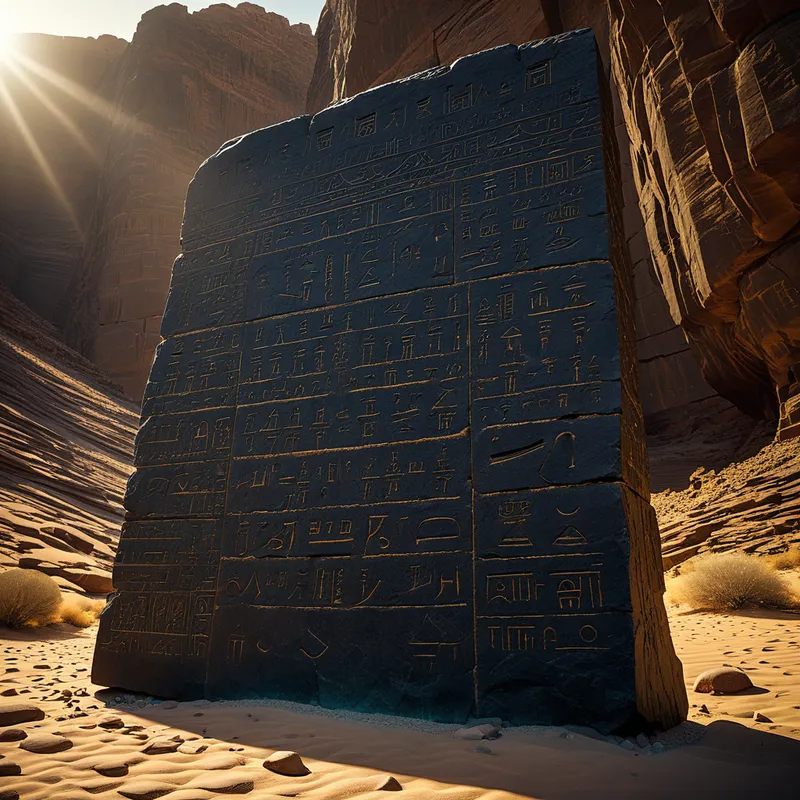
The gods did not rage. They waited. In the sacred precinct of Sais, in a chamber that knew only the footfalls of the highest initiates, a final act of preservation was undertaken. Not with a shout, but with a sigh. The last Master Scribe, his eyes milky with age but his hand steady as the pole star, directed the cutting of a single, unassuming slab. Upon its dark, granitic face, he commanded the inscription of a single decree—a mundane royal pronouncement—but in three tongues.
The first was the holy script, the Medu Netjer, the words of the gods themselves, curling and avian, holding the essence of things. The second was the script of the people, the flowing Demotic, the language of the market and the field. The third was the tongue of the new conquerors, the stark, linear Greek. This was no boast of power. It was a message in a bottle cast into the ocean of time. A plea. A key left in the lock of a door everyone had forgotten was there.
Then, the stone was given to the earth. Not hidden, but placed—a foundation stone for a small temple that would soon itself be swallowed by the drifting sand. The wind covered it. Centuries layered upon it like sedimentary rock. The memory of the key was lost, even the memory that there was a door.
For two thousand years, it slept. It felt the roots of acacia trees curl around it. It heard the march of armies it could not understand. It held its triple message in perfect, patient silence.
Until the day the sun struck it at a different angle. Until the spade of a soldier, digging a fortification in the mud-brick town of Rashid, struck not soft earth, but a hard, unyielding truth. It was pulled from the embrace of the soil, heavy with the weight of all those silent years. Men gathered around, not as priests, but as puzzled engineers. They saw the scripts. They recognized one. And in that moment of recognition, the long, held breath of history began to exhale. The stone had been found. The conversation could begin again.
Cultural Origins & Context
The myth of the Rosetta Stone is unique; it is a modern myth born from a historical artifact, yet it fulfills the deepest functions of ancient storytelling. Its origins are not in the pre-dynastic past but in 196 BCE, during the Ptolemaic period. The stone itself is a decree affirming the royal cult of the young King Ptolemy V. Functionally, it was bureaucratic, designed to be read by the Greek-speaking ruling class, the Egyptian priesthood, and the common people.
However, its cultural resurrection in 1799 and subsequent decipherment by Jean-François Champollion in 1822 transformed it into a profound mythological event. For Western civilization, it became the cipher that unlocked not just a language, but an entire worldview. The "myth" is thus the story of its purpose and its rediscovery—a narrative about cultural memory, continuity, and the terrifying possibility of permanent forgetting.
In this sense, it was "passed down" not by oral bards, but by archaeologists, linguists, and historians. Its societal function mirrors that of foundational myths: to explain a rupture (the loss of understanding) and provide a narrative of healing and reintegration (the recovery of voice). It serves as the ultimate metaphor for the work of Egyptology itself—the patient, devoted act of listening for a whisper across a gulf of millennia.
Symbolic Architecture
At its core, the Rosetta Stone is a symbol of the interface. It is the liminal object that sits precisely on the threshold between the known and the unknown, the comprehensible and the mysterious.
The stone is the psyche’s own attempt at self-translation, carving the messages of the unconscious into the conscious mind in multiple, simultaneous scripts.
The three scripts are its primary symbolic architecture. They represent three layers of the self or three modes of knowing: the Divine/Hieroglyphic (the symbolic, intuitive, archetypal language of the deep unconscious), the Human/Demotic (the emotional, personal, narrative language of the ego and its daily life), and the Structural/Greek (the logical, analytical, and ordering principle of the mind). The myth tells us that true understanding, the decipherment of our own essence, requires all three to be in relationship. One alone is a dead end. The decree—the message—is only whole when all three are seen as expressions of a single, underlying truth.
The burial and rediscovery symbolize the process of repression and integration in the individual psyche. Vital knowledge—our core identity, our forgotten talents, our ancestral wisdom—is often "buried" by the demands of life, trauma, or cultural pressure. It is not destroyed, but placed in safekeeping, awaiting the right moment, the "spade" of crisis or curiosity, to bring it back to the light of consciousness.

The Dreamer's Resonance
When the pattern of the Rosetta Stone appears in modern dreams, it signals a profound psychological process of decipherment underway. The dreamer may encounter a book in an unknown language, a coded message, a wall of intricate symbols, or a literal stone tablet.
Somatically, this can feel like a pressure in the chest or a buzzing in the head—the somatic signature of a meaning struggling to be born. Psychologically, it is the Self organizing a breakthrough. The ego (the Greek script) has encountered a piece of its own history or a complex emotion (the Demotic script) that it cannot process because its origins lie in the archetypal, symbolic realm (the Hieroglyphic script).
The dream is an act of psychic archaeology. The dream-ego is the soldier at Rashid, stumbling upon something foundational. The anxiety or awe in the dream is the recognition that this fragment, if understood, could re-write the entire narrative of one’s life. The dream urges the dreamer to become their own Champollion—to patiently compare scripts, to look for the cartouches (the royal names, the core identity markers) in their own life, and to begin the slow, meticulous work of translation.

Alchemical Translation
The alchemical process modeled by the Rosetta Stone myth is that of the Individuation itself, framed as the translation of the soul's native tongue.
The prima materia, the raw, confused mass, is the modern condition of fragmentation. We speak in the clinical Greek of diagnosis, the chaotic Demotic of social media, but we have lost the Hieroglyphic—the language of soul, myth, and symbolic meaning. This leads to a sense of profound disconnection and existential silence.
The alchemical fire is the focused attention of the seeker. The stone is the resistant, enduring core of the self that must be worked upon.
The process follows the myth's stages:
- Preparation (The Inscription): The Self, in its wisdom, has already encoded the truth within us. Our complexes, our recurring patterns, our deepest wounds and highest joys are the triple-scripted decree.
- Burial (Nigredo): This knowledge is buried in the shadow, in the unconscious. This is a necessary, dark incubation period where the meaning is protected from the corrosive surface world.
- Discovery (Albedo): A moment of crisis or deep introspection (therapy, art, loss, love) brings a piece of this encoded self to light. It is seen, but not yet understood. It is the white, reflective stage of becoming conscious of the mystery.
- Decipherment (Citrinitas): The long, patient work of analysis (comparing life events, emotions, and dreams) and synthesis (finding the underlying pattern). This is the yellowing, the dawning of intellectual and emotional insight.
- Understanding (Rubedo): The final stage is not merely intellectual translation, but full integration. The decoded message becomes lived truth. The three scripts are seen as one. The dialogue between the ego and the Self is restored. The individual speaks, at last, with a voice that is wholly their own, yet echoes with the grammar of the gods. The red gold of the fulfilled personality is achieved.
Thus, the Rosetta Stone is not merely a relic of a dead empire. It is an active, eternal mythogram for the living. It tells us that what is lost can be found, that what is silent can speak again, and that the key to the most profound mysteries often lies in the patient, humble comparison of the different languages of our own being.
Associated Symbols
Explore related symbols from the CaleaDream lexicon: