Rosarium Philosophorum Myth Meaning & Symbolism
An alchemical allegory of sacred marriage, death, and rebirth, where the soul's descent into darkness yields the golden flower of the integrated Self.
The Tale of Rosarium Philosophorum
Listen, and I will tell you of the garden where souls are forged. It is not a garden of earth and [water](/myths/water “Myth from Chinese culture.”/), but of spirit and fire, hidden in [the alembic](/myths/the-alembic “Myth from Alchemical culture.”/) of the heart. This is the [Rosarium](/myths/rosarium “Myth from Christian culture.”/) Philosophorum.
In the beginning, there was Separation. A King, solar and radiant, ruled a kingdom of pure, untempered light. His sister, a Queen, reigned over a complementary realm of lunar silver and reflective depths. They were sovereigns apart, perfect in their isolation, yet incomplete. A profound loneliness, the first stirring of the [prima materia](/myths/prima-materia “Myth from Alchemical culture.”/), echoed in their silent courts.
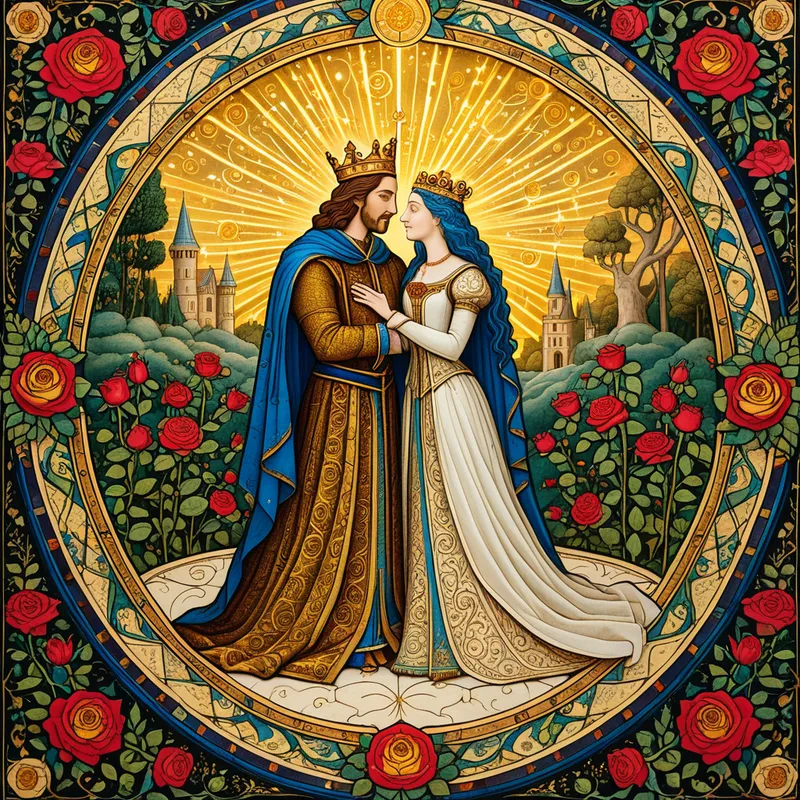
A mysterious summons, older than the stars, drew them from their thrones. They met at [the threshold](/myths/the-threshold “Myth from Folklore culture.”/) of a walled garden, its gate wrought of lead and iron. Without a word, they recognized the other as both stranger and self. This was the Coniunctio. In the garden’s center grew a single, colossal rose, its petals neither red nor white, but holding the potential for both. Here, they joined in a sacred embrace, not of flesh, but of essence. Their light and silver flowed together, creating a new, shimmering substance—the first hope of the filius philosophorum.
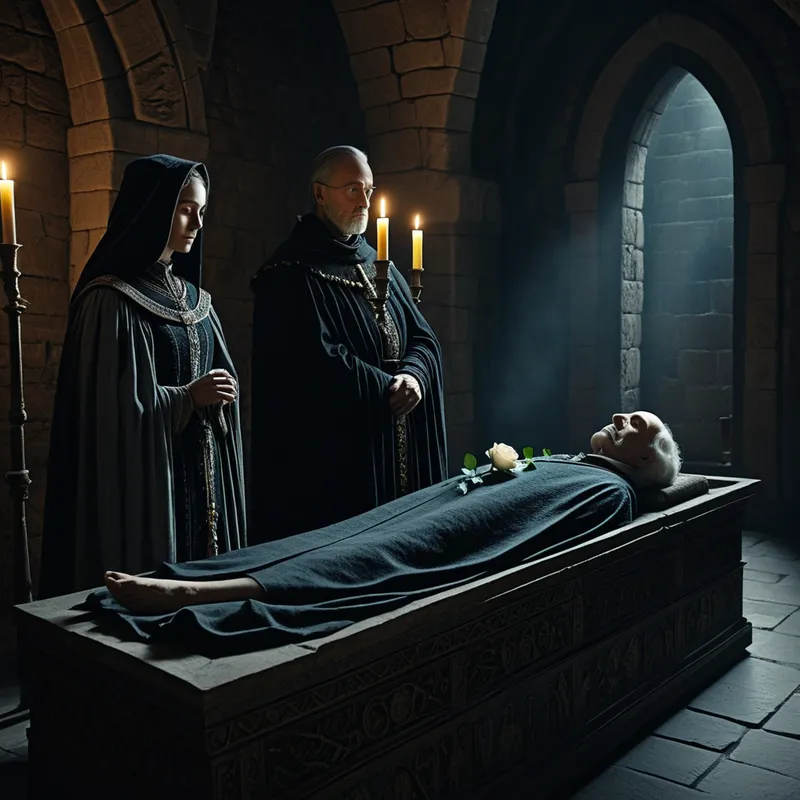
But creation demands descent. From their union sprang not immediate glory, but a shadow. The blended substance darkened, coagulating into a heavy, black mass. The garden walls seemed to close in. The King and Queen, now inextricably linked, felt the weight of this [nigredo](/myths/nigredo “Myth from Alchemical culture.”/) descend upon them. They grew weak, their brilliant forms dimming. In a silent pact, they laid themselves down upon the black earth at the root of [the rose](/myths/the-rose “Myth from Persian culture.”/). [The earth](/myths/the-earth “Myth from Hindu culture.”/) opened, and they were entombed together. This was the Mortificatio, the necessary death.
For an age, the garden was still. Then, a miracle of moisture. A gentle, celestial dew—the aqua permanens—began to fall, soaking the black tomb. Within that darkness, a fermentation began. The separated essences of the royal pair, now dissolved into one chaotic soup, stirred. From the dissolution came a cleansing. The blackness washed away, revealing a blinding, pure white—the albedo. The tomb became a womb.
From this white stone, they were reborn, but not as they were. Purified, they ascended, their bodies now glistening like polished [moonstone](/myths/moonstone “Myth from Various culture.”/). The rose above them began to blush. As they rose, a fervent heat, the inner fire of the work, began to glow within their shared heart. The white intensified, yellowed, and then ignited into a triumphant, solar gold—the citrinitas and [rubedo](/myths/rubedo “Myth from Alchemical culture.”/).
The final embrace was not a union of two, but the revelation of one. Their forms melted into a single, androgynous being of radiant light, holding a rose that was now fully, perfectly red and white. The garden walls vanished. The being was the garden, the rose, [the dew](/myths/the-dew “Myth from Alchemical culture.”/), and the fire. The work was complete. The [Lapis Philosophorum](/myths/lapis-philosophorum “Myth from Alchemical culture.”/) was not made; it was born.
Cultural Origins & Context
The Rosarium Philosophorum is not a myth from a lost civilization, but a living allegory from the heart of European Hermetic Alchemy of the 16th century. Its primary vessel is a series of 20 woodcut illustrations, first published in 1550, accompanied by cryptic Latin verses. These images were not meant for public consumption but were arcana, secret knowledge passed among initiates.
The myth was “told” in the silent language of symbol, in the hushed conversations between master and apprentice in locked laboratories. Its societal function was dual. Exoterically, it was a coded manual for the physical Opus. Esoterically, and more profoundly, it was a map for the opus contra naturam—the work against one’s own fallen nature—a guide for the spiritual transformation of the practitioner. It belonged to a culture that saw no division between the transformation of matter and the salvation of the soul, where the alembic was a model of the mind and the furnace, the heat of introspection.
Symbolic Architecture
The myth’s power lies in its unflinching depiction of the [psyche](/myths/psyche “Myth from Greek culture.”/)’s [journey](/symbols/journey “Symbol: A journey in dreams typically signifies adventure, growth, or a significant life transition.”/) toward wholeness. The [King](/symbols/king “Symbol: A symbol of ultimate authority, leadership, and societal order, often representing the dreamer’s inner power or external control figures.”/) and [Queen](/symbols/queen “Symbol: A queen represents authority, power, nurturing, and femininity, often embodying leadership and responsibility.”/) are not external deities but the fundamental opposites within the [human](/symbols/human “Symbol: The symbol of a human represents individuality, complexity of emotions, and social relationships.”/) [soul](/symbols/soul “Symbol: The soul represents the essence of a person, encompassing their spirit, identity, and connection to the universe.”/): conscious and unconscious, [logic](/symbols/logic “Symbol: The principle of reasoning and rational thought, often representing order, structure, and intellectual clarity in dreams.”/) and [intuition](/symbols/intuition “Symbol: The immediate, non-rational understanding of truth or insight, often described as a ‘gut feeling’ or inner knowing that bypasses conscious reasoning.”/), [spirit](/symbols/spirit “Symbol: Spirit symbolizes the essence of life, vitality, and the spiritual journey of the individual.”/) and [soul](/symbols/soul “Symbol: The soul represents the essence of a person, encompassing their spirit, identity, and connection to the universe.”/), the syzygy. Their initial [separation](/symbols/separation “Symbol: A spiritual or mythic division between realms, states of being, or consciousness, often marking a transition or loss of connection.”/) represents the ordinary state of psychic [fragmentation](/symbols/fragmentation “Symbol: The experience of breaking apart, losing cohesion, or being separated into pieces. Often represents disintegration of self, relationships, or reality.”/).
The sacred marriage is not a romantic union, but a terrifying collision of all that one is with all that one has denied.
The subsequent [death](/symbols/death “Symbol: Symbolizes transformation, endings, and new beginnings; often associated with fear of the unknown.”/) is the critical pivot. The nigredo is the depression, [despair](/symbols/despair “Symbol: A profound emotional state of hopelessness and loss, often signaling a need for transformation or surrender to deeper truths.”/), and [confusion](/symbols/confusion “Symbol: A state of mental uncertainty or disorientation, often reflecting internal conflict, lack of clarity, or overwhelming choices in waking life.”/) that follows any serious attempt at self-confrontation. It is the “dark [night](/symbols/night “Symbol: Night often symbolizes the unconscious, mystery, and the unknown, representing the realm of dreams and intuition.”/) of the soul,” where old identities must rot. The dew, the aqua permanens, symbolizes the grace of unconscious compensation—the healing dreams, insights, and tears that arrive unbidden to cleanse the stagnant psyche. The [rebirth](/symbols/rebirth “Symbol: A profound transformation where old aspects of self or life die, making way for new beginnings, growth, and renewal.”/) into white, then red, charts the [ascent](/symbols/ascent “Symbol: Symbolizes upward movement, progress, spiritual elevation, or striving toward higher goals, often representing personal growth or transcendence.”/) from sterile purity (conscious ideals) through the fire of [passion](/symbols/passion “Symbol: Intense emotional or physical desire, often linked to love, creativity, or purpose. Represents life force and deep engagement.”/) and commitment, to the final integrated state: [the Self](/myths/the-self “Myth from Jungian culture.”/) that contains and transcends its own opposites.
The Dreamer’s Resonance
When this myth stirs in the modern dreamer, it signals a profound somatic and psychological process of integration. One may dream of meeting a captivating stranger who feels eerily familiar (the Coniunctio), or of a beloved figure dying or transforming (the Mortificatio). Visions of immersion in dark water, of washing clean, or of finding a precious stone or flower in mud point directly to the albedo and the discovery of the Lapis.
Somatically, this process can feel like a physical weight or heaviness (nigredo), followed by periods of intense emotional release or weeping (the aqua permanens). There is often a tangible sense of an inner “fermentation”—restlessness, disjointed thoughts, and bodily tension—as unconscious contents seek to coalesce into a new form. The dreamer is not merely having a dream; they are in the alchemical vessel, and the psyche is conducting its own Great Work.
Alchemical Translation
For the modern individual, the Rosarium models the non-negotiable stages of individuation. The first step is the courageous recognition of one’s inner “other”—the neglected qualities, the repressed emotions, the latent potentials (the Queen or King). This meeting often happens in [projection](/myths/projection “Myth from Alchemical culture.”/), falling in love with someone who embodies what we lack.
The inevitable conflict and subsequent “death” translate as the painful dissolution of this idealized projection and [the ego](/myths/the-ego “Myth from Jungian culture.”/)-structures built upon it. The dark night is [the crucible](/myths/the-crucible “Myth from Alchemical culture.”/). Here, one must endure the chaos without fleeing back to one-sidedness.
The Stone is not attained by effort, but received by endurance; it is the psyche’s reward for surviving its own dissolution.
The final stages—the washing white and heating to red—are the long work of integrating these insights into a durable personality. The red-and-white rose symbolizes the achieved state: a consciousness that is both passionate (red) and purified of selfishness (white), a Self that is fully incarnated yet connected to the transcendent. The myth teaches that wholeness is born not from avoiding darkness, but from a [sacred marriage](/myths/sacred-marriage “Myth from Alchemy culture.”/) with it, consummated in the very heart of despair.
Associated Symbols
Explore related symbols from the CaleaDream lexicon: