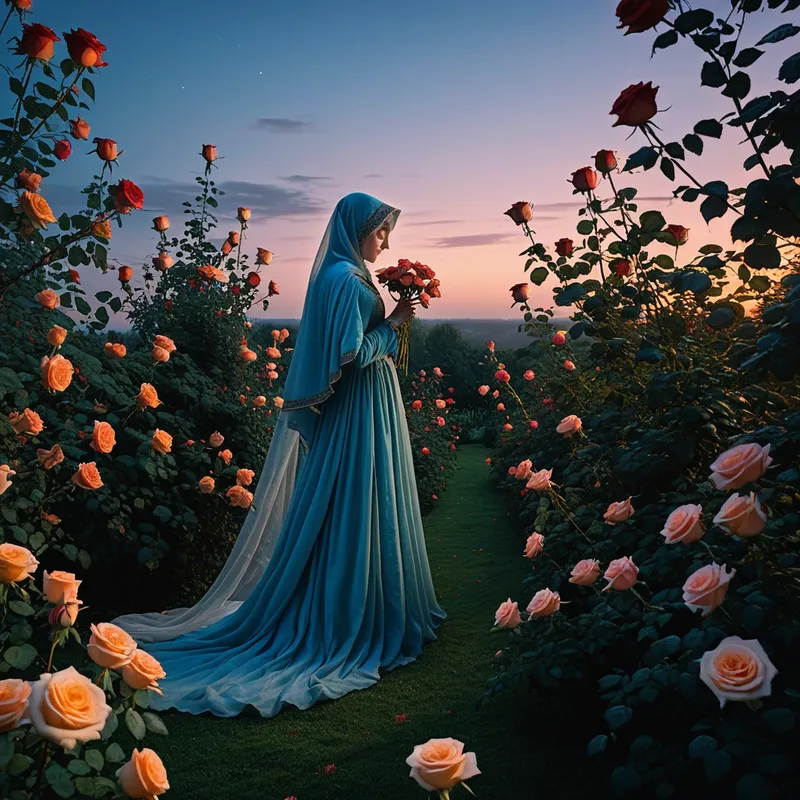
Rosarium Myth Meaning & Symbolism
A sacred garden of roses blooms from tears and prayer, charting the soul's path through sorrow to divine union in a cycle of mystical devotion.
The Tale of Rosarium
Listen, and let the scent of sacred roses fill your soul. In the deep, silent hours before the world awakens, there exists a garden unseen by mortal eyes. It is the Rosarium, a realm woven not from soil and seed, but from the distilled essence of human devotion. Its keeper is the Anima Mundi, the World Soul, who moves through its endless rows not as a queen, but as a gardener cloaked in the soft greys of dawn and dusk.
Her task is eternal and profound. For every whispered prayer of contrition, every sob of genuine remorse that rises from the hearts of humanity, a single, luminous tear falls from her eyes. Where these tears touch the fertile darkness of the garden, a thorn first pierces the ground. It is sharp, a reminder of the pain that birthed it. But from that thorn, a stem grows, tender and seeking the light. And from that stem, a bud forms, tightly wrapped around a secret.
The conflict here is not of clashing swords, but of silent, crushing despair—the terror that sorrow is wasted, that prayer is lost in the void. The garden’s enemy is the chilling wind of Acedia, which seeks to wither the buds before they can open. The Anima Mundi fights this despair not with force, but with patient, relentless attention. She cups each budding rose in her hands, her breath a warm, sustaining hymn.
Then comes the rising action, a celestial tide. As the soul perseveres, moving from the prayer of the lips to the prayer of the heart, the bud begins to stir. One by one, the petals unfurl. They are not all red, but a spectrum of sacred hues: the crimson of martyrdom, the white of purity, the gold of divine wisdom, the mysterious blue of the unattainable. Each opening petal releases not a perfume, but a note of an inaudible song—the Musica Universalis.
The resolution is not an end, but a fragrant, cyclical completion. A fully bloomed rose does not simply fade. At the peak of its radiance, it dissolves into a shower of light, each mote carrying the essence of the sorrow that created it, now transmuted into grace. This light falls back upon the gardener and seeps into the roots of the garden itself, nourishing new thorns, new stems, new buds. The Rosarium is thus forever dying into life, a wheel of fragrant tears and radiant blossoms, where every ending guarantees a new, more beautiful beginning.

Cultural Origins & Context
The myth of the Rosarium finds its roots not in a single scripture, but in the fertile soil of late medieval Christian mysticism and monastic practice. It is a contemplative legend, born in the silent cloisters of Cistercian and Dominican communities, where the repetitive, meditative prayer of the Rosary was cultivated. This was not a myth for the marketplace, but for the cell; passed not by bards, but by spiritual directors to their charges, and recorded in the illuminated margins of prayer books.
Its primary societal function was pedagogical and psychological. In an era where life was often brutal and short, the myth provided a container for overwhelming grief and spiritual anxiety. It taught that no sincere prayer, no tear of true repentance, was ever lost. It gave a tangible, beautiful image to the abstract process of redemption, modeling a path where human fragility (the thorn) was the necessary precursor to divine beauty (the rose). The garden itself became an internal map for the soul’s journey, a way to visualize progress in a life dedicated to prayer and penitence.
Symbolic Architecture
At its heart, the Rosarium is a profound map of the soul’s interior landscape. The garden represents the totality of the psyche—the Self in its cultivated, potential state. The Anima Mundi is the guiding, unifying principle of that psyche, the function that tends to its growth and integration. She is the archetypal presence that connects the individual soul to the divine ground of all being.
The thorn is not the enemy of the rose; it is its vow, its promise sworn in pain.
The thorn symbolizes the necessary encounter with the Shadow—with guilt, limitation, and painful self-awareness. It is the prick of conscience, the sting of reality that pierces unconsciousness. The tear is the conscious acknowledgment of that pain, the affect that must be felt and offered, rather than repressed. It is the water of emotion without which no psychic growth can occur. The rose, then, is the emergent symbol of wholeness—the Mandala—that blossoms only when the shadow has been consciously engaged and its energy transformed.

The Dreamer’s Resonance
When the imagery of the Rosarium blooms in a modern dream, it signals a profound process of emotional and spiritual alchemy underway in the dreamer’s psyche. To dream of tending a garden of roses, especially amidst thorns, speaks to a period of nurturing one’s deepest values and vulnerabilities. It is a somatic call to attend to the heart’s neglected soil.
Dreaming of weeping tears that become flowers indicates a powerful release of long-held grief or shame, and an intuitive understanding that this painful emotion contains the seed of future growth. Conversely, dreaming of a garden blighted by frost or a wind of despair (Acedia) often mirrors a state of depression, burnout, or creative blockage—a feeling that one’s efforts are futile. The dream is presenting the core conflict: the struggle to maintain faith in the process of transformation during the “winter” of the soul. The presence of the gardener figure, whether felt or seen, is a reassuring symbol of the dreamer’s own innate, guiding wisdom that persists even in darkness.

Alchemical Translation
The myth of the Rosarium is a perfect allegory for the Jungian process of Individuation. It models the psychic transmutation required to move from a state of fragmented suffering to one of integrated wholeness.
The initial nigredo, the blackening, is found in the tear of contrition—the confrontation with one’s own darkness and brokenness. The albedo, the whitening, is the patient, repetitive work of attention (the gardener’s care), the conscious effort to hold and understand one’s pain. The budding rose represents the citrinitas, the yellowing or dawning of a new awareness, a nascent symbol of the Self. The full bloom and dissolution into light is the rubedo, the reddening or final union—not a static achievement, but a moment of complete realization where the ego’s striving surrenders to the greater pattern of the Self.
The goal is not to become the perfect, eternal rose, but to participate wholly in the cycle of blooming and dissolution, understanding that one is both the gardener and the garden.
For the modern individual, this translates to the hard, sacred work of turning one’s most painful experiences—failures, losses, regrets—into the fertile ground for meaning. It teaches that healing is not the eradication of scars (the thorns), but the integration of them into a more beautiful, complex, and compassionate whole. The prayer beads become a metaphor for any repetitive, mindful practice—therapy, journaling, art, meditation—that, bead by bead, tear by tear, cultivates the inner garden where the soul can finally come home to itself.
Associated Symbols
Explore related symbols from the CaleaDream lexicon: