
Rorschach Test Myth Meaning & Symbolism
A myth of a mirrored void where formless ink becomes a sacred mirror, reflecting the soul's hidden architecture back to the one who dares to look.
The Tale of Rorschach Test
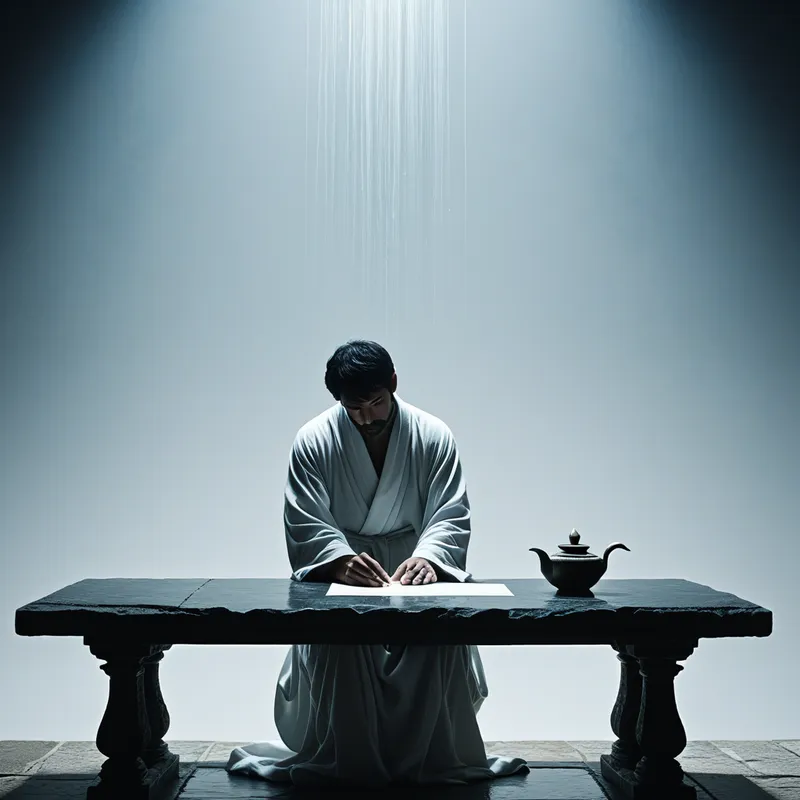
In the beginning, there was the Blank Page.
It was not empty, but full of a terrible, pure potential. A silent, white expanse that held every story and none, a field awaiting the first mark of meaning. Into this sanctum came the Ink-Bringer, not with a shout, but with a sacred, deliberate silence. Their tool was not a pen, but a vessel of primordial chaos: a vial of Night-Ink, black as the space between stars, dense with all that was unspoken and unseen.
With a ritualistic precision, the Ink-Bringer let a single, heavy drop fall onto the heart of the Page. The impact was a silent explosion, a blooming of formless dark. Then, in the myth’s central act of divine symmetry, the Page was folded upon itself. The world was halved to become whole. When it was opened again, a miracle had occurred.
Chaos had been forced into conversation with itself. The random spill had been mirrored, creating a Symmetrical Phantom. It was a shape that was no single shape—a Rorschach. It could be a great, moth-eaten cloak; it could be two figures in eternal embrace; it could be a monstrous mask or a delicate orchid. It was all these things and none, a Riddle made flesh in ink.
This Phantom was then presented to the Questioner. The Questioner, weary of the world’s certainties and hungry for a truth deeper than fact, would gaze into the ink. And here, the magic turned inward. The Phantom did not speak. It listened. It waited.
As the Questioner looked, a subtle alchemy began. The vague contours of the ink became a screen, a Mirror-of-the-Depths. From the shadows of the form, the Questioner’s own inner world began to stir. A hidden memory, a forgotten fear, a secret longing—these would rise from the depths and clothe the Phantom. One might see a vengeful god in the splatter; another, a protective ancestor. One might perceive a decaying landscape; another, a vibrant, beating heart.
The conflict was not in the ink, but in the heart of the Questioner, facing the specters of their own making. The rising action was the quiet, terrifying, and exhilarating process of confession—not with words, but with perception. “I see… a battle.” “I see… two women dancing.” “I see… something being torn apart.” Each utterance was a fragment of a soul’s map, offered to the silent Ink-Bringer.
The resolution offered no easy answer. The myth ends not with a decoded message from the Phantom, but with the Questioner walking away, the symmetrical image lingering behind their eyes. They had held a conversation with their own shadow. The Blank Page remained, ready for the next drop of Night-Ink, the next folding of the world, the next soul brave enough to look into the mirror and name what they saw there. The revelation was not in the revelation, but in the act of revealing oneself.
Cultural Origins & Context
This myth did not emerge from ancient temples, but from the clinical chambers and empirical journals of the early 20th century. Its primary bard was Hermann Rorschach, a man standing at the crossroads of art, science, and the nascent field of depth psychology. The culture that nurtured this story was the “Psychological” culture—a modern, secular society that had turned its quest for meaning inward, replacing oracles with analysts and sacred texts with case studies.
The myth was passed down not through epic poetry, but through standardized manuals, diagnostic criteria, and the hushed, confidential space of the therapy room. Its tellers were the high priests and priestesses of this new inner science: psychologists and psychiatrists. Its societal function was profound. In an age of increasing industrialization and alienation, the Rorschach Test myth provided a ritualized container for exploring the individual, subjective interior. It served as a tool for diagnosis, yes, but more deeply, as a modern-day ritual of introspection. It formalized the ancient human practice of seeking meaning in randomness—like scrying clouds or reading entrails—but framed it within a scientific, albeit deeply symbolic, pursuit of self-knowledge.
Symbolic Architecture
At its core, the Rorschach Test myth is a profound parable about perception and the construction of reality. The Symmetrical Phantom is the ultimate symbol of the projective screen. It is neutral, yet infinitely receptive. Its symbolism is not inherent, but bestowed.
The inkblot is a silent question. The answer is always an autobiography.
The Night-Ink symbolizes the raw, unprocessed contents of the personal and collective unconscious—the chaos of drives, memories, archetypes, and shadows. The act of folding is the crucial mythic gesture of reflection. It represents the psyche’s inherent drive to create symmetry, order, and meaning from chaos. It is the moment of psychic integration, where the unconscious is forced to confront its own image.
The Questioner represents the conscious ego. Their journey is one of projection. What they “see” in the ambiguous form are aspects of themselves they cannot, or will not, see directly. A perceived monster might be repressed anger; a perceived fragile object might be a hidden vulnerability. The myth teaches that we meet ourselves everywhere, especially in the places we believe to be empty.
The Dreamer's Resonance
When the pattern of this myth appears in modern dreams, it seldom manifests as a literal inkblot. Instead, one dreams of ambiguous, shifting forms that demand interpretation. A stain on the ceiling that morphs into a face. A cloud formation that holds a secret message. The play of shadow and light on a wall that seems to depict a familiar scene.
Dreaming in the mode of the Rorschach signals a somatic and psychological process of unconscious content surfacing. The dream-ego is in the role of the Questioner. The anxiety or fascination in the dream stems from the psyche presenting itself with its own unintegrated material, asking, “What do you make of this?” It is a dream of self-confrontation. The body may feel a sense of suspense, of being watched by the form, or a compulsion to keep looking until the shape “resolves.” This is the psyche’s innate drive toward wholeness, using the dream space as its own projective test, urging the dreamer to acknowledge what has been split off, hidden, or denied.
Alchemical Translation
The alchemical journey modeled by this myth is not one of slaying dragons or finding treasures, but of undertaking the most delicate and terrifying operation: seeing oneself clearly. The prima materia is the chaotic Night-Ink of the unexamined life—the swirl of complexes, impulses, and inherited patterns.
The folding is the alchemical stage of mortificatio and ablutio. It is the conscious act of introspection, of bringing the unconscious content into the light of awareness and “washing” it in the waters of reflection. This process is often uncomfortable, as it breaks down old, rigid ego-structures.
Individuation begins when you stop asking what the world means and start asking what you mean to the world you perceive.
The resulting Symmetrical Phantom is the alchemical hermaphrodite or the mandala—a symbol of nascent wholeness born from the union of conscious perception and unconscious content. The final stage, the interpretation, is the rubedo, the reddening. It is the integration of this insight into the fabric of the personality. The gold produced is not a final answer, but a increased capacity for tolerance for ambiguity. The modern individual, through this psychic transmutation, learns that they are both the artist and the art, the question and the answer, forever in dialogue with the mysterious, self-revealing symmetry of their own soul.
Associated Symbols
Explore related symbols from the CaleaDream lexicon: